Emmanuel Ayorinde, Libuseng Semakale, Fortune Aigbe (2025). The Benefits of Adopting Artificial Intelligence-Technologies in Mitigation Construction Risk in the South African Construction Industry. In: Human Factors and Systems Interaction. AHFE Open Access, vol. 192, pp. 108–118. https://doi.org/10.54941/ahfe1006633
The South African construction industry (SACI) continues to face significant safety and operational efficiency challenges, leading to increased risks, accidents and project delays. This study explores how the adoption of AI-driven technologies can address these persistent issues, particularly in improving risk assessment and mitigation efforts within the industry. A quantitative approach was employed, gathering data through a detailed questionnaire targeting industry professionals including engineers, site managers, construction managers, health and safety officers and quantity surveyors. The analysis employed Mean Item Score and Exploratory Factor Analysis (EFA). The findings revealed that while the adoption of AI-driven technologies in mitigating construction risk in the SACI is still in its infancy, there is growing recognition of its value. The adoption of AI-driven technologies in the SACI will mitigate construction risk such as accidents, site accidents, skills shortages and operational issues currently plaquing the industry. Addressing these barriers will unlock the full potential of AI-driven solutions in transforming risk management and project outcomes. This study contributes to the growing body of research on the use of AI-driven technologies in the construction industry, providing crucial insights into its benefits. The findings will guide industry leaders and policymakers in shaping strategies that encourage the successful adoption of AI in managing construction risk.
The South African construction industry (SACI) has shown its dedication to minimizing safety risks by attempting to adhere to relevant legislation. In South Africa, the Occupational Health and Safety Act No. 85 of 1993 is the legislation that all companies have to comply with in terms of achieving acceptable health and safety standards (Aghimien et al., 2018). While the Occupational Health and Safety Act No. 85 of 1993 provides a foundation
The Benefits of Adopting Artificial Intelligence-Technologies 109
for ensuring the safety of workers in the South African construction industry, there is persistent accidents and fatalities on construction sites, these highlights the ineffectiveness of traditional safety methodologies in managing risks. Hong and Teizer (2023) suggest that failure to comply with safety regulations, mistakes made by humans, and insufficient risk assessment have all led to a significant number of accidents and deaths within the industry. Alejo et al. (2020) state that traditional risk management methods and practices have proven insufficient in addressing risks and hazards prevalent in the industry. Hong and Teizer (2023) agree that traditional methods require laborious and empirical predefinitions which have proven to be prone to subjectivity and mistakes. However, there is a growing debate regarding the role of traditional risk management methods and the human factor.
In light of these challenges, the integration of Artificial Intelligence (AI) in safety risk assessment and mitigation presents a promising avenue to enhance construction safety (Blanco et al., 2018). However, its adoption and integration in the SACI remain limited indicating a need to understand the challenges, solutions and the potential benefits it brings to the industry (Aigbavboa et al., 2023). AI is perceived as a technological solution capable of addressing one of the most pressing challenges faced by the construction industry: site safety concerns. A survey of the global construction industry by Deloitte (2020) confirms that while many companies recognize the potential benefits of AI, only a small percentage have implemented AI solutions in their operations. A study by the South African Institution of Civil Engineering (SAICE) (2022), adds that while many construction professionals are aware of AI technologies, only a minority are actively using these technologies in their work. Similarly, a study by the Council for Scientific and Industrial Research (CSIR) found that only 10% of South African construction companies had adopted AI-based solutions, compared to 20% in the UK and 45% in China (CSIR, 2021).
Aghimien et al. (2024) proposed that the adoption of AI technology in the construction industry solution will prevent construction-related fatalities by using intelligent wearable technologies. Also, these technologies could potentially reduce the number of injuries and fatalities by tracking and monitoring workers’ movements and positions and alerting workers to avoid accidents. Furthermore, AI technologies can detect unsafe behaviours and conditions on construction sites, alerting workers and supervisors to potential risks. AI-driven technologies have been increasingly associated with the reduction of accidents on construction sites by analysing large amounts of site data in real-time to predict potential hazards, and therefore preventing accidents before they occur. For instance, wearable AI devices can monitor workers’ movements and environmental conditions, providing alerts in case of danger (Li et al., 2023). According to Smith and Lee (2018), AI facilitates improved data collection and utilization in construction projects because it is faster and more accurate as compared to human beings. AI-driven analytics can process large datasets from multiple sources, helping managers to gain actionable insights from real-time data, such as
project schedules, resource management, and safety protocols. This leads to improved operational efficiency and project outcomes. Sanchez et al. (2017) claim that one of the most significant benefits of AI is its ability to create more proactive and targeted Occupational Health and Safety (OHS) interventions. According to Parks et al. (2023), AI can continuously monitor site conditions and worker behaviours, alerting management to potential safety issues before they escalate. These solutions offer real-time hazard detection, predictive analytics and enhanced monitoring capabilities, enabling companies to proactively identify and mitigate risks, ensure compliance and foster a safer work environment and it allows companies to act promptly thereby improving overall safety standards on site (Whitlock- Glave et al., 2019). The study focuses on the benefits of the successful adoption of AI-driven technologies in mitigating construction-related risk in the SACI.
METHODOLOGY
This study adopted a quantitative research design with a self-administered questionnaire survey within a post-positivist paradigm. The study investigates the benefits of the implementation of AI-Technologies in mitigating construction risk in the South African construction industry. The study targeted respondents with first-hand knowledge of construction activities and direct engagement in onsite physical work. The questionnaire items were carefully developed based on a review of the relevant literature. The questionnaire was pilot-tested with a small group of industry practitioners to ensure that the items were clear, understandable and relevant to the study’s objectives. The Likert scale in the questionnaire assisted the respondents in selecting the most appropriate answer from the questions asked, 1 = strongly disagree; 2 = Disagree; 3 = Neutral; 4 = Agree; 5 = Strongly agree. Mean item score (MIS) was used to present the research findings from the Likert scale in descending order. The study achieved a strong response rate, with 67 completed questionnaires returned from the 80 distributed of which all were viable for analysis, representing an 84% response rate that allowed for meaningful analysis.
RESULTS AND DISCUSSION
The descriptive findings provide a ranking of all benefits, from most to least influential, and a table details each benefits mean score along with its standard deviation. According to the data collected, Engineers (29.9%) and health and safety officers (22.4%) represented the largest groups followed by Site managers (17.9%). In terms of educational background, the majority of respondents held a Bachelor’s degree (37.3%) followed closely by those with Diplomas (34.4%).Regarding experience, (44.8%) of respondents had 0–5 years of experience, showing an openness to adopting new technologies. Meanwhile, (38.8%) had 6–10 years of experience, offering balanced views between traditional practices and technological advancement.
The Benefits of Adopting Artificial Intelligence-Technologies 111
A significant 85.1% of respondents still rely heavily on human personnel for risk assessment and mitigation critical tasks, reflecting a strong preference for traditional, human-centred approaches. Only 3% use AI-based systems and just 9% combine human efforts with AI tools. Another 3% said there are no risk management practices at their workplaces.
Mean Item Score
Table 1 shows the ranking of the result of the ranked the benefits of the adoption of AI-Technology in mitigating construction risk in the SACI. The results indicates that the most ranked variable is more proactive and targeted OHS interventions with mean score of 4.352, improved safety performance with the mean score of 4.327, informed decision making with 4.296, and better data utilization with 4.316. While the least ranked effects are increased efficiency with a mean score of 4.045, advanced design capabilities with 4.013, and cost savings time with 4.090.
Data Analysis Two types of descriptive statistics were conducted: mean item scores and factor analysis. The variables were ranked using mean item scores, while factor analysis was used to group variables that measure similar underlying effects. The Cronbach alpha was used to assess the internal consistency of the variables in the survey. The results shows the highest ranking variables to be More Proactive and Targeted OHS Interventions with a mean score of 4.352 and Cronbach alpha of 0.75 that shows internal consistency, Improved Safety Performance was ranked second with a mean score and Cronbach alpha of 4.327 and 0.71 Cronbach alpha that shows internal consistency, Informed Decision-Making was ranked fourth with a mean score of 4.296, and Cronbach alpha of 0.64 that shows internal consistency, Better Data Utilization was ranked fourth with a mean score of 4.316, and Cronbach alpha of 0.73 that shows internal consistency, Better Risk Mitigation Strategies was ranked fifth with a mean score of 4.270, and Cronbach alpha of 0.72 that shows internal consistency, Reduced Accident Rates was ranked sixth with a mean score of 4.221, and Cronbach alpha of 0.71 that shows internal consistency, Increased Productivity in Risk Management was ranked seventh with a mean score of 4.194, and Cronbach alpha of 0.69 that shows internal consistency, Enhanced Project Planning was ranked eighth with a mean score of 4.138, and Cronbach alpha of 0.70 that shows internal consistency, Increased Efficiency was ranked ninth with a mean score of 4.045, and Cronbach alpha of 0.68 that shows internal consistency, Advanced Design Capabilities was ranked eleventh with a mean score of 4.013, and Cronbach alpha of 0.66 that shows internal consistency and cost savings was ranked tenth with a mean score of 4.090, and Cronbach alpha of 0.67 that shows internal consistency.
Table 1: Mean item score.
Table available in the original PDF paper.
Variables Statistics Benefits of the Adoption Mean Standard
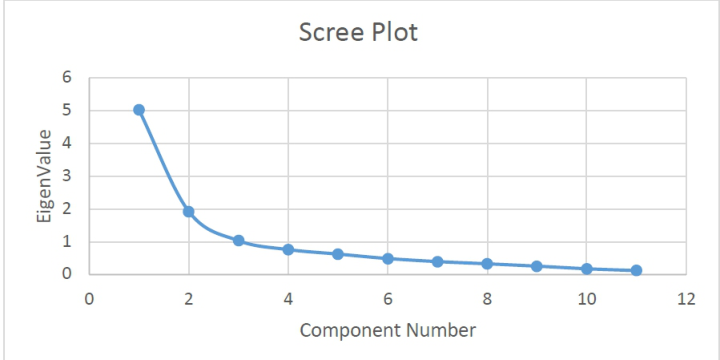
Results From Exploratory Factor Analysis The results of the EFA on the benefits of the adoption of AI-Technology for risk assessment and mitigation in the SACI are shown in Tables 1, 2, 3, and 4, along with Figure 1, encompassing a total of eleven identified variables, with no missing data. These variables highlight the key benefits for AI-Technology adoption in the SACI context.
Factor Analysis The Kaiser-Meyer-Olkin (KMO) Measure of Sampling Adequacy was used to determine the appropriateness of the data to undergo exploratory factor analysis (EFA). Additionally, Bartlett’s Test of Sphericity was performed to assess whether the correlation matrix is an identity matrix, where variables would be uncorrelated. The results of the analysis are presented below. The results of the KMO test yielded a value of 0.801, indicating excellent sampling adequacy. The Bartlett’s Test of Sphericity, which produced a chi-square value of 315.671 with 60 degrees of freedom and a significance level of less than 0.001, this further supports the appropriateness of EFA. A significant result from the Bartlett test indicates that the correlation matrix is not an identity matrix, meaning there are meaningful relationships among the variables.
The Benefits of Adopting Artificial Intelligence-Technologies 113
Table 2: Kaiser-Meyer-Olkin (KMO) and Bartlett’s test of sphericity results.
Table available in the original PDF paper.
Kaiser-Meyer-Olkin Measure of Sampling Adequacy ,801 Bartlett’s Test of Sphericity Approx. Chi-Square 315,67’1 Df 60 Sig. <,001
These components together capture 72.578% of the total variance before rotation, making them substantial factors in understanding the benefits of AI-Technology adoption in construction risk assessment. Varimax rotation was then applied, which is a technique used to make the output more interpretable. This method spreads the variance more evenly across the retained components by aligning the variables more closely to the factors. After applying Varimax, the variance explained by the first three components is redistributed to 45.661%, 17.517%, and 9,400%, respectively, resulting in clearer and more distinct patterns. The Scree Plot typically shows a clear “elbow” after the third component, indicating that three factors are the most meaningful in explaining the variance. This aligns with the eigenvalues, where only three components have eigenvalues greater than 1, justifying their retention in the factor analysis. that the first three components capture the underlying structure of the data effectively. Using the principal axis factoring extraction method, three distinct components were named, each reflecting specific dimensions related to key benefits of AI-Technology adoption in the SACI. Component 1 represented efficiency and safety drivers, Component 2 Data-driven decision-making and risk mitigation and Component 3 reflects cost and design innovation.
Table 3: Rotated component matrix.
Table available in the original PDF paper.
Rotated Component Matrixa
Component
1 2 3
0.842
More Proactive and Targeted Occupational Health and Safety (OHS) Interventions
Component 1: Safety and Operational Efficiency In EFA the first component, Safety and Operational Efficiency, emerged as a major potential benefit of AI adoption. EFA showed high loadings for variables like more proactive and targeted OHS interventions (0.842), improved safety performance (0.815), and reduced accident rates (0.782), increased efficiency (0.778) and increased productivity in risk management (0.765).
In descriptive analysis More Proactive and Targeted OHS Interventions ranked as the top benefit, with a mean score of 4.352, a standard deviation of 0.637 and a Cronbach’s alpha of 0.75. Improved Safety Performance ranked second with a mean score of 4.327 standard deviation 0.648 and an alpha of 0.71. Reduction of Accident Rates ranked sixth with a mean of 4.221, a standard deviation of 0.705, alpha of 0.71. Increased Productivity in Risk
The Benefits of Adopting Artificial Intelligence-Technologies 115
Management ranked seventh with a mean of 4.194, Standard Deviation of 0.695 and an alpha of 0.69. These findings support Hossain and Nadeem (2019) who highlighted that AI-driven safety interventions allow for real-time monitoring, predictive analytics, and proactive risk management, leading to a substantial reduction in accidents. Furthermore, Zhang et al. (2020) agree that AI’s automation of routine tasks not only boosts operational efficiency but also allows for more productive risk management, reducing human error and increasing overall site performance. This combination of safety and efficiency underscores why AI adoption is seen as essential in modern construction.
Component 2: Data-Driven Decision-Making and Risk Mitigation The second component named Data-Driven Decision-Making and Risk Mitigation, reflects the growing importance of AI in making better-informed decisions and improving risk management. EFA revealed strong loadings for better-informed decision-making (0.825), better data utilization (0.798), and better risk mitigation strategies (0.775).
In descriptive analysis, Better-Informed Decision-Making ranked third with a mean of 4.296, a standard deviation of 0.661 and an alpha of 0.73. better data utilization ranked fourth with a mean of 4.316, standard deviation of 0.659 and alpha of 0.64 is ranked fourth. Better Risk Mitigation Strategies ranked fifth with a mean score of 4.270, a standard deviation of 0.674 and an alpha of 0.72. These findings resonate with Oke and Aigbavboa (2017) and Bilal et al. (2016) who noted that AI’s ability to process vast amounts of data helps managers make more accurate and timely decisions, leading to more effective risk mitigation. AI’s capacity to streamline data analysis is transforming how construction projects are managed, resulting in fewer delays and more successful outcomes.
Component 3: Cost and Design Innovation The third component was named Cost and Design Innovation, focused on AI’s ability to drive both cost savings and design advancements. EFA showed strong loadings for cost savings (0.821) and advanced design capabilities (0.785)
In descriptive analysis Advanced Design Capabilities ranked tenth with a mean of 4.013, Standard Deviation of 0.761 and an alpha of 0.66. Cost Savings ranked eleventh, with a mean of 4.090 standard deviation of 0.732 and an alpha of 0.67.
Azhar et al. (2018) and Oke and Aigbavboa (2017) are in agreement with these findings, emphasizing that AI-powered technologies can streamline operations, reduce resource waste, and ultimately lead to substantial cost savings. They argue that AI’s predictive models help avoid costly delays and overruns by improving project planning and real-time decision-making. Bilal et al. (2016) similarly support the notion that AI reduces labour-intensive tasks, leading to a reduction in labour costs and increasing overall project efficiency.
However, some scholars express reservations about the widespread cost- saving potential of AI in construction. Makris and Dimitriou (2020), for example, caution that while AI can optimize certain aspects of project management, the high initial investment required for AI technologies may limit its cost-saving potential, especially for smaller firms. Li and Xie (2019) add that the transition to AI-driven systems may incur hidden costs, such as training workers and integrating new systems into existing operations, which could offset some of the anticipated savings.
Validation The literature reviewed and findings from the questionnaire survey are similar. The literature review provided an overview of the South African construction industry and a detailed assessment of the current state of Artificial Intelligence (AI) adoption in the South African construction industry. Through this literature review, it has become evident that while AI is beginning to make waves in the construction industry its adoption is still in its infant stage in South Africa. However, the literature highlights a promising direction of AI’s potential in the South African construction industry. AI has the capability to revolutionize risk assessment, optimize project management, and significantly reduce operational inefficiencies. The potential for AI to transform the industry is immense. The study highlighted many potential benefits linked to incorporating AI technologies from the respondents, such as increased safety performance, more effective data utilization, and improved project planning abilities. Survey participants pointed out that the implementation of AI technology could cause a notable reduction in both accidents and mistakes, ultimately leading to considerable cost savings and enhanced efficiency. The potential of AI in enabling better data management was emphasized, enabling companies to utilize past data and current information for making well-informed choices. Additionally, utilizing AI to automate repetitive tasks can release important resources, allowing teams to concentrate on more intricate areas of risk management. Together, these benefits make a strong argument for incorporating AI into construction methods, leading to safer and more effective project completion. In conclusion, the study underscores the potential benefits of integrating AI in construction risk management. These technologies not only address current inefficiencies and safety concerns but also pave the way for a more sustainable and productive construction industry. To fully harness these benefits, stakeholders must be willing to overcome the existing barriers and invest in the necessary infrastructure, training, and cultural shifts that support the adoption of AI-driven solutions.
CONCLUSION
In conclusion, several key factors are influencing the adoption of AI technologies, including deficiencies in traditional risk management methods, and perceived benefits of AI in enhancing efficiency, accuracy, and safety in construction projects. The literature highlighted the role of leadership commitment, technological readiness, and the availability of skilled personnel
The Benefits of Adopting Artificial Intelligence-Technologies 117
as significant drivers of AI adoption. However, the journey towards widespread AI adoption is not without challenges. The literature review identifies critical barriers such as high implementation costs, a shortage of specialized skills, resistance to change from traditional methods and regulatory and legal challenges. These obstacles have slowed the pace of AI integration, creating a gap between the potential of AI and its current utilization.
Despite these challenges, the literature highlights a promising direction of AI’s potential in the South African construction industry. AI has the capability to revolutionize risk assessment, optimize project management, and significantly reduce operational inefficiencies. The potential for AI to transform the industry is immense, but realizing this potential will require addressing the identified barriers and fostering a more supportive environment for AI adoption.
In conclusion, the literature underscores the dual reality of AI in the South African construction industry: a technology with transformative potential that is yet to be fully realized. Moving forward, it is imperative to focus on overcoming the barriers to adoption, enhancing industry readiness, and educating stakeholders about the tangible benefits of AI. Only then can the South African construction industry unlock the full potential of AI.
ACKNOWLEDGMENT
We extend our sincere gratitude to the Department of Civil Engineering Technology, Faculty of Engineering and the Built Environment, University of Johannesburg, Johannesburg, South Africa, for their valuable support and the opportunity to undertake this research project with minimal distractions.
REFERENCES
Aghimien, L., Ngcobo, N. and Aghimien, D. (2024), “Intelligent Wearable Technologies for Workforce Safety in Built Environment Projects in South Africa”, Intelligent and Innovative Solutions for Sustainable and Healthy Built Environment. Aghimien, D. O., Oke, A. E., Aigbavboa, C. O. and Ontlametse, K. (2018), “Factors
contributing to disabling injuries and fatalities in the South African construction industry”, Joint CIB W099 and TG59 International Safety, Health, and People in Construction Conference, held in Salvador, in Brazil in 1st-3rd of August 2018, pp. 337–345. Aghimien, D. O., Aigbavboa, C. O. and Oke, A. E. (2018), “Digitalisation for effective construction project delivery in South Africa”, Contemporary Construction Conference: Dynamic and Innovative Built Environment (CCC2018), Coventry United Kingdom, 5–6 July 2018 pp. 3–10. Department of Labour and Employment (2018). Department of Labour and
Employment South Africa Report 2018. [Online] Available at: https:// www.gov.za/sites/default/files/gcis_document/201810/labour-annual-report- 20172018.pdf [Accessed: 3 April 2024]. Esterhuyzen, E. (2019). Small business barriers to occupational health and safety compliance. The Southern African Journal of Entrepreneurship and Small Business Management pp. 1–8.
Harahap, M. I. P., Othman, I. and Dinata, N. A. M (2024), “Investigation on the Nature of Safety Rule Violations in High-Rise Construction Projects”, Journal of Advanced Research in Applied Sciences and Engineering Technology, vol. 41(2), pp. 164–179. Khumalo, M., 2022. Trust issues in AI for risk assessment: The South African
perspective. Journal of Risk Management in Construction, 9(3), pp. 170–185. Kunodzia, R., Bikitsha, L., and Haldenwang, R. (2024). “Perceived factors affecting the implementation of occupational health and safety management systems in the South African construction industry”. Safety, vol. 10, p. 5. Moloi, P., (2022). Data privacy concerns in AI adoption: A South African
construction industry outlook. Technology and Construction Journal, 19(2), pp. 122–138. Ngwenya, B. and Theron, J., (2021). The generational divide in trust for AI adoption in construction: A South African case study. Journal of Engineering and Technology Management, 17(1), pp. 98–112. Park, S., Yu, H., Menassa, C. C., and Kamat, V. R. (2023) “A Comprehensive
Evaluation of Factors Influencing Acceptance of Robotic Assistants in Field Construction Work”. J. Manag. Eng., pp. 39. Sanchez, A. S., Carvajal, G. I. & Alis, J. C. (2017). Occupational Safety and Health in Construction. Industrial Health, pp. 210–218. Sharma, S. and Gupta, R. (2009).’Challenges and Strategies in Construction
Project Management, International Journal of Construction Management, 9(2), pp. 123–136. Smallwood, J. (2015). Optimizing the elements of a construction health and safety (H&S) programme and audit system. Procedia Engineering, vol. 123, pp. 528–537. Teizer, J. The role of automation in right-time construction safety. In Proceedings of
the 33rd International Symposium on Automation and Robotics in Construction (ISARC 2016), Auburn, AL, USA, 18–21 July 2016. Whitlock-Glave, H. C., Jansen, S. B., Weigle, H. L., Brown, L. D. and Capp, M. A. (2019), “The technology revolution in the construction industry: The rise of artificial intelligence”, Illinois Association Defense Trial Counsel Quarterly, Vol. 29, No. 4, pp. 1–34, Available at: www.iadtc.org [Accessed 12 May 2024].
LISTED IN THE AHFE DIGITAL BOOKSTORE CATALOGUE
Explore the complete digital volume
Human Factors and Systems Interaction
Read this individual research paper free through the original publisher, or explore the full digital proceedings book.
ISBN 978-1-964867-68-7
Explore this ISBN in the AHFE Bookstore ↗Listed in the July 2026 bookstore catalogue; search by ISBN to confirm current availability · Digital book purchase optional