Evangelos Markopoulos, Marlena Schmitz, Baiba Ziga (2022). An ESG aligned Global Gender Equity Model for creating equitable corporate and government organisations. In: Creativity, Innovation and Entrepreneurship. AHFE Open Access, vol. 31, pp. 220–230. https://doi.org/10.54941/ahfe1001524
Living in the 21st century does not necessarily mean that men and women are treated fairly and respectfully regarding their respective needs and thus in a gender equitable way. On the one hand, women still do three times the amount of unpaid care work, earn 18% less for the same work, make up the minority of C-Suite Level leaders with only 22% compared to 78% of men (which has become even worse due to the Covid-19 Pandemic) and have to deal with issues such as the glass ceiling or glass cliff which prevent their careers from flourishing, to name a few issues. On the other hand, studies by experts conducted in the field of gender equity have shown that women were rated as more effective leaders during and before a crisis, that female participation in the workforce could add between 12-18 trillion dollars to global GDP and increase profits of companies whilst reducing turnover rates and improving productivity as well as employee satisfaction, therefore potentially benefitting society as a whole. To understand why the world has not become gender equitable yet despite the many benefits it would provide, the research conducted in this paper includes academic primary and secondary research, an international literature review, 13 individual interviews with top level managers and/or diversity, equity and inclusion experts (DEI) as well as a global survey with 66 respondents. The results led to the conclusion that there is a need for a shift away from the patriarchal system towards a gender equitable society, which can be achieved with the help of the Global Gender Equity Model (GGEM). The GGEM is a new conceptual model for understanding and describing the implementation of the factors that create gender equitable nations. It is based on four socioeconomic pillars (People, Economy, Education, Governance) aligned with ESG (Environment, Social Governance) criteria adopted by private and public organizations. The four pillars of the GGEM model blend the traditional corporate and government systems of global nations with the current need for individual and collective accountability, collaboration as well as transparency and free flow of information. These pillars were found to be associated with equitable environments and can be seen as both interdependent and positively reinforcing of each other. This means the relative strength of any one pillar has the potential to either positively or negatively influence national gender equity. The GGEM uses the principles behind these pillars to develop and deliver an assessment tool and guidelines that are holistic in their approach to help transform nations from their current inequitable state. The model has been developed to benefit any organization by enacting some or all of these principles no matter their location or the path selected to achieving true gender equity. The integration of the GGEM model with the ESG index has been designed to incentivise the adaptation of the model towards achieving faster and higher organizational ESG scoring. The paper also presents the limitations of the model at its current stage and areas of further research which can support it with technologies and processes that can give adaptation efficiency and implementation consistency.
Living in the 21st century does not necessarily mean that men and women are treated fairly regarding their respective needs and thus in a gender equitable way. Women still do three times the amount of unpaid care work, make up the minority of C-Suite Level leaders, with only 24% compared to 76% of men, and have to deal with issues, such as the glass ceiling or glass cliff, which prevent their careers from flourishing, to name a few issues (Criado-Perez, 2019), (McKinsey & Company, 2021), (Bagalini, 2020). Studies by gender equity experts have shown that women were rated as more effective leaders during and before a crisis. Female participation in the workforce could add between 12-18 trillion dollars to global GDP and increase profits of companies, while reducing turnover rates as well as improving employee satisfaction and commitment, therefore potentially benefitting society (Zenger et al. 2020). This research paper explores why the world has not yet become gender equitable,despite the many benefits,
An ESG Aligned Global Gender Equity Model for Creating Equitable Corporate 221
and recommends a holistic solution for the problem. It introduces the Global Gender Equity Model (GGEM) and aims at providing a holistic approach in reaching gender equitable nations and societies in alignment with the ESG index.
RESEARCH METHODOLOGY The research conducted includes academic primary and secondary resea- rch,consisting of an international literature review, 20 individual interviews (see Table 1) with executive managers and/or diversity,equity,and inclu- sion (DEI) experts,as well as a global survey with 66 respondents (39 women, 25 men and 2 non-binary), reflecting on the general opinion regarding gender equity. The senior executives and DEI experts, who participated in the inte- rviews, helped to understand the professional opinion on the topic, as leaders within their organisations. Additionally, honest answers were encouraged by allowing interviewees to stay anonymous. The industry experts represented their own viewpoint and not that of their company’s. The industries ranged from Consulting, Entertainment, Retail, Food to Technology and Defense.
The main purposes of the interviews were to understand systemic bia- ses that prevent businesses and institutions from reaching gender equity, compare different approaches that countries have taken towards achieving gender equity and to understand structures and policies that need to be in place for gender equitable cultures and societies.
Table 1. Interviews with DEI professionals and executives.
Table available in the original PDF paper.
Organization Role Country Disneyland Paris CIO France KFC CTO UK and Ireland Twise CEO Germany Elysian Search Consulting Head of Operations UK Inogesis CEO UK Carnival UK CIO UK CooperVision Business Unit Accountant UK Yimba Nonexecutive Board Member UK Svennerstal Leadership Group Managing Partner Finland Anonymous Head of HR UK Anonymous DEI Consultant Finland Anonymous Vice President UK Anonymous CEO Finland Anonymous Resourcing Manager UK Anonymous Talent Manager UK Anonymous Global Product Compliance Specialist Sweden Anonymous Coach and Project Lead Sweden Anonymous Project Manager Finland Anonymous DEI Consultant UK Anonymous Social Care Student Sweden
LITERATURE REVIEW AND RESEARCH GAP The definition used for gender equity is “quality of being fair and impartial” or “absence of gender imbalances”. Living in nations that are not gender equitable presents a range of problems on societal,financial and business levels.
On a societal level, living in a gender equitable nation leads to better healthcare (Soken-Huberty, 2022). Illnesses such as depression and heart attacks affect women and men differently and have not been researched in a gender sensitive manner, resulting in an inadequate treatment (Endler, 2021).Reaching gender equity also contributes to reducing poverty, as poverty rates in most nations are typically highest amongst young women (Soken-Huberty, 2022).This is often due to the insufficient level of education available to young girls, or due to them entering marriage early in their lives. It is still predominantly women taking on caring responsibilities, which leads to jeopardizing opportunities of professional development (Criado-Perez, 2019). Creating opportunities for women to obtain education (including STEM areas) and reducing the amount of care work they take on would reduce poverty rates, contribute to the national and global economy and foster gender equity.
Financially, gender equitable nations would not only lead to an increase of the global GDP by 12-28 trillion dollars, but also to higher revenues genera- ted by businesses (Carosella, 2020). Research by Pipeline demonstrated that for every 10% increase in gender equity, there can be a 1-2% increase in revenue (Roy et al. 2020). Author and feminist Caroline Criado Perez has found that “for every dollar of funding, female-owned start-ups generate seventy-eight cents, compared to male owned start-ups which generate thirty- one cents” (Criado-Perez, 2019).In 2020, female owned start-ups recei- ved only 2.3% of VC funding, even though female owned start-ups generated 10% more in cumulative revenue over a five-year period than their male counterpart businesses. This therefore creates a huge missed financial oppor- tunity and unrealized revenue (Bittner et al. 2021, Criado-Perez, 2019).
Business cultures also suffer from gender inequity, as they miss out on inno- vative and diverse ideas. Inclusive teams make better decisions 87% of the time, gender equitable teams work more productively, and departments led by women have the lowest turnover rates (Carosella, 2020).A Harvard Busi- ness Review study indicated that employees working for a female leader felt more satisfied, which positively impacted the business culture and client satisfaction rates (Roy et al. 2020).
Various global organisations and institutions are taking an action to foster creating gender equitable nations. For instance, the United Nations (UN) has made gender equality one of their Sustainable Development Goals (SDG number 5). The European Commission has identified key objectives between 2020 and 2025 to achieve gender equity, namely encouraging their mem- ber states to free their nations from biases or violence, providing equal pay and equal right to work, as well as closing the gender care gap (European Commission, 2020).
Some countries have set an example on becoming gender equitable. Exam- ples include Iceland’s equal pay law of 2018; Sweden’s parental leave of
An ESG Aligned Global Gender Equity Model for Creating Equitable Corporate 223
480 days, in which both parents get full benefit only if each takes a mini- mum of 90 days off; Norway’s board membership rule, in which women have to make up 40% of Public Listed Companies (PLC) and Rwanda’s political representation, in which 30% of seats are reserved to women (Melling, 2018).
The research conducted indicates a gap on the practical implementation of gender equity best practices. Problems and benefits of becoming gender equi- table have been identified and objectives been set by many nations already. While the “what”and “why”have been evaluated in depth, what is missing is the “how”. A key action plan,which accounts for all the different aspects that need to be considered in becoming gender equitable and that each country can implement,will therefore be presented in this paper.
PRIMARY RESEARCH RESULTS Survey Results
The survey included 66 respondents from 26 countries. Most respondents represented Germany with 28 respondents, followed by India with five and the USA with three. Other countries had either one or two participants. 59% of the respondents identified as female, 38% as male and 3% as non-binary. Please note that the following percentages might not sum up to 100% due to rounding.
The survey results demonstrated that gender equitable cultures are impor- tant to implement,and that gender inequity is a dominant issue. 83% of the respondents believed that gender equity was important, with only 3% stating that this was not the case. Interestingly, these 3% were the respondents from Germany.Most participants believed that there should be more poli- cies and quotas addressing gender equity. Furthermore, diverse ideas, happier employees and enhanced were the top three advantages of gender equitable workplace cultures.
Reporting on gender equity was either non-existent or not transparent, as 46% of the respondents indicated that they did not know if their com- pany was producing such reports. There seemed to be a slow increase in reporting on gender equity, as 37% of the respondents stated that their com- pany had addressed gender equity over the last twelve months, while 33% did not see such increase and 30% were not aware.
To conclude the survey, participants were asked which environmental factors could lead to the creation of more gender equitable business cultu- res, which were the following (ranked by order): flexible working, parental leave (shared care work), education and training on gender equity, universal childcare, increased sponsorship, more policies, and nothing.
Interview Results The interview results presented a similar need to invest in gender equitable business cultures. The interviewees mentioned several benefits for it (ran- ked in order): more diverse ideas, increase in employee satisfaction, higher customer satisfaction, more innovation, enhanced collaboration and teamw- ork, financial benefits.
All 20 interviewees agreed that achieving gender equitable work- place cultures could be done with the introduction of equal pay, paren- tal leave,and flexible working. Parental leave and flexible working were not suggested solely by women but also men, as they felt that they lacked time with their children. What is also required is training on conscious and unconscious gender bias that prevent equal sponsorship and promotion opportunities. One interviewee mentioned that training is not enough and that it is vital to address gender equity in business strategy and make it a part of executive meetings.
Another issue that directly contributes to the research gap identified in part 3 is the lack of transparency that dominates most businesses when it comes to achieving gender equity. For example, interviewee Nina Gillman said that “the lack of transparency is the mother of discrimination”, and so creating a culture of transparency is “the basis of everything”. With- out transparency,gender equitable business cultures will therefore not be achieved.
THE GLOBAL GENDER EQUITY MODEL (GGEM) The GGEM is a new conceptual model for understanding and describing the factors that create gender equitable nations and includes the principles required to implement them.
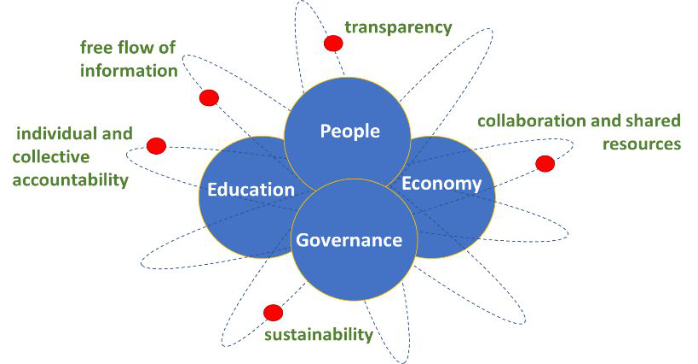
GGEM is composed of four pillars and five principles (see Figure 1). The pillars, People, Education, Governance and Economy, aim to categorize the key aspects of a nation. The implementation of these pillars depends on the following five principles: Individual and Collective Accountability, Col- laboration and Shared Resources, Transparency, Free Flow of Informa- tion and Sustainability.
The GGEM uses these principles to develop and deliver an assessment tool and the guidelines to transform nations from their current state to a gender
Figure 1: The GGEM pillars and principles.
An ESG Aligned Global Gender Equity Model for Creating Equitable Corporate 225
equitable state. By applying this holistic model, all nations can benefit by enacting some or all these principles no matter where they are on their journey of achieving gender equity.
The model described in this paper does not aim at isolating causality. Rather it describes the ‘optimum’ environment for gender equity to flourish. This means that gender equity-building efforts should aim at enhancing and building these pillars as much as possible, while dealing with tactical issues such as gender violence containment.
GGEM PILLARS The four pillars were found to be associated with gender equitable environ- ments and seen as both interdependent and positively reinforcing each other (see Table 2). The weakening or strengthening of any one pillar can weaken
Table 2. GGEM Pillars for gender equitable environment.
Table available in the original PDF paper.
Pilar Description People Represents the role people play in fostering gender equitable nations. It is underpinned by bringing people together and engaging the appropriate communities when creating a shared vision and making important decisions for their nation.The ‘People’ in this context is understood as the nation’s citizens, residents and those otherwise conducting their lives within the borders and laws of the nation (e.g., refugees and foreign businesses). Economy The world’s healthiest economies are directly correlated to the level of peace and stability within the country, which gender equity is a key aspect of. This suggests that the level of nation’s gender equity directly contributes to creating and sustaining strong and stable economies.Some elements of gender equity in this context include women being fairly represented in the labor across the industries and seniority levels, receiving equitable remuneration as well as there being fair and equitable parental leave and universal childcare available for both carers. Education Entails formal,informal,and professional education. It considers education as a flow of lifelong learning; the beliefs, values and behaviours instilled by the family; the quality and accuracy of the national curriculum at state and private education institutions; and any further learning and accreditations associated with professional development. Education must be available to all gender identities and must honor the principles of gender equity. Governance Governing systems and services need to be transparent and fair, and honor the vision set out in collaboration with the People.The governing systems must be developed based on the traditions, principles, vision and values of the people and the land. The Governance is responsible for designing and implementing fair and equitable laws, regulations and policies, and produce transparent reporting on gender equity.
or strengthen the presence of the other pillars.The relative strength of any one pillar has the potential to influence the level of the nation’s gender equity posi- tively or negatively.A gender equitable environment is therefore dependent on the presence and strength of all pillars.
GGEM OPERATIONS GGEM starts with acknowledging and building a common understanding of the five core principles of the GGEM (Individual and Collective Accoun- tability, Collaboration and Shared Resources, Transparency, Free Flow of Information and Sustainability). These will be the indicators of the gender equity level within the nation.
This is followed by a National Gender Equity Readiness assessment, which consists of a comprehensive audit of all four pillars to establish the presence of the core principles in each of the individual pillars.This determines the level of their intersection and the presence of an overarching vision and governa- nce. For the audit and the success of the implementation of the GGEM, it is important to ensure that the preservers of the vision and governance are an independent and neutral entity to ensure the sustainability and fairness of the process.
All four pillars must be assessed against each of the five GGEM principles, so that the degree of the nation’s gender equity can be determined and illu- strated on a scorecard.This scorecard will indicate the overall nation’s gender equity state and break each pillar down individually to highlight areas with the most prominent gaps that would require immediate attention.
The metrics on the scorecard are of qualitative and quantitative nature. Qualitative metrics include the existence of different policies on gender equity, equal rights, human rights, financial independence, reporting transparency, healthcare and social support systems. Quantitative metrics include gender quotas, the pay gap, female and male labor market participation rate, entre- preneurship rate, the corporate pipeline based on gender, retention, mortality rate by gender and the immigration rate.
Both assessment types must be completed to obtain a holistic and objective view of the overall state of gender equity in the nation.
GGEM METRICS AND INDEXES The National Gender Equity Readiness Assessment is the main method in the implementation of the GGEM. The following qualitative (see Table 3) and quantitative (see Table 4) metrics are indicative, representing the key elements that need to be assessed. Each one of these metrics, and others not listed, can be broken down to sub-metrics that measure each concept in more detail.
ALINGNMENT WITH THE ESG INDEX Over the years the ethical dimension on business operations has become stronger than ever. Today contributes to identifying the organizational future in terms of operations, financial performance, and risk tolerance (Markopoulos et al. 2020a). Consumers, investors, and markets tend to
An ESG Aligned Global Gender Equity Model for Creating Equitable Corporate 227
Table 3. Qualitative metrics in the GGEM national gender equity readiness assessment.
Table available in the original PDF paper.
Metric (Qualitative) Description Presence and depth of Policy Ensures responsibility and accountability towards the People of the nation. Existence and depth of Human Rights
Ensures a common standard of the inherent dignity and of the equal rights of the People. Existence and depth of Equal Rights
Plays a preventative and a repressive role in creating gender equitable nations.
Guarantee of equal legal rights for the People regardless of sex. Financial Independence Ensures the ability for the People to engage in labor and the free market with no restrictions associated with their sex. Reporting Transparency Prevents ‘gender-washing’ by sharing the methodology and data sources when reporting on gender related issues. Presence and effectiveness of a network of criminal justice and social support systems Accessibility, affordability, and quality of a healthcare system Creates sustainable healthcare solutions for the People. Presence of gender quotas A tool to enforcing gender balanced institutions and businesses, while ensuring inclusive and gender equitable practices. Presence and depth of Policy Ensures responsibility and accountability towards the People of the nation.
expect more from organizations, seeking ethicality besides legality. The ESG - Environmental, Social and Governance - index has been developed over the last ten years to address these societal demands.
Research indicates that organizations that adopt ethical, environmen- tal, and social standards tend to achieve better operational performance, which is also reflected in their stock value (US News, 2018). Today, ESG is one of the most impactful indices for corporate valuations and signifi- cantly impacts the decisions of investors, who prefer organizations with high ESG scores (Wealthsimple, 2022). It must be noted that in 2018 the sustainable, responsible and impact (SRI) investment assets reached 12 tril- lion dollars from 8.1 trillion in 2016. From those 12 trillion, 11.6 trillion were handled by asset managers that significantly consider ESG criteria (US/SIF, 2018).
GGEM has been developed by bearing in mind the ESG criteria and requi- rements. It is a model that contributes on both the societal level, which covers the needs of the people, and the governance dimension, which covers ethi- cal management and leadership, of which diversity,equity and inclusion are part of.
LIMITATIONS AND AREAS OF FURTHER RESEARCH GGEM as a model and the research conducted for its development focusses on men and women, which is not representative of the entire population,
Table 4. Quantitative metrics in the GGEM national gender equity readiness assessment.
Table available in the original PDF paper.
Metric (Quantitative) Description Gender balance ratio Demonstrates the representation of genders across industries. Gender pay gap Reports on the difference between the average earnings of women and men in the workforce and the progress of closing this gap. Labour market participation rate
Measures the labor participation of the People in their working age by gender. Entrepreneurship rate Measures the new business and start-up activity rate by gender. Corporate pipeline based on gender
Measures the rate at which men and women move through the talent funnel within organisations and institutions. Retention Rate at which organisations and institutions can retain their talent pipeline based on gender and assesses the points at which discrepancies appear. Mortality rate Measures the number of deaths by gender. Migration rate Measures the difference between the number of immigrants and emigrants throughout the year by gender. Productivity rate Measures the productivity gap between men and women.
as individuals, who identify as non-binary or different, have not been considered.
To perfectionate the primary research, it would be necessary to interview more experts, especially from countries where traditional views regarding gender prevail. The survey needs to be expanded to cover participants’ views on the operations of the model as well. In addition, the survey would also benefit from a more gender balanced view, considering that 59% of the respondents were female.
Nevertheless, the research done on gender equity as part of this paper is still highly relevant and accurate. There are more credible resources and findings not presented in the literature review due to the page limitations. They could have provided more details on both the justification of the model and its operations, such as the execution process on the readiness assessments.
During the research, it became evident that other genders and ethnicities, such as men and women of color, are facing even higher levels of inequity. The research on this is publicly available and will be included in the future work making the model even more holistic.
To eliminate the limitations found in the primary research, further intervi- ews should be conducted with people coming from countries where gender might be viewed more traditionally. Future surveys on this topic should represent bigger samples, with a minimum of 500 respondents.
Future work also includes developing the scorecard and detailing the metrics, so that nations can analyse their gender equity level more precisely.
An ESG Aligned Global Gender Equity Model for Creating Equitable Corporate 229
More research should also be dedicated to socio-economic metrics that can factually demonstrate the gender equity benefits.
CONCLUSION
The GGEM has been developed to empower pink capitalism with the ethical employment of the female workforce. From green capitalism, where organi- zations placed the environmental priorities in the center of their strategies and operations (Markopoulos et al. 2020b), pink capitalism can follow, where gender equity will lead the corporate ethical governance. The model can be used for re-assessing organizational management and leadership but also towards developing democratic organizational cultures for the most ethical utilization of human capital (Markopoulos et al. 2020c). The GGEM aligns organizational performance with the ESG metrics and the UN 2030 agenda for sustainable development and can be applied on an organizational and governmental level.
REFERENCES
Bagalini, A. (2020). 5 Ways Intersectionality Affects Diversity And Inclusion At Work. World Economic Forum: https://www.weforum.org/agenda/2020/07/dive rsity-inclusion-equality-intersectionality Bittner, A., Lau, B. (2021). Women Led Start-Ups Received Just 2.3% of VC Funding
in 2020. Harvard Business Review, https://hbr.org/2021/02/women-led-startups-r eceived-just-2-3-of-vc-funding-in-2020 Carosella, C. (2020). Why Gender Equality Matters In Business Success. Forbes, https://www.forbes.com/sites/forbesnonprofitcouncil/2020/03/27/why-gend er-equality-matters-in-business-success/?sh=7cdf0a5c669c Criado-Perez, C. (2019). Invisible women: Exposing data bias in a world designed
for men. Random House, London Endler, R. (2021).Das Patriarchat der Dinge: Warum die Welt Frauen nicht passt.
Dumont, Köln European Commission (2020). A Union of Equality: Gender Equality Stra- tegy 2020-2025. https://eur-lex.europa.eu/legal-content/EN/TXT/?uri=CELEX% 3A52020DC0152 Markopoulos E., Kirane I.S., Gann E.L., Vanharanta H. (2020a). A Democratic, Green Ocean Management Framework for Environmental, Social and Gover- nance (ESG) Compliance. In: Ahram T. et al. (eds) IHIET 2020. Advances in Intelligent Systems and Computing. pp. 21–33,vol 1152. Springer. DOI: https: //doi.org/10.1007/978-3-030-44267-5_4 Markopoulos E., Gann E.L., Kirane I.S., Vanharanta H. (2020b). Green Capitalism:
Democratizing Sustainable Innovation by Recycling Intellectual Capital Energy. In: Ahram et. al. (eds) IHIET 2020. Advances in Intelligent Systems and Compu- ting, pp 507-519. vol 1152. Springer, Cham. DOI https://doi.org/10.1007/978-3- 030-44267-5_77 Markopoulos E., Kirane I.S., Gann E.L., Vanharanta H. (2020c). Avoiding Post-Merger Corporate Downsize Restructuring: The Democratic Employee- Culture Fit Model (DeECFit). In: Ahram et. al (eds) IHIET 2020. Advances in Intelligent Systems and Computing, pp 51-62. vol 1152. Springer, Cham. https://doi.org/10.1007/978-3-030-44267-5_8 McKinsey & Company (2021). Women in the Workplace 2021. DEI Report
Melling, L. (2018). 12 Things Other Countries Have Done to Promote Gender Equity. ACLU, https://www.aclu.org/blog/womens-rights/12-things-other-countri es-have-done-promote-gender-equity Roy, K., Smith, D. G., Johnson, W. B. (2020). Gender Equity Is Not Zero Sum.
Harvard Business Review, https://hbr.org/2020/12/gender-equity-is-not-zero-sum Soken-Huberty, E. (Unknown). 10 Reasons Why Gender Equality is Important.
Human Rights Careers,https://www.humanrightscareers.com/issues/10-reasons- why-gender-equality-is-important/ US News (2018). https://money.usnews.com/investing/investing-101/articles/2018- 06-28/how-esg-investing-increases-risk-adjusted-returns US/SIF (2018). Sustainable investing assets reach $12 trillion as reported by the
US SIF Foundation’s biennial Report on US Sustainable, Responsible and Impact Investing Trends. Wealthsimple (2022). Wealth Simple Website: https://www.wealthsimple.com/enus/learn/esg-investing - pros_of_esg_investing Zenger, J., Folkman, J. (2020). Research: Women Are Better Leaders During a Crisis.
Harvard Business Review, https://hbr.org/2020/12/research-women-are-better-le aders-during-a-crisis
LISTED IN THE AHFE DIGITAL BOOKSTORE CATALOGUE
Explore the complete digital volume
Creativity, Innovation and Entrepreneurship
Read this individual research paper free through the original publisher, or explore the full digital proceedings book.
ISBN 978-1-958651-07-0
Explore this ISBN in the AHFE Bookstore ↗Listed in the July 2026 bookstore catalogue; search by ISBN to confirm current availability · Digital book purchase optional