Mark Turner (2025). Educating for Innovation: Using Problem-Based Collaborative Tasks and Belbin’s Team Roles to Enhance the Development of Student Enterprise Skills. In: Creativity, Innovation and Entrepreneurship. AHFE Open Access, vol. 166, pp. 132–143. https://doi.org/10.54941/ahfe1006119
Educating university students about enterprise and entrepreneurship helps to equip graduates with skills and behaviours that are likely to have a significant impact on the success of their future careers. Enterprise education provides students with opportunities to generate ideas, show initiative, design creative solutions to problems, and gain experience of practical activities that can have social and commercial value. A key enterprise skill that is highly demanded of graduates is the ability to collaborate and work effectively with others. The current study investigates the use of problem-based, collaborative work to enhance student enterprise skills. In particular, it explores students’ perceptions of the development of specific enterprise skills during teamwork, and the extent to which skills development and academic performance were related to students’ own team-role preferences. Data on enterprise skills development are examined across seven academic cohorts of psychology undergraduate students taking an optional Social Enterprise module in one university.
Integrating enterprise and entrepreneurship education into university courses can broaden the range of skills and behaviours that students experience and develop, but to date, their inclusion in many traditional degree programmes has not been widespread. Enterprise education fosters creativity, initiative, problem-solving, and provides students with opportunities to generate and communicate ideas, and engage in practical action. Among these skills, the ability to collaborate effectively with others is a cornerstone of employability that is highly valued in graduates in most areas of professional practice. From an educational perspective, the benefits of group-based learning are clear (Leon-del-Barco et al., 2018). However, students often face significant challenges during group-based activities, particularly when they lack prior experience, may have limited social connections within their groups, or
Educating for Innovation: Using Problem-Based Collaborative Tasks 133
have not yet developed the interpersonal skills necessary to build productive working relationships.
Guidance for group tasks in higher education tends to focus on task- specific requirements, often neglecting the processes necessary for effective collaboration (Davies, 2009). Similarly, assessments of teamwork are typically based on final outputs rather than the processes by which the team functions. This approach can obscure critical insights into how teamwork skills develop and fails to provide students with meaningful feedback on their contributions to team dynamics (Chang & Brickman, 2018). These gaps can lead to dissatisfaction, frustration, and maladaptive behaviours such as social loafing, scapegoating, avoidance or independent rather than shared working, undermining the intended benefits of group- based learning. Whilst learning to work together as a team is often seen as an important learning objective within academic courses, the extent to which students are able to successfully achieve this can be highly variable. Higher education often assumes students will intuitively navigate the complexities of teamwork and be able to work effectively on short- term, high stakes projects, with any difficulties encountered being attributed to part of the learning process. When this assumption proves incorrect, the resulting negative experiences can impact students’ engagement and academic success.
Team composition further complicates these challenges (Warhuus et al., 2021). For example, self-selected groups can lead to imbalances in diversity and skills, with some students left marginalized in “leftover” teams. Teacher- assigned groups, while potentially more diverse, can increase the likelihood of interpersonal conflicts due to differences among members. Naturally formed groups, which emerge as tasks evolve, may foster a more organic team dynamic but often require substantial time for relationship building. Repeated exposure to dysfunctional teams during a student’s degree course can further entrench negative attitudes, especially when assessments fail to recognize individual contributions within the team. An emphasis on task outcomes over group processes can create resentment, particularly among students concerned that their individual performance or grades may be affected by the work of others (Francis et al., 2024).
Given these challenges, there is a need to further investigate how students perceive teamwork and other enterprise skills during collaborative tasks. One approach that has been widely used in industry to facilitate the development of teams is the model proposed by Meredith Belbin which identifies nine common patterns of behaviour (or roles) that individuals adopt in team situations (Belbin et al., 1976). When combined with educating university students about team role theory, student work groups formed using Belbin team roles were found to outperform self-selected teams on academic tasks (Aranzabal et al., 2022). Students in Belbin teams were also more likely to report that teamwork had helped improve interpersonal relationships, aiding them to identify their own strengths and weaknesses and understand the behaviours of others.
This study explores the use of collaborative, problem-based learning to enhance student enterprise skills. Specifically, it examines (i) students’
134 Turner
perceptions of how specific enterprise skills and behaviours develop during teamwork and (ii) the relationship between students’ team-role preferences, skills development, and academic performance. The findings aim to inform educational practice, and the design of group-based learning experiences that are effective and equitable.
METHOD
Module Design The development of enterprise skills is examined in students taking an optional Social Enterprise module taught to undergraduate psychology students in one university running over a seven-year period. In this module, a problem-based learning (PBL) approach is used where students work together in self-selected teams to design a potential business idea that, in some way, could help to address one of four broad social challenges of relevance to current UK society: the aging population; child online safety; declining mental health; the sharing economy.
The nature of the teamwork task to be completed and the four challenge briefs are outlined to students at the beginning of each module presentation, and examples of social enterprise models are explained. Students are supported through weekly workshops covering basic business and marketing concepts and team tutorials over the 12-week period of the module. All sessions integrate time for team activities and discussion to enable students to work together on developing their idea.
The solution proposed by each team must follow a social enterprise business approach. Each business must have a ’social mission’ and each team should be able to demonstrate how their idea will contribute positively to the local community, as well as generating profit that can be reinvested back into the business. Whilst students are not required to begin trading as part of the taught module, teams are expected to complete many of the practical activities involved in setting up their business including identifying and researching opportunities, assessing customer needs, determining market conditions, designing the products or services to be offered, developing a marketing strategy, as well as determining the resource needs and financial costs of operating their business, and projections for income generation. Tasks and the management of work were organised collaboratively through negotiation of personal responsibilities within each team.
Students are assessed both individually, and as a team, during the module by completing two assessments. Firstly, the team’s proposed social enterprise is assessed via a business pitch delivered by the team which integrates both a live presentation and promotional video component through which they are required to present a coherent and robust case in support of their idea. Secondly, all students complete an individual written report providing a reflexive account of their experiences, skills development, and contribution to the team during the business development process. Both the individual report and group presentation are equally weighted in determining the students overall mark for the module.
Educating for Innovation: Using Problem-Based Collaborative Tasks 135
MEASURING TEAM ROLES As part of the module, students complete the Team Role Self-Perception Inventory (TR-SPI; Fisher et al., 2006). The TR-SPI measures how the respondent acts in group situations, defined against the nine different ‘team roles’ defined in the Belbin model. Belbin (2010) defines a team role as “a pattern of behaviour characteristic of the way in which one team member interacts with others in facilitating the progress of the team” (p. 130). Team roles are seen as different from a person’s professional position, job title or functional role within the team, with the effectiveness of a team being dependent on the versality of members to fulfil specific team roles. Within a student project team, members on the surface may appear to share similar functional roles within the team but adopt very different behavioural team roles. The nine team roles are broadly differentiated by the degree to which they are people-focussed, action-focussed or solution-focussed, with three distinct roles associated with each primary focus (Belbin & Brown, 2022). However, in the Social Enterprise module, the ‘Specialist’ role was excluded from evaluation, given its focus on prior domain knowledge which was felt not to be applicable in the case of student learners on the current task. Definitions of the eight remaining team roles are shown in Table 1.
Within Belbin’s model, individuals are assumed to favour one or more team roles. Their preferred roles, identified by their highest scoring components on the TR-SPI, are those that come more naturally to an individual, although all individuals are assumed to be able to take on other roles if needed, referred to as manageable roles. In this way, teams do not require nine members to cover all possible behaviours, but the smaller the team, the more likely there will be an absence of a particular role type (or ‘void’). In addition, each role type is associated with making certain contributions at which they excel, as well as possessing certain negative characteristics in team situations or ‘allowable weaknesses’ (Belbin & Brown, 2022). These can be used to aid an individual’s personal understanding of their behaviour in teams. As part of the Social Enterprise module, results of the TR-SPI were used by students to inform their personal reflection about their contribution to the teamwork completed as part of their individual written assessment. Specifically, the TR-SPI was used to identify each student’s primary (highest scoring) and secondary (second highest scoring) preferred team roles which they then discuss in relation to their experience during the teamwork task.
Measuring Enterprise Skills At the end of the module, students were asked to rate their self-perceived competence on 15 different enterprise skills defined by the European Entrepreneurship Competence (EntreComp) Framework (McCallum et al., 2018), relative to the start of the module. Ratings were made on a scale from 0 to 10, where 0 indicates the student felt their ability was much worse, 10 indicates their ability had greatly improved, and 5 indicates their ability had remained about the same as at the start of the course. EntreComp was used to evaluate the development of enterprise skills given its foundation as a comprehensive and multi-purpose framework designed
136 Turner
to aid understanding of entrepreneurship as a key competence of learning. The 15 skills or competencies within the framework are defined into three areas: Action (e.g. Planning and management, taking initiative, working with others), Ideas (e.g. creativity, spotting opportunities) and Resources (e.g. motivation & perseverance, mobilising others, financial & economic literacy).
Peer Evaluation At the end of the module, team members were asked to rate each person in their team on four main attributes: Contribution (degree to which they undertook activities); Participation (degree to which they actively engaged in team meetings, discussions and communication); Timeliness (degree to which they completed tasks in good time); and Quality (degree to which work was of a good standard).
Each attribute was rated on scale from 0 (None) to 5 (Excellent), with the ratings awarded to each student being averaged across all four attributes. Each student’s final module mark could then be moderated downwards on a sliding scale, by up to 50% based on the peer rating received. In this sense, peer ratings had real consequences for the academic outcome each team member achieved.
For the purposes of the current analysis, the mean peer ratings awarded by a student to all other members of their team was also calculated to provide a measure of overall ‘team ethic’ where higher scores were indicative of a greater sense of unity and cohesion experienced by a team member, within their team.
RESULTS
Data on the team role preferences and their relationship to the skills development and academic performance for 132 students completing this module are reported, from 24 different teams of sizes varying between 4 and 7 students (mean, 5.5).
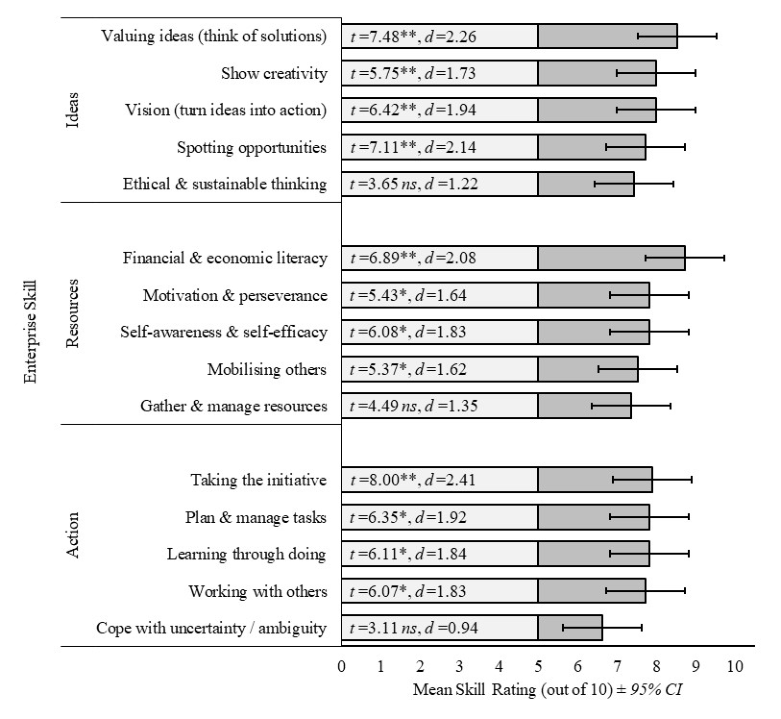
Enterprise Skills Student enterprise skills development over the module was evaluated using single mean t-tests (Figure 1). Significant improvements (p<0.05) were found in 12 of the 15 different enterprise skills defined by the European Entrepreneurship Competence Framework. The greatest self-rated increases reported by students compared to pre-module skill levels occurred in understanding financial and economic factors (M=8.73); thinking of solutions/ valuing ideas (M=8.55); turning ideas into action/ vision (M=8.00); and showing creativity (M=8.00), when evaluated on a 10-point scale. Coping with uncertainty or ambiguity (M=6.64), Gathering and making use of resources (M=7.36), and the ability to think ethically and sustainably (M=7.44) were found to be the least improved enterprise skills, and did not differ significantly from pre-module baseline levels.
Educating for Innovation: Using Problem-Based Collaborative Tasks 137
Figure 1: Mean ratings (± 95% CI) of 15 different enterprise skills in students. Data labels show single mean t-tests and effect sizes (d) comparing self-ratings of each skill after taking the module to a pre-module baseline score of 5 (* p<.05; ** p<.01 Bonferroni corrected).
Team Role Characteristics With respect to the team role characteristics of students, the two most commonly occurring Belbin types overall cohorts were Team Worker and Coordinator which were identified by 24.0% (n = 47) and 17.9% (n = 35) of the sample respectively as being either their primary or secondary preferred team role. Resource Investigators (4.1%, n = 14), Plants (8.2%, n = 15) and Shapers (9.2%, n = 16) by comparison were rare, with few students identifying these amongst their preferred roles (Table 1).
138 Turner
Table 1: Distribution of team role characteristics from seven cohorts of students (n = 132).
Table available in the original PDF paper.
Team Role Key Attributes1 Primary Role Secondary Role n % n %
Plant Creative, imaginative,
8 8.2% 7 7.1%
generates ideas, solves problems.
Monitor Evaluator Sober, strategic, sees
13 13.3% 10 10.2%
options, and judges accurately.
Shaper Challenging, dynamic,
9 9.2% 7 7.1%
drive to overcome obstacles.
Implementer Practical, reliable,
10 10.2% 12 12.2%
organizes tasks, turns ideas into action
12 12.2% 12 12.2%
Completer Finisher Painstaking, conscientious, searches out errors and omissions
1Adapted from Belbin (2010). Team Roles at Work. Routledge, London.
Relationship Between Team Roles and Performance Pearson correlations were calculated between individual preference scores for each of the eight role types with team scores on the presentation assessment, individual scores on the written assessment, and ‘team ethic’ scores. Individual assessment performance was positively correlated with both receiving higher appraisal ratings from other team members (r(126)=.218, p=.014) and awarding higher peer ratings to others (r(97)=.244, p=.015), suggesting individually, members of more harmonious groups fared better. However, no relationship was found between group presentation scores with mean peer ratings either awarded (r(128)= −.103, p=.242 ns) or received from others (r(96)= −.113, p=.269 ns). Peer ratings awarded or received also did not correlate at p<.05 with preference scores for any of the eight team roles assessed by the TR-SPI. This indicates stronger preferences for a particular Belbin type were not necessarily better valued as a team colleague. In addition, no significant correlations were found between the team role preference scores and either group presentation scores or individual
Educating for Innovation: Using Problem-Based Collaborative Tasks 139
assessment scores, indicating that no specific Belbin type performed better on the module overall.
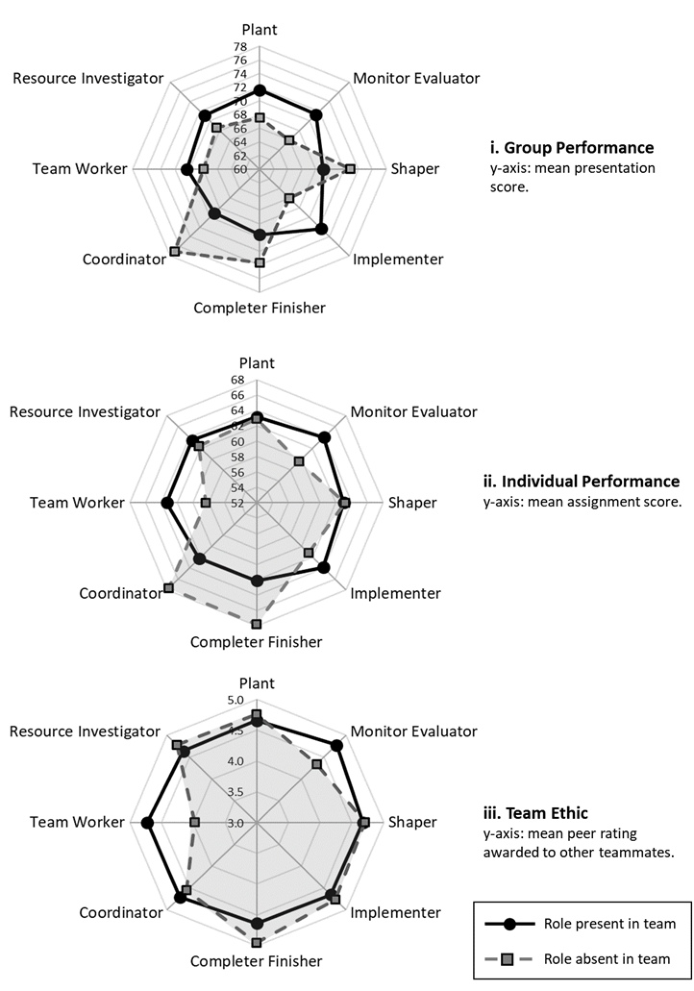
To examine the impact of team composition, independent samples t-tests were used to compare team presentation and individual assessment scores, and average peer ratings awarded to each member of a team, when teams either included or did not include at least one member with an identified Belbin team role within their preferred primary or secondary team role types (i.e. where a void was present in the team’s composition). With respect to the group task, team presentation scores were significantly better in teams which contained at least one individual who adopted the Monitor- Evaluator (t(96)=3.90, p<.001, d=0.65), Implementer (t(96)=4.45, p<.001, d=0.79), Plant (t(96)=2.48, p=.015, d=0.49) or Team Worker (t(96)=2.63, p=.010, d=0.28) role, compared to teams where these roles were missing. By contrast, group performance was significantly poorer in teams that contained at least one individual who adopted the Coordinator role (t(96)= −3.53, p<.001, d=1.02), compared to teams where this role was absent, and no difference was found regardless of the presence of absence of the Shaper (t(96)= −1.95, p=.057 ns, d=0.48), Completer-Finisher (t(96)= −1.83, p=.071 ns, d=0.50), or Resource-Investigator (t(96)= 1.42, p=.160 ns, d=0.30) roles (Figure 2(i)).
A similar pattern was observed for the individual written assessment whereby the presence of a Monitor-Evaluator within the team was associated with students achieving significantly higher individual assessment scores by 4.5% on average, compared to students who worked in teams without a Monitor-Evaluator (t(97)=2.59, p=.011, d=0.64). However, the presence of a Coordinator (t(97)= −2.76, p=.007, d=0.77) or Completer-Finisher (t(97)= −2.98, p=.004, d=0.81) within the team was associated with significantly poorer performance on the subsequent individual assessment task, with scores on average being 5.4% better when Coordinators were absent, and 5.7% better when Completer-Finishers were absent. No other significant differences in individual performance scores were observed as a function of the presence or absence of specific team roles (Figure 2(ii)).
With respect to ratings of ‘team ethic’, both the presence of one or more Team Worker (t(98)=2.59, p=.011, d=0.28) or Monitor-Evaluator (t(98)=2.87, p=.005, d=0.65) within each student team led to significantly higher peer ratings being awarded by students to other members of their team, suggesting these roles enhanced subjective impressions of team cohesion, with mean ratings being 0.5 and 0.7 scale points higher. In contrast, the presence of a Completer-Finisher (t(98)= −4.04, p<.001, d=0.50) within the team led to significantly lower peer ratings being awarded to other members of a team suggesting this role inhibited cohesion, with peer ratings being on average 0.3 scale points lower compared to when the role was absent. No significant differences in peer ratings were observed as a function of the presence or absence of other team role types (Figure 2(iii)).
Team Roles & Enterprise Skills Development Few relationships were found between the development of different enterprise skills and preference strength for different Belbin team roles. Those with
140 Turner
Figure 2: Radar plots comparing the impact of presence or absence of different Belbin team roles on (i) group performance, (ii) individual performance and (iii) team ethic.
stronger Implementer preference scores were more likely to report greater increases in their ability to work with others (r(92)=.24, p=.023), to learn through doing (r(92)=.22, p=.034), and be motivated and persevere (r(92)=.24, p=.021), by virtue of taking part in the task. Those with stronger Team Worker preferences were less likely to report increases in
Educating for Innovation: Using Problem-Based Collaborative Tasks 141
their ability to be motivated and preserve (r(97)= −.28, p=.007). Moreover, after adjusting for false discovery rate (Benjamini & Hochberg, 1995), no significant correlations remained between enterprise skills and role preference scores. Together, these data suggest no clear association between preferred team roles and enterprise skills development during the collaborative task completed.
DISCUSSION
Performance on student collaborative tasks is influenced by the individual team role characteristics of group members. Teams that included Monitor- Evaluators, Plants, Implementers, and Team Workers tended to perform better overall, consistent with their roles in idea generation, refinement, execution, and maintaining team harmony. Conversely, the presence of Coordinators and Completer-Finishers appeared to detract from performance. These roles may conflict with the more egalitarian nature and collaborative dynamics typical of student learning teams, where directive leadership and excessive quality control can be perceived as overbearing or unnecessary.
Monitor-Evaluators in particular, were associated with enhanced individual as well as team assessment scores, likely due to their tendency to encourage deeper discussion and critical thinking during group tasks. This aligns with the reflective and analytical skills valued in individual assessments. By contrast, Completer-Finishers may only enhance outcomes when they are themselves highly skilled and their efforts are aligned with team expectations; otherwise, their involvement may result in imbalanced workloads or frustration where they are perceived to interfere with the outputs of other team members.
With respect to peer evaluations, averaged ratings per team tended to be higher when team workers and monitor-evaluator roles were present, indicating the greater harmony these may bring to the group. However individually, students showing stronger preferences for a particular team role were not necessarily better valued as a team colleague. A restriction in the range of peer evaluation scores was apparent in the current study, with fewer than 5% of students receiving average peer ratings of less than 4 (out of 5). This indicates students may use peer ratings strategically where there is a direct consequence of receiving poor evaluations on assessment scores and that factors such as tactical voting or conflict avoidance may undermine the validity of these ratings when tied to students’ grades.
While thinking or action focused team roles are beneficial for group performance, traditional leadership roles like Coordinators may be less effective in student-led settings. This finding is consistent with Channon et al (2017) who observed that, during the later stages of a task in particular, a greater number of Coordinators within a group can be detrimental to overall team performance. A dominant Coordinator within a student team may lead to inactivity or sense of reliance from others who may have otherwise more actively participated. Leadership in student groups often emerges dynamically, with responsibilities and decision-making shared among members. In essence, effective teams on the enterprise task were
142 Turner
observed to function as ‘leaderless teams’ (Choi & Schnurr, 2014) whereby students worked in parallel for set periods without the need for a typical management structure. It was noted that Coordinator and Team Worker roles dominated student groups, accounting for approximately 42% of the primary or secondary role preferences of the teams examined. Encouraging and providing students with opportunities to practice less preferred team roles such as Resource Investigators, Plants or Shapers may therefore help increase their versatility in work groups beyond graduation.
With respect to enterprise skills, it is encouraging that students perceived a significant improvement in 12 of the 15 competencies evaluated, which points to the utility of problem-based learning and design tasks as a suitable means of developing employment-relevant skills in students. This positive outcome suggests that engaging students in a collaborative innovation-based tasks can significantly enhance self-reported enterprise skills, irrespective of students’ dominant team role preferences, or the degree to which their performance was valued by others.
REFERENCES
Aranzabal, A., Epelde, E., & Artetxe, M. (2022). Team formation on the basis of Belbin’s roles to enhance students’ performance in project-based learning. Education for Chemical Engineers, 38, 22–37. https://doi.org/10.1016/j.ece.2021. 09.001 Belbin, M. (2010). Management Teams: Why they succeed or fail (3rd ed.).
Butterworth-Heinemann. https://doi.org/10.1016/B978-1-85617-807-5.10015-9 Belbin, R. M., Aston, B. R., & Mottram, R. D. (1976). Building effective management teams. Journal of General Management, 3(3), 23–29. https://doi.org/10.1177/ 030630707600300 Belbin, R. M., & Brown, V. (2022). Team Roles at Work (3rd ed.). Routledge. https:
//doi.org/10.4324/9781003163152 Benjamini, Y., & Hochberg, Y.(1995). Controlling the false discovery rate: a practical and powerful approach to multiple testing. Journal of The Royal Statistical Society: Series B (Methodological), 57(1), 289–300. https://doi.org/10.1111/j. 2517-6161.1995.tb02031.x Chang, Y., & Brickman, P. (2018). When group work doesn’t work: Insights from
students. CBE—Life Sciences Education, 17(3), ar52. doi: 10.1187/cbe.17–09- 0199 Channon, S. B., Davis, R. C., Goode, N. T., & May, S. A. (2017). What makes a ‘good group’? Exploring the characteristics and performance of undergraduate student groups. Advances in Health Sciences Education, 22, 17–41. https://doi.or g/10.1007/s10459-016-9680-y Choi, S., & Schnurr, S. (2014). Exploring distributed leadership: Solving disagreements and negotiating consensus in a ‘leaderless’ team. Discourse Studies, 16(1), 3–24. https://doi.org/10.1177/1461445613508891 Davies, W. M. (2009). Groupwork as a form of assessment: Common problems and
recommended solutions. Higher Education, 58, 563–584. https://doi.org/10.1007/ s10734-009-9216-y Fisher, S. G., Macrosson, W. D. K., & Sharp, G. (1996). Further evidence concerning the Belbin team role self-perception inventory. Personnel Review, 25(2), 61–67. https://doi.org/10.1108/00483489610110096
Educating for Innovation: Using Problem-Based Collaborative Tasks 143
Francis, N., Pritchard, C., Prytherch, Z., & Rutherford, S. (2024). Making Teamwork Work: Enhancing Teamwork and Assessment in Higher Education. FEBS Open Bio. https://doi.org/10.1002/2211-5463.13936 León-del-Barco B, Mendo-Lázaro S, Felipe-Castaño E, Fajardo-Bullón F and Iglesias-
Gallego D (2018) Measuring Responsibility and Cooperation in Learning Teams in the University Setting: Validation of a Questionnaire. Frontiers in Psychology. 9:326. https://doi.org/10.3389/fpsyg.2018.00326 McCallum, E., Weicht, R., McMullan, L. and Price, A., EntreComp into Action - Get inspired, make it happen: A user guide to the European Entrepreneurship Competence Framework. In M. Bacigalupo and W. O‘Keeffe (Eds), EUR 29105 EN, Publications Office of the European Union JRC109128. https://doi.org/10. 2760/574864 Warhuus, J. P., Günzel-Jensen, F., Robinson, S. and Neergaard, H. (2021), “Teaming
up in entrepreneurship education: does the team formation mode matter?”, International Journal of Entrepreneurial Behavior & Research, Vol. 27 No. 8, pp. 1913–1935. https://doi.org/10.1108/IJEBR-10-2020-0701
LISTED IN THE AHFE DIGITAL BOOKSTORE CATALOGUE
Explore the complete digital volume
Creativity, Innovation and Entrepreneurship
Read this individual research paper free through the original publisher, or explore the full digital proceedings book.
ISBN 978-1-964867-42-7
Explore this ISBN in the AHFE Bookstore ↗Listed in the July 2026 bookstore catalogue; search by ISBN to confirm current availability · Digital book purchase optional