Yulu Yang, Ruoxuan Ma, Yi Xiao (2025). A Comparative Study on the Impact of AIGC and Traditional Inspiration Sources on the Design Process of Designers. In: Creativity, Innovation and Entrepreneurship. AHFE Open Access, vol. 166, pp. 103–113. https://doi.org/10.54941/ahfe1006116
This research delves into the impact of artificial intelligence generated content (AIGC) as a source of inspiration on the ideation process of designers. The study aims to juxtapose the efficacy of designers employing AIGC tools, exemplified by Midjourney, against traditional search engines such as Pinterest during the ideation phase, emphasizing the stages of keyword definition, inspiration search, and inspiration selection. Utilizing think-aloud protocol analysis and semi-structured interviews, the research scrutinized the ideation processes of 12 master's students in design under various task constraints. The outcomes indicated that designers employing AIGC tools demonstrated heightened prudence during the keyword definition phase, and their search depth and selection strategies varied significantly. AIGC tools were found to be more effective in managing associative creative searches, yielding unique design solutions. The study demonstrates that AIGC, as an emerging source of inspiration, possesses certain advantages and potential, showcasing its efficacy as an inspirational source in the early stages of the design process. Additionally, the study offers recommendations for designers on integrating both AIGC and traditional inspiration sources in their creative endeavors.
In the field of design, the pursuit of inspiration is the core driving force for innovation. In the early stages of design, designers usually need to rely on external stimuli to construct and solve the problems they encounter. Factors such as the type of inspiration sources, the semantic distance between them and the design task, and the stage of involvement all have an impact on the designers’ ideation activities and creative processes (Goldschmidt, 1997; Gonçalves et al., 2014).
Although there has been a relatively rich body of research on designers’ inspiration sources, in recent years, with the advancement of generative artificial intelligence (AIGC) technology, its powerful data processing capabilities and creative potential have opened new avenues for designers to obtain inspiration (Dai, 2024, Wang et al., 2024). AIGC technology can not only rapidly generate many design concepts according to designers’
needs but also create unprecedented design ideas by imitating and integrating different styles and elements (Lin and Liu, 2024). Designers claim that using image inspiration websites is a traditional way to obtain inspiration. However, with the emergence of an increasing number of AIGC tools, the high-quality visual images generated by these tools have made their use in the inspiration-stimulating stage more frequent, and many designers use them in their daily work (Rao and Xiong, 2023, Wu et al., 2024). Nevertheless, there is currently relatively little research on the specific role and influence mechanism of AIGC in this process. Most of the current research still focuses on the analysis of traditional inspiration, such as inspiration types, sources, and the timing of inspiration stimuli. The research on AIGC as an emerging inspiration source is still in its infancy. Lin et al. (2024) compared the influence of AIGC and traditional methods on designers’ creativity and preliminarily explored whether the AIGC method is superior in product design. They also analyzed the roles of factors such as image quality and gender in the design process. However, this study has limitations. It did not consider the influence of task constraints on designers, nor did it conduct an in-depth analysis of the designers’ inspiration process. Instead, it mainly focused on the evaluation of the creativity of the design schemes proposed by designers.
With the continuous development of artificial intelligence technology, it is crucial to study the influence of AIGC as an emerging inspiration source on the creative thinking patterns of future designers. Research has shown that image stimulation is the most effective in inspiring design inspiration in the early stage of design (Chen et al., 2018). Therefore, this paper focuses on the ability of AIGC-generated images as visual stimuli. Referring to the research of Milene and Carlos (Gonçalves et al., 2016), the early stage of design (especially the ideation divergence stage) is divided into three stages: keyword definition, stimulus search, and stimulus selection. Through comparative experimental analysis, the influence of AIGC-based inspiration sources on the designers’ inspiration process is examined, and whether different design task constraints have an effect is also explored. This study has taken the lead in filling this gap in the research on new inspiration sources in the field of designers’ creative thinking.
METHOD
This experiment focuses on the behavior patterns of designers under different inspiration sources and task constraints, aiming to analyze their creative thinking processes. The experiment comprehensively employs the think- aloud protocol analysis and semi-structured interview method. In previous studies, the think-aloud protocol has been regarded as a valuable method because it can analyze various aspects of the designer’s thinking process with minimal interference (Ericsson, 2017). However, some researchers believe that this method may affect the performance of participants due to increased cognitive load (Chiu and Shu, 2010). To enhance the effectiveness of verbal report analysis, Lloyd, Lawson, and Scott advocate incorporating other methods into the analysis to obtain a richer perspective on the designer’s
A Comparative Study on the Impact of AIGC and Traditional Inspiration Sources 105
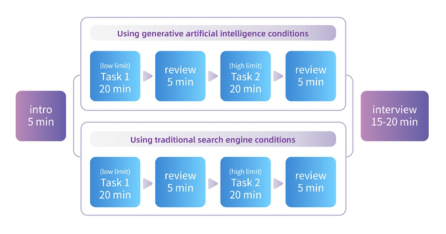
process and performance (Lloyd et al., 1995). Therefore, in this study, we also combine non-participant observation and semi-structured interviews to make the experimental data more reliable. The experiment is divided into six stages (see Figure 1). The participants are 12 master’s students from the design school, including 7 females and 5 males, with an average age of 23 years old, and all have 4–5 years of design learning experience. The experiment is divided into a traditional search engine group (using Pinterest, n = 6) and an AIGC group (using Midjourney, n = 6). Both groups conduct brainstorming activities under two different levels of task constraints, namely high and low. After the brainstorming session, an interview session is immediately carried out. The average duration of each interview is 20–30 minutes. The interview content includes asking designers to review the inspiration stimulation process to fill in the gaps in the think-aloud protocol, inquiring about their commonly used inspiration search methods and selection strategies, and understanding their feelings about inspiration acquisition and the influence of task constraints. During this period, the materials used or created by the participants and their search behaviors are recorded in detail. Before the formal experiment, we conduct a pre-test to ensure that the task description is easy to understand and can stimulate multiple ideas.
Figure 1: Experimental procedure.
RESULTS
Based on the inspiration process diagram developed by Gonçalves et al. (2016), which represents inspiration as a cyclical and iterative process that occurs repeatedly throughout any design process, we place particular emphasis on the initial phase of the inspiration process, specifically three critical junctures: design definition, inspiration search, and inspiration selection. These stages are most relevant to our study and constitute the most frequently recurring cycles during the ideation divergence phase for designers.
Design Definition Phase - Keyword Input The experiment found that the participants who used Midjourney to generate inspiration were more cautious than those who used traditional search engines. They spent a longer time selecting keywords and made more deliberate decisions. We believe this is because the AIGC tool
generates a limited number of images at a time, so the participants felt that more detailed and rich keywords were needed to obtain potentially useful directions. In contrast, the users of traditional search tools quickly determined the keywords without explicitly linking them to the search objectives. Meanwhile, we found that the designers who used Midjourney would adjust their keyword input strategies. For example, when illustrating Mars wearable devices, one participant used the keywords “one-piece spacesuit” that he believed were more easily understood by artificial intelligence.
Further research data shows that when using AI, the participants tended to input adjectives with “sensory” characteristics to explore inspiration, and often used the method of stacking adjectives, such as “vibrant style”. In the traditional search scenario, the participants preferred to use objective nouns as keywords (see Table 1).
Table 1: Comparison of keywords input by participants under different inspiration source conditions.
Table available in the original PDF paper.
Use Traditional Image Search Engines Use Artificial Intelligence “Automotive interior design” “A car that can lie down and sleep, designed with a lively style, comfortable and quiet environment, four-wheel car, pink car, green environment” “Intelligent cockpit” “Car cabin sleep design, comfortable,
soft, spacious, and technologically advanced” “Concept car” “Car interior designed for working young people to sleep, single, can be turned into a bed seat, to meet the safety, comfort, privacy needs, car cabin design”
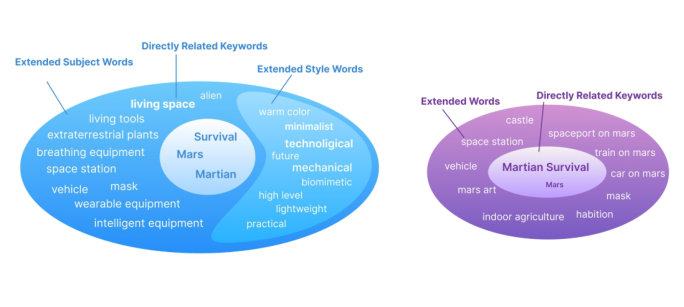
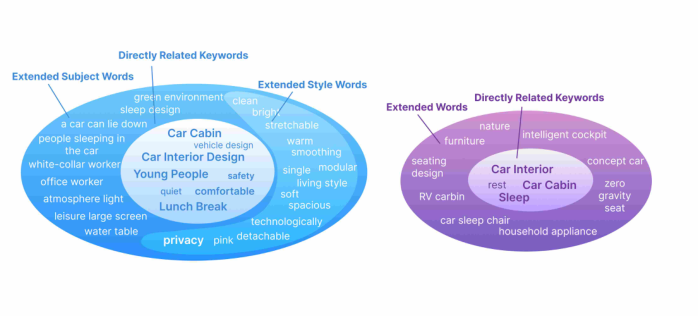
This study conducted a statistical analysis of the keywords input by designers under two experimental conditions. In the low-constraint task environment, the core keywords were mostly directly related to the design task, such as “Mars” (see Figure 2), and occasionally there were terms with weak associations. When AIGC technology was adopted, there was no significant commonality in the main subject words related to the extension of the design task. However, terms such as “technology” and “minimalism” were frequently selected by multiple participants as generation constraints, while these style words did not appear as search keywords when participants used traditional search engines (see Figure 3).
A Comparative Study on the Impact of AIGC and Traditional Inspiration Sources 107
Figure 2: Under low restriction tasks, keywords searched using AIGC (left) and keywords searched using traditional search engines (right).Figure 3: Under high restriction tasks, keywords searched using AIGC (left) and keywords searched using traditional search engines (right).
When using AIGC in a high-constraint task scenario, there is no longer a commonality among participants in the selection of extended style words. This implies that when the design task is more specific, the individual differences among designers in the selection of style words are more prominent.
Inspiration Search Phase During the research process, we observed that when designers conducted searches with the help of search engines, they were frequently immersed in the experience of browsing many relevant images and often failed to recognize their own needs for inspiration. For instance, one designer stated, “When I saw the theme of ‘Conceptual Design of Mars Survival’, I didn’t have any clear ideas, so I extracted the keyword ‘Mars Survival’ to search for pictures and obtained some interesting ones.”
The research also found that when designers were seeking visual stimuli, they were often triggered by specific images that evoked their latent memories and past cognitions. At this time, designers would actively look for images related to personal memories as references. However, there were significant differences in their abilities to obtain ideal results under the two search conditions. When using traditional search engines, designers’ search experiences were limited. One participant claimed that he wanted to search for content like that in the movie “Weight Loss Factory”, but due to vague memories or inaccurate selection of keywords, he repeatedly encountered setbacks and couldn’t find the desired images. In contrast, when using AIGC, designers were more likely to achieve their search intentions. One designer said that after watching a movie about superheroes, he wanted AIGC to refer to the design of the respirator of the Kryptonians in the movie and found that the generated content was highly consistent with his requirements. This demonstrates that AIGC has a significant advantage in handling searches with creative associations.
Meanwhile, there were obvious differences in the search depths of participants under the two search conditions. Participants using AIGC were more inclined to conduct in-depth iterative searches, while those using traditional search engines would often terminate further exploration after obtaining inspiration and shift their attention and search behaviors to other unexplored areas.
Inspiration Selection Phase Statistics indicate that users of traditional search engines chose 241 inspiration-related images, whereas AIGC users selected only 76. Despite equal time allocation, participants unearthed more inspiration when utilizing traditional search engines. Although participants accessed a greater number of inspiration images under the traditional search engine condition, they frequently lacked clear consideration regarding how these images related to the design.
During the inspiration selection phase, we categorized the participants’ reference directions for inspiration images into three dimensions: emotional with atmosphere, modelling with function, and color with material. The classification criteria were grounded in the participants’ descriptive definitions of the desired images within the think-aloud protocol (see Table 2). In the low-constraint task, the proportions of images selected by participants under both conditions in the emotional with atmosphere, modelling with function, and color with material dimensions were 49.6%, 48.4%, and 2% respectively. In the high-constraint task, the corresponding proportions were 34.4%, 57.2%, and 8.4%.
As observed from the think-aloud protocol, under the AIGC inspired condition, discrepancies often emerged between designers’ intentions and the generated outcomes. Four out of six designers expressed dissatisfaction with the visual materials generated by AIGC, as they felt these materials did not accurately represent the concepts or scenarios implicit in the keywords. Nevertheless, some designers managed to glean inspiration from
A Comparative Study on the Impact of AIGC and Traditional Inspiration Sources 109
these unanticipated images. Conversely, when the images generated by AIGC closely matched the keywords, they failed to stimulate the designers’ creativity. The following table (see Table 3) summarizes the differences in designers’ inspiration processes across different dimensions under the two scenarios.
Table 2: Classification scheme for selected inspirational images based on think-aloud protocol data.
Table available in the original PDF paper.
Three Reference Levels Representative Examples of Relevant
Descriptions
Emotions with Atmosphere “This style is very cool and may serve as a reference for the atmosphere inside the car.” Modelling with Function “When I see this image, I’m inspired to
consider integrating storage functions with the seating design.” Color with Material “I find this really appealing; the soft, cushiony texture makes me feel incredible.”
Table 3: Differences in the inspiration process of designers under two conditions across different dimensions.
Table available in the original PDF paper.
Dimension Condition Use Artificial Intelligence Use Traditional Image Search Engines Longer Shorter Time for selecting
keywords
Emotional adjectives Rational noun
The style of the selected
keywords
Divergent
Search frequency Low frequency High frequency Search behavior Deep and constantly
iterating Less More Number of selected inspiration images
Strong correlated Unrelated
Correlation between inspiration images and design schemes
CONCLUSION
While existing literature has primarily focused on the influence of inspiration on designers’ creative output, this study investigates the specific mechanisms by which inspiration derived from AIGC affects different stages of designers’ inspiration process through experimental methods. The findings systematically summarize this influence pattern, providing a new theoretical framework for understanding the role of generative AI in the creative generation process of design.
Design Definition—Co-Evolutionary Keyword Input Strategies Under AIGC Intervention The data analysis of this study reveals a generative artificial intelligence (AIGC)-based inspiration acquisition mechanism, wherein designers exhibit a “co-evolutionary” pattern in their interactive process with artificial intelligence during the keyword input phase. Specifically, designers adjust their subsequent keyword inputs based on the feedback received from the initial input, aiming to achieve image outputs that more closely align with their expectations.
The advantage of this strategy is that, by iteratively adjusting keywords, designers can guide artificial intelligence in the direction they desire, thereby obtaining outcomes that are more in line with their personal aesthetics and design philosophy, a level of personalized customization that traditional inspiration acquisition methods find hard to achieve. However, as the design concepts become more specific, designers may become overly focused on details, an area where artificial intelligence still has limitations in understanding and generation. This divergence may lead designers to spend excessive time adjusting keywords, thereby reducing work efficiency.
Design Definition—A Sensibility-Oriented Design Definition Tendency In the experiment, designers employ more abstract and emotive language to articulate design concepts, hoping that generative AI will produce inspiration images with greater ambiguity and openness, providing room for subsequent divergence. In contrast, participants using traditional search engines expect to find specific, pre-existing images, and thus, they may use more concrete and precise keywords to ensure the retrieval of the most relevant results.
However, not all designers prefer this sensibility-oriented definition pattern. Some designers have pointed out that while inspiration images generated from sensibility-oriented design definitions are visually impressive, they often lack consideration in terms of functionality and usability.
Inspiration Search—AIGC Enhances Designers’ Conscious Search Behavior The findings of this study reveal that designers exhibit a higher frequency of conscious search behavior when using generative artificial intelligence (AIGC) for inspiration generation compared to traditional search engines. Conscious search refers to the proactive exploration of specific stimuli with a clear objective in mind. During the use of traditional search engines, designers browse through a vast array of visual images, selecting them based on personal experience and superficial cognition, often without deeply considering how these inspirational images integrate with the final design. However, in the process of inspiration generation using generative artificial intelligence, designers must consciously control and select keywords during the input phase, a behavior that promotes contemplation of the generated outcomes.
A Comparative Study on the Impact of AIGC and Traditional Inspiration Sources 111
Inspiration Search—Utilizing AIGC to Demonstrate Continuously Optimized, Deeply Iterative Search Strategies During the inspiration search phase, designers employing AIGC tools for design exploration exhibit deeply iterative and refined search behaviors. Participants using traditional search engines to search for inspiration tend to quickly shift towards exploring other potential creative areas after obtaining preliminary inspiration, rather than deeply mining in a single direction. In contrast, with the support of AIGC, designers can swiftly transition into a more profound focusing phase after divergence, with a significant increase in time investment. Users of AIGC are more capable of transforming broad inspirations into more defined design concepts, and through continuous refinement and iteration, designers can transform initial vague ideas into clear and distinctive design directions.
Inspiration Search—Designers Emphasize Emotional and Atmospheric Information in Low-Constraint Tasks, and Practicality in High-Constraint Design Tasks During the inspiration selection phase, by comparing the reference directions of inspirational images among participants under different task constraints, we reveal the significant impact of the degree of design task constraints on creative inspiration selection. Specifically, in high-constraint tasks, participants clearly tend to select images related to form and function, a preference that highlights the designers’ inclination to rely on functional and practical information when facing a well-defined problem. In contrast, in low-constraint task scenarios, due to the relatively vague design objectives, participants’ preference for emotional and atmospheric images significantly increases, indicating that during the exploration phase, designers place greater emphasis on the construction of emotions with atmosphere, while attention to detailed aspects such as color with material is relatively less.
Inspiration Selection—Images Obtained From AIGC Promote More Concentrated Exploration of Design Possibilities, but May Sometimes Stifle Creativity This study reveals the distinct characteristics of designers’ inspiration selection when using traditional search engines versus AIGC tools.
Traditional Search Engines: High volume, low specificity—Designers can easily obtain a vast number of inspirational materials through traditional search engines. However, this abundance often lacks specificity, making it difficult for designers to connect the discovered images with their design objectives. This phenomenon aligns with the concept of “information overload,” where an excess of information hinders decision-making and creative thinking (Eppler and Mengis, 2008).
AIGC Tools: Low volume, high specificity—Although AIGC tools generate fewer inspirational images compared to traditional search engines, these images have a higher consistency with the designers’ intended direction. Despite initial dissatisfaction, the fewer but more directionally clear images generated by AIGC may assist designers in focusing their attention more
effectively. This suggests that, despite its limitations, AIGC can promote a more concentrated exploration of design possibilities.
SUGGESTION This study demonstrates that AIGC and traditional search engines each possess distinct advantages and limitations in terms of inspiration sources. In response, this paper proposes a combined strategy: during the early stages of the design process, the traditional search engine can be utilized to facilitate comprehensive information gathering and provide diverse sources of inspiration. Subsequently, AIGC can be leveraged for in-depth exploration and optimization within specific design directions. This approach not only compensates for the limitations of using a single tool but also balances diversity and practicality for designers. The proposed strategy offers a novel perspective on understanding and applying generative AI in the design process, overcoming the limitations of conventional methods and providing a more effective solution for inspiration generation in design.
ACKNOWLEDGMENT
This paper is a supported outcome of the School of Design at Hunan University, China. Gratitude is expressed for the support provided by the Digital Intelligence and Cultural Innovation Laboratory at the School of Design, Hunan University.
REFERENCES
Chen, M., Zhao, T., Zhang, H. & Luo, S. A study of the influence of images on design creative stimulation. Social Computing and Social Media. User Experience and Behavior: 10th International Conference, SCSM 2018, Held as Part of HCI International 2018, Las Vegas, NV, USA, July 15–20, 2018, Proceedings, Part I 10, 2018. Springer, 3–18. Chiu, I. & Shu, L. Potential limitations of verbal protocols in design experiments.
International Design Engineering Technical Conferences and Computers and Information in Engineering Conference, 2010. 287–296. Dai, Z. 2024. Does AI Help? A Review of How AIGC Affects Design Education.
Arts, Culture and Language, 1. Eppler, M. J. & Mengis, J. 2008. The Concept of Information Overload-A Review of Literature from Organization Science, Accounting, Marketing, MIS, and Related Disciplines (2004) The Information Society: An International Journal, 20 (5), 2004, pp. 1–20. Kommunikationsmanagement im Wandel: Beiträge aus 10 Jahren= mcminstitute, 271–305. Ericsson, K. A. 2017. Protocol analysis. A companion to cognitive science, 425–432. Goldschmidt, G. 1997. Capturing indeterminism: Representation in the design
problem space. Design Studies, 18, 441–455. Gonçalves, M., Cardoso, C. & Badke-schaub, P. 2014. What inspires designers?
Preferences on inspirational approaches during idea generation. Design studies, 35, 29–53. Gonçalves, M., Cardoso, C. & Badke-schaub, P. 2016. Inspiration choices that matter: the selection of external stimuli during ideation. Design Science, 2, e10.
A Comparative Study on the Impact of AIGC and Traditional Inspiration Sources 113
Lin, H., Jiang, X., Deng, X., Bian, Z., Fang, C. & Zhu, Y. 2024. Comparing AIGC and traditional idea generation methods: Evaluating their impact on creativity in the product design ideation phase. Thinking Skills and Creativity, 54. Lin, Y. & Liu, H. The Impact of Artificial Intelligence Generated Content Driven Graphic Design Tools on Creative Thinking of Designers. International Conference on Human-Computer Interaction, 2024. Springer, 258–272. Lloyd, P., LAWSON, B. & SCOTT, P. 1995. Can concurrent verbalization reveal
design cognition? Design Studies, 16, 237–259. Rao, J. & Xiong, M. A New Art Design Method Based on AIGC: Analysis from the Perspective of Creation Efficiency. 2023 4th International Conference on Intelligent Design (ICID), 2023. IEEE, 129–134. Wang, Y., Wang, Z. & Mu, R. 2024. Modern Design Thinking and AIGC
Intervention. Design Studies and Intelligence Engineering. IOS Press. Wu, Z., Tang, R., Wang, G., Li, H., Yang, S. & Shidujaman, M. The Research and Design of an AIGC Empowered Fashion Design Product. International Conference on Human-Computer Interaction, 2024. Springer, 413–429.
LISTED IN THE AHFE DIGITAL BOOKSTORE CATALOGUE
Explore the complete digital volume
Creativity, Innovation and Entrepreneurship
Read this individual research paper free through the original publisher, or explore the full digital proceedings book.
ISBN 978-1-964867-42-7
Explore this ISBN in the AHFE Bookstore ↗Listed in the July 2026 bookstore catalogue; search by ISBN to confirm current availability · Digital book purchase optional