Samuele Morvillo, Salvatore Di Dio, Benedetto Inzerillo, Daniele Ronsivalle, La Gennusa Maria (2024). Strategic Design for mobility: Study of a methodology for the analysis of user behavior and choices regarding mobility. In: Intelligent Human Systems Integration (IHSI 2024): Integrating People and Intelligent Systems. AHFE Open Access, vol. 119, pp. 581–589. https://doi.org/10.54941/ahfe1004523
The study of user behavior and mobility choices is a crucial aspect in the design of innovative transportation services that genuinely cater to people's needs, placing the user and their senses at the core, developing services that address not only the needs but also the sensemaking of individuals (Pennington, 2016). To achieve this goal, the design team developed a strategy for mapping qualitative and quantitative data, including the identification of user needs and frustrations In the collection of qualitative data, the method introduced by Cooper in 1999 known as Personas is employed (Cooper, 1999). This method serves to gather input for designers, compelling them to take into account the specific needs of users. Originally utilized in software development, this method is now increasingly applied in the creation of products and services. It can also be leveraged in the design of public services and within the realm of mobility (Siddall, 2011). Personas are constructed through meticulous observation and subsequently (Turner, D.W., 2010), the conduct of a significant number of user interviews. These insights are then translated into personas by identifying common needs, frustrations, dreams, and fears(Çalışkan 2012).The objective was to create a scalable approach to easily understand local needs, fears, trends, and opportunities related to mobility systems, walkability, road desirability, and services (Dogan, T., 2018).This research was conducted in collaboration with the laboratory of the Master's Degree program in Design at Palermo University, within the scope of territorial development strategy and services.The user research analysis was divided into several simple steps to be easily executed with the aid of guidelines, incorporating methodologies utilized in design, such as Design Thinking, and in urban planning disciplines, like participatory interviews and observations (Carrasco, Pizzaro 2022). The project commenced with an analysis of the context of two specific mobility hubs in Palermo, namely, two stations within the city's metro system, which are major and complex nodes, serving different user bases and allowing for interaction with a large number of users (Turner, D.W., 2010). Alongside the contextual analysis, the next step involved actual participatory observation, establishing discussions with users in the areas, and identifying potential users who utilize them most frequently, developing semi-structured, empathic interviews aimed at identifying their needs and the reasons why they chose to take that route or use the station (Kalbach, 2020).The designers also took photographs, marking the most interesting nodes, strengths, and weaknesses according to the users, and analyzed them to create proto-empathy maps using a five-senses format and proto-personas (Califano et al. 2022).The aim is to develop qualitative maps of users' daily experiences, referred to as "User Journey Maps" as well as empathy maps, where their feelings are traced to identify needs and frustrations (Tharon, H., 2014).Subsequently, these maps could be employed to delve deeper into the urban and mobility design process (Gothelf, Schloesser, 2023).The project is committed to making this methodology scalable, showcasing its results and design contributions to facilitate its adaptability in other contexts within the same city of Palermo or in other Italian cities. The goal is to provide a well-defined, phased methodology for developing the replicability of the approach, thus enabling the creation of personas in any location we wish to analyze in mobility services.In conclusion, the strategy developed by the Design team provided valuable insights into user behavior and mobility choices (Sheller, 2011). The use of Design tools, such as empathy maps and personas, contributed to creating profiles that could be used to deepen the design process, as well as to serve as a testing phase. The combination of methodologies was successful in achieving a new level of mapping to be integrated into the mobility service design processes. The methodology was designed to be easily scalable in other contexts, which could prove invaluable in the future of the research project.
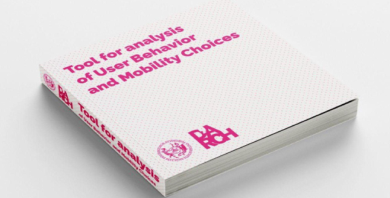
Investigating user behavior and mobility decisions is vital for the formula- tion of cutting-edge transport solutions. To this end, the design group crafted an observational methodology as part of the “Urban Mapping and Sensing Project’s Geographical and Societal Context”. The goal was to devise a versa- tile method for swiftly grasping the local requirements, concerns, prevailing trends, and potentialities linked to mobility infrastructures. This study was carried out in partnership with the master’s program laboratory focused on territorial planning, under the domain of strategic and territorial develop- ment services and in the research framework of Italian Sustainable Mobility Center - Spoke 9 “Urban Mobility”. The user exploration process was seg- mented into straightforward stages, simplified further by reference guidelines (see Figure 1), in order to contribute to define a new integrated and consistent mobility and urban planning strategical approach.
The design team conducted a comprehensive analysis of two major mobility hubs in Palermo, involving desk research, expert opinions, field observations, and photo evaluations to develop initial empathy maps and proto-personas. This progressed to creating interview guides, conducting interviews, and analyzing data to construct detailed user profiles and improve urban and mobility planning. The methodology was then refined for broader application across various contexts in Palermo and other Italian areas, highlighting the crucial role of observational strategies and design tools in understanding user behavior, forming detailed user profiles, and enhancing the overall design process while maintaining flexibility for future research.
Figure 1: Manual of guidelines for operators.
THEORETICAL FRAMEWORK Infrastructure, mobility and the city. An integrated approach
In recent studies and applied experiences, the strategies for enhancing the quality of public space are inevitably connected to an incremental and adap- tive vision of urban transformation (Carta, 2021b, pp. 406–407). This vision has been accelerated and accentuated by the pandemic phase, which has required a rethinking of how city users interact with public spaces (D’onofrio & Trusiani, 2022).
Marchigiani & Bonfantini (2022) and Carta (2021b, pp. 406–407, 2022, pp. 153–168) underline the significant impact of the pandemic on reshaping
Strategic Design for Mobility: Study of a Methodology 583
the concept of neighborhood planning. This new vision focuses on revi- talizing physical spaces and providing local services within a framework of increasingly integrated and multisectoral policies. These policies span a spectrum of complexity, from short-term Covid-19 strategies to long- term transformative initiatives (Casanova & Hernandez, 2015; Mostafavi & Doherty, 2016, pp. 428–431; NACTO & Global Designing Cities Initiative, 2020). Even the “Ottavo rapport sulle città – Mobilità e Città: verso una post- car city” (Coppola et al., 2023, pp. 57–68) describing the case studies of Milan, emphasizes a desire to return to neighborhood-based urban design as a reference point for communities. It highlights the importance of tac- tics like Tactical Urbanism (Lydon & Garcia, 2015) and Urban Acupuncture (Casanova & Hernandez, 2015) in the city’s “restart” with a citizen-centered approach rather than a focus on specific transportation categories (pedes- trian, cyclist, driver, and so on).
Thanks to the increased awareness in recent years (Carta, 2021a; Cop- pola & Silvestri, 2021; D’onofrio & Trusiani, 2022; Gehl & Svarre, 2013; Marchigiani & Bonfantini, 2022; Žnidaršiˇc & Juvanˇciˇc, 2021) the city of sustainable spaces is increasingly imagined and designed as a citizen-friendly place, and no longer exclusively pedestrian-friendly.
Thus, a paradigm shift has occurred in which the livability of our cities is once again measured by the dimension of the human being (Forsyth, 2015; Žnidaršiˇc & Juvanˇciˇc, 2021), not only from a strictly functional perspec- tive but also from a perceptual (Lynch, 1964) and well-being standpoint (Bonaiuto et al., 2015).
In a qualitative and quantitative approach, the main requirement is to integrate subjective components focused on the individual with objective components based on evidence. This integration occurs within a decision- making context where behaviors result from the interaction between purely objective aspects (e.g., road quality, lighting, slope, etc.) and exclusively sub- jective aspects (e.g., sense of safety and security, architectural and artistic heritage, pleasantness of a place, etc). This approach requires considering both the objective elements such as pavement quality, lighting, and slope, as well as the subjective elements such as the sense of safety and security, archi- tectural and artistic heritage, and the overall pleasantness of a place (Bonaiuto & Fornara, 2017).
The development of coherent and integrated policies and the subsequent actions for the spatial transformation of cities, starting from urban mobility hubs, must be based on a strategic vision that works with adaptable groups of stakeholders. The user experience assessment belongs to a strategic approach in integration of urban planning, infrastructure and mobility services as the Sustainable Urban Mobility Plan (SUMP) Giudelines (Wefering et al., 2014) places particular emphasis on citizen and stakeholder engagement, policy and planning coordination across sectors (transportation, urban planning, environment, economic activities, social services, health, safety, energy, etc.), between entities, and across different levels within and across territories, as well as among neighbouring institutions.
This research delves into whether mobility experiences are consciously designed or naturally occur, emphasizing accessible and sustainable options in the urban citizenship context. The study highlights Mobility-Justice and Sustainable Mobility-Justice as major challenges, advocating for a compre- hensive approach to ensure high-quality, eco-friendly public and private mobility services.
A critical evaluation of the existing mobility framework is essential to iden- tify areas of high citizen expectations and inadequate service performance to prioritize improvements. A focus on key challenging intersections within pub- lic/private mobility services, identifying crucial moments and pain points, is necessary for significant enhancements (Kalbach, 2020).
METHODOLOGY: A SIX-STEP PROCESS.
This research integrates Design Thinking and Urban Design to create a pow- erful methodology for context-specific design initiatives, fostering innovation in complex settings. This integration supports reflective learning and enrich- ing educational interactions, enhancing the understanding and engagement with intricate urban dynamics. This blend of methodologies provides a robust platform to address the complex challenges in urban environments, encour- aging a culture of continuous learning and adaptation, aligning with wider discourses on informed and responsive engagement with complex, evolving urban ecosystems (Dogan, T., 2018).
The methodology thus employed is as follows:
1. Context analysis 2. On-site observation 3. Proto-personas 4. Interview guidelines and surveys 5. Personas and profiles 6. Validation The concept of transdisciplinary design plays a vital role in this research, navigating complexity and encouraging innovative solutions within urban settings. This approach brings together varied perspectives from territorial social actors, utilizing observation, analysis, and dialogue to unveil novel design directions and insights. Illustrated through a case study conducted by scholar-practitioners and academics, the adaptability of this methodology is demonstrated across different urban design situations, ranging from walka- bility issues to scenarios necessitating engagement with potential residents. It delves into conflict resolution, generating opportunities, and strengthening territorial connections, all while striving to develop effective solutions to the challenges at hand.
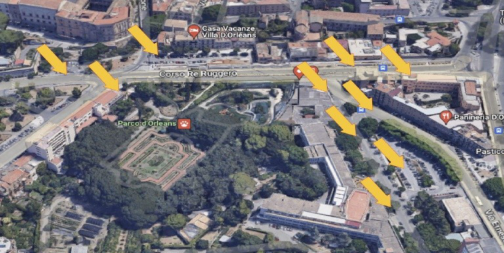
Context analysis: The research team conducted an in-depth contextual analysis at the“Palazzo Reale Orleans” (see Figure 2), metropolitan station in Palermo to understand its dynamics, encompassing identification of key stakeholders, analysis of entrance/exit points and circulation within the sta- tion, assessment of peak usage times, and exploration of adjacent space usage during low patronage periods. This meticulous analysis yielded a wealth of
Strategic Design for Mobility: Study of a Methodology 585
insights on the operational and spatial interactions at the station, laying a solid foundation for subsequent investigative and design-oriented efforts to address the challenges and opportunities within this urban setting.
Figure 2: Analysis of Nodes and Points of Interest at Orleans Station, Palermo.
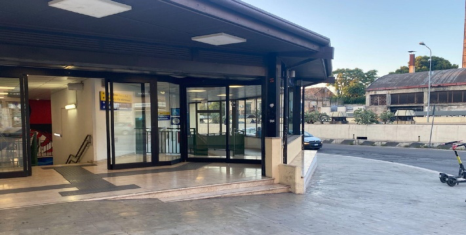
Observation: Utilizing an observational tool, master’s students from the “Design Cultura del Territorio” program aided in acquiring an in-depth comprehension of regular station users, positioning themselves at strategic vantage points for analysis across different time periods (refer to Figure 3). The process began by identifying target demographics and linking them to nearby points of interest or connectivity options, as illustrated by the associa- tion of a university’s proximity with a predominant student user group. This meticulous methodology yielded a nuanced understanding of user dynam- ics and preferences, providing a time-variant snapshot of user patterns and offering valuable insights for informed design interventions.
Figure 3: Main Entrance of Orleans Station Royal Palace Palermo.
Proto Analysis (Proto-Personas; Proto User Journey Empathy-Map): Proto-analysis efficiently consolidates persona development, user journey mapping, and empathy mapping to swiftly generate actionable insights from user data, circumventing extensive resource investment and enabling a rapid, informed exploration of user dynamics for the critical refinement of design propositions.
Proto User Journey and Empathy Map Canvas: The integration of the Empathy Map and User Journey provides a comprehensive view into users’ experiences, capturing their behaviors, desires, and concerns. The Empathy Map’s main aim is to foster empathy towards a specific individual, requiring us to adopt their perspective, though it’s acknowledged that this analysis is preliminary and requires further validation. This combination of tools aids in developing a detailed understanding of user interactions and experiences, forming a solid foundation for more in-depth analysis in later stages, with the provisional nature of this approach highlighting the necessity of ongoing validation to ensure accuracy and relevance.
Proto Personas: The persona serves as a unique user archetype with distinct goals in product or service interactions. Utilizing proto-personas based on initial observational insights, our methodology transitions to direct research for validation and refinement. These preliminary proto-personas, acting as a “minimum viable product” in user research, are instrumental in generat- ing interview hypotheses and aiding in both structured and semi-structured queries, particularly crucial given the limited user data at this stage. This approach sets a foundational framework for deeper investigation as the research evolves.
Interview Guidelines and Surveys: Leveraging initial observations and proto-personas, a Semi-Structured Interview guide was created, allowing flexibility while targeting identified user groups, and facilitating the cap- ture of subtle cues through tandem interviewing (Turner, D.W., 2010). A Structured survey, aligned with the Italian Ministry of Sustainable Mobil- ity’s guidelines, further explored individual mobility habits and openness to behavioral change, contributing to the development of sustainable mobility practices.
Develop User Journey and Empathy-Map Canvas: After the interviews, the focus shifts to refining user archetype profiles, necessitating the creation of User Journey Maps and Empathy Maps to capture user pathways and emotional responses, thus offering a comprehensive view of user interactions (Tharon, H., 2014). With data from interviews and observations, the process continues towards validating and evolving the Proto-Personas into detailed Personas, with particular attention to identifying genuine fears and needs (Çalı¸skan, 2012).
Validation: A significant portion of the process has garnered affirmative validation from the personnel spearheading the user research activities. A deeper analytical dive into counterfactual outcomes, precipitated from the employment of alternative tools (e.g., standard empathy maps vis-à-vis 5 senses empathy maps), is currently in progress, potentially unearthing further insights and refinements to this methodological apparatus.
OUTCOMES The Observation phase at Palermo’s “Orleans” subway station was a pivotal first step in our design methodology, encompassing 9 hours across differ- ent weekdays during peak times, and scrutinizing 1732 individuals. This initial data collection allowed for a detailed understanding of the station’s
Strategic Design for Mobility: Study of a Methodology 587
demographic, subsequently categorizing users into distinct groups based on characteristics and behaviors, providing a solid basis for future design phases.
1330 student,
273 Workers,
21 seniors,
30 travellers
1 disable
68 other (N.C.)
Observations at the subway station reveal a predominance of university students due to its proximity to the campus, highlighting the need for in-depth research into their specific needs and preferences to enhance the station’s appeal. The use of the station by working professionals is also noted, while the scarcity of travelers and users with disabilities suggests potential architec- tural barriers, necessitating further investigation through both quantitative and qualitative methods, particularly targeted conversations with disabled individuals in the academic area.
The preliminary observations have become pivotal in guiding the sub- sequent stages of the project, particularly in planning and strategizing the interviews, enriching the understanding of user dynamics and instilling a nuanced, user-focused perspective for more informed and empathetic design decisions. The next phase, carefully conducted by the research team using the aforementioned semi-structured interview methodology, resulted in:
11 hours of interviews Accumulating to:
53 interviews Encompassing:
26 University Students
18 Workers
5 Teenagers
3 Elderly Individuals
2 Homemakers The interviews corroborated the observational data on station usage, yield- ing valuable qualitative insights for generating “personas” reflecting users’ explicit and implicit fears and needs. This integration of semi-structured interviews and observational findings enriched our understanding of user dynamics, verifying the data and uncovering in-depth insights for a nuanced, empathetic approach to design evaluation and refinement. This demonstrates the research team’s commitment to a holistic, iterative, and user-centered methodology as the project progresses.
CONCLUSION
This document articulates a research journey utilizing a blended methodology grounded in Design Thinking and Urban Design principles to scrutinize user
behaviors and mobility choices in urban transit areas. Through a comprehen- sive integration of contextual analysis, on-site observations, and empathetic user interactions, a robust tapestry of insights was crafted, enhancing our qualitative understanding and setting the stage for future design phases. This iterative, user-centric approach, transitioning from initial proto-personas to detailed personas, ensures the inclusivity and responsiveness of the design to the dynamic urban environment. The case study at “Palazzo Reale Orleans” metro station in Palermo exemplifies the methodology’s potential impact across varied urban contexts, emphasizing the need for an empathetic, user- centric strategy to address the unique needs and challenges of different user demographics. Regarding the examination of user experience, this aspect will undergo development in the later stages of the collaborative efforts under- taken by the team at the National Centre for Sustainable Mobility (MOST), Spoke 9 Urban Mobility. The focal points of this endeavor will include the articulation of the monitoring framework as well as the establishment of engagement platforms In conclusion, this paper presents a methodical, empathetic exploration of the complex challenges and opportunities within urban mobility ecosys- tems, positioning Urban Design and Strategic Design on a trajectory towards sustainable, inclusive urban mobility solutions and a richer academic and practical discourse in the field.
REFERENCES
Bonaiuto, M., & Fornara, F. (2017). Residential Satisfaction and Perceived Urban Quality. In Reference Module in Neuroscience and Biobehavioral Psychology. Elsevier. https://doi.org/https://doi.org/10.1016/B978-0-12-809324-5.05698-4 Bonaiuto, M., Fornara, F., Alves, S., Ferreira, I., Mao, Y., Moffat, E., Piccinin, G.,
& Rahimi, L. (2015). Urban environment and well-being: cross-cultural stud- ies on Perceived Residential Environment Quality Indicators (PREQIs). Cognitive Processing, 16(1), 165–169. https://doi.org/10.1007/s10339-015-0691-z Califano, G., Hampshire, N., & Spinks, D., “Mastering Collaboration in a Product Team: 70 Techniques to Help Teams Build Better Products,” N.p.: Apress, 2022. Carrasco Pizarro, C., et al., “Potenciales implicaciones en la aplicación metodológica
del Design Thinking en procesos de diseño urbano. Análisis desde la experiencia del diseñador,” Revista de urbanismo, vol. 46, pp. 75–94, 2022. Carta, M. (2021a). Città aumentate. Dieci gesti-barriera per il futuro. Il Margine.
https://books.google.it/books?id=Akp0zgEACAAJ Carta, M. (2021b). Palermo: biografia progettuale di una città aumentata. LetteraVentidue. Carta, M. (2022). Homo urbanus. Donzelli Editore. Casanova, H., & Hernandez, J. (2015). Public Space Acupuncture. Actar Publisher. Çalı¸skan, O., “Design thinking in urbanism: Learning from the designers,” Urban
Des Int, vol. 17, pp. 272–296, 2012. [Online]. Available: https://doi.org/10.1057/ udi.2012.21. Coppola, P., & Silvestri, F. (2021). Gender inequality in safety and security perceptions in railway stations. Sustainability (Switzerland), 13(7), 1–15. https: //doi.org/10.3390/su13074007 Coppola, P., Pucci, P., & Pirlo, G. (2023). Ottavo rapporto sulle città. Mobilità &
Città: verso una post-car city. Il Mulino.
Strategic Design for Mobility: Study of a Methodology 589
D’onofrio, R., & Trusiani, E. (2022). The Future of the City in the Name of Proximity: A New Perspective for the Urban Regeneration of Council Housing Suburbs in Italy after the Pandemic. Sustainability, 14(3). https://doi.org/10.3390/ su14031252 Dogan, T., Samaranayake, S., & Saraf, N., “Urbano: A new tool to promote
mobility-aware urban design, active transportation modeling and access anal- ysis for amenities and public transport,” in Proceedings of the Symposium on Simulation for Architecture and Urban Design, 2018, pp. 1–8. Ferreira, B., et al., “Designing Personas with Empathy Map,” SEKE, vol. 152, 2015. Forsyth, A. (2015). What is a walkable place? The walkability debate in urban design.
Urban Design International, 20(4), 274–292. https://doi.org/10.1057/udi.2015.22 Gehl, J., & Svarre, B. (2013). How to Study Public Life. Island Press. https://doi.org/ 10.5822/978-1-61091-525-0 Gothelf, J., & Schloesser, N., “Using Proto-Personas for Executive Alignment,” UX
Magazine, n.d. [Online]. Accessed on: June 18, 2023. Available: https://uxmag.co m/articles/using-proto-personas-for-executive-alignment. Howard, T., “Journey mapping: a brief overview,” Commun. Des. Q. Rev, vol. 2, no.
3, pp. 10–13, May 2014. [Online]. Available: https://doi.org/10.1145/2644448. 2644451. Kalbach, J., Mapping Experiences, O’Reilly Media, 2020. Lydon, M., & Garcia, A. (2015). Tactical Urbanism: Short-term Action for Longterm Change. Island Press. Lynch, K. (1964). The Image of the City. MIT Press. Marchigiani, E., & Bonfantini, B. (2022). Urban Transition and the Return of Neigh-
bourhood Planning. Questioning the Proximity Syndrome and the 15-Minute City. Sustainability, 14(9). https://doi.org/10.3390/su14095468 Mostafavi, M., & Doherty, G. (2016). Ecological Urbanism. Harvard University, Graduate School of Design. https://books.google.it/books?id=jP5ergEACAAJ NACTO & Global Designing Cities Initiative. (2020). Streets for Pandemic Response
& Recovery. 49. https://nacto.org/streets-for-pandemic-response-recovery/ Pennington, A., The Customer Experience Book: How to design, measure and improve customer experience in your business, Pearson UK, 2016. Sheller, M., “Sustainable mobility and mobility justice: Towards a twin transition,”
in Mobilities: New perspectives on transport and society, 2011, pp. 289–304. Turner, D. W., “Qualitative Interview Design: A Practical Guide for Novice Investigators,” The Qualitative Report, vol. 15, no. 3, pp. 754–760, 2010. [Online]. Available: https://doi.org/10.46743/2160-3715/2010.1178. UN-Habitat. (2012). State of the world’s cities 2012/2013: prosperity of the cities.
- Forshung und Berantung GmbH. (2014). Linee guida. Sviluppare e attuare un piano urbano della mobilità sostenibile. 98. Žnidaršiˇc, K., & Juvanˇciˇc, M. (2021). Walkability in residential neighbourhood.
LISTED IN THE AHFE DIGITAL BOOKSTORE CATALOGUE
Explore the complete digital volume
Intelligent Human Systems Integration (IHSI 2024): Integrating People and Intelligent Systems
Read this individual research paper free through the original publisher, or explore the full digital proceedings book.
ISBN 978-1-958651-95-7
Explore this ISBN in the AHFE Bookstore ↗Listed in the July 2026 bookstore catalogue; search by ISBN to confirm current availability · Digital book purchase optional