Yuriko Sawatani (2019). Designing Service System Prototype Workshops. In: Advances in The Human Side of Service Engineering. AHFE Open Access, vol. 8. https://doi.org/10.54941/ahfe100280
The design focus is shifting from industrial projects to service systems due to the service economy. The research on designing a service system becomes more important. The difficulty of designing a new service system is how to share values among many stakeholders involved. The scope of design becomes wider, more complex and including more interactions among various stakeholders. Because of these shifts, the new research on service system design is emerging. In this paper, a service system design framework is proposed, which is based on two viewpoints, such as systems with value sharing condition and scopes of system layers. Using the framework, a service system prototype workshop is designed and executed. The paper shares the evaluation result and findings.
The society has been fast advancing toward a service-based economy. This phenomenon, common to both developed and developing countries, results from the growth of the service sector’s share of the economy, spurred by rapid growth in service industries consequent to increased social sophistication and diversification. The growth of services encouraged the researchers to study the fundamental business changes from product-based systems to service economies (IfM and IBM, 2007, Chesbrough and Spohrer, 2006). Besides the follow-up sales of product- based services, the business strategies of the most of companies had to shift their focus to services as a key differentiator in their new business models (Sawatani, et al., 2007, van der Aa and Elfring, 2002). Such a shift does affect the design focus.
The design focus is shifting from industrial projects to service systems due to the service economy. The research on designing a service system becomes more important. The difficulty of designing a new service system is how to share values among many stakeholders involved. The scope of design becomes wider, more complex and including more interactions among various stakeholders. Because of these shifts, the new research on service system design is emerging. In this paper, a service system design framework is proposed, which is based on two viewpoints, such as systems with value sharing condition and scopes of system layers. Using the framework, a service system prototype workshop is designed and executed. The paper shares the evaluation result and findings.
SHIFT OF THE DESIGN FOCUS Industrial products
Literatures on design appeared since 1950 in the most industrialized countries. The followings show some definitions of design (Jones, 1992).
• Fining the right physical components of a physical structure (Alexander, 1963) [Equation or mathematical symbol available in the original paper PDF] Decision making, in the face of uncertainty (Archer, 1965)
• The conditioning factor for those parts of the product which come into contact with people (Farr, 1966) [Equation or mathematical symbol available in the original paper PDF] The performing of a very complicated act of faith (Jones, 1966)
• A creative activity – it involves bringing into being something new and useful that has not existed previously (Reswick, 1965)
The design was described using various different words, such as decision making, conditioning factor, creative activity, etc... The commonality among these definitions is to initiate change in man-made things (Jones, 1992). Industrial design initiated by William Morris is growing influenced by the economic and societal change, such as Bauhaus and Postmodern design. IDEO and d.school at Stanford are expanding the target of design, not only industrial products, but service systems.
Service products The early research on service design discusses service products (Shostack, 1984, Bitner, 1992, Marger, 2004) by distinguishing between product and service. Service design starts focusing on user experience and interaction (Holmlid, 2007), such as human-computer interaction and participatory design. Recently the systemic perspective in service design including engineering viewpoints is emerging.
Service systems Discussions on a service system are growing in SSMED community. Service is value co-creation interaction that is beneficial changes that result from communication, planning, or other purposeful interactions between distinct entities (Spohrer and Maglio, 2010). The entity can be viewed as a service system entity. A service system is dynamic configurations of resources that include one or more persons, and evolve complex structures and interaction patterns (Spohrer and Maglio, 2010). Designing service systems including various industrial and service products needs additional knowledge.
Looking at the history of design since 1950, focus areas are shifting from products to service systems. The design focus is shifting from industrial, tangible products to service products focusing on interaction design, and service systems. At the same time, the scope of a service system is expanding from one particular organization e.g. a closed system to an open system that covers multiple stakeholders.
FRAMEWORK FOR SERVICE SYSTEM DESIGN The design of a service system requires various viewpoints. Jackson (Jackson, 2003) categorized systems approach from complexity of systems and value sharing condition among participants in the problem contexts. First looks at the complexity of systems. The complexity of systems by Jackson (Jackson, 2003) is as the following: a system is simple if it is static, closed and has a few subsystems, or is complex if it is dynamic, open and has many subsystems. Human Side of Service Engineering (2019)
Service systems could be categorized as a simple system or a complex system. The class 1 to 3 (Ueda, et al., 2009) introduces the shared value concept to an open system. Class 1 is a closed system. Class 2 is an open system, but the purposes of the system are fixed, and Class 3 is an open system without concrete purposes by synthesis approaches (Ueda, et al., 2009).
Value sharing conditions among participants (Jackson, 2003) are discussed as (1) Unitary which shares similar values, beliefs and interests, (2) Pluralist which does not share the same values and beliefs, however, accommodations and compromises can be found, (3) Coercive which has few interests in common and conflicting values and beliefs, and decisions are taken on the basis of who has most power. From the solution point of views, interactions in a service system are typed as value proposition based and governance based (Spohrer, et al., 2011).
On the other hand, service system design incudes multi-level interactions, such as people interactions, as well as organizations and society level. S3FIRE program (Sawatani, et al., 2013) introduced three layers, micro-meso-macro as the following:
• The first layer, Micro, expresses a one to one relationship, mainly person-to-person interactions. From business point of views, it shows operational relationship.
• The second layer, Meso, is for an n-to-n relationship, mainly organizational interactions, which shows strategy and collaborative organizational policy.
• The third layer, Macro, is for the social system and policymaking.
Jones (Jones, 1992) describes the level of design as components, products, systems, and communities. Service systems include community level as well as systems level, such as relationships between products and between systems. Many unsolved design issues occur at the systems level and the above. These levels are beyond the scope of traditional designing (Jones, 1992). It includes the political and social aspects of user behavior.
Viewpoints such as system complexities, value sharing conditions and scopes of a service system help to identify technical and social difficulties designing a service system. Table 1 shows the summary of the discussions.
Table 1: Service system viewpoints: Complexities, Interactions, and Scopes
System complexities Systems Simple Complex
Value sharing conditions Interactions Value proposition based Governance based Spohrer, et al. (Spohrer, et al., 2011)
Scopes System layer Micro: People Meso: Organization Macro: Social systems S3FIRE (Sawatani, et al., 2013)
Industrial products are developed in a factory and are sold to customers (consumers or companies). On the other hand, service products vary from an almost closed system like a maintenance support a printer, to an open system with multiple stakeholders like an on-line auction service at an e commerce site. Service systems are not limited to the area of these products, but include a regional community system that is the intersection of class 2 or 3 and the meso scope, and a national society system at the macro scope level. As the result, service system design needs to expand research areas from products as the following.
Figure 1. Expanded research areas by service system design
Figure available in the original PDF paper.
SERVICE SYSTEM PROTOTYPE WORKSHOP The service system prototype workshop is designed to focus on the intersection of the micro-meso scope and class 2 value sharing condition. The target of attendees of the workshop includes students, teachers, and professionals from companies. The six project teams are formed for the prototyping from Dec., 2013 to March, 2014.
Design process At the project level, the following steps are designed.
1. Problem identification and definition
2. Idea generation
3. Hypothesis inspection based prototyping
4. Prototype testing and feedback
Step1: problem indication and definition is trying to capture the interested area from objective and intuition like perspective. Idea generation, step 2, is executed by the innovation workshops using various ideation methods. This workshop puts stress on concept, product and experience testing by prototyping. So that step 3 and 4 are important, which include plans for the prototyping, the execution and the feedback to the original prototype.
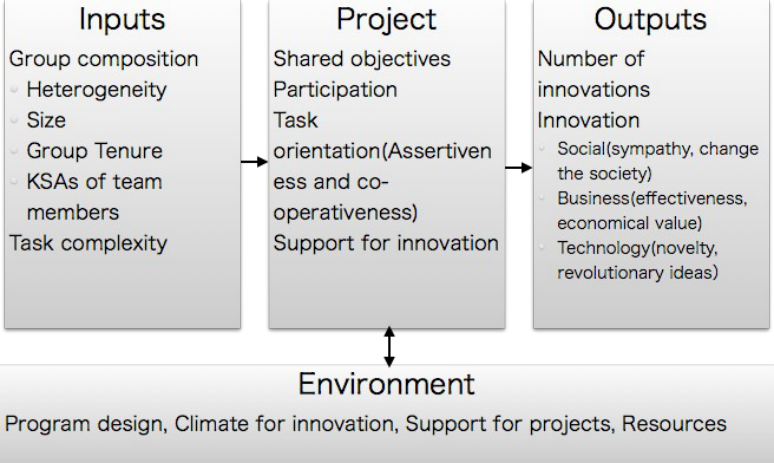
Meta-Design process At the program level, the following are examined extending an input-process-output model (West and Aderson, 1996) from service system viewpoints.
Figure 2. Evaluation of service system prototype workshop
The inputs of the workshop are team group composition and task complexity. The progress of projects is majored by surveys at each event, such as the kick off, idea generation workshops, the middle team presentation, and the final team presentation. The outputs are tested by the judges from social, business and technical point of views.
RESULT AND DISCUSSIONS
Result
Table 2 shows the early evaluation result of the service system prototype workshop.
Table 2: Evaluation result of service system prototype workshop
Table available in the original PDF paper.
From the limited evaluation, the following points are considered. The total assessment was high when there was an outstanding score at the evaluation. Team D that has a strong technology score was evaluated as the top at the final team presentation. The team has the stronger assertion task orientation than co-operative task orientation. The deep argument needs to be considered as an important element for innovative idea generation (Badke-Schaub et al., 2010). The excessive sense of cooperation may be rather associated with a sharp idea in an argument reversely.
Team C and team B shared project objectives with team highly, which is ranked the second and the third at the final team presentation. The joint ownership of the objectives might be important to start the innovative idea generation. When a purpose is not shared enough, arguments may not be carried out effectively. As a result, an idea may become commonplace. For team D case, even though a purpose is not shared enough, if a team is more homogeneous and keeps the same quality, then deep arguments are possible to generate a sharp idea.
Discussions From the early research on the service system prototype workshop, it becomes important how to create the idea generation environment, which is the meta-design process such as the team formation, the value sharing process and innovation evaluation. These areas need to be studied in the future. Adding to the meta-design process study, prototype methods need to be explored.
From the interviews of attendees at the service system prototype workshop, prototyping of the service system was challenging. The most of the service systems, which teams created, were not a products, but social systems. The areas of prototyping are expanding from products to concepts and experience. The operationalization from the model (concept or experience) to the reality is difficult. The methods supporting the concept and the experience prototype areas need to be researched more.
REFERENCES
Alexander, C. (1963), The Determination of Components for an Indian Village. In conference on Design Methods (Edited by J.
Christopher Jones and D. G. Thornley), Oxford, New York Archer, L. Bruce, (1965), Systematic Method For Designers, London Badke-Schaub, Petra, Goldschmidt, Gabriela, and Meijer, Martijn (2010), “How Does Cognitive Conflict in Design Teams Support the Development of Creative Ideas?”, Cognitive Conflict in Design Teams, Vol. 19, No. 2, pp.119-133 Bitner, M.J. (1992), Servicecapes: The Impact of Physical Surroundings on Customers and Employees, Journal of Marketing
56(2), pp.56-71. Chesbrough, H., and Spohrer, J. (2006), A Research Manifesto for Services Science, Communications of the ACM, Vol. 49, No.
7, pp. 35-40. Farr, M. (1966), Design Management, London, Hutchinson Holmlid, S. (2007), Interaction design and service design: Expanding a comparison of design disciplines, Nordic Design Research Conference, NorDes, Stockholm, Sweden. IfM and IBM (2007), Succeeding through Service Innovation: A Service Perspective for Education, Research, Business and
Government, Cambridge, United Kingdom: University of Cambridge Institute for Manufacturing. Jackson, Michael C. (2003), Systems Thinking: Creative Holism for Managers, John Wiley & Sons Ltd., UK Jones, C. (1966), Design Methods Reviewed. In The Design Method (Edited by S. Gregory), London, Butterworths Jones, C. (1992), DESIGN METHODS, John Wiley & Sons. Marger, B. (2004), Service design: A review, Cologne, Germany: KISD. Reswich, J. B. (1965), Prospectus for Engineering Design Center, Cleveland, Ohio Sawatani, Y., Arai, T., and Murakami, T., (2013), Creating Knowledge Structure for Service Science, PICMET Sawatani, Y., Nakamura, F., Sakakibara, A., Hoshi, M., and Masuda, S. (2007), Innovation Patterns, Proceeding of IEEE International Conference on Services Computing, pp. 427-434. Shostack, L. (1984), Designing Services that Deliver, Harvard Business Review, 62(1), pp.133-139. Spohrer, J. C., Maglio, P. P. (2010), Toward a Science of Service Systems: Value and Symbols, In P. P. Maglio, C. A.
Kieliszewski, J. C. Spohrer Eds, Handbook of Service Science. Spohrer, J. C., Demirkan, H., and Krishna, V. (2011), Service and Science, In H. Demirkan, J.C. Spohrer and V. Krishna, Eds.
The Science of Service Systems, Springer, pp.325-358. Ueda, K., Takenaka, T., Vancza, J., and Monostori, L. (2009), Value creation and decision-making in sustainable society, CIRP Annuals, Manufacturing Technology 58, pp.681-700 van der Aa, W. and Elfring, T. (2002), Realizing innovation in services, Scandinavian Journal of Management, Vol. 18, pp.155-
171. West, Michael A. And Aderson, Niel R. (1996), “Innovation in Top Management Teams”, Journal of Applied Psychology, Vol.
81, No. 6, pp.680-693
LISTED IN THE AHFE DIGITAL BOOKSTORE CATALOGUE
Explore the complete digital volume
Advances in The Human Side of Service Engineering
Read this individual research paper free through the original publisher, or explore the full digital proceedings book.
ISBN 978-1-4951-2091-6
Explore this ISBN in the AHFE Bookstore ↗Listed in the July 2026 bookstore catalogue; search by ISBN to confirm current availability · Digital book purchase optional