Yuriko Sawatani (2026). Creative Care in Motion: Mediating Institutions Through Design. In: The Human Side of Service Engineering. AHFE Open Access, vol. 221, pp. 301–310. https://doi.org/10.54941/ahfe1007734
Care-oriented initiatives often struggle not because they lack value, but because their early forms are difficult to sustain under uncertainty and institutional constraint. This paper examines how creative care—care emerging from underdefined desires or relational improvisation—unfolds within service systems. Drawing on three European cases, it introduces a structural model that reframes care as a trajectory shaped by mediation rather than a discrete service outcome. The analysis shows that sustaining care depends less on isolated solutions than on mediated infrastructures, and that care evolves through translation and provisional stabilization rather than linear implementation. Managing mediation thus emerges as a core organizational capability for sustaining care under uncertainty.Rather than framing creativity as an individual trait or a market-driven outcome, this model positions creative action as a trajectory. Practices begin as personal or collective impulses—dissonance, longing, aesthetic discomfort—and gradually take form through mediation. Drawing from effectuation theory, design mediation, care ethics, and capability theory, the framework conceptualizes creative care as a process shaped by translation across boundaries: between desire and means, between aesthetic disruption and institutional legibility, between informal practice and formal recognition.Three European cases—Circle (UK), WeMi (Milan), and Barcelona’s Superblock—serve as interpretive platforms for analyzing how creative practices move across the quadrant space. Each case demonstrates how symbolic representations, relational networks, participatory storytelling, material infrastructures, and policy environments mediate the evolution of creative care. These cases highlight not only the emergence of new practices but also the fragility of their institutional trajectories: expressive impulses risk dilution when formalized, while grassroots experimentation risks invisibility without translation. The paper argues that design coalitions—assemblages of actors, artifacts, narratives, and infrastructures—play a critical role in sustaining these transitions by holding open ambiguity, enabling proximity, and preventing premature closure.For fashion and cultural institutions, this framework offers a way to reinterpret styling, exhibition, and participatory design as relational care practices that rely on symbolic resonance, shared authorship, and situated meaning. For museums and service organizations, it reframes innovation not as solution delivery but as the crafting of enabling conditions—temporal, spatial, and relational—that allow cultural practices to become livable and collectively held. For the broader creative economy, it positions care as a generative infrastructure: a medium through which aesthetic impulses gain form, publics are composed, and new cultural ecologies emerge.By providing a structural grammar for understanding how creative practices travel across domains of desire, means, and institutional mediation, this paper extends current design research and offers a theoretical foundation for “styled innovation” as a relational and infrastructural process.
Care-oriented initiatives have become central to contemporary service systems, yet many struggle not because they lack social value, but because their early forms are difficult to articulate, evaluate, and sustain under uncertainty and institutional constraint. Relational and improvisational practices of care often emerge before goals, resources, or evaluative criteria are clearly defined, making them vulnerable when they encounter organizational demands for coherence, accountability, and performance.
Existing research provides important insights into care as an ethical commitment and as a domain of service provision (Gilligan, 1982; Tronto, 1993, 2013; Sangiorgi & Prendiville, 2017). However, it offers limited understanding of how fragile forms of care originate and survive early encounters with institutional structures before their value can be clearly specified.
This paper addresses that gap by focusing on creative care—forms of care that emerge from underdefined desires, relational concerns, or situational improvisation. Creative care is structurally fragile: it often precedes problem definition, resists early evaluation, and depends on mediation to become visible and sustainable. Building on a multi-origin view of creative action under uncertainty (Author, under review), this study shifts attention from how care is optimized to how it is mediated as it moves through service systems.
To analyze this process, the paper introduces a structural model of creative care organized along two analytical dimensions: the source of action (desire versus available means) and the orientation of goals (self-initiated versus Received January 30, 2026; Revised April 13, 2026; Accepted April 28, 2026; Available online July 20, 2026
302 Sawatani externally defined). Their intersection generates four recurrent configurations that provide a vocabulary for tracing how care moves, stabilizes, and re-opens under constraint.
Empirically, the paper examines three European initiatives—Circle (UK), WeMi (Milan), and the Superblock (Barcelona)—as interpretive vignettes. Tracing their trajectories highlights the role of design mediation—symbolic, relational, and infrastructural—in sustaining care without prematurely fixing its meaning or outcomes.
The paper makes three contributions: it reframes care as a trajectory under mediation, conceptualizes design as mediated infrastructure, and offers a diagnostic framework for practitioners and service system designers to identify where care initiatives are positioned, what vulnerabilities they face, and what forms of mediation are required to sustain them over time.
CREATIVE ACTION UNDER UNCERTAINTY AND INSTITUTIONAL MEDIATION This paper builds on a multi-origin theory of creative action developed in prior work (Author, under review), which conceptualizes creativity as emerging from multiple starting points under conditions of uncertainty, including desire- driven impulses, means-based enactment, and processes of translation. Rather than reproducing this framework in full, the present study takes it as a point of departure and focuses on how creative action is sustained, translated, and rendered workable in care-oriented service systems.
Creative Action Under Uncertainty Creative action often begins in situations where goals are underdefined, resources are ambiguous, and institutional expectations are unclear. Under such conditions, creativity rarely follows a linear progression from problem definition to solution; instead, it emerges through situated action, affective impulse, and ongoing sensemaking (Weick, 1995; Garud et al., 2014). Prior research shows that creative initiatives may originate from different starting points—such as available means, experiential discomfort, or symbolic disruption—and only later acquire form, direction, or legitimacy.1
Effectuation theory highlights one such starting point by emphasizing action grounded in available means rather than predefined ends (Sarasvathy, 2001, 2008). While this perspective captures the pragmatic dynamics of action under uncertainty, it is less attentive to creative impulses that arise prior to instrumental reasoning—those grounded in affect, desire, or ethical discomfort. Aesthetic and interpretive accounts address this dimension by foregrounding ambiguity, play, and non-teleological exploration as generative conditions for novelty (Dewey, 1934; March, 1971).
Such impulses are structurally fragile. Institutional environments typically privilege coherence, justification, and evaluability—criteria that conflict 1The theoretical foundations of creative action under uncertainty are developed in detail elsewhere (Sawatani, under review). The present paper focuses on the institutional mediation of such action in care-oriented service systems.
Creative Care in Motion: Mediating Institutions Through Design 303 with the open-ended and affective nature of early creative action (Puig de la Bellacasa, 2011; Voronov & Vince, 2012). As a result, creative initiatives originating from desire or affect are particularly vulnerable to dismissal or premature closure unless they are mediated into forms that institutions can temporarily accommodate. For the purposes of this study, the key issue is therefore not which origin of creative action is primary, but what happens after creative action begins—how it survives, travels, and evolves within institutional environments.
Design and Institutional Mediation: Holding Fragility Open In care-oriented service systems, this challenge is especially pronounced. Care practices are relational, affective, and temporally extended, and they rarely conform to standardized problem definitions or performance metrics at early stages (Tronto, 1993; Kittay, 1999). Consequently, creative care initiatives often stall—not because they lack value, but because they cannot yet be articulated in forms that institutional actors can recognize or support.
Design becomes critical here not as a method for generating solutions, but as a practice of institutional mediation. Research on participatory design and infrastructuring shows that design can shape relations, meanings, and conditions of collective action rather than deliver finalized outcomes (Björgvinsson et al., 2012; Hillgren et al., 2011). Mediation may take symbolic, relational, or infrastructural form, translating fragile creative action into provisional arrangements that can circulate within organizations and service systems (Carlile, 2002; Orlikowski, 2007).
Importantly, design mediation does not resolve uncertainty. Instead, it holds creative action open long enough for meaning, relevance, and legitimacy to emerge, functioning as a buffer against premature evaluation and closure (Light & Akama, 2014). Without such mediation, desire-driven or relationally grounded initiatives are easily reduced to personal sentiment or informal labor within institutional settings (Puig de la Bellacasa, 2011).
Following Manzini (2015), we conceptualize these mediating arrangements as design coalitions: socio-material configurations of actors, artifacts, and narratives that enable creative care to circulate without being prematurely stabilized. Accordingly, this study treats design as a mediating infrastructure that allows creative care to move across institutional boundaries while preserving its affective and relational core. The following sections apply this perspective to three empirical cases, examining how different forms of mediation shape the trajectories of creative care within service systems.
STRUCTURAL MODEL OF CREATIVE CARE This section introduces a structural model of creative care designed to trace how care-oriented initiatives originate, move, and are sustained under institutional uncertainty. The model does not aim to classify care practices exhaustively, but to provide a heuristic for analyzing trajectories of creative care and the role of mediation in shaping them.
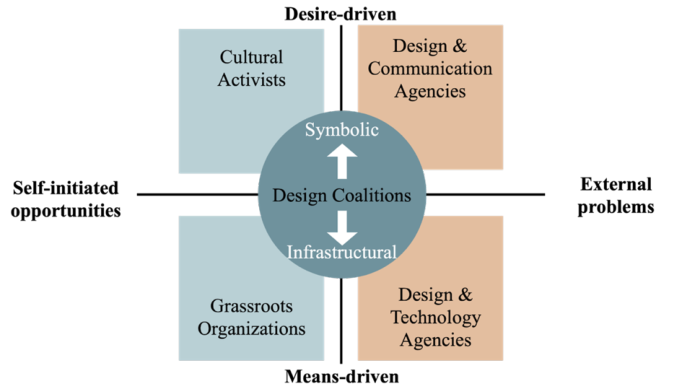
304 Sawatani The Four Configurations of Creative Care The dual-axis model introduced above distinguishes four recurrent configurations through which creative care originates and becomes mediated under conditions of institutional uncertainty. These configurations do not represent stages, best practices, or ideal types. Rather, they describe structural positions from which care- oriented action begins, gains provisional support, or encounters constraint as it moves across institutional environments. Building on the original model (Sawatani, 2026), this study extends the analysis to creative care.
Cultural Activists (Desire × Self-Initiated): Expressive Emergence refers to forms of creative care that originate from personal, affective, or symbolic impulses prior to institutional articulation. Such practices often arise from ethical discomfort, emotional urgency, or experiential rupture rather than from predefined goals or problem statements. At this point, care is neither publicly legible nor institutionally supported; it remains fragile, inarticulate, and difficult to evaluate. Prior research on aesthetic experience and playful deviation highlights how creative action can begin as non-teleological exploration grounded in feeling rather than intention (Dewey, 1934; March, 1971). In this configuration, the primary challenge is not implementation but survival: without mediation, expressive impulses risk remaining private, dismissed, or unintelligible within organizational settings.
Design & Communication Agencies (Desire × Externally Oriented): Empathic Reframing captures the translation of expressive impulses into publicly shareable concerns. Here, personal or localized discomfort is reframed as a collective issue through narrative, symbolism, or participatory engagement. Care becomes oriented toward others and begins to acquire social relevance, though it remains underdefined in terms of solutions or outcomes. Research in participatory and agonistic design emphasizes how such reframing can make marginalized concerns visible without resolving them prematurely (DiSalvo, 2009; Björgvinsson et al., 2012). While this configuration enhances legitimacy and resonance, it also introduces new vulnerabilities: as care becomes public, it becomes exposed to appropriation, simplification, or instrumental framing by institutional actors.
Grassroots Organizations (Means × Self-Initiated): Situated Experimentation refers to care practices enacted through pragmatic engagement with available means—tools, relationships, spaces, and routines—without formal institutional mandate. Action in this configuration is driven less by expressive desire than by what can be done here and now. Such practices are often adaptive, provisional, and embedded in local contexts, reflecting what effectuation theory describes as means-driven action under uncertainty (Sarasvathy, 2001, 2008). Although situated experimentation enables responsiveness and improvisation, it typically lacks durability and visibility. Without mediation, these practices remain difficult to scale, sustain, or recognize beyond their immediate context.
Design & Technology Agencies (Means × Externally Oriented): Constraint- Driven Adaptation describes care initiatives that operate within established institutional mandates, policy frameworks, or organizational infrastructures. In this configuration, goals are externally defined and action is shaped by regulatory, financial, or evaluative constraints. Care becomes operationalized through services, platforms, or programs designed to meet predefined
Creative Care in Motion: Mediating Institutions Through Design 305 criteria of performance or accountability. Research on institutional work and infrastructuring shows how such adaptation can stabilize care practices while simultaneously narrowing their interpretive flexibility (Suchman, 1995; Hillgren et al., 2011). The central tension here lies between durability and closure: while institutional embedding enables continuity, it also risks reducing care to standardized procedures unless ongoing mediation preserves relational and affective dimensions.
Taken together, these four configurations provide a structural vocabulary for analyzing how creative care emerges and travels across institutional contexts (see Figure 1). As illustrated by the dual-axis model, creative care rarely remains within a single configuration. Instead, it moves—often unevenly— across configurations through processes of mediation, encountering moments of translation, friction, provisional stabilization, and re-opening. The value of this model lies not in categorizing practices, but in clarifying where care is positioned at a given moment, what vulnerabilities it faces, and what forms of mediation are required to sustain it over time.
Movement across these configurations is enabled by mediation, which operates through symbolic, relational, and infrastructural forms. Symbolic mediation renders inarticulate or affective concerns visible through narratives, metaphors, and representations. Relational mediation is enacted through design coalitions—provisional constellations of actors that coordinate interpretation, trust, and collaboration across boundaries. Infrastructural mediation provides material and procedural scaffolding, such as platforms, pilot programs, or organizational arrangements, that sustain care practices without fully fixing their outcomes. Together, these forms of mediation allow creative care to travel across configurations while remaining provisionally underdefined (see Figure 1).
Figure 1: Structural model of creative care.
Movement, Mediation, and Fragility To clarify how movement across these configurations is mediated in practice, Figure 1 introduces design
306 Sawatani coalitions as mediating constellations of actors that connect symbolic and infrastructural forms of mediation in care-oriented service systems. Creative care rarely remains within a single configuration of the dual- axis model. As care-oriented initiatives encounter new actors, evaluative regimes, and resource constraints, they tend to move—often unevenly— across configurations through processes of mediation. Such movement is not incidental but constitutive of how creative care survives and evolves within institutional contexts.
Movement typically occurs through moments of translation, when initially underdefined practices must be rendered provisionally legible to others. Translation does not imply convergence on a shared meaning; rather, it involves creating temporary points of connection that allow care to circulate across boundaries without being fully specified (Czarniawska & Joerges, 1996; Carlile, 2002). In care contexts, these translations are frequently partial and reversible, enabling initiatives to gain attention or support while preserving interpretive openness.
At the same time, movement generates friction. As care shifts from expressive or situated configurations toward more institutionalized ones, it encounters evaluative pressures related to accountability, performance, and standardization. Such pressures can stabilize care by providing resources and continuity, but they can also narrow its scope and reduce relational depth (Suchman, 1995; Smets et al., 2012). Friction thus marks points where care is at risk of premature closure or instrumentalization.
The role of mediation is to manage this tension between movement and closure. Mediation operates through symbolic means (e.g., narratives, metaphors, visualizations), relational means (e.g., facilitation, coordination, coalition-building), and infrastructural means (e.g., platforms, pilot programs, procedural scaffolds) that allow care to remain provisionally workable without fixing outcomes (Orlikowski, 2007; Hillgren et al., 2011; Light & Akama, 2014). Rather than resolving uncertainty, mediation sustains it long enough for meaning, relevance, and legitimacy to emerge.
Despite such mediation, creative care remains structurally fragile. Its vulnerability lies not only in limited resources or lack of authority, but in its resistance to early evaluation and formal justification. Care initiatives may stall, fragment, or be reabsorbed into existing routines when mediation collapses or becomes overly instrumental (Puig de la Bellacasa, 2011; Tronto, 2013). Fragility, in this sense, is not a failure to be eliminated but a condition to be actively managed.
Taken together, movement, mediation, and fragility define the dynamic through which creative care unfolds. Care persists not by settling into a stable configuration, but by oscillating between positions while remaining interpretable and supported. This perspective reframes success in care- oriented innovation: not as achieving closure, but as maintaining the conditions under which care can continue to move. The following case vignettes illustrate how these dynamics play out empirically, tracing the trajectories of creative care across institutional contexts. Specifically, the cases trace how creative care shifts across configurations, where mediation succeeds or falters, and how fragility is managed at moments of institutional engagement.
Creative Care in Motion: Mediating Institutions Through Design 307 CASE VIGNETTES – CREATIVE CARE IN MOTION
Each vignette illustrates how creative care originates from different starting points and is sustained—or constrained—through institutional mediation.
Circle (UK): From Empathic Reframing to Infrastructural Care Circle emerged from moral concern about social isolation among older adults, reframing aging as participation rather than dependency (Cottam, 2011). Design mediation translated this empathic impulse into symbolic narratives, relational coordination, and a digital platform that made informal care visible and repeatable (Manzini, 2015). As the initiative scaled, it shifted toward Means × External, gaining institutional support but facing pressures of standardization that risked diluting its relational foundations (Tronto, 2013).
WeMi (Milan): From Institutional Coordination to Relational Care WeMi originated within the municipal welfare system (Means × External) to reorganize fragmented services (Manzini, 2022). Design mediation softened this institutional mandate through relational encounters, spatial design, and service navigation, gradually incorporating elements of Desire × External. While this hybrid positioning enabled proximity, it remained fragile under political and evaluative pressures, requiring continuous mediation to prevent care from becoming procedural (Suchman, 1995).
Superblock (Barcelona): From Ecological Desire to Institutionalized Care The Superblock began as an ecological vision (Desire × Self) and evolved through political adoption and infrastructural implementation (Desire × External → Means × External) (Rueda, 2011). Tactical urbanism and policy mediation rendered the vision legible at scale, while ongoing relational work and contestation periodically reactivated expressive impulses. The case shows that large-scale institutionalization can sustain creative care only through continued mediation, without which care risks being reduced to spatial or mobility metrics (Tronto, 2013).
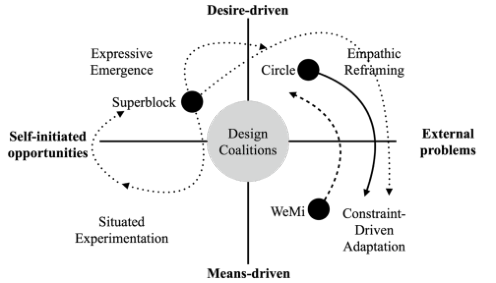
Cross-Case Synthesis Across the cases, creative care begins from distinct origins yet faces a shared challenge: surviving institutional engagement without premature closure. What distinguishes the trajectories is not the value of initial impulses, but how mediation enables care to move across configurations while remaining provisionally underdefined. As summarized in Figure 2, creative care persists not through solution optimization, but through the ongoing management of mediation.
Figure 2: Case trajectories across the creative care quadrants.
308 Sawatani Each trajectory illustrates the movement of a care initiative across the four quadrant framework. Solid lines: Circle (UK), dashed: WeMi (Milan), dotted: Superblock (Barcelona). Distinct shapes indicate stages: initial, transitional, and institutionalized. The central node, “Design Coalitions,” represents mediating infrastructures enabling these transitions.
DISCUSSION
This discussion draws together the cross-case analysis to clarify what the study contributes to understanding creative care in service systems. Building on a multi-origin view of creative action under uncertainty (Author, under review), the findings highlight two interrelated implications: (1) design operates as mediated infrastructure, and (2) creative care is best understood as a trajectory under mediation rather than a deliverable solution.
Design as Mediated Infrastructure Across Circle, WeMi, and the Superblock, design does not appear as a discrete intervention with a clear endpoint. Instead, it functions as mediated infrastructure—a set of symbolic, relational, and material arrangements that render fragile initiatives provisionally workable within institutional environments (Carlile, 2002; Orlikowski, 2007; Hillgren et al., 2011). Symbolic mediation (e.g., narratives, metaphors, visualizations) enables inarticulate concerns to become shareable; relational mediation (e.g., facilitation, coordination) sustains trust and participation; and infrastructural mediation (e.g., platforms, pilots, procedural scaffolds) provides continuity without fixing outcomes.
Crucially, mediation here does not resolve uncertainty. It holds fragility open long enough for meaning, relevance, and legitimacy to emerge (Light & Akama, 2014). When mediation collapses into premature standardization— through metrics, routines, or managerial closure—care is flattened into procedure. When mediation is sustained, care remains interpretable and adaptable despite institutional constraints (Puig de la Bellacasa, 2011).
The cases further show that these mediations are not interchangeable. Circle’s reliance on relational coordination enabled participation but became vulnerable as accountability intensified; WeMi’s infrastructural anchoring created access but required ongoing relational work to prevent proximity from becoming procedural; and the Superblock’s large-scale infrastructuring depended on continued symbolic and relational mediation to preserve its ethical and social intent (Tronto, 2013; Björgvinsson et al., 2012). Together, these patterns position design as an infrastructure of translation rather than a method of solution delivery.
Creative Care as a Trajectory under Mediation The analysis also reframes creative care as a trajectory under mediation. Each initiative began from a different starting point—empathic reframing (Circle), institutional coordination (WeMi), and ecological desire (Superblock)—yet none stabilized within a single configuration. Instead, care moved across structural positions through iterative translation, friction, and coalition-building, as summarized in Figure 2.
These movements are neither linear nor predictable. They involve moments of provisional stabilization followed by re-opening, as initiatives encounter new actors, evaluative regimes, and governance demands (Czarniawska & Joerges,
Creative Care in Motion: Mediating Institutions Through Design 309 1996; Suchman, 1995). What sustains care across these shifts is not the intrinsic quality of an initial idea, but the availability and calibration of mediation that allows care to travel without losing its affective and relational core.
Understanding care as a trajectory shifts analytical attention from outcomes to conditions of continuity. It explains why promising initiatives often stall at points of institutional engagement and why others persist despite remaining underdefined. In this view, success is less about optimization and more about whether mediation can maintain interpretive openness while securing temporary support.
Implications for Managing Creative Care in Service Systems For practitioners in care-oriented service systems, these findings suggest a reorientation of managerial attention. First, initiatives should be assessed by where they start and what forms of mediation they require, rather than by uniform performance criteria. Second, mediation roles—often informal and weakly specified—are critical assets and should be recognized and protected rather than absorbed into efficiency-driven routines. Third, evaluation practices benefit from incorporating temporal and relational criteria alongside metrics, attending to whether care can continue to evolve meaningfully over time (Kittay, 1999; Tronto, 2013).
Taken together, the discussion underscores that sustaining creative care is not a matter of delivering better solutions, but of managing mediation. Design contributes by composing and recomposing the infrastructures that allow care to move across institutional boundaries without premature closure.
CONCLUSION
This study examined how what we term creative care—forms of care that emerge from underdefined desires, relational concerns, or situational improvisation—unfolds and is sustained within service systems characterized by uncertainty and institutional constraint (Gilligan, 1982; Tronto, 1993; Puig de la Bellacasa, 2011). Drawing on a comparative analysis of Circle, WeMi, and the Superblock initiative, the paper proposed a structural framework that reframes creative care not as a discrete service outcome, but as an evolving trajectory shaped by ongoing mediation.
Two insights follow. First, sustaining care in service systems depends less on isolated solutions than on mediated infrastructures—symbolic, relational, and organizational arrangements that enable care to circulate across institutional contexts (Carlile, 2002; Hillgren et al., 2011; Manzini, 2015). Second, care unfolds as a trajectory under mediation, repeatedly reshaped through encounters with organizational routines, evaluation frameworks, and governance structures, rather than stabilized at a single point in time (Czarniawska & Joerges, 1996; Suchman, 1995; Orlikowski, 2007).
Together, these insights shift attention from optimizing services to managing mediation. Rather than asking whether care is efficient or scalable, the framework highlights whether care can continue to move—remaining interpretable, adaptable, and supported by mediating roles that hold tensions between standardization and responsiveness in workable balance (Tronto, 2013; Akama & Light, 2015). In this sense, sustaining care involves stewardship of conditions rather than delivery of solutions.
REFERENCES
Akama, Y., & Light, A. (2015). Crafting relational ethics for stakeholder encounters in design. International Journal of Design, 9(2), 25–35. Björgvinsson, E., Ehn, P., & Hillgren, P.-A. (2012). Agonistic participatory design:
Working with marginalised social movements. CoDesign, 8(2–3), 127–144. Carlile, P. R. (2002). A pragmatic view of knowledge and boundaries: Boundary objects in new product development. Organization Science, 13(4), 442–455. Cottam, H. (2011). Relational welfare. Soundings, 48, 134–144. Dewey, J. (1934). Art as experience. Minton, Balch & Company. DiSalvo, C. (2009). Design and the construction of publics. Design Issues, 25(1),
48–63. Gilligan, C. (1982). In a different voice: Psychological theory and women’s development. Harvard University Press. Hillgren, P.-A., Seravalli, A., & Emilson, A. (2011). Prototyping and infrastructuring
in design for social innovation. CoDesign, 7(3–4), 169–183. Kittay, E. F. (1999). Love’s labor: Essays on women, equality, and dependency.
Routledge. Light, A., & Akama, Y. (2014). Structuring future social relations: The politics of care in participatory practice. Design Issues, 30(4), 16–27. Manzini, E. (2015). Design, when everybody designs: An introduction to design for
social innovation. MIT Press. Manzini, E. (2022). Livable proximity: Ideas for the city that cares. EGEA–Bocconi University Press. March, J. G. (1971). The technology of foolishness. In J. G. March & J. P. Olsen
(Eds.), Decisions and organizations (pp. 253–265). Blackwell. Orlikowski, W. J. (2007). Sociomaterial practices: Exploring technology at work.
Organization Studies, 28(9), 1435–1448. Puig de la Bellacasa, M. (2011). Matters of care in technoscience: Assembling neglected things. Social Studies of Science, 41(1), 85–106. Rueda, S. (2011). Urban ecology and the Barcelona superblocks. Agència d’Ecologia
Urbana de Barcelona. Sangiorgi, D., & Prendiville, A. (2017). Designing for service: Key issues and new directions. Bloomsbury Publishing. Sarasvathy, S. D. (2001). Causation and effectuation: Toward a theoretical shift from
economic inevitability to entrepreneurial contingency. Academy of Management Review, 26(2), 243–263. Sarasvathy, S. D. (2008). Effectuation: Elements of entrepreneurial expertise. Edward Elgar. Sawatani, Y. (2026). Creative Action in Motion: A Multi-Origin Framework for
Creativity under Uncertainty. [Manuscript submitted for publication] Smets, M., Morris, T., & Greenwood, R. (2012). From practice to field: A multilevel model of practice-driven institutional change. Academy of Management Journal, 55(4), 877–904. Suchman, L. (1995). Making work visible. Communications of the ACM, 38(9),
56–64. Tronto, J. C. (1993). Moral boundaries: A political argument for an ethic of care.
Routledge. Tronto, J. C. (2013). Caring democracy: Markets, equality, and justice. NYU Press.
LISTED IN THE AHFE DIGITAL BOOKSTORE CATALOGUE
Explore the complete digital volume
The Human Side of Service Engineering
Read this individual research paper free through the original publisher, or explore the full digital proceedings book.
ISBN 978-1-964867-97-7
Explore this ISBN in the AHFE Bookstore ↗Listed in the July 2026 bookstore catalogue; search by ISBN to confirm current availability · Digital book purchase optional