Jose Villa, Peioneti Lam, Stephanie Brown, Linda De Simone, Meghan O'donovan, Clifford Hancock, Wade Elmore, Seth Elkin Frankston, Victoria Bode, Blake Mitchell (2024). The Relationship between the Individual Events within the U.S. Army’s Combat Fitness Test and a Simulated Marksmanship Performance Task. In: Human Factors and Simulation. AHFE Open Access, vol. 139, pp. 26–34. https://doi.org/10.54941/ahfe1005021
The Army Combat Fitness Test (ACFT), the U.S. Army’s new physical fitness test, was introduced to assess operationally relevant combat physical fitness. The present study assessed the relationship between performance in the individual events of the ACFT and a simulated marksmanship task. Results indicate that higher ACFT scores align with better marksmanship lethality, mobility, and stability. Notably, upper body strength, explosiveness, and agility demonstrated significant positive associations with marksmanship effectiveness. However, nuances emerged, with some ACFT events showing mixed correlations with marksmanship metrics. Further research is needed to understand the complex interplay between physical fitness and marksmanship proficiency, essential for optimizing military readiness. Overall, the presented results provide evidence that ACFT performance can provide valuable insight on Soldiers’ readiness beyond just physical fitness.
The U.S. Army implemented the Army Combat Fitness Test (ACFT) as the new standard fitness assessment test in 2022. The ACFT was designed to promote Soldiers’ combat readiness and to help reduce preventable injuries (Hardison et al., 2022). The ACFT is a direct replacement of the Army’s Phys- ical Fitness Test (APFT). The ACFT aims to assess physical fitness in a more operational way than the APFT by implementing tasks that typically happen on the battlefield, such as lifting, carrying, throwing, dragging, and sprint- ing. The APFT consisted of three test events: push-ups, sit-ups, and a 2-mile run. The new ACFT consists of six test events (U.S. Army, n.d.): deadlift, sprint-drag-carry, standing power throw, hand-release push-up, plank, and a two-mile run. Earlier versions of the ACFT used a leg tuck event instead of the plank to assess core strength. However, Army leadership chose the plank as the official core strength event after Hardinson et al.’s (2022) review of
the ACFT found that the leg tuck was not a true assessment of core strength since it also relies on upper body strength (U.S. Army Public Affairs, 2022).
Previous research has found that higher physical fitness is associated with better marksmanship ability. For example, stronger grip strength is associated with better marksmanship performance, specifically better lethality through higher shooting accuracy and precision, as well as better handling stability and trigger control (Christopher et al., 2019; Muirhead et al., 2019; Orr, Stierli, & Hinton, 2017). Muirhead et al. (2019) found that leg and upper back strength was associated with correctly identifying threat targets. Other studies have also found that higher physical fitness is associated with faster recovery from a fatiguing event. While in a fatigued state, marksmanship performance measures such as accuracy, precision, and stability can be nega- tively impacted (Evans, 2003; Ito et al., 2000). However, those who are more physically fit can recover faster and more quickly return to a baseline level of performance (Evans, 2003; Ito et al., 2000). Previous analysis with the dataset assessed in the present study also revealed that the overall ACFT scores are associated with improved marksmanship performance, namely an increased probability of hitting targets, better shot accuracy and precision, as well as better aiming stability, trigger control, and quicker transitions between tar- gets (Villa et al., 2023). Based on the findings from these studies, it may be implied that higher physical fitness can aid weapon handling and effective shooting. The presented study aims to assess this hypothesis further by look- ing at the relationship between performance in the individual ACFT events and a simulated marksmanship task.
METHODOLOGY
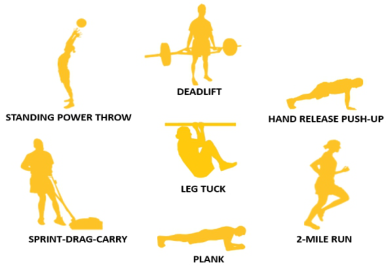
Each of the ACFT events (Figure 1) focuses on assessing specific physical fitness areas (U.S. Army, n.d.). The deadlift is performed 3 times, with the maximum weight lifted determining the event score. This event focuses on assessing lower body, grip, and core strength as well as flexibility and bal- ance. The standing power throw asks Soldiers to throw a 10-pound medicine ball backward and overhead, with the distance thrown determining the event score. This event focuses on assessing balance, coordination, flexibility, and explosive movements with the upper and lower body. The hand release push- up asks Soldiers to perform as many repetitions as possible within 2 minutes, with the number of repetitions performed determining the event score. This event focuses on assessing upper body and core strength as well as upper body endurance and flexibility. The sprint-drag-carry event asks Soldiers to perform five 50-meter shuttles with the total task time determining the event score. The 5 shuttles consist of a sprint, drag, lateral, carry, and another sprint. This event focuses on assessing high intensity muscular work as well as balance, coordination, agility, flexibility, and reaction time. The 2-mile run asks Soldiers to perform a 2-mile run as fast as they can, with the total task time determining the event score. This event focuses on assessing aero- bic endurance. The plank asks Soldiers to maintain a plank position for as long as possible, with the total task time determining the event score. This event focuses on assessing core strength, endurance, and balance. The leg- tuck (New York Army National Guard, 2021), which was replaced by the plank as the official core strength event, asks Soldiers to bring the knees up
while hanging from a bar, making sure the thighs touch the elbows. The number of completed repetitions determines the event score.
Figure 1: Illustration of the ACFT events (courtesy of U.S. Army, n.d.).
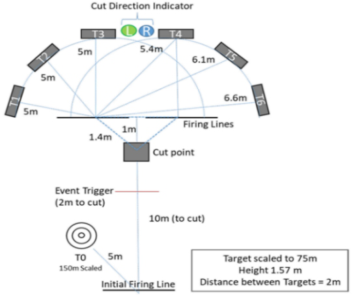
Marksmanship performance was assessed using the individual shooting scenario (ISS) task described in detail in Brown et al. (2022). Described briefly, the ISS is a two-part task consisting of static and dynamic engage- ments (layout shown in Figure 2). The task was completed in the standing, unsupported position. The static component of the ISS is self-paced and tasks the participant with prioritizing shot accuracy and precision to focus on their fundamental marksmanship ability. The dynamic component begins immedi- ately after the static component with the participant sprinting to a left/right cut point, after which they scan across timed targets and engage when ene- mies appear. The participant prioritizes both shot accuracy and speed in the dynamic component to focus on their operational marksmanship. Before the ISS task, the participant is trained and tested on recognizing the threat (i.e., enemy) or non-threat (i.e., friendly) target patterns to ensure they understand the difference. The main equipment used in the ISS task consists of a demilita- rized M4 rifle manufactured by LaserShot, Inc., an FN Expert (FN America, LLC., Columbia, SC) marksmanship training system, and a rifle-mounted IMU sensor to validate the collected FN Expert marksmanship performance data (Brown et al., 2022).
Figure 2: Diagram of the ISS task layout (courtesy of Brown et al., 2022).
The Relationship Between the Individual Events 29
The marksmanship performance measures that can be derived from the ISS task are described in detail in Brown & Mitchell (2022). Table 1 below lists the measures that had significant results in the present analysis.
Table 1. Marksmanship performance measures and descriptions.
Table available in the original PDF paper.
Measure Description Unit
Ratio of center of mass hits to misses
Lethality Measures Shot Accuracy* Distance of the shot to the target center mm Shot Group Precision (SGP)* Shot group dispersion, or cluster tightness mm Probability of hit (P(Hit)) Ratio of hits to misses Probability of lethal hit ((P(Lethal Hit)) Correct Target Engagement Decision (CTED)
Mean time elapsed between target engagements Secs
Ratio of correct enemy-friendly target engagements Mobility Measures Time Between Target Engagements (TBT)* Secs Target Acquisition Time (TAT)* Time required to move, detect, and position prior to target engagement
mm
Weapon Handling/Stability Trigger Control (TC)* Distance from the last 0.2 seconds of aiming to the final shot coordinates mm Horizontal Stability* Barrel steadiness across the x-axis prior to shot, measured by the horizontal spread (range of aiming points across x-axis) during the last 0.6 to 0.2s of aiming
mm Vertical Stability* Barrel steadiness across the y-axis prior to shot, measured by the vertical spread (range of aiming points across the y-axis) during the last 0.6 to 0.2s of aiming
*Lower scores indicate better marksmanship performance (i.e., negative correlations with ACFT scores are associated with better performance).
The test participants consisted of 155 male, active-duty Army infantry Soldiers. The group had a mean age of 23.1 (SD = 3.4) years and a mean service time of 2.8 (SD = 2.3) years. The group had a mean total ACFT Score of 513.7 (SD = 49.9), where 360–600 scores were considered passing. All participants reported passing scores in the marksmanship qualification test (mean = 36.6, SD = 5.2). The ACFT was completed as part of a large data collection event where Soldiers completed a battery of tests and was sep- arate from the marksmanship data collection event. Some of the participants (N = 29) completed the ACFT at a time when the leg tuck event was the default core strength event. The majority of the group (N = 124) completed the ACFT when the plank was the default core strength event. Both tasks are reviewed here, with only those who completed each task included in analysis for that task.
Analysis utilized Pearson’s correlations between the ACFT event scores and the ISS performance metrics. All required statistical assumptions were verified for the analyses conducted.
RESULTS
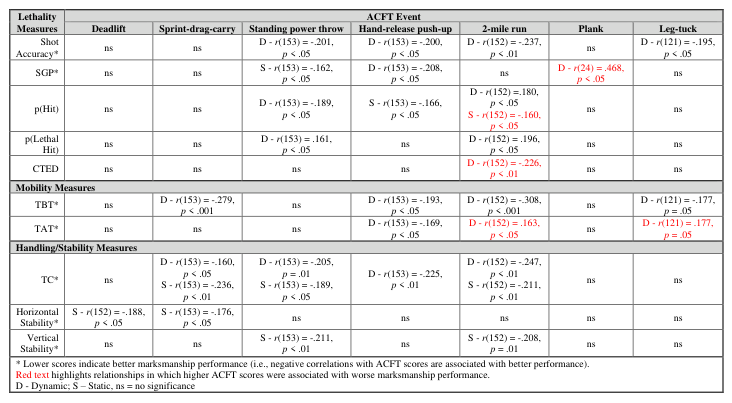
Lethality. There were significant correlations in which higher ACFT event scores were associated with better lethality measures, including standing power throw score with dynamic accuracy (r(153) = −0.201, p <0.05), static SGP (r(153) = −0.162, p <0.05), dynamic p(hit) (r(153) = −0.189, p <0.05), and dynamic p(lethal hit) (r(153) = 0.161, p <0.05). Higer scores in the hand release push-up event were correlated with bet- ter accuracy (r(153) = −0.200, p <0.05) and SGP (r(153) = −0.208, p <0.05) in the dynamic task, and with static p(hit) (r(153) = −0.166, p <0.05). The 2-mile run score was correlated with better dynamic accuracy (r(152) = −0.237, p <0.01), dynamic p(hit) (r(152) =0.180, p <0.05), and dynamic p(lethal hit) (r(152) = 0.196, p <0.05). The leg tuck score was corelated with better dynamic accuracy (r(121) = −0.195, p <0.05).
Mobility. There were also significant correlations in which higher ACFT event scores were associated with better mobility measures, including hand release push-up score with TBT (r(153) = −0.193, p <0.05) and TAT (r(153) = −0.169, p <0.05). The sprint-drag-carry score was correlated with better TBT (r(153) = −0.279, p <0.001). Higher scores in the 2-mile run event were correlated with better TBT (r(152) = −0.308, p <0.001). The leg tuck score was corelated with better TBT (r(121) = −0.177, p = 0.05).
Stability. Additional significant correlations in which higher ACFT event scores were associated with better stability measures were also found, includ- ing standing power throw score with overall TC (static (r(153) = −0.189, p <0.05); dynamic (r(153) = −0.205, p = 0.01)) and static vertical stabil- ity (r(153) = −0.211, p <0.01). The deadlift score was correlated with better static horizontal stability (r(152) = −0.188, p <0.05). The hand release push- up score was correlated with better dynamic TC (r(153) = −0.225, p <0.01). Higher scores in the sprint-drag-carry event were correlated with overall TC (static (r(153) = −0.236, p <0.01); dynamic (r(153) = −0.160, p <0.05)) and static horizontal stability (r(153) = −0.176, p <0.05). The 2-mile run score was correlated with overall TC (static (r(152) = −0.211, p <0.01); dynamic (r(152) = −0.247, p <0.01)) and static vertical stability (r(152) = −0.208, p = 0.01).
There were several significant correlations in which higher AFCT event scores indicated lower marksmanship performance. In particular, higher event scores in the 2-mile run were associated with worse static p(hit) (r(152) = −0.160, p <0.05), CTED (r(152) = −0.226, p <0.01), and TAT (r(152) = 0.163, p <0.05). Additionally, higher scores in the plank event were asso- ciated with worse dynamic SGP (r(24) = 0.468, p <0.05). Higher scores in the leg tuck event were corelated with worse TAT (r(121) = 0.177, p = 0.05).
The Relationship Between the Individual Events 31
Table 2. Summary of pearson correlation results.
DISCUSSION
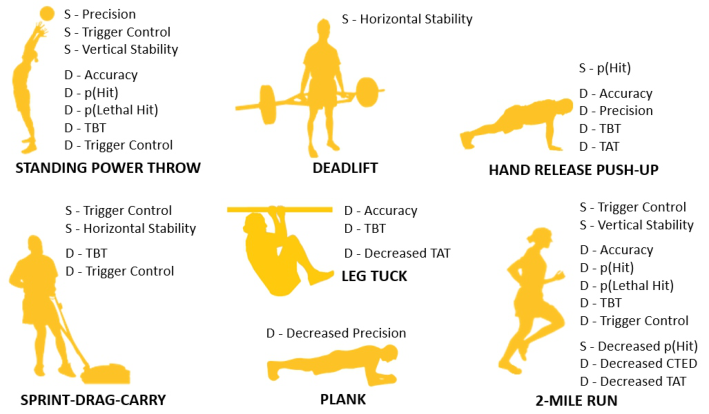
The presented findings show that higher scores in the standing power throw event were associated with better overall trigger control, over- all vertical stability, static SGP, and several dynamic measures, includ- ing accuracy, (p(hit), and p(lethal hit). These findings suggest that upper body strength and explosiveness may play a role in enhancing marksman- ship effectiveness, particularly in dynamic shooting scenarios. Similarly, higher scores in the hand-release push-up event were associated with bet- ter TBT, TAT, overall (p(hit), as well as dynamic accuracy, SGP, and TC. These relationships may indicate the importance of upper body strength and endurance in achieving effective marksmanship performance. Higher scores in the sprint-drag-carry event were associated with better over- all TC, static horizontal stability, and TBT. These findings may indicate the importance of overall physical conditioning and operational agility on marksmanship stability. Higher scores in the deadlift event were associ- ated with better horizontal stability, which may indicate the importance of lower body and grip strength on weapon handling. Figure 3 highlights what the corresponding correlated marksmanship measures were for each ACFT event.
As noted earlier, the leg tuck event was substituted by the plank as the official core strength event for the ACFT because leg tucks relied partly on upper body strength. Interestingly, the two events had different correlations with the marksmanship metrics. While higher plank scores were associated with worse dynamic SGP, higher leg tuck scores were associated with better dynamic accuracy and TBT. This suggest that upper body strength may play a more significant role in effective marksmanship than core body strength. However, further research is needed to confirm this finding since the number of participants were much larger for the analysis with the plank (N = 124) than with the leg tuck (N = 29).
Figure 3: ACFT events with the associated marksmanship measures that were signif- icantly correlated. The listed measures note improved performance, unless preceded with “decreased”. “D” notes a dynamic measure and “S” notes a static measure.
The 2-mile run event had several correlations in which higher event scores (i.e., better performance) were associated with poorer marksmanship per- formance (namely static p(hit), CTED, and TAT). This observation, along with the ones noted with the plank event (with dynamic SGP) and the leg tuck (with TAT), suggests a nuanced relationship between physical fitness and specific aspects of marksmanship proficiency. While overall physical fit- ness can be considered important for military readiness, it may not uniformly translate to improved marksmanship abilities in all contexts. One possible explanation for this discrepancy could be the trade-offs between different physical attributes required for endurance-based activities like running and those necessary for some aspects of marksmanship. Moreover, performance in the plank event, which assesses core strength, might not directly translate to marksmanship ability as the skills required for each may focus on using different sets of muscle groups.
CONCLUSION
The transition from the APFT to the ACFT highlights one of the ways in which the U.S. Army is shifting towards assessing Soldier performance in a more operationally relevant manner. Marksmanship is one of the most critical operational skills for military personnel. Although the ACFT does not assess marksmanship ability, there are several skills that may be beneficial in both situations, including hand-eye coordination, upper and lower body strength, balance, stability, agility, and endurance.
Overall, the presented results provide initial indications that ACFT per- formance can provide valuable insight on Soldiers’ readiness beyond just physical fitness. Other than some of the findings with the 2-mile run, plank,
The Relationship Between the Individual Events 33
and leg tuck events, the majority of the observed results indicate that higher ACFT scores are weakly associated with better marksmanship lethality, mobility, and stability. However, one of the known limitations of using cor- relational analyses is that correlation does not imply causation. While it may seem intuitive that higher physical fitness levels would lead to better marks- manship proficiency, there are likely other factors at play. These could include individual differences in training, experience, mindset, or even external fac- tors such as access to resources or environmental conditions. Future potential research should delve deeper into the underlying mechanisms linking phys- ical fitness to marksmanship proficiency and exploring possible mediators of the observed relationships. In addition, future analysis should include multi-variate modelling to see how these physical fitness factors in combi- nation predict marksmanship performance. Ultimately, by understanding the nuanced relationship between physical fitness and marksmanship, military leadership can better prepare their personnel for the challenges of achieving operational readiness.
REFERENCES
Brown, S. A., Christopher, J. J., Villa, J. D., Goodenough, R. R., Hancock, C. L., O’Donovan, M., & Mitchell, K. B. (2022, September). Methodology to Assess Individual Shooting Skills that is Predictive of Squad Level Performance in a Close Combat Training Engagement. In Proceedings of the Human Factors and Ergonomics Society Annual Meeting (Vol. 66, No. 1, pp. 1487–1491). Sage CA: Los Angeles, CA: SAGE Publications. Brown, S., Mitchell, K. (2022). Development of a Fundamental and Operational
Marksmanship Score based on Expert and Novice Marksmanship Data. In: Salman Nazir (eds) Training, Education, and Learning Sciences. AHFE (2022) International Conference. AHFE Open Access, vol. 59. AHFE International, USA. Christopher, J. J., Schindler, J., Villa, J., Hussey, E., Ramsay, J., & Brown, S. A.
(2019, November). Holding on Tight: Relationship Between Grip Strength and Marksmanship Stability. In Proceedings of the Human Factors and Ergonomics Society Annual Meeting (Vol. 63, No. 1, pp. 2156–2160). Sage CA: Los Angeles, CA: SAGE Publications. Evans, R. K., Scoville, C. R., Ito, M. A., & Mello, R. P. (2003). Upper body fatiguing exercise and shooting performance. Military medicine, 168(6), 451–456. Hardison, C. M., Mayberry, P. W., Krull, H., Setodji, C. M., Panis, C., Madison,
R., Simpson, M., Avriette, M., Totten, M. E., & Wong, J. (2022). Indepen- dent review of the Army Combat Fitness Test: Summary of key findings and recommendations. RAND Corporation. Ito, M. A., Sharp, M. A., Johnson, R. F., Merullo, D. J., & Mello, R. P. (2000, December). Rifle shooting accuracy during recovery from fatiguing exercise. In 22nd Army Science Conference. Muirhead, H., Orr, R., Schram, B., Kornhauser, C., Holmes, R., & Dawes,
J. J. (2019). The relationship between fitness and marksmanship in Police Officers. Safety, 5(3), 54. New York Army National Guard. (2021, December 2). ACFT - LEG TUCK. Retrieved January 12, 2024 from https://www.youtube.com/watch?v=QjKfNRG9VKc.
Orr, R., Pope, R., Stierli, M., & Hinton, B. (2017). Grip strength and its relationship to police recruit task performance and injury risk: A retrospective cohort study. International journal of environmental research and public health, 14(8), 941. U. S. Army. (n.d.). Army Combat Fitness Test. Retrieved January 12, 2024, from
https://www.army.mil/acft/. U. S. Army Public Affairs. (2022, March 23). Army implements ACFT based on scores, RAND study, Soldier feedback. U. S. Retrieved January 12, 2024, from https://www.usar.army.mil/News/News-Display/Article/2975522/army-imp lements-acft-based-on-scores-rand-study-soldier-feedback/. Villa, J. D., Peioneti, L. Brown, A. T., Christopher, J. J., DeSimone, L., O’Donovan,
M., Hancock, L., Elmore, W., Elkin-Frankston, S., Bode, V. G., & Mitchell, K. B. (2023). The relationship between the U. S. Army’s new combat fitness test and a simulated marksmanship performance task. In 6th International Congress on Soldiers’ Physical Performance (ICSPP) Program Book (pp. 109–110).
LISTED IN THE AHFE DIGITAL BOOKSTORE CATALOGUE
Explore the complete digital volume
Human Factors and Simulation
Read this individual research paper free through the original publisher, or explore the full digital proceedings book.
ISBN 978-1-964867-15-1
Explore this ISBN in the AHFE Bookstore ↗Listed in the July 2026 bookstore catalogue; search by ISBN to confirm current availability · Digital book purchase optional