Sumona Sen, Patrick Poetters (2024). Implementation Concept for Optimization Methods in Human-Robot Collaboration by using Full-Scope Simulation. In: Human Factors and Simulation. AHFE Open Access, vol. 139, pp. 1–7. https://doi.org/10.54941/ahfe1005018
Human-robot collaboration (HRC) is an emerging field that is revolutionizing efficiency and performance in production environments. A central point here is the integration of proven methods of process and quality management, which create the basis for optimized collaboration between humans and robots.In order to fully exploit the potential of this collaboration, established methods such as lean management, Six Sigma and PDCA cycle are being closely examined for their applicability in the context of HRC. These methods have already proven themselves in traditional production environments and could now form the basis for effective human-robot interaction.A fundamental aspect for the successful implementation of these methods is the creation of a realistic test environment. The full-scope simulator plays a crucial role here, as it provides an authentic environment for the research and development of human-robot collaboration. Numerous research projects have already benefited from the use of this simulator and have been able to gain new insights for HRC. A particular focus is on the development of a specific use case based on existing HRC systems in industry. This use case serves as a starting point for the further development and improvement of the interaction between humans and robots using process and quality management methods. The implementation and analysis of various methods in the context of this use case aims to increase performance and efficiency in production and assembly environments. A key objective here is to minimize production downtime and increase overall productivity at the same time.After thorough testing, the paper presents a comprehensive overview of the methods identified as particularly useful for improving the effectiveness of human-robot collaboration. This research contributes significantly to structuring the possibilities of HRC in production and assembly environments and provides a detailed list of methods specifically aimed at optimizing processes in these areas.The integration of process and quality management methods into HRC offers numerous advantages. For example, lean management enables the reduction of waste and efficiency production, while Six Sigma aims to minimize errors and improve process quality. The PDCA cycle supports continuous improvement. By specifically applying and adapting these methods to HRC, a more harmonious and effective collaboration between humans and robots can be achieved.The further exploration and integration of process and quality management methods into HRC not only promises increased productivity and efficiency, but also helps to improve the safety, reliability and quality of human-robot collaboration. The development and refinement of these methods in the context of HRC is therefore becoming an increasingly important facet of the modern production landscape.
In the ever-evolving landscape of Human-Robot Collaboration (HRC), improving efficiency and optimizing work processes are crucial. This need arises from the increasing integration of robotic systems alongside human workers, where the smooth interaction between these entities is important for achieving optimal outcomes (Gualtieri et al., 2021). As industries adapt to this transformative era, marked by the coexistence of human cognitive capac- ities and robotic precision, applying optimization methodologies becomes significant for navigating the complexities of HRC (Mueller et al., 2023).
The aim is to understand how Lean Management principles, Toyota Pro- duction System methodologies, and various optimization techniques can be applied in this unique setting. By examining these approaches within the spe- cialized context of Full-Scope Simulators, including PDCA, Kanban, Poka Yoke, and 5S, our research contributes practical insights to the discourse on HRC optimization.
By detailing a practical use case and analyzing the outcomes, this research seeks to show the potential of optimization methods as valuable tools for refining and changing task allocations and processes within HRC
environments. As industries strive to enhance productivity while ensuring the safety of human workers, this study aims to be a guiding resource in navigating the transformative landscape of HRC.
HRC IN THE INDUSTRY The evolution of Human-Robot Collaboration (HRC) in industrial settings reflects a paradigm shift in manufacturing processes. Initially, industrial robots were standalone entities, operating in segregated spaces, and devoid of direct interaction with human counterparts (Mueller et al., 2023). Over time, the recognition of the inherent strengths of both human and robotic capabilities led to the emergence of collaborative scenarios, where humans and robots share a workspace and collaborate on tasks. This shift has been spurred by advancements in robotic technologies, enabling safer and more adaptive interactions between humans and robots (Peifer et al., 2020).
The significance of HRC lies in its potential to amplify productivity and flexibility within manufacturing environments. However, the integration of humans and robots in shared workspaces introduces complexities that neces- sitate a differentiated understanding. Challenges arise from ensuring the safety of human workers, optimizing task allocation, and planning seam- less collaboration between humans and robots. Consequently, there is a need for research directed towards refining these collaborative processes and enhancing overall efficiency (Wang et al., 2020).
This research imperative is underscored by the conviction that success- ful HRC implementation can yield substantial gains in process optimization, minimizing production downtime, reducing errors, and enhancing overall productivity. Consequently, this study deals with the implementation of optimization methods in HRC scenarios.
OPTIMIZATION METHODS Aligned with the evolution of Human-Robot Collaboration (HRC) in indus- trial settings, this study’s theoretical framework extends to the principles of optimization methodologies. The incorporation of these methodologies into HRC environments aims to address inherent challenges in collaborative workspaces and maximize operational efficiency.
Lean Management and the Toyota Production System (TPS) form the basis for operational excellence in manufacturing. Lean Management empha- sizes waste elimination, efficient resource use, and continuous improve- ment (Bertagnolli, 2020). TPS, originating from the automotive industry, refines these principles, emphasizing the elimination of inefficiencies through standardized processes and continuous flow production (Liker, 2020).
Beyond these frameworks, various optimization methodologies, Finclud- ing PDCA, Kanban, Poka Yoke, and 5S, offer targeted approaches to process improvement. (Hofmann, 2020).
The relevance of these methodologies within HRC stems from their capac- ity to streamline collaborative processes. Possible errors could be reduced and the overall productivity increased.
Implementation Concept for Optimization Methods in Human-Robot Collaboration 3
METHODOLOGY
In order to investigate whether optimization methods of process management can be applied in the field of HRC, a pre-test is designed. In this first test, a scenario is to be set up that is very closely based on typical industrial work- places with collaborative robots. The scope of the pre-test should be kept small, so only the Kanban and 5S methods are used.
Moreover, the complete implementation of the Kanban optimization method was not feasible due to the requirement for the robot to receive a signal to continue working. Implementing such a signal system proved to be overly complex. The “Wizard of Oz” method facilitated the examination of Kanban’s potential impact on collaboration without the need for the intricate signal system, offering valuable insights despite the limitations in the pre-test environment.
The “Wizard of Oz” method is an experimental approach used in Human- Robot Collaboration (HRC) to simulate human-like behavior in robots, even when the robot’s technological capabilities are limited. In application, a research scenario is created where a human-robot interaction process is simulated. While the actual robot may have limited capabilities, a human “wizard” takes control of the robot, guiding its actions to maintain the illusion of autonomous robotics (Riek, 2012).
In the context of the current research on testing optimization methods in Human-Robot Collaboration in the Full-Scope Simulator, the “Wizard of Oz” method could be used to simulate different optimization scenarios. The human “wizard” could make real-time decisions and control and simulate the robot’s actions to assess the impact of various optimization methods on the collaboration process on the side of the robot.
This method has proven supportive for experiments, allowing researchers to test and evaluate different scenarios without relying on fully automated robots. This is particularly useful when considering technological constraints or uncertainties in the application of optimization methods. By employ- ing the “Wizard of Oz” method, realistic interactions between humans and robots can be simulated, enabling an assessment of the feasibility of various optimization approaches.
USE CASE The study involves an examination of applicable optimization methods for Human-Robot Collaboration (HRC) within a Full-Scope Simulator. A specific use case serves as the platform for investigation, assessing the fea- sibility and effectiveness of optimization methodologies tailored to HRC applications.
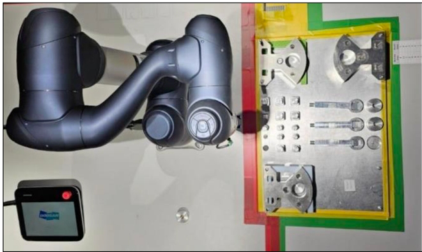
The Full-Scope Simulator comprises a standard assembly scenario fea- turing a collaborative application. Depicted in Figure 1 is an image of the experimental area, where various workpieces are positioned within the yellow-marked region. The adaptability of workpiece positions allows for flexible adjustments and the addition or removal of workpieces. As a col- laborative robot, the Doosan M0609 is used. The robot’s movement is programmable, defining a specific assembly point (Point D).
4 Sen and Pötters
The experimental setup involves the selection of workpieces for the trial and their strategic placement within the designated yellow-marked area. Sub- sequently, two scenarios are conceived: Case A, representing the application without optimization methods, and Case B, integrating specified optimiza- tion methodologies. A comparative analysis between these scenarios aims to discern the impact of optimization methods on collaborative processes within the Full-Scope Simulator. This first Pre-Test should validate the the- oretical ideas to implement process optimization methods in HRC, using a real-world scenario and probands.
Figure 1: Experimental setup.
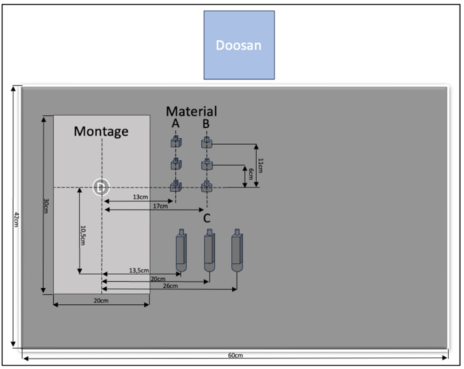
Two procedures were developed for the pre-test and compared with each other. As the illustration 2 shows, workpieces A, B and C are positioned at fixed locations. The Doosan picks up the pieces of pieces of material and transports them to assembly point D (circular indentation on the left in the illustration). The task of the employee is to refill the empty positions with workpieces.
Figure 2: Schematic illustration Case A.
Implementation Concept for Optimization Methods in Human-Robot Collaboration 5
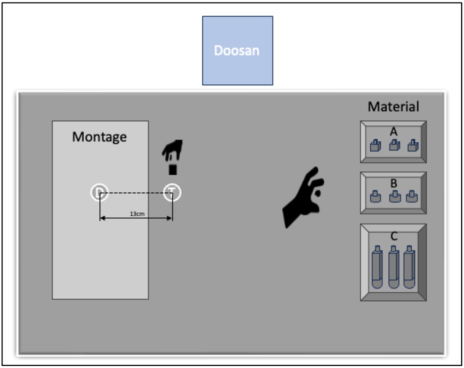
In Case B, the workpieces are sorted into boxes. According to the “Wizard of Oz” method, a second human takes part by reacting to the signal of the worker and filling up the boxes with new material. The worker removes the workpieces and positions them at a point T, from which the Doosan removes the workpiece and transports it to the assembly point D assembly point. Figure 3 schematically illustrates the test setup for Case B. The task of the employee is to fill the boxes with workpieces and to place the workpieces A, B and C at position T.
Figure 3: Schematic illustration Case B.
These changes in Case B result in the use of two optimization methods mentioned above. For the pre-test, only the time factor is considered and compared in order to obtain initial results. In subsequent studies, further aspects can be included. The Kanban and 5 S methods are used to improve the workflow in Case B.
RESULTS
These are the results of the time measurement of both cases. Each work- piece has three parts in the material compartment. Table 1 shows the time measurement without implementing optimizing methods.
Table 1. Time measurement Case A.
Table available in the original PDF paper.
Parts Workpiece A Workpiece B Workpiece C 6 1 32,7 sec 34,1 sec 35,9 sec 102,7 sec 2 31,7 sec 33,1 sec 34,3 sec 99,1 sec 3 33,7 sec 35,3 sec 38,2 sec 107,2 sec
In Table 2 the results of the measurement of Case B is visualized. Here both optimizing methods where used to improve the process.
6 Sen and Pötters
Table 2. Time measurement Case B.
Table available in the original PDF paper.
Parts Workpiece A Workpiece B Workpiece C 6 1 24,3 sec 25,4 sec 26,1 sec 75,8 sec 2 23,4 sec 25,3 sec 24,8 sec 73,5 sec 3 25,9 sec 24,8 sec 27,2 sec 74,9 sec
Kanban: Kanban is used to support the efficient control of the material flow. In Case B of the use case, Kanban is realized through the sorted stor- age of workpieces in boxes and supply of the workpieces into the crates by simulating a reaction and robot movement by the “Wizard of Oz” method. If there is only one workpiece left in a crate, e.g. crate A, a signal will be sent to fill this crate in order to ensure a continuous and efficient material flow. By limiting the number of workpieces in a box, clarity is also maintained, which is another principle of Kanban.
5S: Elements of the 5S are applied in the use case. By sorting the work- pieces, the work area is organized and the space is used more efficiently. In Case A, the workpieces are distributed on the work surface. In Case B, the workpieces are sorted into sorted boxes. The work steps of the employee are standardized. Shifting the assembly process from the employee to the robot, the safety of the process can also be increased. The proportion of human labor work in the assembly process is reduced, which means that human errors, e.g. due to fatigue, for example, can be reduced.
Nevertheless, the data set is too small for a statistical evaluation but the results show that the delta between both cases is around 30%.
CONCLUSION
The assessment reveals the practical applicability of optimization methods derived from process management in the context of human-robot collabora- tion. The outcomes of this pre-test provide insights for further research. By using Full-Scope Simulation, it’s easy to design different kind of processes and testing various optimization methods. A subsequent experiment could extend the investigation by quantifying process accuracy, achieved through system- atic recording and analysis of data related to error rates from both the robot and human participants. This method represents an additional approach to optimization, with the potential to enhance the efficiency of human-robot collaboration not only as an overarching process but also within specific sub-processes.
The initial findings underscore the adaptability of optimization method- ologies in refining collaborative processes. Expanding upon this exploration to incorporate quantitative metrics, such as process accuracy and error rates, would provide a more nuanced understanding of the impact of optimization strategies in human-robot collaboration.
Implementation Concept for Optimization Methods in Human-Robot Collaboration 7
REFERENCES
Bertagnolli, F. (2020). Lean management. Wiesbaden: Springer. Gualtieri L, Rauch E, Vidoni R (2021) Methodology for the definition of the optimal assembly cycle and calculation of the optimized assembly cycle time in human- robot collaborative assembly. Int J Adv Manuf. Technol. 113(7):2369–2384. Hofmann, M. (2020). Methoden der Prozessoptimierung. In: Prozessoptimierung als
ganzheitlicher Ansatz. Springer Gabler, Wiesbaden. Liker, J. (2020). The Toyota Way. McGraw Hill; 2. Edition. Müller R, Franke J, Henrich D, Kuhlenkötter B, Raatz A, Verl A (2023) Handbuch Mensch-Roboter Kollaboration, 2., aktualisierte Auflage, Hanser Verlag. Peifer, Y., Weber, MA., Jeske, T., Stowasser, S. (2020). Human-Robot-Collaboration
in the Context of Productivity Development and the Challenges of Its Implemen- tation: A Case Study. In: Nunes, I. (eds) Advances in Human Factors and Systems Interaction. AHFE 2020. Advances in Intelligent Systems and Computing, vol 1207. Springer, Cham. Riek, L. D. (2012) Wizard of Oz studies in HRI: A systematic review and new reporting guidelines. J. Hum.-Robot Interact. Wang, L., Liu, S., Liu, H., Wang, X.V.(2020). Overview of Human-Robot Collabora-
tion in Manufacturing. In: Wang, L., Majstorovic, V., Mourtzis, D., Carpanzano, E., Moroni, G., Galantucci, L. (eds) Proceedings of 5th International Conference on the Industry 4.0 Model for Advanced Manufacturing.
LISTED IN THE AHFE DIGITAL BOOKSTORE CATALOGUE
Explore the complete digital volume
Human Factors and Simulation
Read this individual research paper free through the original publisher, or explore the full digital proceedings book.
ISBN 978-1-964867-15-1
Explore this ISBN in the AHFE Bookstore ↗Listed in the July 2026 bookstore catalogue; search by ISBN to confirm current availability · Digital book purchase optional