Sandi Baressi Šegota, Darko Etinger, Nikola Tankovic, Romeo Šajina, Vedran Mrzljak, Ivan Lorencin (2026). Influence of operator physical characteristics on compliance with collaborative robot. In: Intelligent Human Systems Integration (IHSI 2026): Disruptive and Innovative Technologies. AHFE Open Access, vol. 200, pp. 589–597. https://doi.org/10.54941/ahfe1007117
This work investigates the influence of human physical characteristics on behavioural compliance during human–robot collaborative tasks. Using data derived from a collaborative robot experiment published in Behaviour-Based Biometrics for Continuous User Authentication to Industrial Collaborative Robots, participant attributes such as height, gender, and handedness were analyzed against the frequency of non-compliance events. The analysis combined statistical correlation metrics with machine learning-based feature importance estimators to provide both linear and nonlinear perspectives. Pearson, Spearman, and Kendall correlations were computed to quantify monotonic relationships, while model-driven approaches including Random Forest, Gradient Boosting, XGBoost, Mutual Information, and SHAP were used to capture higher-order dependencies. The results show that height exhibits the strongest nonlinear influence on operator compliance, indicating that anthropometric factors substantially affect user behaviour and task adherence. In contrast, gender and handedness were found to contribute moderately, primarily through secondary interaction effects. These findings emphasize the need to account for physical characteristics when designing adaptive and personalized control interfaces for collaborative robots.
The amount of industrial robotic manipulators present in manufacturing environments continues to grow, with an increasing number of robots being deployed for cooperative and shared tasks alongside human operators. Unlike traditional industrial automation, collaborative robots (cobots) are designed to operate in close proximity to humans, often sharing workspaces and dynamically responding to human actions. This paradigm introduces a new set of challenges related to human behavioural variability, physical ergonomics, and compliance with task instructions. Compliance in human– robot collaboration refers to the degree to which an operator follows the prescribed sequence of movements and safety constraints during the interaction (Bassi et al., 2025). Deviations from compliant behaviour—termed non-compliance—can occur due to physical limitations, misunderstanding Received November 13, 2025; Revised November 28, 2025; Accepted December 13, 2025; Available online February 1, 2026
of instructions, or intentional disregard of safety boundaries (Glawe et al., 2025). Understanding the factors that lead to non-compliance is critical for improving the design of control interfaces, safety mechanisms, and adaptive assistance systems. Previous studies have primarily focused on optimizing control strategies or monitoring the robot’s own dynamics (Bibbo et al., 2025; Figliolini et al., 2025; Ruan et al., 2025). In contrast, this work focuses on the human side of the collaboration, investigating whether intrinsic participant characteristics influence behavioural compliance. The data analyzed in this study originate from the publicly available dataset introduced in Behaviour-Based Biometrics for Continuous User Authentication to Industrial Collaborative Robots. In that dataset, human operators executed standardized manipulation tasks under supervised conditions, with the system logging binary indicators of compliance and collision events.
The main objective of this study is to quantify the influence of three human- related attributes—Height, Gender, and Handedness—on the frequency of non-compliance events. Two complementary approaches were employed. The first utilizes correlation coefficients to assess linear and monotonic dependencies, while the second applies machine learning regression models to capture nonlinear interactions and feature importance. By comparing these two methodological perspectives, this work aims to establish whether physical characteristics significantly affect operator compliance and to identify which of these characteristics are most influential.
The remainder of this paper is structured as follows. Section II describes the methodology, including the preprocessing, correlation, and model-based analysis procedures. Section III presents and discusses the obtained results. Section IV provides concluding remarks and outlines potential directions for future research
METHODOLOGY
The methodology employed in this work was designed to quantitatively assess the relationship between human-related variables and non-compliance during collaborative robot operation. The procedure was divided into three stages. In the first stage, the dataset was aggregated and pre-processed to ensure consistency of input features. In the second stage, correlation-based methods were applied to identify the presence of linear and monotonic relationships. In the third stage, machine learning regression models were trained and their internal importance measures were analyzed to determine the influence of each independent variable on the target variable. The results of these two complementary approaches were compared to obtain a comprehensive view of the relationships present in the data.
Data Description The data used in this study originates from the publicly available dataset presented in the work Behaviour-Based Biometrics for Continuous User Authentication to Industrial Collaborative Robots (Almohamade et al.,
Influence of Operator Physical Characteristics on Compliance 591 2020). The original dataset was obtained from a set of experiments performed on a collaborative robot under supervised human operation. During the experiments, multiple users interacted with the robot in predefined sequences. Several variables were recorded by the robot’s control unit, including positional data, tool forces, and binary indicators of behavioural states. The variable of interest was extravted from the logs isCompliance, which marks whether the human operator followed the prescribed procedure during the cooperative task. The value of isCompliance was assigned as TRUE when the operator acted according to the expected behaviour, and FALSE otherwise. For each participant, the total number of non-compliant events was computed and added to a summary file containing participant information such as height, gender, and handedness. The resulting dataset therefore contains four relevant attributes for this analysis: Height ( 1 x ), Genderenc ( 2 x ), Handednessenc ( 3 x ), and the target variable NonCompliance (y).
Data Preprocessing Prior to the analysis, a series of preprocessing steps were applied to ensure consistency and numerical stability of the dataset. Each participant record contained both numerical and categorical attributes, including the variables Height, Gender, and Handedness. The categorical variables were encoded numerically to allow for direct quantitative processing, resulting in the new attributes Genderenc and Handednessenc. The encoding procedure assigned integer values to each unique category, with the mapping stored for reproducibility. Missing or incomplete records were removed from the dataset to prevent bias in the feature importance estimation. After filtering, the dataset was reindexed to maintain a continuous range of identifiers corresponding to the experimental subjects. All numerical features were subsequently standardized according to the z-score normalization, defined as (Fei et al., 2021):
, x
− = ′ (1)
x x µ σ x
where x µ and x σ represent the mean and standard deviation of the original variable x. This step was necessary to ensure that features measured in different units were brought to a comparable scale, allowing their relative importances to be directly compared across the applied models. The resulting dataset consisted of three independent variables: Height ( 1 x ), Genderenc ( 2 x ), and Handednessenc ( 3 x ), along with the target variable NonCompliance (y). Each sample therefore represented an individual user, characterized by anthropometric and categorical attributes, as well as the number of non- compliance events observed during robot operation.
Correlation-Based Analysis To evaluate the degree of association between each independent variable ix and the target variable y, three correlation coefficients were employed: the Pearson, Spearman, and Kendall coefficients. The Pearson correlation
coefficient quantifies the linear relationship between two continuous variables and is given by (Shaqiri et al., 2023):
n ( ) = ( ) 1
(2)
− − =
x x y y r
i i i xy n n
2 2
x x y y
. ( ) ( ) = =
1 1
i i i i
Equation available in the original PDF paper.
While Pearson correlation captures only linear dependencies, the Spearman coefficient is based on ranked values and measures monotonic relationships between the variables (Shaqiri et al., 2023):
n
2
d i i xy
− ∑ (3)
n n ρ = = −
1 2 6 1 , 1
( ) where id denotes the difference between the ranks of ix and iy . The Kendall coefficient, on the other hand, evaluates the degree of concordance between pairs of observations and is defined as (Shaqiri et al., 2023):
n n (4) c d xy −
n n τ − =
( )
, 1 1 2
where c n and d n represent the number of concordant and discordant pairs respectively. These three measures provide complementary information, with Pearson correlation emphasizing proportional relationships, and Spearman and Kendall focusing on ordinal and monotonic dependencies.
Machine Learning-Based Analysis The models included Random Forest Regressor, Gradient Boosting Regressor, XGBoost Regressor, and Linear Regression. Additionally, model- agnostic methods such as Mutual Information and SHAP (SHapley Additive exPlanations) were employed to provide nonlinear and interaction-aware importance estimates (Baressi Šegota, Anelić, Štifanić, Štifanić, et al., 2024).
The Mutual Information (MI) between an input feature x and the target variable y quantifies the reduction in uncertainty about y when x is known and is computed as (Takefuji, 2025a):
, ; , ,
p x y I X Y p x y log p x p y ∈ ∈ x Xy Y
( ) ( ) ( ) ( ) ( )
[Equation or mathematical symbol available in the original paper PDF][Equation or mathematical symbol available in the original paper PDF] = [Equation or mathematical symbol available in the original paper PDF][Equation or mathematical symbol available in the original paper PDF][Equation or mathematical symbol available in the original paper PDF][Equation or mathematical symbol available in the original paper PDF][Equation or mathematical symbol available in the original paper PDF][Equation or mathematical symbol available in the original paper PDF] ∑∑ (5) where ( ) , p x y is the joint probability distribution and ( ) p x and ( ) p y are the marginal distributions. Higher MI values indicate stronger dependencies. For tree-based models such as Random Forests and Gradient Boosting, the importance of a feature is derived from the average reduction in node
Influence of Operator Physical Characteristics on Compliance 593 impurity, which for the Mean Squared Error (MSE) criterion can be expressed as (Takefuji, 2025a):
T
1 MSE MSE ,
j
( )
( ) parent children 1
Equation reproduced from the original PDF.
( )
where T is the number of trees and ( ) t j S f denotes the set of nodes where feature jf was used for splitting.
For the linear regression model, the feature importance is proportional to the absolute value of the standardized regression coefficients (Takefuji, 2025b): ( ) . j j I f β = (7)
Finally, the SHAP framework was used to decompose the model prediction into additive feature contributions. For a given instance i, the SHAP value jφ of feature j is defined as (Takefuji, 2025a):
Equations and mathematical formulas are available in the original paper PDF.
f x f x F φ ∪ ∪ ⊆
{ } { } ( ) ( ) ! 1 ! , ! j S S S j S j S F j { } where F represents the full feature set and ( ) S S f x is the model prediction using only the subset of features S. The absolute mean of the SHAP values across all observations was used as the feature importance score. The final feature importance table was obtained by normalizing all metrics within each method and aggregating them into two separate groups: correlation- based and machine learning-based. This separation allows direct comparison between purely statistical dependencies and those captured by nonlinear predictive models.
The decision to separate the correlation-based and machine learning- based analyses was motivated by the fundamentally different nature of the information these methods capture. Correlation coefficients describe direct statistical relationships between the observed variables, limited to linear or monotonic dependencies. These methods are interpretable and provide an initial estimate of proportionality between the input features and the output variable. However, they are unable to account for nonlinear effects, multivariate dependencies, or interaction terms that frequently appear in behavioural and human–robot interaction data. Machine learning regressors, in contrast, are capable of modeling nonlinear mappings and feature interactions. By combining model-derived measures such as impurity reduction and coefficient magnitudes with model-agnostic techniques such as SHAP and Mutual Information, a more comprehensive understanding of variable influence is achieved. This dual approach allows one to distinguish between apparent statistical associations and effective predictive contributions (Baressi Šegota, Anelić, Štifanić, Štifanić, et al., 2024). The correlation-based results therefore serve as an initial validation of the expected trends, while the machine learning-based importances provide an extended view that includes latent nonlinear effects. The separation of the two analytical domains was
performed intentionally to maintain interpretability while also capturing the complex structure of dependencies present in the recorded human–robot behavioural data (Baressi Šegota, Anelić, Štifanić, & Car, 2024).
RESULTS AND DISCUSSION
This section presents the outcomes of both the correlation-based and machine learning-based feature importance analyses. The objective was to determine which participant attributes most strongly influence the number of non- compliance events recorded during human–robot collaboration. The analyses are presented sequentially to illustrate the consistency and divergence between simple statistical associations and model-derived variable importances.
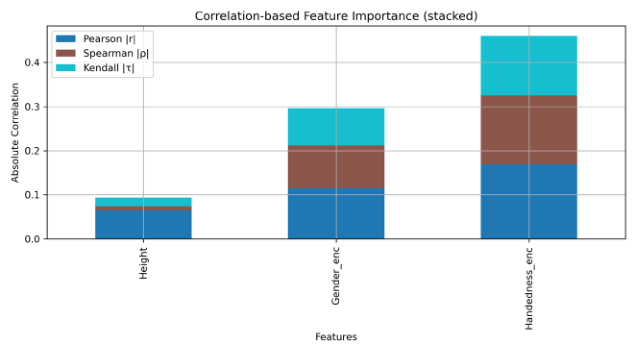
Correlation-Based Results The correlation coefficients calculated using the Pearson, Spearman, and Kendall methods are summarized in Table 1, while the aggregated results are graphically represented in Figure 1. The table and corresponding plot indicate that both Genderenc and Handednessenc exhibit higher absolute correlations with the target variable than Height. Specifically, the highest absolute correlations were observed for the Handednessenc feature across all three correlation measures, suggesting a moderate monotonic dependency between handedness and non- compliance behaviour. Height, on the other hand, shows a much weaker relationship, remaining near the noise threshold in all correlation metrics.
Table 1: Correlation-based feature importance for the selected features. Note – the subscript enc indicates a feature that was numerically encoded.
Figure 1: Correlation-based feature importance for Height, Genderenc, and Handednessenc.
Influence of Operator Physical Characteristics on Compliance 595 The overall pattern indicates that categorical characteristics such as gender and handedness exhibit stronger associations with non-compliant behaviour than continuous anthropometric measures. However, the absolute magnitudes of correlation remain relatively low, implying that linear and monotonic relationships alone may not fully explain the observed variability in non-compliance.
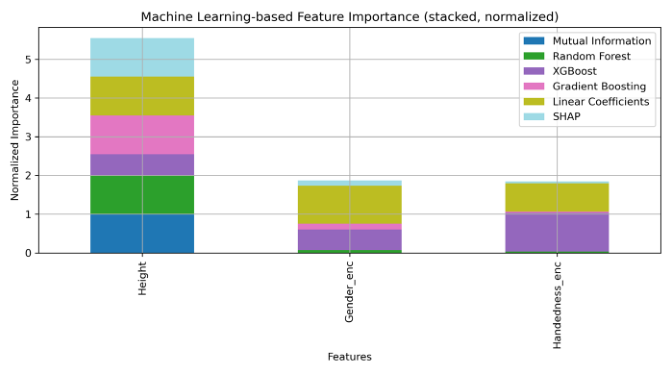
Machine Learning-Based Results The machine learning regression models provide a complementary view of feature relevance by considering nonlinear dependencies and feature interactions. The normalized feature importances computed using six independent approaches—Mutual Information, Random Forest, XGBoost, Gradient Boosting, Linear Regression Coefficients, and SHAP—are reported in Table 2 and illustrated in Figure 2.
Table 2: Machine learning-based feature importance for the selected features (normalized).
Figure 2: Machine learning-based feature importance for Height, Genderenc , and Handednessenc using nonlinear and model-agnostic methods.
In contrast to the correlation-based findings, all machine learning models consistently assigned the highest relative importance to the Height variable. This result suggests that nonlinear dependencies or threshold-like effects related to anthropometric dimensions significantly affect user performance and compliance during collaborative robot operation. The categorical variables Genderenc and Handednessenc retained moderate importance, yet their relative influence was notably smaller across all models. The SHAP values and Mutual Information, which are capable of capturing nonlinear feature–target dependencies, reinforce the conclusion that Height plays
a primary role when the system’s behavioural dynamics are considered holistically.
The combined results demonstrate that physical and anthropometric characteristics play a non-negligible role in determining human compliance during robot interaction tasks. While the correlation-based methods revealed only weak monotonic relationships, the machine learning-based analysis uncovered stronger nonlinear dependencies, suggesting that small variations in physical parameters can lead to disproportionate effects on user performance. This aligns with the intuitive understanding that ergonomic factors and operator stature influence control precision and comfort when performing constrained movements with collaborative robots. The divergence between the two analytical approaches can be attributed to their methodological scope. Correlation analysis quantifies direct pairwise dependencies, thus overlooking higher-order interactions and nonlinear effects. Machine learning models, on the other hand, approximate the joint input–output function, allowing them to reveal latent dependencies not observable through linear methods. Consequently, while correlation coefficients provide an interpretable first-order approximation, the model-based results reflect more complex relationships driven by the underlying kinematic, cognitive, and ergonomic mechanisms influencing operator compliance. Taken together, the results indicate that physical characteristics—particularly height—are influential determinants of compliant behaviour in collaborative robot operation. The findings highlight the necessity of including anthropometric information when modelling human–robot interactions, as such features can significantly impact both the predictability and safety of collaborative tasks.
CONCLUSION
The analysis presented in this work demonstrates that physical and anthropometric characteristics have a measurable effect on operator compliance during human–robot collaborative tasks. Although correlation- based metrics revealed only weak linear dependencies, the machine learning models identified strong nonlinear relationships, particularly between height and the frequency of non-compliance events. This finding indicates that the physical stature of an operator can influence comfort, reachability, and control precision when interacting with a collaborative robot. The categorical factors of gender and handedness exhibited moderate influence, suggesting that biomechanical and ergonomic asymmetries contribute to variations in compliant behaviour. The observed differences between correlation and model-based results underscore the importance of employing nonlinear and interaction-aware methods when analysing behavioural data, as linear statistics alone are insufficient to capture the complexity of human–robot dynamics. These results highlight the necessity of integrating anthropometric and behavioural features into adaptive control frameworks and ergonomic design strategies for collaborative robots. By accounting for human variability at the physical and cognitive levels, future systems can achieve higher levels of safety, intuitiveness, and task efficiency. Further research should extend this analysis by including physiological and cognitive parameters to provide a more holistic understanding of human compliance in collaborative robotics.
ACKNOWLEDGMENT
The authors would like to acknowledge the usage of AI/LLM tools such as ChatGPT and Grammarly for help in text generation and correction.
This research was funded in part by the following projects: SPIN projects IP.1.1.03.0120, IP.1.1.03.0028 and IP.1.1.03.0039; UNIRI projects UNIRI-IZ-25-220 and UNIRI-IZ-25-6; the EU NextGeneration under the Juraj Dobrila University of Pula institutional research project number IIP_010144 and IIP_010136; and EC Digital Europe Programme EDIH Adria 101083838.
REFERENCES
Almohamade, S. S., Clark, J. A., & Law, J. (2020). Behaviour-based biometrics for continuous user authentication to industrial collaborative robots. International Conference on Information Technology and Communications Security, 185–197. Baressi Šegota, S., Anelić, N., Štifanić, J., Štifanić, D., & Car, Z. (2024). Influence of
dimensionality reduction approaches on various machine learning models for a biomedical high-dimension dataset. Serbian International Conference on Applied Artificial Intelligence, 279–288. Baressi Šegota, S., Anelić, N., Štifanić, J., & Car, Z. (2024). Regression model for the prediction of total motor power used by an industrial robot manipulator during operation. Machines, 12(4), 225. Bassi, G., Orso, V., Salcuni, S., & Gamberini, L. (2025). Understanding workers’
well-being and cognitive load in human-cobot collaboration: Systematic review. Journal of Medical Internet Research, 27, e75658. Bibbo, D., Corvini, G., Schmid, M., Ranaldi, S., & Conforto, S. (2025). The impact of human-robot collaboration levels on postural stability during working tasks performed while standing: Experimental study. JMIR Human Factors, 12(1), e64892. Fei, N., Gao, Y., Lu, Z., & Xiang, T. (2021). Z-score normalization, hubness, and
few-shot learning. Proceedings of the IEEE/CVF International Conference on Computer Vision, 142–151. Figliolini, G., Lanni, C., & Tomassi, L. (2025). Cobot kinematic model for industrial applications. Inventions, 10(3), 37. Glawe, F., Kremer, L., Vervier, L., Brauner, P., & Ziefle, M. (2025). Trust and human
autonomy after cobot failures: Communication is key for industry 5.0. arXiv Preprint arXiv:2509.22298. Ruan, H., Yao, B., & Xu, W. (2025). Improved dynamic model identification of cobots based on a nonlinear friction model. 2025 IEEE International Conference on Industrial Technology (ICIT), 1–6. Shaqiri, M., Iljazi, T., Kamberi, L., & Ramani-Halili, R. (2023). Differences between
the correlation coefficients pearson, kendall and spearman. Journal of Natural Sciences and Mathematics of UT, 8(15–16), 392–397. Takefuji, Y. (2025a). Beyond XGBoost and SHAP: Unveiling true feature importance.
Journal of Hazardous Materials, 488, 137382. Takefuji, Y. (2025b). Unveiling feature importance biases in linear regression: Implications for protein-centric cardiovascular research. Atherosclerosis, 401.
LISTED IN THE AHFE DIGITAL BOOKSTORE CATALOGUE
Explore the complete digital volume
Intelligent Human Systems Integration (IHSI 2026): Disruptive and Innovative Technologies
Read this individual research paper free through the original publisher, or explore the full digital proceedings book.
ISBN 978-1-964867-76-2
Explore this ISBN in the AHFE Bookstore ↗Listed in the July 2026 bookstore catalogue; search by ISBN to confirm current availability · Digital book purchase optional