Kevin Owens, Lisa Townsend, Benjamin Goldberg (2024). Integrating Experiential Simulation into Classroom Instruction with Synthetic Experience Events. In: Human Factors and Simulation. AHFE Open Access, vol. 139, pp. 96–105. https://doi.org/10.54941/ahfe1005028
The US Military still uses a traditional instructional model that typically employs didactic methods, limited periods of active practical application, and the study of two-dimensional content with sparse generalized testing. This model of instruction has shown to produce less learning outcomes than instructional models that use more active learning methods (Hake, R. 1998; Freeman, S., et.al 2013). In addition, traditional instructional methods are incapable of developing the most important level of knowledge for military occupations, which is tacit knowledge. Research sponsored by DARPA has focused on developing tacit knowledge, and exploiting the state of flow in military education and training, which reportedly has shown significant increases in learning and performance.Experiential learning is a philosophy and well-established model of learning that precedes today’s typical industrial-era based instructional methods. Experiential learning requires learners to participate and learn in real task experiences that not only enables the learning of more declarative and procedural knowledge but with the use of new technologies and content, can develop tacit knowledge as well.This paper will discuss a continuing learning engineering effort, first tested with the US Navy and now being researched by the US Army Development Command (DEVCOM), Soldier Center (SC), Synthetic Training Technology Center (STTC), called competency-based experiential learning (CBEL). The purpose of CBEL is to advance traditional classroom learning by incorporating experiential learning, modern neuroscience and learning science, and learning technologies that together we hypothesize will develop increased occupational performance through the development of increased tacit knowledge. We will discuss at a high-level how CBEL incorporates technologies like synthetic environments, adaptive instructional systems, and a form of content called experience events to form a new model of classroom instruction
Integrating Experiential Simulation Into Classroom Instruction 97
INTRODUCTION
Many comprehensive studies comparing instructional models found that 55% more students failed lecture-based courses than classes with some form of active learning method. (Hake, 1998; Freeman et al., 2013). Yet for the past several centuries, the dominant method of education and train- ing instruction has been based on lectures, two-dimensional content (e.g., worded, oral or graphic), rote-study, and generalized formative and summa- tive testing. This method is based on the philosophy of pedagogy, which in ancient Greek means “teaching children”. Today the US military still pre- dominantly uses this method of education and training, despite these studies, and other recent research conducted by DARPA that is reporting a 490% increase in military learning (U.S. Department of Defense, 2017) by focusing on similar capabilities described in this paper.
This paper argues that while the traditional education and training model focuses on learning declarative and procedural knowledge, its incapable of developing what modern learning science and neuroscience shows will increase learning transfer and long-term human competence; what is referred to as tacit knowledge. Tacit knowledge is what enables a natural human abil- ity to perform tasks with hyper-cognitive reasoning, decision-making, and virtually automated behaviors in what is called the “flow state” (Huskey, 2022). Flow state enables people and teams to perform well when faced with novel situations, volatile and life-threatening conditions, and under extreme time-pressures, as is often faced in medical, first-responder, and mili- tary occupations. However, tacit knowledge can only be constructed through experiences and learning through different forms of feedback and reflec- tion. While traditional instructional methods are systematically sound, they simply are not aligned with how humans naturally learn better or enable humans to maximize competence in tasks and traits they need to excel. This requires a new instructional model termed competency-based experiential learning (CBEL) (Owens, 2023). This model was first conceived and tested in applied research for the US Navy, and now for the last several years, has been researched for the US Army (Goldberg, Owens, Hellman, et al., 2021), in support of the US Army Learning Concept 2020–2040 (US Army, 2017), and the Synthetic Training Environment (STE) program (STE, 2023).
DISCUSSION
If one was to travel back 10,000 years or more to observe how our stone-age ancestors learned, we wouldn’t see them attending classes, lecturing, or read- ing books to develop the motor-skills, insight, and intuition to hunt, gather, and build. We would instead observe our predecessors learning tasks while engaged in them, within varying conditions, and in various environments they were expected to survive in. They would also be learning tasks in sit- uations they didn’t necessarily have every skill for but would learn them as
they needed them, and even create new skills never used before. This collec- tively describes the process of experiential learning that was first theorized and practiced in the early 20th century (Dewey, 1938), and eventually con- verted into a more practical model (Kolb & Plovnick, 1974; Kolb, 1984; Kolb & Kolb, 2017) that CBEL expands upon.
Tacit knowledge is a form of multi-dimensional cognitive framework, often referred to as mental models (Gentner & Stevens, 1983; Borders, Klein, Besuijen, 2024). Mental models are colloquialisms of what neuro- science calls human neural networks, based on Hebbian Theory (Hebb, 1961), and are responsible for developing human rapid reasoning and decision-making (Klein, 2017). While modern artificial intelligence (AI) is based on the same model of human neural networks, and learning through experiences, what AI cannot replicate is the human ability to reason or rapidly form new knowledge from that experience, as solu- tions and decisions when faced with novel problems; only human tacit knowledge can enable this. Tacit knowledge is deemed thee main missing objective in traditional didactic instruction, and can only be presented and developed through experiential events, which is key strategy of the CBEL model.
COMPETENCY-BASED EXPERIENTIAL LEARNING IN SYNTHETIC TRAINING ENVIRONMENTS This approach isn’t actually a novel one, as it has been attempted as far back as the 1980’s (Rivers, Vockell, 1987). However, today, we have a combina- tion of technologies and architectures that enable novice learners to be taught experientially for occupational tasks, through experimentation, and without the dangers and expense of practicing in live environments for early phase training. Modern synthetic environments and supporting technology enable learners a way to automatically setup real occupational environments and conditions, perform as one would in those environments, and view holistic results, reset and try-again with minimal workload. This is ideal for peo- ple learning their first occupation or those seeking to upskill to other more challenging roles.
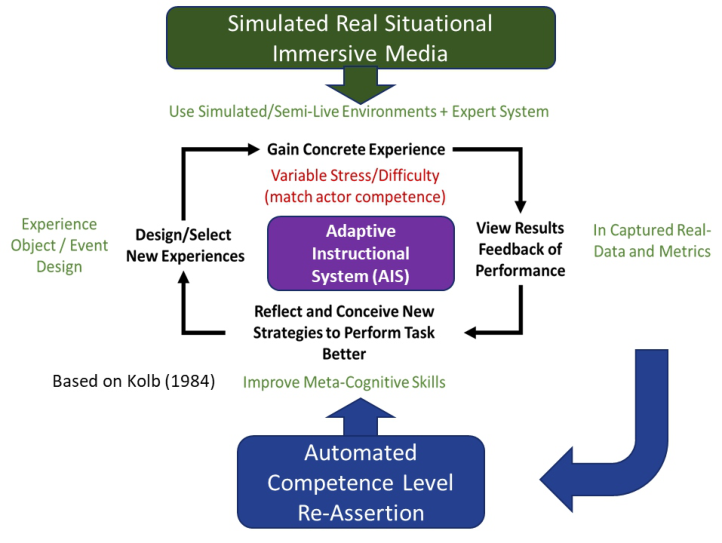
The general process of CBEL is shown in Figure 1, CBEL includes addi- tional elements based on needs revealed from previous applied research. Capabilities such as learning content delivered through synthetic envi- ronments enable concrete experiences of task performance. Other capa- bilities include the use of adaptive instructional systems (AIS) (Gold- berg, Hoffman & Graesser, 2020) and what is referred to as a Total Learning Architecture (Hernandez et al., 2022). Together these pro- vide the simulation control, evaluation, and both raw and processed data necessary to optimize the learning experience and produce the nec- essary evidence for meaningful reflection and inspectable competence assertions.
Integrating Experiential Simulation Into Classroom Instruction 99
Figure 1: Process of competency-based experiential learning (adapted from theories and models by Dewey, 1938; Piaget, 1951; Lewin, 1951; and Kolb, 1984).
The goal of CBEL is to increase the previously noted lack of tacit knowl- edge developed in classroom environments and also provide a natural learn- ing model that can be used inside or outside the classroom. To do this, it’s critical that the learning environment is capable of creating a “flow state” that is aligned to the competence of the learner, and measured against the standards that are directly related to occupational tasks.
Last year we began a resource effort to incorporate CBEL into a military leader development institution. We began by analysing the existing course structure, curriculum and learning objectives that make-up the current insti- tutional courses. From this analysis, existing military topic areas have been identified where CBEL can be applied, and that work well within the existing course design.
Integrating CBEL Simulation Into Classroom Instruction A key characteristic of CBEL content is that unlike traditional course cur- riculum design that uses learning stimulus and learning evaluation separately (e.g., lesson presentations and post-tests), the content design here supports both the learning stimulus and the testing to occur at the same time. Unlike traditional tests, the assessments in CBEL are intended to produce feedback and later reflection, and does not use the word “fail”. Learners are either at, above or below expected performance for a given task, and this is designed
to produce the flow state. Because live performance is impractical in a class- room, the experiential stimulus is possible by using synthetic environments, AIS technology, and a form of learning content referred to as experience events.
Synthetic Environments In the US military synthetic environments can be one of several config- urations: full-synthetic (interaction with synthetic stimulus and systems through keyboard and mouse), semi-synthetic (semi-live interaction with real/realistic-systems vs. scenario controlled synthetic stimulus), and live- synthetic (full-live interaction with real-systems vs. synthetic stimulus). The US Army also uses a scale of training phases defined as “Crawl, Walk or Run”. As trainees qualify to move up each phase of training, they are also able to perform in different types of synthetic environments which even- tually lead to performance in live environments, with real stimulus. The Crawl, Walk, Run phased approach for training is a foundation for CBEL as it provides a framework of feedback and growth in task capability and expertise, which become long-term competence. This framework has proven effective in improving performance in other US Army research projects (John- ston, Gamble et al. (2016); Squad Overmatch (SOvM) Phase II Final Report (2017).
In addition to being associated with different phases of training, each type of synthetic environment is best used for different warfighting tasks. Fur- thermore, each type of synthetic environment requires distinct simulation systems designed to interface synthetic content with different types of real systems (e.g., virtual headsets, vehicle or weapon simulators and real vehi- cles and weapons). Each system uses a simulation engine that produces the synthetic content a learner will virtually interact with. Simulation engines produce four-dimensional (4D) content that not only present stimulus within realistic spatial dimensions but behavior and dynamic changes over time. This is what provides the experiential context in which CBEL can be used to learn tasks to a level of competence necessary before qualifying for training at the next phase.
For institutional classroom education, since this method of training is typ- ically used in the Crawl phase of training where KSAs are acquired, CBEL will use the full-synthetic type of synthetic environment and content, edging towards the Walk phase where KSAs can be practiced. For the US Army this simulation system is called the Virtual Battle Space (VBS).
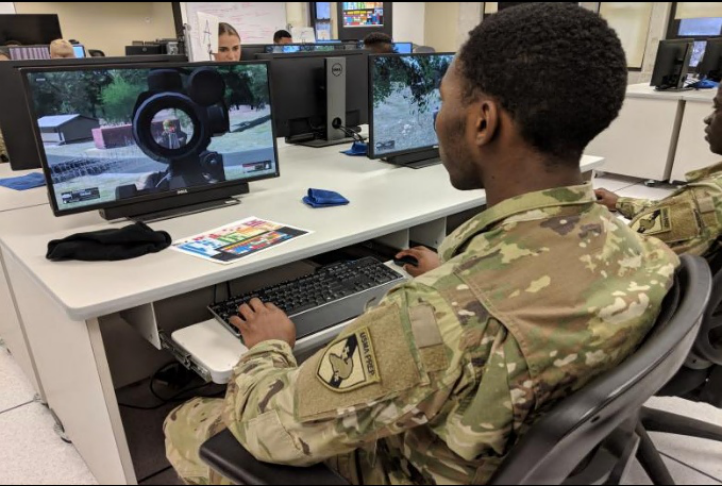
CBEL uses an AIS to configure the VBS automatically to minimize instruc- tor workload, and support and assess the multiple military tasks and under- lying declarative, procedural knowledge VBS is capable of prompting. This combination of simulation and adaptive instructional support is what pro- duces tacit knowledge in tasks like target classification as shown in Figure 2. In addition, the VBS enables either a single person to train by themselves (with AIS support) or enables multiple trainees to work together in the syn- thetic environment as a team, with verbal and visual communication; each
Integrating Experiential Simulation Into Classroom Instruction 101
“player” performing specific roles and tasks as they would in a live occupa- tional environment – as directed by a virtual team leader or the AIS. This is precisely the kind of environment and content CBEL requires to enable the natural human learning state discussed earlier.
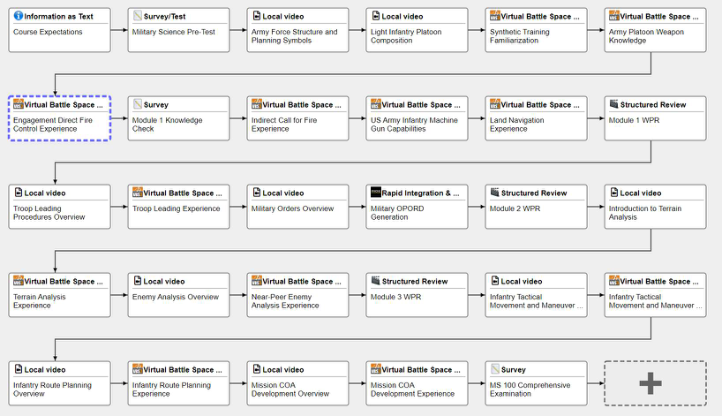
Adaptive Instructional System As noted, another key element of CBEL is the use of AIS technology to not only help setup and modify the synthetic environment to match the trainee’s level of competence but to also collect low-level situation and player per- formance data that is used by artificial intelligence built into the AIS for task assessment. All stimulus and evaluation (performance result) data is reported and saved as Experience Application Program Interface (xAPI) data for later competence assertion, and so that other forms of analysis and/or machine learning can use it to improve upon future AIS capabilities. The AIS is provided with a course outline in a machine-readable format that auto- matically produces the required experiences and experience events, in a fixed or dynamic sequence – depending on how the course is designed. As shown in Figure 3, some of the experience events can be supported by traditional two-dimensional content like text, tests, and video files; however, most of the course consists of 4D synthetic experiences that prompt the performance and learning of specific tasks, stimulated through the VBS simulation system..As trainees move through a course using the AIS user interface, the AIS auto- matically sets up both any preliminary instructional sessions as well as the experiential sessions. The latter includes the key trigger elements, the task
focused AI-based, assessment engines, and the synthetic content strategies and activities that adapt to the learner. (collectively called experience events). Experiences are based on real occupational mission, stimulated with realistic environmental conditions that provide the rich task context that forms tacit knowledge. As trainees move through a course, they receive points based on not only how well they do a task, but the difficulty of the conditions they faced, and the number of times they attempt the tasks. These outcomes ultimately are used by down-stream competence and talent management sys- tems that assert competence levels to each task, which future learning is then recommended and aligned to.
Figure 3: Experience events within a military course delivered through an AIS. (The AIS is the US army’s generalized intelligent framework for training (GIFT).)
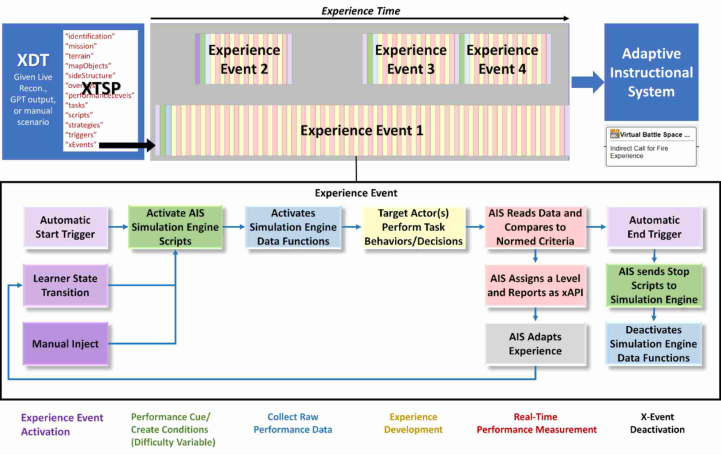
Experience Events The way experience (thus tacit knowledge) is controlled, tracked and shared in CBEL is by using what’s called experience events. These machine-readable content items are tailored to develop tacit knowledge in specific domain occu- pational task(s) the learner wants or is required to become competent in for a given job or role they either are pre-skilling, re-skilling or up-skilling for in a given occupational team. Experience events can be initiated automati- cally from the AIS or manually by a course proctor or facilitator using their own AIS user interface. The experience events are intended to set the trig- gers, conditions, and make specific tools or systems available in order for learners to replicate real tasks in a real work environment, with as much fidelity as necessary, based on the phase of learning a learner is at. Experi- ence events are created and shared in a common machine-readable format (JSON) that an AIS reads in and uses within the given course. As shown in Figure 4 below, experience events can activate alone in series or in parallel and/or within other experience events (e.g., in the case that other learners
Integrating Experiential Simulation Into Classroom Instruction 103
are in the same synthetic environment but focused on different tasks for dif- ferent roles). Experience events are created using an application called an Experience Design Tool (XDT), which either uses captured (recorded) live events that it reconstructs into synthetic environmental requirements, AI gen- erated experiences based on a created Large Language Models from many past recorded real experiences, or a manual scenario designed from a different application.
Figure 4: Experience event components as part of an AIS course – defined from an experience design tool (XDT).
CONCLUSION
This paper proposes a model of learning for future education and train- ing based on the latest research, learning science and neuroscience called CBEL. CBEL can be integrated into classroom instruction by embracing new technologies and capabilities that allows people to learn occupational tasks through “trial-and-error”and flow-state or to relive past failures or successes vicariously within a STE. Furthermore, learning and training can occur in environments dynamically tailored to the learner’s competence-level, without risk or danger of personal injury or damage.
More research is needed and is currently ongoing to explore integrating the CBEL model of learning into classroom environments. This research is hap- pening with the assistance of classroom based courses at a major US Army learning institution where we will collect data from carefully applied experi- ments both laterally across populations and longitudinally over the student’s academic tenure.
REFERENCES
Borders, J., Klein, G., Besuijen, R. (2024). Mental Model Matrix: Implications for System Design and Training. Journal of Cognitive Engineering and Decision Making. Dewey, J. (1938). Experience and Education. Touchstone, NY. Avail at https://archive.org/details/ExperienceAndEducation. Freeman, S., Eddy, S. L., McDonough, M., Smith, M. K., Okoroafor, N., Jordt, H.,
Wenderoth, M. P. (2013). Active learning increases student performance in science, engineering and mathematics. Proceedings of the National Academy of Sciences. Gentner, D. & Stevens, A. (1983). Mental Models. Hillsdale, NJ: Erlbaum. Goldberg, B., Hoffman, M. & Graesser, A. (2020). Adding a Human to the Adaptive Instructional System Loop: Integrating GIFT and BattleSpace Visualization. In A. Graesser, X. Hu, Rus, V. and B. Goldberg (Eds.) Design Recommendations for Intelligent Tutoring Systems, Vol. 7: Data Visualization, U. S. Army Combat Capability Development Command. Goldberg, B., Owens, K., Hellman, K., Robson, R., Blake-Plock, S., Hoffman, M.
& Gupton, K. (2021). Forging Proficiency and Readiness through an Experiential Learning for Readiness Strategy. In Proceedings of the 2021 Interservice/Industry Training Simulation and Education Conference (I/ITSEC). Orlando, FL. Hake, R. (1998). Interactive engagement versus traditional methods: A six-thousandstudent survey of mechanics test data for introductory physics courses. American Journal of Physics, 66(1), 10.1119–1.18809. Hebb, D. O. (1961). “Distinctive features of learning in the higher animal”. In J. F.
Delafresnaye (ed.). Brain Mechanisms and Learning. London: Oxford University Press. Hoffman, M. & Goldberg, B. (2022). The GIFT Architecture and Features Update: 2022 Edition. In Proceedings of the 10th Annual Generalized Intelligent Frame- work for Tutoring (GIFT) Users Symposium (GIFTSym7). Orlando, FL. Hernandez, M. Johnson, A., & Neeley, M. (2019). Cybersecurity Strategies for
Accrediting xAPI. Interservice/Industry Training, Simulation, and Education Con- ference (I/ITSEC). Orlando, FL. Huskey, R. (2022, January 5). The science of ‘Flow states’, explained by a cognitive science researcher : ScienceAlert. ScienceAlert. https://www.sciencealert.com/the- science-of-why-flow-states-feel-so-good-according-to-a-cognitive-scientist. Johnston, J. H., Gamble, P., Patton, D., Fitzhugh, S., Townsend, L., Milham,
L. (2016). Squad overmatch for tactical combat casualty care: Phase II initial findings report. In Program Executive Office Simulation, Training and Instrumen- tation, Orlando, FL. Kolb, D. A. & Plovnick, M. S. (1974). The Experiential Learning Theory of Career Development. Conference on Career Development, 22 May 1974. Cambridge, MIT. Kolb, A. Y., & Kolb, D. A. (2017). The Experiential Educator. EBLS Press,
Kaunakakai, HI. Klein, G. (2017). Sources of Power, MIT Press. Neurotechnology & Advanced Sleep. (n.d.). Retrieved January 28, 2018, from https://www.advancedbrainmonitoring.com/ (2017, February 24). The Science of Navy SEAL Superlearning. Ochen.com. Retrieved January 15, 2024, from https://ochen.com/the-science-of-navy-seal-superlearning/. Owens, K. P. (2023). Learning Engineering for Competency-Based Experiential
Learning Design. HFES Annual Meeting Proceedings.
Integrating Experiential Simulation Into Classroom Instruction 105
Owens, K. P., Goldberg, B. Robson, R., Hoffman, M., Ray, F., Colburn, A., Hernandez, M., Divovic, M., Blake-Plock, S., & Casey, C. (2022). Synthetic Training Environment Experiential Learning for Readiness (STEEL-R) Demonstration. In Proceedings of the 10th Annual Generalized Intelligent Framework for Tutoring (GIFT) Users Symposium (GIFTSym10). Orlando, FL. Rivers, R. H.; Vockell, E. (1987). “Computer simulations to Simulate scientific
problems solving”. Journal of Research in Science Teaching. 24 (5): 403–416. Bibcode:1987JRScT..24..403R. doi: 10.1002/tea.3660240504. Squad Overmatch (SOvM) Phase II Final Report (2017). Optimizing War- riors…Achieving Squad Overmatch…Saving Lives. PEO STRI: Orlando. U.S. Army (2017). The U.S. Army Learning Concept for Train- ing And Education 2020–2040. TRADOC Pamphlet 525-8-2. https://adminpubs.tradoc.army.mil/pamphlets/TP525-8-2.pdf U.S. Department of Defense. (2017, April 27). DARPA Funds Brain- Stimulation Research to Speed Learning. Retrieved January 8, 2024, from https://www.defense.gov/News/News-Stories/Article/Article/1164793/darpa- funds-brain-stimulation-research-to-speed-learning/.
LISTED IN THE AHFE DIGITAL BOOKSTORE CATALOGUE
Explore the complete digital volume
Human Factors and Simulation
Read this individual research paper free through the original publisher, or explore the full digital proceedings book.
ISBN 978-1-964867-15-1
Explore this ISBN in the AHFE Bookstore ↗Listed in the July 2026 bookstore catalogue; search by ISBN to confirm current availability · Digital book purchase optional