Sumona Sen, Hans Juergen Buxbaum (2023). Trajectory-based Optimization of Safety and Process Efficiency in Human-Robot Collaboration. In: Human Factors and Systems Interaction. AHFE Open Access, vol. 84, pp. 329–335. https://doi.org/10.54941/ahfe1003619
The interaction between humans and robots in industrial applications of human-robot collaboration has so far been determined almost exclusively by technically oriented machine programmers and operators. The task allocation and especially the programmed trajectories of the robot are regularly subordinated to technical aspects, mental or cognitive demands of the human are usually not considered. The aim of this research is the investigation and optimization of robot movements considering cognitive and ergonomic aspects. The stress on humans caused by the workstation is to be reduced and the safety in the not harmless collision scenario is to be increased.
One of the current topics of Industry 4.0 is human-robot collaboration (HRC). The focus here is on the idea of no longer operating robots exclu- sively behind protective devices and instead driving automation forward in areas such as manufacturing or assembly. Here, collaborative robots are to support workers in their tasks. In the shared workspace, human skills and abilities are supplemented by the power and precision of automated mach- ines. Such a novel concept of collaboration between humans and machines requires a modern, flexible orientation of work design (Wischniewski et al. 2019). In addition to this advantage, there are further aspects to be conside- red in this context. Due to the elimination of separating protective devices, safety is one of the factors that have to be considered and re-evaluated as a priority (Buxbaum & Häußler 2020).
In this paper, the research question is investigated how standardized tra- jectories in the movement of a robotic arm are perceived and cognitively processed from the perspective of the collaborating human.
One starting point is human Situation Awareness (SA), a construct that describes perception and understanding of information in complex situations. In addition to these aspects, which according to Endsley (1998) are divided into the following three different levels:
Level 3 refers to the prediction of future events in the situation and is particularly important here. Methods used in several, successive empirical studies with probands are eyetracking, SAGAT (Situation Awareness Global Assessment Technique) and questionnaires.
The aim is to develop a recommendation for machine programmers and operators. To date, the human factor has been given less consideration in these areas and the installations tend to be based on technical considera- tions (Sen 2020). Appropriate programming of the robot arm trajectory should avoid unintended collisions and increase safety during collabora- tion (Nemec et al. 2017). Here, an experiment, combining different types of measuring Situation Awareness will be presented. Two previously con- ducted studies show clear trends. Before directly addressing the Situation Awareness of the collaborating human in the second study (Sen et al. 2020), the first study addresses the predictive ability of the target position depen- ding on the deployed trajectory of the robotic arm (Sen et al. 2020). Both studies provide significant results. It is demonstrated that linear trajecto- ries allow better prediction of motion and higher Situation Awareness in comparison.
Here, an additional experiment is described, that investigates the variation in terms of Situation Awareness between all three standard trajectories by using different measurement methods in combination. The obtained findings are discussed in regard to the research question and finally a recommendation for the setup of HRC applications with respect to optimized trajectories is formulated.
MOVEMENT TYPES IN HUMAN-ROBOT COLLABORATION Motion controllers of robotic systems can be classified according to diffe- rent trajectories. The following standard trajectories are used in typical robot control systems (Weber 2017):
Point-to-Point Trajectory (PTP) The motion of the robot is described by the initial and final positions of the axes and is independent of the geometric position of the gripper in broach during the motion. Since the motion of the individual axes is independent of each other and therefore uncoordinated, the trajectory of the gripper from the start to the end position is not geometrically defined.
Linear trajectory (LIN) If the trajectory is also important in robotic processes, the trajectory of the gripper from the start point to the target point must be interpolated by the robot controller. Typically, trajectory interpolation is used in path welding processes or when joining components in assembly processes. The advantage of linear trajectories is that the shortest path from the start point to the target point is selected. In any case, the traverse time is longer than for a comparable PTP movement from the start to the destination.
Circular trajectory (CIRC) Again, the trajectory of the end effector between the start and target points
Trajectory-Based Optimization of Safety and Process Efficiency in Human-Robot 331
is important. In a circular trajectory interpolation, the robot controller interpolates an arc between the start and target points, again regularly at a given trajectory speed.
RESEARCH QUESTION It will be investigated to what extent the trajectories differ with respect to their cognitive effect on the Situation Awareness of the collaborating human. With the help of different measurement methods it will be evaluated when a fast and correct prediction of further movement is possible. Derived from this, the research question of this experiment is:
“Does the trajectory of the collaborating robot influence the prediction ability of the motion?”
In order to investigate this question in an explorative framework, the expe- riment presented here is hypothesized and the research design is developed.
OBJECTIVES The final experiment presented here involves a complex workflow between a human and a collaborative robot. The scenario is set up in a full scope simulator, which represents a realistic image of an assembly scenario. Due to its isolation from the outside world as well as an embedded programmable logic controller, it is possible to create identical conditions for each proband, making the experiment reliable and objective (Buxbaum et al. 2018).
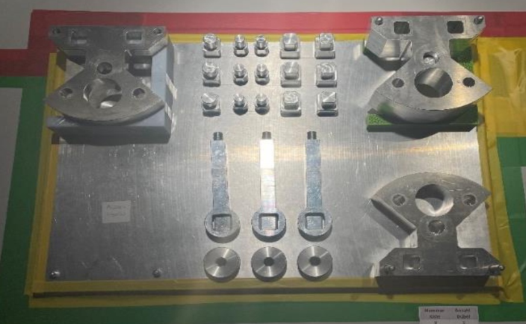
The procedure of the experiment is divided into a main task and a secon- dary task. The main task consists of building an assembly set. The assembly set used in the experiment was developed at the Cranfield Institute of Technology as a benchmark for assembly robots (Collins et al. 1986). The robot and the probands work sequentially on the assembly set within a shared workspace. Task allocation is chosen according to the capabilities of the inte- racting partners, allowing an optimal workflow. Figure 1 shows the assembly kit in the experiment.
Figure 1: Assembly set cranfield benchmark.
332 Sen and Buxbaum
The secondary task involves assembling a Lego set into a small box, which must be filled with a certain number of dowels before they are placed in the collaborative workspace and the robot can remove and relocate them.
INSTRUMENTS In order to be able to measure Situation Awareness during the experiment, three different measurement methods are used. One is the SAGAT method and the other is eyetracking. Both methods allow an objective measurement of Situation Awareness in a dynamic situation. based on the fact that a corre- lation between Situation Awareness and expectation conformity during an activity is established, a questionnaire as a final measurement instrument will record the subjective perception of expectation conformity of each pro- band in the experiment. For this purpose, a specially developed questionnaire, based on the ISOmetrics (Hamborg et al. 2002), will be used.
SAMPLE The experiment is conducted with 51 probands. The subjects are between 18 and 33 years old (M = 23.98, SD = 4.8). All of them are students. A between- subjects design is used. Thus, each proband receives one of the three types of trajectories. As a result, the tested groups are independent of each other and show less confounding of the measurement by external factors.
Since the analysis has not been completed at the time of writing this paper, a sample of 15 probands is used for the results.
RESULTS
The results are presented below individually, with regard to
Eyetracking,
Situation Awareness Global Assessment Technique (SAGAT) and
Questionnaire.
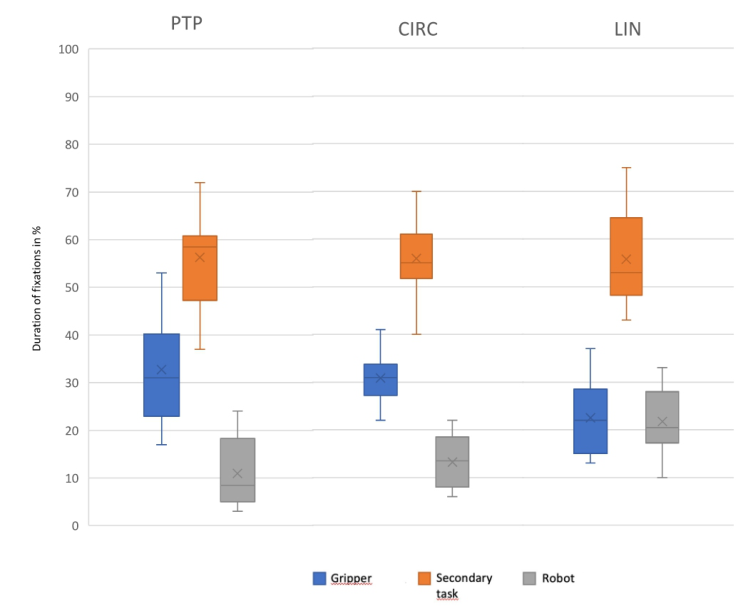
Eyetracking The analysis of the eyetracking data takes place by collecting the distribution of the duration of fixations on three different AOIs (Areas of Interest) of the experiment. The gripper of the robot, the whole robot arm and the secon- dary task are considered. Since it can be assumed that with a lower Situation Awareness and due to underconfidence in the interaction with the robot, pri- marily the gripper and the robot itself become the focus of the probands’ attention, these areas are selected. The secondary task, in turn, also requi- res attention and is considered as the third domain. Thus, the distribution of fixation duration on all three areas is evaluated in percentage.
The distribution shows large differences, the attention of the probands of all three groups is mainly on the secondary task. The boxplot (Fig. 2) illu- strates the percentage distribution of fixation duration on the three different areas. It can be seen that the fixation duration related to the gripper dif- fers significantly between the three trajectories. The gripper is the tool of the
Trajectory-Based Optimization of Safety and Process Efficiency in Human-Robot 333
Figure 2: Box-whisker plot eyetracking data.
robot that comes closest to the proband and thus poses a potential danger due to avoidable collisions. The secondary task, on the other hand, achieves a higher percentage in the LIN trajectory compared to the other trajectories.
Situation Awareness Global Assessment Technique (SAGAT) A separate score is formed for each of the 3 levels of Situation Awareness. It can be seen that there is not much difference between stage 1 and stage 2 of Situation Awareness in all three trajectories. In stage 1, the Situation Awareness score for the PTP trajectory is 58%, for the LIN trajectory is 62%, and for the CIRC trajectory is 63%. The PTP trajectory in stage 2 has an Situation Awareness value of 54% and the LIN trajectory of 61% and in CIRC trajectory 60%.
However, the greater difference in stage 3 is striking. Here the three values differ more, mainly the PTP trajectory is to be evaluated differently. The Situation Awareness value for the PTP trajectory is 43% and the Situation Awareness value for the LIN trajectory is 55%, while the CIRC trajectory is 51%. The delta here is larger than at the other levels. The total Situation Awareness value for the PTP trajectory is 51.6%, LIN trajectory has a value of 55.3% and the CIRC trajectory of 58%.
334 Sen and Buxbaum
Questionnaire The questionnaire is created specifically for the experiment. It is based on the ISOmetrics, an already established questionnaire that operationalizes the dia- log criteria of DIN EN ISO 9241. Since only the dialog criterion of conformity to expectations is considered for the question mentioned here, the 7 items of the short form of the ISOmetric are adapted to the present situation with a collaborative robot. In addition, the concerns of a possible collision and the general use are questioned.
On average, the probands rate their technical understanding as very good (ø 5.2/6) and have never worked with a collaborative robot before.
The group of probands with linear trajectories indicate on average that the interaction with the robot is clear and understandable (ø 4.9/6). Similarly, they state that the robot’s movements do not distract from the task (ø 5.1/6). The CIRC trajectory shows similar indications. Deviations are found in the PTP trajectory. On average, the test persons state here that the interaction with the robot is not completely clear and understandable (ø 2.9/6). In addi- tion, the subjects state on average an increased fear that a collision could occur (ø 4.6/6).
CONCLUSION
The presented results allow some conclusions about the different perception of the probands regarding the applied trajectories. The results of the eyetra- cking show that the PTP trajectory causes the probands of this experimental group to focus more on the gripper. The uncertainty about the robot motion and possible collisions is reinforced by the results of the questionnaire as well as the SAGAT. The PTP trajectory allows a worse predictability of the robot motion. The LIN and CIRC trajectories, on the other hand, are perceived to be more understandable and clearer. The higher Situation Awareness value as well as the distribution of fixation duration reflect this. However, the differe- nces of these two trajectories are marginal. The Situation Awareness value of the CIRC trajectory is slightly higher, but the probands fixate the gripper sli- ghtly more in the LIN trajectory. Thus, the research question can be answered. PTP trajectories differ in their predictive ability compared to the other two standard trajectories. Machine programmers and operators can be recom- mended to design robot motion trajectories as linear trajectories or circular trajectories for a safe and cognition-oriented design of HRC applications.
REFERENCES
Buxbaum H. J. Häusler R. (2020) Ladenburger Thesen zur zukunftigen Gestaltung der Mensch- Roboter- Kollaboration. In: Buxbaum H. J. (Ed.) Mensch-Roboter- Kollaboration. Springer Gabler, Wiesbaden. Buxbaum, H. J. Kleutges, M. Sen, S. (2018) Full-scope Simulation of Human-Robot
Interaction in Manufacturing Systems. IEEE Winter Simulation Conference, Gothenburg. Collins, K. Palmer, A. J. Rathmill, K. (1985) The Development of a European Benchmark for the Comparison of Assembly Robot Programming Systems. In: Rathmill,
Trajectory-Based Optimization of Safety and Process Efficiency in Human-Robot 335
K., MacConaill, P., O’Leary, P., Browne, J. In Robot Technology and Applications. Springer, Berlin, Heidelberg. Endsley, M. R. (1988) Design and Evaluation for Situation Awareness Enhancement.
In Proceedings of the Human Factors Society 32nd Annual Meeting. Hamborg, K. C. Willumeit, H. (1996) Untersuchungen zu Itemformulierungen des IsoMetrics-Verfahrens. Osnabrücker Schriftenreihe Software-Ergonomie - 1. Osnabrück, Universität Osnabrück ISONORM 9241/10 und Isometrics: Usability-Fragebögen im Vergleich. Nemec, B. Likar, N. Gams, A. Ude, A. (2017) Human Robot Cooperation with
Compliance Adaptation along the Motion Trajectory. In: Autonomous Robots Vol. 42. Sen, S. (2020) Erwartungskonformität von Roboterbewegungen und Situationsbewusstsein in der Mensch-Roboter-Kollaboration. In: Buxbaum H. J. (Ed.), Mensch-Roboter-Kollaboration, Kapitel 12. Springer Fachmedien, Wiesbaden. Sen, S. Buxbaum, H. J. Kremer, L. (2020) The Effects of Different Robot Trajectories
on Situational Awareness in Human-Robot Collaboration. In Human-Computer Interaction. Multimodal and Natural Interaction. Sen, S. Buxbaum, H. J. Kremer, L. (2020) Vorhersagbarkeit der Zielposition einer Roboterbewegung in der Mensch-Roboter Kollaboration. 66. Frühjahrskongress der Gesellschaft für Arbeitswissenschaften Berlin. Weber, W. (2017) Industrieroboter. 3. Aufl., Carl Hanser Verlag, Leipzig. Wischniewski, S. Rosen, P. H. Kirchhoff, B. (2019) Stand der Technik und zukunf-
tige Entwicklungen der Mensch-Roboter-Interaktion. 65. Fruhjahrskongress der Gesellschaft fur Arbeitswissenschaft, Dresden.
LISTED IN THE AHFE DIGITAL BOOKSTORE CATALOGUE
Explore the complete digital volume
Human Factors and Systems Interaction
Read this individual research paper free through the original publisher, or explore the full digital proceedings book.
ISBN 978-1-958651-60-5
Explore this ISBN in the AHFE Bookstore ↗Listed in the July 2026 bookstore catalogue; search by ISBN to confirm current availability · Digital book purchase optional