Sumona Sen, Sarah Kunz, Tobias Rusch, Hans Juergen Buxbaum (2022). An exploration into the dependency of speed and distraction of vehicle drivers on a Handling Course at Bosch Boxberg Proving Ground. In: Human Factors and Systems Interaction. AHFE Open Access, vol. 52, pp. 249–255. https://doi.org/10.54941/ahfe1002162
Driving a car is a complex activity. In addition to physical abilities, cognitive and perceptive abilities play a major role. Investigating this is already the subject of a large number of studies. In addition to the typical safety-relevant aspects and human behaviour in critical situations, distraction in particular is becoming more important in recent studies. Distractions that affect the driver from the outside should also be considered. This study, in cooperation with the Bosch company, looks at how a distraction on a handling course track affects the speed of the drivers at the proving ground. The Bosch company operates a proving ground in Boxberg, Germany, for testing active driving safety. The focus of this study is a handling course, for tests in dynamic and curvy situations.2 Objectives In the regular course scenario, energy absorber mats have been installed for safety reasons. During a reconstruction phase, the mats were temporarily deinstalled. After that, an increased number of accidents was noticed. It is assumed, that the mats’ absence may have had an influence on the speed and the behaviour of the drivers.The following research questions are raised on the basis of these aspects: 1. Do the mats have an influence on the occurrence of accidents?2. Do the absence of the mats distract the driver while driving? 3. Do the absence of the mats has an influence on the speed driven in this area?In order to answer these research questions, the following hypotheses need to be investigated: H1: The mats help to focus the driver's attention.H2: The driver is consciously aware of the mats.H3: The speed in this area is higher in the absence of mats.H4: There is a difference in the driving speed between drivers who fixate the mats and those who do not register them. 3 Methods and experimental design A case-control study is developed as the study design so the effects can be revealed by comparison. In order to avoid bias, such as selection effects or similar, the group allocation of the drivers is randomised.The experiment thus consists of two different groups (15 test persons per group) who each drive the route individually; group 1 with mats installed; group 2 without mats. The car is equipped with a velocity tracking, so that the speed is recorded at any time. During the drive, each test person in both groups wears eye-tracking glasses with a recorder. The whole tracked data is synchronized with GPS and time stamp. Each test person drives the route 2 times. 4 Results The research questions are answered by the research methods adapted to the hypotheses. A moderately strong distraction and speed increasing was detected in the absence of the energy absorber mats. This leads to the conclusion that the energy absorber mats have an influence on the accident occurrence in a positive way. The statistical analyses are presented in the full paper.
Figure 1: Bosch Boxberg Proving Ground in Boxberg germanny.
control of their vehicle becomes an obligation for drivers to be constantly attentive, ready to react, careful and foresighted. This obligation is concreti- zed in the exemplarily formulated subsequent sentences of the German Road Traffic Act, according to which the driving speed is to be adapted especially to the personal abilities. Drivers who are distracted from their driving tasks are subject to significantly reduced personal abilities during distraction phases and must therefore reduce their speed on a mandatory basis due to this regu- lation (Müller 2017). While distraction can generally be considered as the orientation of attention away from the driving task, it is still unclear whether distraction can be described as part of inattention (Hackenfort 2012), so this aspect is being further investigated in current studies.
This study, in cooperation with the Bosch company, focusses at how a distraction on a Handling Course track affects the speed of the drivers at a Proving Ground. The cornerstone for the founding of the proving ground was laid in the development of systems for active safety which aids the stabilizing of vehicles leading to the avoidance of accidents. The focus of this study is a handling course, for tests in dynamic situations.
Bosch Boxberg Proving Ground The Bosch Proving Ground Boxberg is located 90 km north-east of Stuttgart, Germany and provides different test modules for vehicle and system testing on a total area of 94 hectare. The main purpose of the Proving Ground is to ensure safe testing conditions for applications that are not yet approved for public roads. Vehicles can be tested in many different situations, like for example low friction areas, off-road-tracks or dynamic areas. Besides internal utilization, the Proving Ground is open for other companies of the automo- tive industry. With over 20 different modules, the Proving Ground offers ideal conditions for all customers and all kinds of vehicles. To ensure safe testing, numerous measures were implemented. Besides personal and organizational measures, also technical measures like the installation of FIA and FIM homo- logated safety installations, like for example guard rails or energy absorber mats were taken. The whole area is pictured in Figure 1.
An Exploration Into the Dependency of Speed and Distraction of Vehicle Drivers 251
The focus of this study is the Handling Course, where the vehicle’s hand- ling can be tested in extreme dynamic situations in higher-speed driving. The module is used by all kind of vehicles. Due to the high utilization of motor- bikes, Bosch decided to upgrade the existing energy absorber in front of the guardrails and tyre stacks to FIM-certified energy absorber mats. These energy absorber mats are also being used for racetracks and for example Moto GP events. As the companys’ brand color is red, the energy absorber mats were chosen in the colors red and grey, which is also considered as an often-used color in terms of safety installations.
OBJECTIVES In the regular course scenario at the Handling Course described above, energy absorber mats have been installed for safety reasons. During an exchanging phase, the energy absorber mats where temporarily deinstalled, but the track was still open for passenger cars. Within that timeframe, three similar acci- dents happened in the same area. Except of the missing energy absorber mats there were no differences on the module or any other reason that could explain a higher accident rate. It is assumed, that the energy absorber mats’ absence may have had an influence on the speed and the behavior of the drivers.
The proof, that the color of the energy absorbers mats or their absence has got an influence on the driving behavior, especially in terms of speed and distraction, could play an important role when deciding over further preventional measures focusing on design of the Course and safety instal- lations. The following research questions are raised on the basis of these aspects.
1. Do the energy absorber mats have an influence on the occurrence of accidents?
2. Do the absence of the energy absorber mats distract the driver while driving?
3. Do the absence of the energy absorber mats has an influence on the speed driven in this area?
In order to answer these research questions, the following hypotheses need to be investigated: H1: The energy absorber mats help to focus the driver’s attention. H2: The driver is consciously aware of the energy absorber mats. H3: The speed in this area is higher in the absence of the energy absorber mats.
H4: There is a difference in the driving speed between drivers who fixate the energy absorber mats and those who do not register them.
METHODS
Sample The experiment is carried out with 30 probands, 27 men and 3 women. The probands are aged between 25 and 50. Most of them are application engi- neers. They are divided into two experimental groups, both groups with a
balanced number of 15 each. For the first group the energy absorber mats are not present, for the second experimental group the energy absorber mats are present. A case-control study is developed as study design so the effects can be revealed by comparison. In order to avoid bias, such as selection effe- cts or similar, the group allocation of the drivers is randomised. Furthermore, it was not mentioned what the exact goal of the study is. It was briefly explai- ned to each proband that this was an investigation regarding safety on the track. They should drive quickly, not in the sense of the best lap time, but as far as the feeling of safety allows the driven speed.
Experimental Design The experiment thus consists of two different groups (15 probands per group) who each drive the route individually; group 1 with absence of the energy absorber mats; group 2 with the energy absorber mats. The car is equip- ped with a velocity tracking, so that the speed is recorded at any time. During the drive, each proband in both groups wears eyetracking glasses with a recorder. The tracked data is synchronized with GPS and time stamp. Each proband drives two rounds. Before completing the rounds, each pro- band receives a safety briefing for the course. As already been mentioned, it was very important not to create a racing character. At the end of each run, a questionnaire is given to each proband. Subjective opinions are asked there.
Measures Eyetracking
The nowadays most used capturing and recording of eye movements is called eyetracking. Physiology connects the eye with attention, as it serves to absorb information. According to Just and Carpenter (1980), the viewing duration of objects is closely related to their cognitive processing (eye-mind hypothesis). Furthermore, it is stated that the processing of visual stimuli in the brain takes place immediately after the reception of the visual sti- mulus and is not delayed. This describes the theoretical background of the connection between attention and eye movements (Strohmaier 2014). The possibility of a time stamp allows the eyetracking data to be synchronized with the residual measurements.
Questionnaire A specially designed questionnaire was developed for the study. It covers the most important aspects related to the remarkability of the energy absorber mats, the speed, self-perceived exertion and distraction and the own driving experience.
Velocimetry For accurate measurement of speed in the experiment, a V-Box is installed in the car used. The V-Box makes it possible to determine the speed at any point along the route with a precise time stamp and GPS data.
Table 1 illustrates the different types of measurements and how they relate to the hypotheses stated.
An Exploration Into the Dependency of Speed and Distraction of Vehicle Drivers 253
Table 1. Types of measurement and relation to the hypotheses.
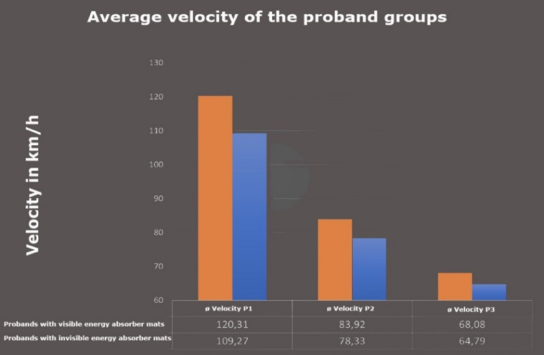
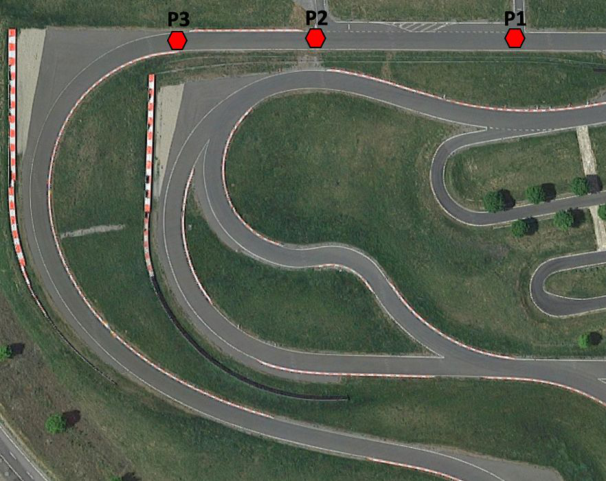
Figure 2: Average velocity of the proband groups at three points.Figure 3: Points of speed and eyetracking measurement.
RESULTS AND CONCLUSION The data, provided by the different measurements, showed some interesting findings. The results are divided into the different types of measurements.
Eyetracking: Heatmaps with Areas of Interests are created and demon- strated a different focus of the driver’s attention. The fixations in group 1 are much more distributed in the complete area. Group 2, with present energy absorber mats focused intensely on the inside of the curve. The energy absorber mats were only perceived in the peripheral field of vision.
Velocimetry: Figure 2 shows the difference between both groups. The ave- rage velocity of group 2 (orange color) is significantly higher than the average velocity of group 1, especially at P1. The three points of measurement are illustrated in Figure 3.
Questionnaire: No probands without energy absorber mats consciously noticed their absence. So there was no difference in answering the questions.
In summary, there is a remarkable difference between the speed of the two groups. Above all, eyetracking and velocimetry show that present energy absorber mats have led to a better and safer driving experience. The average higher speed and the type of fixations support this statement. Hypothesis H1 and H4 can thus be verified. With regard to H2, it is striking that none of the drivers are aware of the presence of the energy absorber mats, so the hypoth- esis can be falsified. H3 is also not verified. The assumption that an absence of the energy absorber mats could lead to high speed is incorrect. It behaves exactly the other way around. In further investigations, attention should also be paid to other environmental factors.
ACKNOWLEDGMENT
A special thanks to the cooperation of the students of the Niederrhein Uni- versity of Applied Sciences Felix Claßen, Zeynep Acar, Alain Arriens, Emily Bruns and Johannes Hinrichs.
REFERENCES
Aarts, L. & vanSchagen, I. (2006). Driving speed and the risk of road crashes: A review, Accident Analysis and Prevention, 38, S. 215–224. Aarts, L., Brandenburg, S. & vanNes, N. (2011). The influence of environmental
factors on speed choice. In: Proceedings of the IEEE Forum on Integrated and Sustainable Transportation Systems (FISTS), S. 91–96. Brandenburg, S. (2014) Einflüsse von Umweltvariablen und Fahrereigenschaften auf die Wahl der Geschwindigkeit im Kraftfahrzeug. PhD thesis TU Berlin. dePelsmacker, P. & Janssens, W. (2007). The effect of norms, attitudes and habits
on speeding behavior: Scale development and model building and estimation. Accident Analysis & Prevention, 39, S. 6–15. Elliot, M. A., Baughan, C. J. & Armitage, C. J. (2003). Drivers Compliance with Speed Limits: An Application of the Theory of Planned Behavior. Journal of Applied Psychology, 88(5), S. 964–972. Fuller, R. (2000). The task-capability interface model of the driving process. Recher-
che - Transports - Securite, 66, S. 47–57.
An Exploration Into the Dependency of Speed and Distraction of Vehicle Drivers 255
Fuller, R. (2005). Towards a general theory of driver behavior. Accident Analysis & Prevention, 37, S. 461–472. Goldenbeld, C. & vanSchagen, I. (2007). The credibility of speed limits on 80km/h
rural roads: The effects of road and person(ality) characteristics. Accident Analysis & Prevention, 39, S. 1121–1130. Goodwin, F., Achterberg, F & Beckmann, J. (2006). Intelligent Speed Assisstence Myths and Reality: ETCS position on ISA. Technischer Report. European Transport Safety Council, Brussels. Hackenfort, M. (2012) Inattention & Distraction. Literature review on behalf of the
Swiss Insurance Association, Zurich University of Applied Sciences, Zurich. Horberry, T., Anderson, J., Regan, M. A., Triggs, T. J. & Brown, J. (2006). Driver distraction: The effects of concurrent in-vehicle tasks, road environment com- plexity and age on driving performance. Accident Analysis & Prevention, 38, S. 185–191. Just, M. A., & Carpenter, P. A. (1980). A theory of reading: From eye fixations to
comprehension. Psychological Review, 87, 329–354Booher, Harold, ed. (2003). Handbook of human systems integration. New Jersey: Wiley. Kreußlein, Maria; Schleinitz, Katja; Krems, Josef F. (2020) Frequency of distraction while driving. TU Chemnitz, Reports of the Federal Highway Research Institute People and Safety, booklet M 297. Müller, D. (2017) Ablenkung im System des Deutschen Verkehrsrechts. In Wie kann
die Unfallgefahr “Ablenkung im Straßenverkehr” verringert werden?, Series of publications on road safety, Deutscher Verkehrssicherheitsrat e.V.. Strohmaier, S. (2014). Visuelle Analyse von Eyetracking-Experimenten mit einer Vielzahl von AOI. Stuttgart: Universitätsbibliothek Stuttgart. Wong, S.C., Sze, N.N., Lo, H.K., Hung, W.T. & Loo, B.P.Y. (2005). Would rela-xing
speed limits aggravate safety? A case study of Hong Kong. Accident Analysis & Prevention, 37, S. 377–388.
LISTED IN THE AHFE DIGITAL BOOKSTORE CATALOGUE
Explore the complete digital volume
Human Factors and Systems Interaction
Read this individual research paper free through the original publisher, or explore the full digital proceedings book.
ISBN 978-1-958651-28-5
Explore this ISBN in the AHFE Bookstore ↗Listed in the July 2026 bookstore catalogue; search by ISBN to confirm current availability · Digital book purchase optional