Tobias Rusch, Benjamin Hübner, Silja Meyer-nieberg, Wolfgang Winter, Armin Leopold, Marko Hofmann, Cornelia Küsel (2024). Physiological and psychological performance measurement for the practical driving test. In: Advances in Human Factors of Transportation. AHFE Open Access, vol. 148, pp. 382–389. https://doi.org/10.54941/ahfe1005229
Even with the advancement of automobile technologies supporting drivers in most situations on the road, the practical driving test required to obtain a driver’s license in Germany is still a major obstacle for students. Although additional tools such as driving simulation systems as well as mobile apps are available for initial driving training, the failure rate stagnated around 37% for the last ten years, according to the ADAC, the largest german automobile club. In Germany, students learn to drive with the help of private companies specialized on teaching and leading the students up to the official practical driving test demanded by government regulations to obtain a driver’s license.Using a multimodal sensory setup obtaining biophysiological and derived mental state data of each driving student, the resulting database is used to identify possible causes about fatal driving errors. Each student is evaluated and accompanied throughout his or her entire learning journey, starting with a questionnaire-based personality trait test. Using synchronization by timestamp, the biophysiological data most related to stress, such as HRV, EDA or eye tracking, are collected both while within the driving simulation system and on the real-world road. Besides collected sensor-based data, the database is also enriched with subjective insights provided by the student before and after each driving session. On the road, the driving instructor assessment, a standardized driving log, containing special events and student behaviour, as well as an event-synchronized video recording is added to each dataset. For analysis of the collected data, particular attention is paid to anomalies correlated to special events during each session to identify situational patterns which may be associated to an increased failure rate in the final, official practical driving test. The gained insights are then used to optimize driving training to actively reduce the practical driving test failure rate.
Physiological and Psychological Performance Measurement for the Practical Driving Test 383
INTRODUCTION
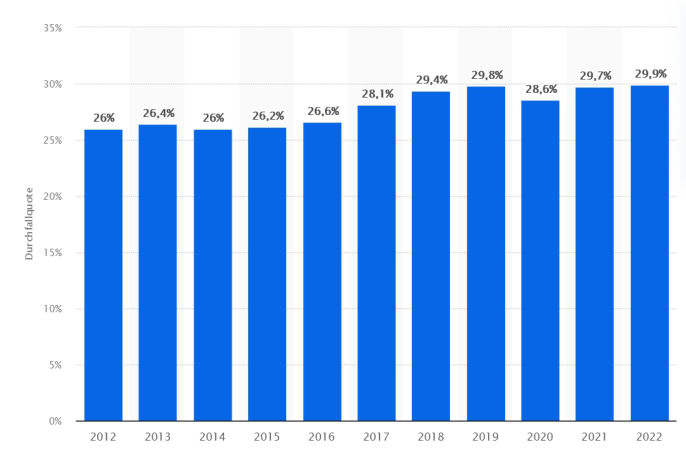
In terms of road traffic hazards, young drivers and novice drivers in partic- ular represent a major statistical safety risk. Most recently, this age group, which includes all driving license holders under the age of 25, was involved in around 20% of fatal road accidents. (Jannusch, 2023) In the 18–24 age group, an increased willingness to take risks, overconfidence, overconfidence and lack of experience lead to a dangerous starting point in road traffic (IM- NRW, 2024). To prepare for road traffic and gain initial practical driving experience, every driver must pass theoretical and practical driving tests. In 2017, 1.80 million theoretical and 1.66 million practical driving tests were carried out in Germany (Janson, 2019). If you look at Figure 1, you can see that 28.1% of practical driving tests taken in Germany in 2017 were failed.
Figure 1: Failure rate for the practical driving test in Germany (KBA, 2023).
In 2022, the failure rate is even higher at 29.9%. One factor in these high figures may be that the training is still largely based on concepts from the 1970s and 1980s and is therefore no longer up to date in an increasingly changing road traffic environment (Bredow, 2016). As a com- parative value, we use the figures from Switzerland, which perform even worse with 66.5% of practical driving tests passed in 2022 (Vereinigung der Strassenverkehrsämter, 2023). If we interpret these figures, we come to the conclusion that almost one in three learner drivers were unable to pass the practical driving test during their training at driving schools. Nowadays, learner drivers have a wide range of information and technical support at their disposal in driving schools to prepare them for the test and for road traffic in general (Mörl, 2020). Much of the theoretical and some of the practical training now takes place digitally in apps and driving simulators (Vohle, 2012). In practice, too, driving simulators are already available in
many driving schools and modern vehicles are equipped with a variety of Advanced Driver Assistance Systems (ADAS) that make driving easier for the driver (Schramm, 2020). Examples include Hill Hold Control (HHC) and traffic sign recognition. Driving schools can now draw on decades of experi- ence in training and the continuous improvement of technical aids for these technical aids. The question remains: how can safe and responsible driving be taught? This includes a detailed consideration of the actual driving task and the associated skills that a novice driver must have (Grattenthaler, 2009). But also the influence of the actual learning process, which includes not only the result but also the individual personality profile of each learner driver. It can therefore be concluded that there are other factors besides learning to drive that prevent learner drivers from passing their driving test. In our study, we want to get to the bottom of possible psychological issues that may also be related to the personality profile of individual learner drivers. We also plan to evaluate and validate these studies, which are mostly based on questionnaires, using physiological indicators from stress research.
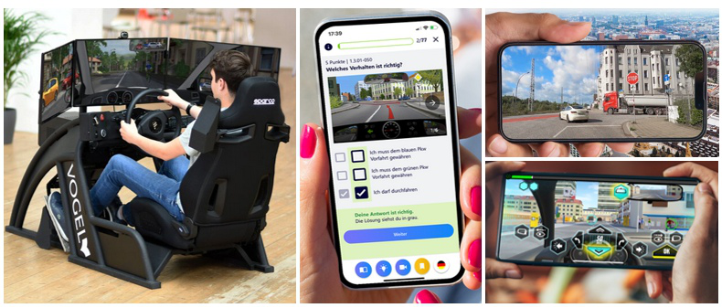
Research Background The Uwe Hübner Driving School and the Smart Health Lab (SHL) of the Uni- versity of the Bundeswehr Munich have joined forces to clarify the research questions raised. The driving school has two branches in Schwarzenberg and Aue with a total catchment area of around 38,000 inhabitants. In 2023, there were around 750 learner driver registrations, which are supervised by 15 driving instructors and 5 office staff. Three of the driving instructors are still in training. The company uses the most modern permitted options avail- able from a technical perspective to train learner drivers. For example, the learner drivers are prepared for participation in road traffic with three differ- ent learning apps and driving simulators. Figure 2 shows the simulator and the interfaces of the apps used.
Figure 2: State-of-the-art technology for driving school training (Vogel, 2024).
While the focus of self-learning programs was initially only on training facts and theoretical test tasks, they are increasingly being used to develop
Physiological and Psychological Performance Measurement for the Practical Driving Test 385
practical traffic awareness and hazard avoidance (Weiß, 2009). Driving sim- ulators enable driving schools to adapt their training content precisely to the learning level of the individual learner driver. In addition, the learning suc- cess of learner drivers can be objectively recorded and driving performance can be clearly visualized for learning purposes (Genschow, 2013). Motor sequences, such as shifting gears, can be practiced and the reaction to danger- ous situations that do not necessarily occur in practical driving lessons can be trained (Weiß, 2009). The learning effectiveness of virtual scenarios was already established by Regan et al. in 2000. Looking at the learner driver training regulations, it is clear that only minor changes have been made to the framework plans and subject areas in the last 20 years. This means that every driving instructor is free to ensure that the content of their train- ing is complete (Sturzbecher, 2022). Measures for continuous improvement in the implementation of practical driving training are listed in the “Man- ual on the driving license examination system (practice)” (TÜV, 2019). Even when using the current possibilities of new concepts and technologies for the training of learner drivers, driving schools cannot ensure that learner drivers will pass the practical driving test. However, a prerequisite for admission to the practical driving test is a positive assessment by the supervising driving instructor (Sturzbecher, 2022). In addition to the factual consideration of knowledge for participation in road traffic, there are also minimum psycho- logical requirements for test candidates. Adequate performance of the learner driver is required in the following 5 areas for driving aptitude: Orientation ability, concentration ability, attention, reaction ability and resilience. Other dimensions, such as intelligence, sustained attention or vigilance, can be taken into account if necessary by referring to the assessment guidelines for driving aptitude (Gräcmann, 2022). Table 1 compares the performance areas with the necessary assessment criteria (Brenner-Hartmann, 2023).
Requirements Evaluation Guidelines load capacity sufficient attention capacity even under stress and prolonged strain orientation - fast and reliable perception of visual information - reasonably fast target orientation in the visual environment (traffic area) concentration uninterrupted concentration attention adequate distribution of attention ability to respond - timely onset of motor response - safe and appropriate reactions to the situation - balance between speed and caution
Driving instructors and driving examiners are thus confronted with psy- chological issues whose assessment goes far beyond the content of their own training. The term stress, which appears here, could offer a way of techni- cally validating the subjective assessment of driving instructors. Stress can be understood as the heavy strain placed on an organism by internal or external
stimuli. Current stress research is based, on the one hand, on the biological explanatory model of the physician Hans Selye and, on the other, on the psy- chological stress management model of the psychologist Richard Lazarus. In the biological model, stress is seen as a reaction and stress factors out- side the body are linked to internal reaction processes in a measurable way. The psychological model describes stress as an interaction between the effect of stressors and the coping options available (Ernst, 2022). Stress research makes use of a whole range of self-assessment questionnaires, but stress can also be assessed via the resulting physiological activation. Cardiovas- cular stress indicators in particular, such as heart rate, heart rate variability, blood pressure and electrodermal activity, are technically relatively easy to measure (Kasten 2018). Studies have shown that heart rate (HR), blood pres- sure (BP), respiratory rate (RR) and skin conductance (GSR) increase during stress, while heart rate variability (HRV) and skin temperature (ST) decrease. These biological values can now be recorded using commercially available, wearable sensors that can also be worn while driving (Gedam, 2021). In com- bination with classic psychological questionnaires and personality tests, these measured values should provide an insight into the stress level of learner drivers during practical driving school training. This data can enable the driving instructor to respond individually to a high level of stress among learner drivers. Based on this, the planned study will focus on answering the following interdisciplinary research questions: Q: Is there a correlation between learner drivers’ state of stress while driving and passing the practical driving test?
Q: How can physiological stress data during driving be correlated with the psychological stress recordings and the personality profile of learner drivers?
Q: How do the training of learner drivers and the working environment of driving instructors change as a result of continuous stress measurement during practical driving training?
Method
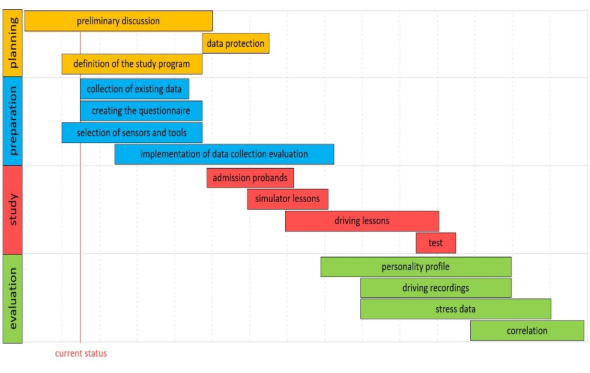
The study is currently still in the conceptual preparation phase. In the plan- ning phase, the main contents of the study are defined in the preliminary meetings and the course of the study is determined. Due to the methodical collection of personal data from learner drivers, a tested data protection con- cept is essential. This must also include all questionnaires and sensors used and can therefore only be drawn up after the questionnaires have been cre- ated and the sensors have been finally selected. In the first steps, the data already available at the driving school from handwritten logs and from the simulator must also be recorded and evaluated. Based on this, standardized online surveys are used. The task here is to develop a system for data collec- tion and to define the corresponding interfaces. This system must be able to record and correlate the different data from the questionnaires, the protocols, the simulator and the physiological sensors. Added to this is the information from the personality profile of the individual learner drivers, as well as the vehicle data, which must be recorded at the same time as the stress states
Physiological and Psychological Performance Measurement for the Practical Driving Test 387
obtained. The staggered procedure for the study is divided into individual work packages and can be seen in Figure 3.
Figure 3: Procedure model of the study.
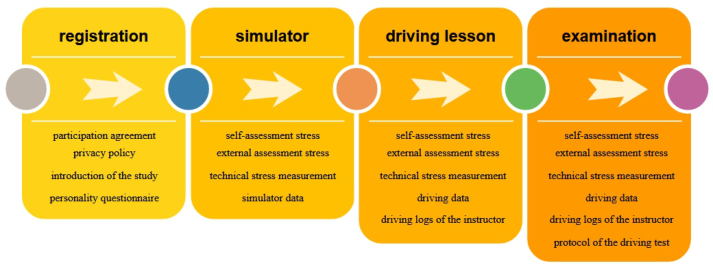
The actual study involves collecting data on the personality profile and stress levels of individual learner drivers in four different situations. These result from the course of practical driving training at the driving school. The first data is already collected during registration after the learner driver has given their consent to participate in the study and to the data protection con- cept. The actual driving training then starts parallel to the theory lessons in the driving simulator. In addition to the data collection that begins here with the help of the sensors, an assessment of the stress level before and after the simulator driving lesson is also collected. This assessment is made both by the test person themselves and by the responsible supervisor via the learner driver. The same procedure is planned for the subsequent practical driving lessons in the car. Here, the data collected is supplemented with the driving data of the vehicle and a report by the driving instructor on the procedure and special events during the driving lesson. Every learner driver must first complete several simulator driving lessons in order to qualify for the practi- cal driving lessons. At least a prescribed number of driving lessons must be completed and admission to the driving test is only granted once the driving instructor has additionally assessed that the learner driver has mastered all the necessary training content. The driving test with an external examiner can also be used as a data source for the test report, which was prepared as proof of performance. The procedure is the same for all learner drivers and Figure 4 shows the data collections that are assigned to the individual training sections.
Figure 4: Data capture during the study.
CONCLUSION
Technological progress and modern approaches enable stress research to open up new perspectives, particularly in areas of training. If stress states are a significant factor in failing examinations, the foundations for improved stress resilience can be laid during training and methodical action can be trained to enable the examinee to better control their stress state. This also changes the training content and tasks of the trainers to some extent. Taking practical driving training as an example, the psychological aspects of failing the test are obvious, as admission is only granted if all the necessary behaviors have been practiced and carried out correctly. The extent to which psycho- logical stress can be correlated with the technically recorded stress levels of learner drivers has yet to be evaluated in this study.
ACKNOWLEDGMENT
Many thanks to the driving school Uwe Hübner for providing their resources and to the dtec.bw Smart health lab of the University of the Bundeswehr Munich. This project is funded by dtec.bw - Center for Digitization and Technology Research of the German Bundeswehr. dtec.bw is funded by the European Union -NextGenerationEU.
REFERENCES
Bredow, B., & Sturzbecher, D. (2016). Ansätze zur Optimierung der Fahrschulausbildung in Deutschland: Approaches to the optimisation of driver education in Germany. Bundesanstalt für Straßenwesen. Brenner-Hartmann, J. & Schützhofer, B. (2023) Standards und Anforderungspro-
file in der Fahreignungsdiagnostik. In R. Dohrenbusch (Hrsg.), Psychologische Begutachtung, Springer-Verlag GmbH Deutschland, ein Teil von Springer Nature 2023. Ernst, G., Franke, A. & Franzkowiak P. (2022) Stress und Stressbewältigung. BZgA, Die Bundeszentrale für gesundheitliche Aufklärung, doi: 10.17623/BZGA:224- i118-2.0.
Physiological and Psychological Performance Measurement for the Practical Driving Test 389
Gedam, S. & Paul, S. (2021) A Review on Mental Stress Detection Using Wearable Sensors and Machine Learning Techniques. In IEEE Access, vol. 9, pp. 84045–84066, 2021, doi: 10.1109/ACCESS.2021.3085502. Genschow, J., Sturzbecher, D. & Willmes-Lenz, G. (2013): Fahranfängervorbereitung
im internationalen Vergleich. Berichte der Bundesanstalt für Straßenwesen, Reihe “Mensch und Sicherheit”, Heft M 234. Bremen: Fachverlag NW. Gräcmann, N., & Albrecht, M. (BASt). (2022). Begutachtungsleitlinien zur Kraftfahreignung vom 27. Januar 2014 (Verkehrsblatt S. 110) Fassung vom 17.02.2021 (Verkehrsblatt S. 198), in Kraft getreten am 01.06.2022 mit der Fünfzehnten Verordnung zur Änderung der Fahrerlaubnis-Verordnung und an-derer straßen- verkehrsrechtlicher Vorschriften (Bundesgesetzblatt Teil I Nr. 11 vom 25. März 2022). Grattenthaler, H., & Krüger, H. P. (2009). Bedeutung der Fahrpraxis für den
Kompetenzerwerb beim Fahrenlernen: Literaturstudie. IM-NRW (2024) 18-24-Jährige im Straßenverkehr: Die sieben risikore- ichen Jahre!. Ministerium des Innern des Landes Nordrhein-Westfalen, https://polizei.nrw/artikel/18-24-jaehrige-im-strassenverkehr-die-sieben-risikore i chen-jahre, access: 08.02.2024. Jannusch, T., Ressel, J., Völler, M. (2023). Sicherheitsversprechen im Wandel. In: Arnold, R., Berg, M., Goecke, O., Heep-Altiner, M., Müller-Peters, H. (eds) Risiko im Wandel. Springer Gabler, Wiesbaden. https://doi.org/10.1007/978-3- 658-37071-8_9 Janson, M. (2019). Neue Autofahrer für das Land. Statista. Statista GmbH. Zugriff:
09. Februar 2024. https://de.statista.com/infografik/17463/anzahl-der-fuehrersc heinpruefungen-in-deutschland/ Kasten, N., Fuchs, R. (2018). Methodische Aspekte der Stressforschung. In: Fuchs, R., Gerber, M. (eds) Handbuch Stressregulation und Sport. Springer Reference Psychologie. Springer, Berlin, Heidelberg. Mörl, S. (2020) Entwicklung und Erprobung konzeptioneller Grundlagen zur
lernförderlichen Gestaltung von Kompetenzrückmeldungen bei der Praktischen Fahrerlaubnisprüfung. Dissertation, Universität Potsdam. Regan, M. A., Triggs, T. J. & Godley, S. T. (2000): Simulator-based evaluation of the DriveSmart novice driver CD-ROM training product. Monash: MUARC. Schramm, D., Schweig, S. (2020). Fahrerassistenzsysteme – ein Überblick. In:
Proff, H., Brand, M., Schramm, D. (eds) Altersgerechte Fahrerassistenzsysteme. Springer Gabler, Wiesbaden. Sturzbecher, D. & Brünken, R. (2022) Ausbildungs- und Evaluationskonzept zur Optimierung der Fahrausbildung in Deutschland, BASt-Bericht M 330, https: //www.bast.de/DE/Publikationen/Berichte/unterreihe-m/2022-2021/m330.html. TÜV | DEKRA ARGE TP 21 (2019): Handbuch zum Fahrerlaubnisprüfungssystem
(Praxis). Dresden: TÜV | DEKRA arge tp 21. Vogel, Verlag Heinrich Vogel (2024) https://www.fahren-lernen.de/de, access: 08.02.2024. Vohle, F., Reinmann, G. (2012). Förderung professioneller Unterrichtskompetenz mit digitalen Medien: Lehren lernen durch Videoannotation. In: Schulz-Zander, R., Eickelmann, B., Moser, H., Niesyto, H., Grell, P. (eds) Jahrbuch Medienpäda- gogik 9. VS Verlag für Sozialwissenschaften. Weiß, T., Bannert, M., Petzold, T. & Krems, J. F. (2009): Einsatz von computergestützten Medien und Fahrsimulatoren in Fahrausbildung, Fahrerweiterbildung und Fahrerlaubnisprüfung. Berichte der Bundesanstalt für Straßenwesen, Reihe “Mensch und Sicherheit”, Heft M 202. Bremerhaven: Wirtschaftsverlag NW.
LISTED IN THE AHFE DIGITAL BOOKSTORE CATALOGUE
Explore the complete digital volume
Advances in Human Factors of Transportation
Read this individual research paper free through the original publisher, or explore the full digital proceedings book.
ISBN 978-1-964867-24-3
Explore this ISBN in the AHFE Bookstore ↗Listed in the July 2026 bookstore catalogue; search by ISBN to confirm current availability · Digital book purchase optional