Christian Di Natali, Pinar Sancandan, Darwin Caldwell (2025). User-Centred Design of Industrial Exoskeletons: Addressing Anthropometric Differences to Enhance Performance and Acceptance. In: Human Factors in Design, Engineering, and Computing. AHFE Open Access, vol. 199, pp. 390–402. https://doi.org/10.54941/ahfe1006851
Industrial exoskeletons represent a transformative technology with significant potential to revolutionize worker conditions across various sectors by substantially reducing the risk of musculoskeletal injuries and work-related disorders[1]. By providing mechanical assistance and redistributing loads, these wearable robotic systems support the worker's natural movement pattern and reduce the stress on vulnerable body regions such as the spine and joints during physically demanding tasks[2]. This minimizes cumulative fatigue that leads to long-term health complications and enhances accessibility to physically intensive roles that require heavy lifting, repetitive motions, and prolonged static postures, by reducing physical barriers in the workforce[3]. Furthermore, industrial exoskeletons serve as powerful equalizers in the workforce, significantly reducing physical barriers that have historically limited access to specific heavy-duty occupations.This technological advancement has profound implications for workforce diversity and inclusion, particularly in promoting gender balance within traditionally male-dominated industries such as construction, manufacturing, logistics, and heavy machinery operations[4]. Exoskeletons enable a broader range of individuals to perform demanding manual labor safely and effectively, regardless of their natural physical capabilities and endurance[5]. This democratization of physical labor expands employment opportunities for underrepresented groups and addresses critical labor shortages in essential sectors[6].However, realizing this inclusive potential relies on applying human factors in the design and development of the exoskeletons. Industrial workers represent a diverse population with varying anthropometric characteristics, body types, sizes, and physiological differences across genders[7]. To accommodate the wide user range, many exoskeleton developers follow universal sizing strategies, which require developing various sizes of wearables and mechanical components to adapt the exoskeleton for different users. This prolongs development time and complicates manufacturing, thus increasing costs.Alternatively, others pursue a one-size-fits-all approach, designing a device that allows, in rough steps, size adjustment to accommodate all users in the broadest range possible. However, this may fail to adequately address individual users' nuanced biomechanical and ergonomic needs[8]. This compromise between commercial viability and user-specific optimization can result in suboptimal performance, reduced comfort, compromised safety, and ultimately limited adoption rates[9].The consequences of this oversimplified design approach become particularly pronounced when examining user acceptance rates, with evidence suggesting that inadequate customization leads to poor fitting and widespread rejection of exoskeleton technology among end users[10]. This challenge is especially acute when considering female body morphology, where fundamental differences in skeletal structure, muscle distribution, center of gravity, and joint mechanics require specialized design accommodations that generic solutions cannot adequately address[11],[12].The female body typically exhibits distinct anthropometric characteristics, including narrower shoulders, wider pelvic regions, different torso proportions, and varying limb-to-torso ratios compared to males. These factors significantly influence how exoskeletons interface with the body and distribute mechanical loads[13]. When exoskeletons are designed primarily around male anthropometric data or averaged measurements that fail to account for these biological differences, female users often experience poor fit, inadequate support, pressure points, restricted range of motion, and compromised biomechanical assistance[7], [14].To address these critical design shortcomings and advance toward truly inclusive exoskeleton technology, this paper comprehensively applies user-centered design principles to develop an enhanced human-machine interface for industrial exoskeletons. Specifically, we focus on redesigning the wearables (exoskeleton's harness components) that serve as the critical interface between the robotic system and the human body in our StreamEXO industrial exoskeleton platform.Method and Achievements: An active exoskeleton, StreamEXO, with continuously size-adjustable components, was developed to accommodate 90% of the target population, and stability and comfort were assessed during physical working activities. While static fitting was effective across genders, instability was observed in female users during dynamic tasks due to anthropometric differences. The redesign of the wearables with a user-centered approach, based on female-specific body characteristics, significantly improved fit and stability, with an increment of about 15% and reaching a score of 6 on a 7-point Likert scale in device acceptance in a formal test with 15 female subjects.
Industrial exoskeletons represent a transformative technology with significant potential to revolutionize worker conditions across various sectors by substantially reducing the risk of musculoskeletal injuries and work-related disorders (Bogue, 2018). By providing mechanical assistance and distributing loads, these wearable robotic systems support the worker’s natural movement pattern and reduce the stress on vulnerable body regions such as the spine and joints during physically demanding tasks (De Looze, 2016). This minimizes cumulative fatigue that can lead to long-term health complications while enhancing accessibility to physically demanding roles requiring heavy lifting, repetitive motions, or prolonged static postures (Howard, 2020). Industrial exoskeletons act as powerful equalizers in the workforce by reducing physical barriers that have historically limited access to heavy-duty occupations.
User-Centred Design of Industrial Exoskeletons 391
This technological advancement has profound implications for workforce diversity and inclusion, particularly in promoting gender balance within traditionally male-dominated industries such as construction, manufacturing, logistics, and heavy machinery operations (Rodgers, 2025). Exoskeletons enable a broader range of individuals to perform demanding manual labour safely and effectively, regardless of their natural physical capabilities and endurance (Kim, 2019). This democratization of physical labour expands employment opportunities for underrepresented groups and addresses critical labour shortages in essential sectors (Chao, 2024).
However, realizing this inclusive potential relies on applying human factors in the design and development of the exoskeletons. Industrial workers represent a diverse population with varying anthropometric characteristics, body types, sizes, and physiological differences across genders (Bardagjy, 1973). To accommodate the wide user range, many exoskeleton developers follow universal sizing strategies, which require developing various sizes of wearables and mechanical components to adapt the exoskeleton for different users. This prolongs development time and complicates manufacturing, thus increasing costs.
Alternatively, others pursue a one-size-fits-all approach, designing a device that allows, in rough steps, size adjustment to accommodate all users in the broadest range possible. However, this may fail to adequately address individual users’ specific biomechanical and ergonomic needs (Søraa, 2020). This compromise between commercial viability and user-specific optimization can result in suboptimal performance, reduced comfort, compromised safety, and ultimately limited adoption rates (Chao, 2024).
The consequences of this oversimplified design approach become particularly pronounced when examining user acceptance rates, with evidence suggesting that inadequate customization leads to poor fitting and widespread rejection of exoskeleton technology among end users (Sposito, 2022). This challenge is especially acute when considering female body morphology, where fundamental differences in body proportion, muscle distribution, centre of gravity, and joint mechanics require specialized design accommodations that generic solutions cannot adequately address (Wollesen, 2024) (Wollesen, 2024). The female body exhibits distinct anthropometric characteristics compared to the male body, including a relatively smaller torso, greater hip breadth, and differing limb-to-torso and waist-to-hip ratios. These factors significantly influence how exoskeletons interface with the body and distribute mechanical loads (Hokka, 2024). When exoskeletons are designed primarily around male anthropometric data or averaged measurements that fail to account for these biological differences, female users often experience poor fit, inadequate support, pressure points, restricted range of motion, and compromised biomechanical assistance (Sposito, 2021).
To address these critical design shortcomings and advance toward truly inclusive exoskeleton technology, this paper comprehensively applies user- centred design principles to develop an enhanced human-machine interface for industrial exoskeletons. Specifically, we focus on redesigning the
wearables (exoskeleton’s harness components) that serve as the critical interface between the robotic system and the human body in our StreamEXO industrial exoskeleton platform.
DESIGN OF WEARABLES FOR INDUSTRIAL EXOSKELETONS StreamEXO: Overall Description
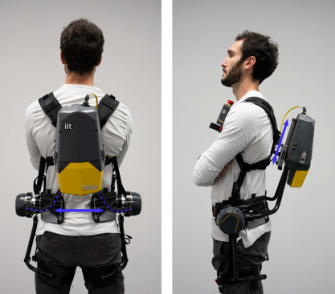
The exoskeleton used in this study, StreamEXO (Figure 1), is a wearable robot specifically designed to assist construction workers in manual material handling (MMH). It provides physical support to the lower back while ensuring a wide range of fit and minimizing encumbrance for optimal usability. The StreamEXO is an active exoskeleton that integrates two electric motors, sensors, electronics, a battery, and an onboard computer able to run adaptive control algorithms that allow the exoskeleton to adjust the assistive strategies compatible with the task performed by the user (Di Natali, 2024). Its continuous size adjustment system ensures maximum fit and comfort to 95 percent of the European workers’ population. Thanks to this design solution, although the exoskeleton features a rigid structure, it can accurately accommodate diverse sizes in hip width and torso length without the need for component replacement (WO Patent No. WO2024062364A1, 2022).
Figure 1: StreamEXO (Di Natali, 2024) including the compass design functional details for waist and hip widths and torso length adjustments.
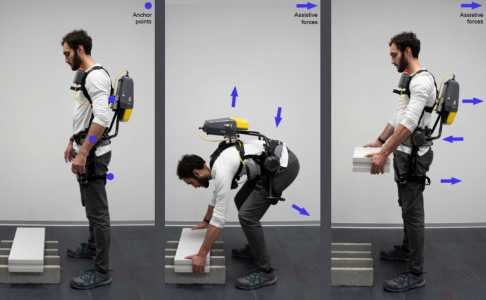
StreamEXO: Working Principle From a mechanical point of view, an exoskeleton is a wearable robot that is anchored to the human body to support joint movements by transferring assistive forces and torques. The anchor points are chosen based on the target biological joints to assist to ensure a kinematic compatibility of the exoskeleton. The wearable robot unloads assistive forces comfortably by enabling the target joint to perform a natural range of motion. The back support exoskeletons aim to support the user’s trunk during MMH, particularly lifting, lowering, and carrying motions with augmented torques at the user’s hip joints. Typically, these exoskeletons are anchored to the body at the shoulders (through the shoulder straps), waist (through a belt),
User-Centred Design of Industrial Exoskeletons 393
and legs (with leg straps). In contrast to existing exoskeleton designs, the StreamEXO eliminates floating actuators above the hip joint which provide the axis alignment between the actuator and hip joint centres of rotation. Instead, StreamEXO anchors the actuators on the two sides of the iliac crest, above the hip joints. This solution ensures stable positioning and offloads the exoskeleton load.
It enables increased freedom of movement for the user’s legs, particularly for abduction and adduction movements. A simplified representation of the StreamEXO in Figure 2 shows how the exoskeleton supports the user by transferring the assistive forces (arrows) over the anchor points while lifting an object.
Figure 2: Anchor points of the exoskeleton (left) and trunk-leg force diagram generated by the exoskeleton.
User Centred Design Methodology We have applied the user-centred design (UCD) approach (ISO_9241, 2010) to create improved versions of StreamEXO. In the UCD, four linked activities shall take place during the design of the system: understanding and specifying the context of use, specifying the user requirements, producing design solutions, and finally evaluating the design. The two activities, “Producing design solutions” and “Evaluating the design,” have been performed in sequence within the development process, enabling us to apply the iterative approach to improve our development quickly. This work presents the following main areas of development: (i) Analysing the anthropometric differences between genders, (ii) Understanding the worker movements which affect dynamic fit, (iii) Designing new wearables dedicated to female body morphology to ensure stability and comfort, and (iv) Testing the dynamic & static fit of the wearables on female users to gather feedback.
Human Factors and Ergonomics In wearable technologies, the ergonomics must be considered in the early design stage to create an optimal user experience and to be able to
access all potential users (Francés-Morcillo, 2018) (Duval, 2010) (Chae, 2007). The main characteristic to be considered is the fit to various body sizes and forms of male and female users of our target group (construction workers). The proper fit of an exoskeleton is not only needed for the user’s comfort and acceptance, but it is also crucial to provide effective assistance (Sposito, 2021). The exoskeleton’s wearables must fit adherently to the user’s body without hindering any range of motion. Therefore, it is essential to analyse body dimensions and form of both genders.
Anthropometric Study The parent population was extracted from the anthropometric dataset centred between the 97.5th percentile and the 2.5th percentile (Table 1) of the U.S. population (Tilley, 2017). Then, we collected anthropometrical data from potential users: 15 subjects (12 males and 3 females) from a construction company, and additionally, 15 female subjects from our research institute (Table 2).
Based on the ratio scaling technique, it is found that the male target population represents the 57th percentile and the female target population represents the 75th percentile of the parent population (Table 1). We have chosen to accommodate 95% of the parent population (between the 2.5th and the 97.5th percentile) by providing adjustable sizes within this range.
Table 1: Anthropometric data of the chosen parent population, which reports principal body dimensions of males and females.
Table available in the original PDF paper.
Male Female
Body Measurements/ Population Percentile 2.5th 50th 97.5th 2.5th 50th 97th
The anthropometric measurements of the target population give the general dimension range that must be followed in the design of the exoskeleton. These measurements are very important for static fit, which is defined as the fitting of the exoskeleton on the user in static postures such as standing and sitting. Table 1 shows the main body dimensions that are crucial to comply with each user for our exoskeleton; the stature, trunk length, and hip width are the important dimensions for static fit taken from the parent population. Since the exoskeleton must be anchored to the body, its structure must be adjustable in both vertical and horizontal dimensions to accommodate anthropometric variability.
Moreover, the exoskeleton must fit the user’s body properly to provide adequate support during physical activities, and such a feature is named dynamic fit (Sposito, 2022). For dynamic fit, we need to accommodate with the changing body measurement during the working activity movements such as stooping, squatting, and walking. Therefore, the difference in the hip width while standing and sitting is very important. As it is seen in the table, the hip width enlarges in sitting posture. Moreover, the difference between the waist and hip circumferences changes drastically in women. The wearables must anchor the exoskeleton to the body and provide stability while accommodating the size and form changes of the body to ensure workers to perform comfortably without feeling any hindrance in their movements.
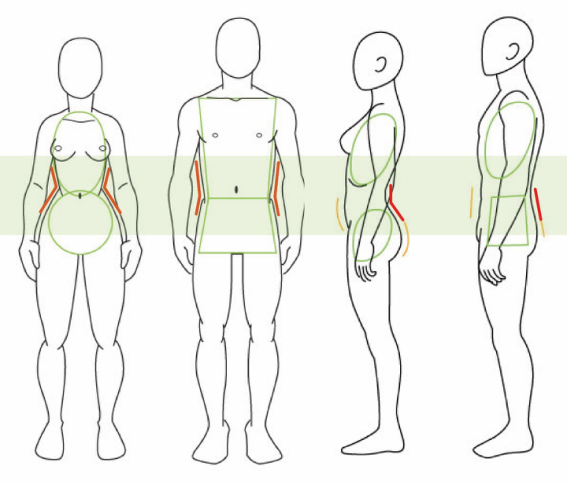
Male vs Female Anthropometry When the anthropometric data is analysed, it’s evident that male and female bodies have very different shapes. Female body morphology is characterized by a comparatively shorter trunk length, narrower waist, greater hip breadth, and more pronounced body curvature than that of males (Figure 3). The difference between waist and hip breadth in females is approximately twice that observed in male body dimensions (Table 1). These measurements show that the female body has a significant concave shape in the waist area, whereas the male body is almost flat. Moreover, hip width enlarges up to 2.2 cm in sitting and squatting positions. The exoskeleton must comply with these dynamically changing body dimensions. The waist and hip circumference are essential when designing the belt fitting for different genders. Indeed, the belt must adapt to a significant dimension change. In addition, the belt positioned over the iliac crest (lower waist) tends to slide up during physical movements, because of the female’s narrowing form of the waist. Therefore, the female body requires a specific design for wearables and countermeasures to prevent instability in the anchor points of the exoskeleton.
Figure 3: Main body shape differences illustrated between male and female bodies.
Exoskeleton Design A distinct design feature called the “compass design” mechanism was developed to ensure size regulation (WO Patent No. WO2024062364A1, 2022). The exoskeleton frame is composed of two rods connected to the back joint, and these can move freely on an axis, changing the distance between the two motors for a continuous size adjustment. The belt and the compass design allow the frame to easily adapt to different users’ sizes by adjusting the opening of the structure rods with varying waist widths. This design enables the exoskeleton to fit people with a waist width range of 26 to 48 cm. A slider system is used to adjust the torso length of the exoskeleton and distribute the weight between the shoulders and the waist (Zeagler, 2017). The wearables interface between the rigid components of the exoskeleton and the user must be developed with proper compliant materials to unload assistive forces safely and comfortably over the user’s body.
Wearables Design Exoskeleton’s wearables have multiple functions, such as providing stability to the anchor points, unloading the assistive forces comfortably, and distributing the exoskeleton’s weight evenly on the body, while avoiding hindering movements.
StreamEXO is worn on the user’s upper body like a backpack. Since the high discomfort on the shoulders is rated as the most limiting factor for load carriage tasks, it is essential to balance the device’s load as much as possible to improve comfort and align it to the body’s centre of gravity. It is recommended that the load be distributed so that the waist supports approximately two to three times more weight than the shoulders.
User-Centred Design of Industrial Exoskeletons 397
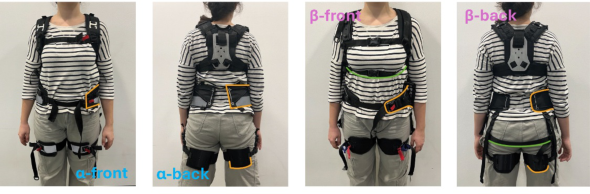
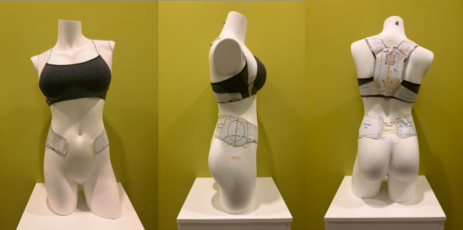
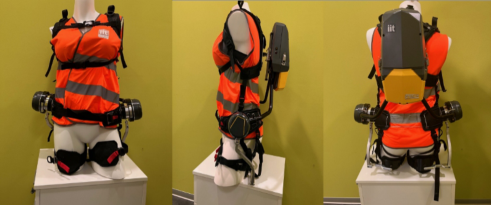
The exoskeleton must fit appropriately to the user’s body to effectively support workers during physical activities without hindering movement. Since the male and female bodies are significantly different in form and dimensions, the wearables must be explicitly designed for the genders to ensure a good fit and stability of the exoskeleton. After detailed research on female anthropometry, the design requirements are defined, and new wearables for females are designed to improve the fit and stability of the wearables on the female body. New prototypes are produced in-house. Figure 4 and Figure 5 highlight the key differences between the male (alpha) and female (beta) versions of wearables.
Figure 4: Wearables male version - alpha (left), wearables female version - beta (right).
Belt The distance between C7 and S1 vertebrae changes on average to 71.1 mm ±7.3 mm when performing a stoop (Huysamen, 2018). Therefore, the lumbar area is unsuitable for an anchor point, since it will result in uncomfortable rubbing. The most stable belt placement is over the iliac crest, which can ensure secure motor positioning on the body while minimizing discomfort due to its limited deformation during movement. This solution moves the actuators away from the hip joints, allowing increased freedom of movement to the hip and legs. To protect the lumbar area from any direct force, the belt is designed in a specific form to leave the spine free. The belt features a bi- directional adjustment system for continuous sizing with two lateral BOA fit systems, and a cabling system is used to regulate the distance between the two halves of the belt easily and provide a better fit. The goal is to keep the motors aligned with the coronal plane, while the compass design adjusts the waist width based on the user’s body. To provide evenly distributed pressure all around the belt surface, the channels for the cables are positioned on top and the bottom of the belt (Figure 4).
The beta belt design is contoured to conform more closely to the curvature of the female body, accommodating the larger gluteal musculature and the more pronounced lumbar region, which can influence belt stability. To address this, the posterior section of the belt is narrowed to enhance fit and mobility, while the anterior part is also slimmed to improve comfort. Due to the narrowing waist shape of the female body, the belt tends to migrate upward during squatting and stooping. To prevent this and ensure long- term dynamic stability, a stability-enhancer was developed. This component
consists of webbings that connect the belt with the leg straps, and it is shown with green colour in Figure 4, showing the back side of the beta design. The size and the position of the stability-enhancer can be adjusted.
Shoulder Straps Carrying loads on the shoulder for long periods and applying assistive forces may cause enhanced fatigue, discomfort, and pain. To reduce the discomfort and soft tissue deformations, the device’s loads should also be balanced over the medial segment of the body. Therefore, in addition to the sternum strap, a chest strap that interconnects the shoulder straps under the bust is integrated into the shoulder straps to distribute the pressure on the chest and shoulder area more evenly and improve the load’s stability (Figure 4). Based on ergonomic studies, S-shaped shoulder straps that follow the body form have been developed to improve the fit of the shoulder straps. In addition, an enhanced size adjustment solution has been developed to allow users to regulate the size simply by pulling the webbing on the shoulder forward with a limited effort. Thanks to the new design and size adjustment system, the beta’s shoulder straps can cover a wider range of sizes (L, M, S, and XS), which is crucial for females having a smaller and shorter torso than males.
Figure 5: Female wearables’ pattern design on a manikin.Figure 6: Female design (beta) of the exoskeleton harness on a manikin.
Leg Straps The leg straps aim to secure the position of the leg joint on the middle hamstrings to transmit the pulling force to the quadriceps effectively. Since it
User-Centred Design of Industrial Exoskeletons 399
is located on highly active muscles in working activities (walking, stooping, and squatting), the design requires not only to grip the leg comfortably, but also to adapt responsively to the form changes caused by the muscle activity. Leg straps tend to slip downward along the legs due to their cylindrical geometry and muscular activity. The stability enhancer described above was developed as a unique solution to eliminate this issue and ensure the positional stability of the leg straps and the belt. The design accommodates leg sizes from 45–60 cm, with easy adjustment using a magnetic buckle (Figure 6). Elastic and inelastic webbings provide a secure fit in dynamic conditions. New leg straps have a curved form composed of hard and soft materials that help users to place them easily in the correct position. A rigid part that follows the form of the leg is added on the front to distribute the pulling force applied to the leg (Figure 4).
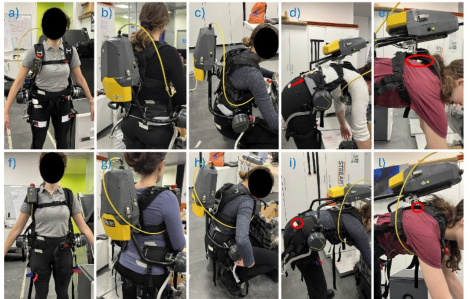
Test Protocol Fifteen female subjects were tested, and feedback was collected from each subject to evaluate the comfort and fit of the beta design when compared with the alpha design of wearables (Figure 7). Each participant wore both exoskeleton versions and repeated three different MMH movements with exoskeleton assistance: walking (3min), stooping (3min), and squatting (3min). At the beginning of the experiment, the positions of the wearables were marked on the subject to observe any relative movement of the wearables over the body during the experiment, and to compare the stability of each wearable. After the experiment, the participants completed a questionnaire about the tested exoskeleton. The participants did not know which version of the exoskeleton (alpha or beta), they were wearing.
Figure 7: Experiment with female subjects, alpha (on top), beta (on bottom).
RESULTS AND DISCUSSION
The harness’s female (beta) and male (alpha) versions are tested on subjects to observe their fit and stability.
It is observed that the alpha belt design is moving up during squatting on the female body and does not return to its initial position after the movement
because of the narrowing waist shape of the female body (Figure 7.c). However, it is clearly visible from Figure 7.i that the female belt (beta), thanks to its form and the stability-enhancer integration, is very stable on the female body during squat and stoop.
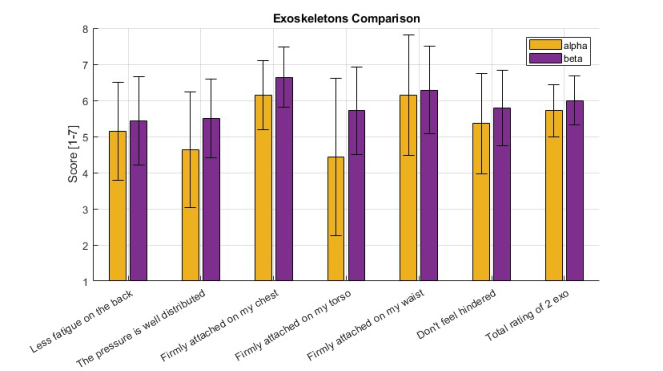
As shown in Figure 7.l, when compared to Figure 7.e, the fit of the shoulder straps is improved in the beta design, which significantly enhances the pressure distribution and the stability of the exoskeleton on the user’s shoulders and chest. We gathered feedback from the user at the end of the tests. Figure 8 shows the comparison graph. The subjects indicated that the beta design was firmly attached to their torso, with a significant increment of 24% compared to the alpha design. The beta design also received a high score in the even distribution of the overall pressure of the harness on the body, with an increment of 16%. When the pressure is distributed correctly, less fatigue is expected on the body, and the subjects indicated less fatigue in the beta design with a 5% increment. When considering the stability of the exoskeleton on the user’s body, we also analysed the chest area and the waist, obtaining an increment for the beta design with respect to the alpha design of 9% and 3% respectively, which justifies a better fit and pressure distribution on the shoulder straps and the belt for the beta design. Then, the beta design reduces the hindrance perceived by about 8%, allowing users to move naturally while wearing the beta design. Finally, both wearables were evaluated with a high score of 5.7 and 6 out of 7, respectively, but the beta increased its overall acceptance by 5%.
It is observed that the new shoulder straps and the belt of the beta design provide better fit on the female body, ensure stable attachments and improve the pressure distribution over the body. Subjects indicated that the beta wearable design makes them feel less hindered during physical activities. The beta design is evaluated with a higher score than the alpha design, with an average increment of 10%.
User-Centred Design of Industrial Exoskeletons 401
CONCLUSION
This work demonstrates that the user-centred design principles applied to the active exoskeleton, StreamEXO, enable truly inclusive redesign of an enhanced human-machine interface for such industrial exoskeletons. StreamEXO enables a continuous size-adjustable solution accommodating 90% of the target population, while ensuring good stability and comfort. Before this work, we observed that static fitting was effective across genders, but significant instability arose in female users during dynamic tasks due to anthropometric differences. The redesign of the wearables with a user- centred approach, based on female-specific body characteristics, significantly improved fit and stability, with an increment of about 10% and reaching a score of 6 on a 7-point Likert scale in device acceptance in a formal test with 15 female subjects.
ACKNOWLEDGMENT
This work was supported by the BEEYONDERS project funded by the European Union’s Horizon Europe research and innovation programme under grant agreement N 101058548.
REFERENCES
Bardagjy, J. C. (1973). Humanscale 1: A Portfolio of Information, 1. Sizes of People, 2. Seating Considerations, 3. Requirements for the Handicapped and Elderly. MIT Press. Bogue, R. (2018). Exoskeletons–a review of industrial applications. Industrial Robot:
An International Journal, 585–590. Chae, H.-S. e. (2007). An investigation of usability evaluation for smart clothing. in International Conference on Human-Computer Interaction. Chao, G. T. (2024). Occupational exoskeletons: Supporting diversity and inclusion
goals with technology. Journal of Vocational Behavior, 104016. Christian Di Natali, P. S. (2024). StreamEXO, Industrial Exoskeleton. Retrieved from if design award: https://ifdesign.com/en/winner-ranking/project/streamexo/ 633441 Christian Di Natali, T. P. (2022). WO Patent No. WO2024062364A1. De Looze, M. P. (2016). De Looze, Michiel P., TimExoskeletons for industrial
application and their potential effects on physical work load. Ergonomics 59, no. 5 (2016): 671–681. Duval, S. e. (2010). Humanistic needs as seeds in smart clothing. Smart Clothing: Technology and Applications, 153–188. Francés-Morcillo, L. e. (2018). The role of user-centred design in smart wearable
systems design process. in DS 92: Proceedings of the Design 2018 15th International Design Conference. Hokka, J. (2024). Gender and the Diversity of the Human Body as Challenges for the Inclusive Design of Wearable Technology. Fashion Practice, 108–133. Howard, J. V.-L. (2020). Industrial exoskeletons: Need for intervention effectiveness
research. American Journal of Industrial Medicine, 201–208. Huysamen, K. V. (2018). Elongation of the surface of the spine during lifting and lowering, and implications for design of an upper body industrial exoskeleton. Applied ergonomics, 10–16. Retrieved from 10–16.
ISO_9241. (2010). Ergonomics of human-system interaction–Part 210: Humancentred design for interactive systems. ISO_9241–210, 1–19. Kim, S. A.-A. (2019). Potential of exoskeleton technologies to enhance safety,
health, and performance in construction: Industry perspectives and future research directions. IISE Transactions on Occupational Ergonomics and Human Factors, 185–191. N., T. A. (2017). Humanscale: A portfolio of information. AI collaborative. Rodgers, Y. v. (2025). Wearable Assistive Robots Reduce Gender Gaps in the Construction industry? papers.ssrn.com. Søraa, R. A.-V. (2020). Exoskeletons for all: The interplay between exoskeletons,
inclusion, gender, and intersectionality. Paladyn, Journal of Behavioral Robotics, 217–227. Sposito, M. T. (2021). Physical comfort of occupational exoskeletons: Influence of static fit on subjective scores. In Proceedings of the 14th PErvasive Technologies Related to Assistive Environments Conference, 60–68. Sposito, M. V. (2022). Measuring anthopometric fit for exoskeletons: Methodologies
and preliminary assessment. In 2022 9th IEEE RAS/EMBS International Conference for Biomedical Robotics and Biomechatronics (BioRob), 01–08. Wearable-technology-affordances-body-maps. (n.d.). Retrieved from http:// wcc.gatech.edu/content/wearable-technology-affordances-body-maps. Wollesen, B. J. (2024). Gender Differences in Performing an Overhead Drilling Task Using an Exoskeleton—A Cross-Sectional Study. Biomimetics, 601. Wollesen, B. J.-W. (2024). Gender differences in the use of an upper-extremity
exoskeleton during physically and cognitively demanding tasks-a study protocol for a randomized experimental trial. Frontiers in Neurology, 1401937.
LISTED IN THE AHFE DIGITAL BOOKSTORE CATALOGUE
Explore the complete digital volume
Human Factors in Design, Engineering, and Computing
Read this individual research paper free through the original publisher, or explore the full digital proceedings book.
ISBN 978-1-964867-75-5
Explore this ISBN in the AHFE Bookstore ↗Listed in the July 2026 bookstore catalogue; search by ISBN to confirm current availability · Digital book purchase optional