Miriam Maibaum, Marc-André Weber, Sascha Stowasser (2023). Measures for human design of mental stress factors of digital work in public administrations. In: Human Factors and Systems Interaction. AHFE Open Access, vol. 84, pp. 1–8. https://doi.org/10.54941/ahfe1003584
The digital transformation is concerning people in several aspects. In working environments of many workers, major changes and challenges are becoming apparent because of the proceeding dissemination of information and communication technologies (ICT). With the implementation of new digital technologies and digitalized work processes, the demands and burdens of employees are also inevitably changing. The rapid pace of technological development can increase mental strain on employees (Gimpel 2018), and as a result, impairment in the form of stress can occur among individual employees. Especially, public administrations are under pressure, not only because they are facing a digitalization-driven transformation, but also because employees are encountered with an increased workload in their daily work due to legislative requirements. The study focuses on public administrations in Germany and aims to answer the overarching question of how the digital transformation can succeed by involving the employees in the process of change. Its also analysed how to design mental stress factors in a human-oriented way. For this purpose, the stress factors of digital work are defined as the following, according to GIMPEL et al. (2020):•Invasion of privacy & performance monitoringConcern about invasion of privacy and favouring the perception of surveillance. •Modification & complexityContinuing ICT changes and upgrades unsettle users and create uncertainty. The complexity of new technologies leads users to feel inadequate regarding their computer skills. Individuals are forced to constantly learn new technologies and undergo frequent educational trainings. •Fewer completed work tasksDigitization can make it more difficult to assess completed tasks and can lead to the feeling of hardly making any work progress.•Interruptions in the workdayThe use of ICT often introduces frequent interruptions into individuals' daily work routine, leading to increased stress and lower productivity.•Unavailability and unreliabilityDue to e.g. organizational restrictions new technologies are prohibited and it comes to an increased workload because of unstable running systems. •Information overloadThe workload increases due to higher amount of provided information and acceleration of work.•Overload and invasionDue to the dissolution of boundaries between work and private life employees force to work faster and longer where ICTs is used. They feel of being constantly reachable and a shorter response time is expected.In the paper, results of an interview study will be presented. As part of the study, 19 semi-structured interviews have been conducted between the beginning of August 2022 and the beginning of November 2022 with a total of 17 experts from public administrations in Germany who deal with digital transformation in their administrations and three consultants who support public administration in the transformation process. In the interview study, first the above-mentioned stress factors of digital work affect employees (with and without management responsibility) in public administrations were be determined. Then, with the help of an interview guide, insights were gained which concrete measures can be taken to involve employees to reduce psychological stress factors. Furthermore, an outlook is given which competencies need to be developed in the long term about dealing with digital transformation, both on part of the employees and in the role as a manager, and which actions can be derived regarding manager-employee relationships. The qualitative content analysis of the transcribed interviews will be carried out according to the general content analytical process model according to MAYRING (2022). In the Paper, a focus is laid on the category formation of the content analysis and the summary of the text material with the most important findings. LiteratureGimpel, Henner et al. (2020): Belastungsfaktoren der digitalen Arbeit. Eine beispielhafte Darstellung der Faktoren, die digitalen Stress hervorrufen. Augsburg.Gimpel, Henner et al. (2018): Digitaler Stress in Deutschland. Eine Befragung von Erwerbstätigen zu Belastung und Beanspruchung durch Arbeit mit digitalen Technologien. Working Paper Forschungsförderung. Edt. Hans-Böckler-Stiftung (101).Mayring, Philipp (2022): Qualitative Inhaltsanalyse. Grundlagen und Techniken. 13., überarbeitete Auflage. Weinheim: Beltz (Ciando library). Online verfügbar unter https://ebooks.ciando.com/book/index.cfm/bok_id/3137418.
The rapid pace of technological development is having a fundamental impact on the working world and may result in an increase of work stress for emplo- yees due to the digital transformation (Gimpel et al., 2018). As a result, impairments can occur, e.g., in the form of an increased sense of stress among individual employees. Public administrations are under pressure, not only because it is facing a digitalization-driven transformation, but also because employees are facing an increased workload in their day-to-day work due to legislative requirements in connection with the digital transformation of the public sector, as can be recognized for example in Germany (e.g., the imple- mentation of the Online Access Act (Onlinezugangsgesetz, OZG) by the end of 2022).
The technological changes may bring a change in the requirements of work activities and even in the job profiles (Schlicher et al., 2020). To minimize possible risks of the digital transformation in the working world as well as to use the potentials for a human design of work through new technological developments, a fundamental understanding of the effects of digital work on employees is necessary (Adolph et al., 2020). Currently, there is little research
on how digitalization in public administrations affects employees (Bogumil et al., 2022) and how work tasks can be designed according to the criteria of human work design in a working environment in which people increa- singly work with digital tools. The aim of our actual research is to find out how employees of public administrations participate in the progress of digital transformation and thus how the mental stress factors of digital work can be designed in a human-oriented way. For this purpose, qualitative interviews were conducted in the first step among employees in public administrations in Germany. In a second step, the results of the interview study serve as the basis for the development of a quantitative online survey.
METHODICAL APPROACH This paper presents the results of an interview study, which was conducted in the form of a qualitative preliminary investigation. It is reasonable in this context because it allows for an in-depth exploration of the subjective experiences of employees, identifies potential measures to improve their well- being, and is more flexible and adaptive to the specific context and research question.
To find out what effects the stress factors of digital work have on emplo- yees in public administrations and to identify possible measures for the participation of employees in the implementation process of new technolo- gies, 19 semi-structured expert interviews were conducted with a total of 20 participants (18 individual interviews and one with two interviewees). 17 participants are employees in public administrations who deal with digi- tal transformation in administrations (8 participants at the local-authority level, 9 participants at the state level). Three interviews were conducted with experts in research and consulting who support public administrations in the transformation process.
Data collection took place between August 2022 and November 2022, with interviews lasting between 24 and 54 minutes. To get started and to later deepen into the topic, in advance of conducting the interviews, the participants were asked to rank the following stress factors of digital work according to their subjective assessment (rank 1–7 with 1 as stress factor applies most to our administration, to 7 as stress factor applies least to our administration). The stress factors of digital work are defined in line with Gimpel et al. (2019) and provided with the following examples:
Invasion of privacy and performance monitoring: Performance data can be more easily collected through technological means. Concerns about invasion of privacy and a sense of constant surveillance may arise.
Modification and complexity: Constant change and the increasing com- plexity of ICT can trigger a feeling among employees of insufficient competence to use the new technologies.
Automatic inflow of tasks: The use of ICT can make it more difficult to assess completed tasks, since new work tasks are constantly being induced by the system. This can lead to a lack of sense of achievement and the feeling that less work progress is being made.
Measures for Human Design of Mental Stress Factors of Digital Work 3
Interruptions in the workday: Spontaneous notifications and information generated by ICT can lead to interruptions in the individual’s daily work routine. This can lead to concentration problems.
Unavailability and unreliability: Organizational restrictions, e.g., the pro- hibition of new technologies or the increase of workload due to unstable systems. As a result, employees can feel impaired in their work.
Information overload: The workload increases due to the greater or other structured quantity of information provided. A feeling of overload can arise.
Omni- and permanent presence: The use of ICT blurs the boundary between work and private life. The perception arises of the necessity of perpetual availability and reaction at short notice.
The result of the survey shows that, in the subjective perception of the inte- rviewees, primarily the two stress factors “Modification and complexity”and “Information overload” take effect in public administrations. These factors will be discussed further in this article.
Table 1 presents the evaluation categories. The evaluation of the transcri- bed interviews was carried out according to the qualitative content analysis by Mayring (2022). Inductive subcategories were added to the deductive categories that emerged from the interview guideline. The assignment to the categories was done using MAXQDA 2022. The focus was on explo- rative research, the quantification of the statements was not part of this analysis.
The results will be discussed further in the paper, after an explanation of the understanding of ‘digital transformation’ in public administration.
Table 1. Evaluation categories of the semi-structured interviews.
Table available in the original PDF paper.
Question Main category Subcategory Examples of coding units Perception of the stress factors Mental stress factors of digital work
Conducive framework conditions
“Pick up” at the workplace “Helping to shape the workplace”, “individual approach” Accompanying and transparent implementation
Modification and complexity “Insecurity and excessive demands despite training” Information overload “Faster and quicker pace”, “increasing e-mail flood” Involvement of the employees in the processes of change
“Accompanying implementation process” Support from colleagues “Peer-to-peer learning” Making decisions together “Implementation proposals”, “team decisions” Implementation barriers
Lack of time resources “Not enough time for training” Skills and knowledge “Still basic work has to been done” Way of thinking and slight willingness to change
“Not open minded”, “little willingness to change” Communication “Poor communication”
CONCEPTUAL UNDERSTANDING OF DIGITAL TRANSFORMATION For a uniform understanding of the term, it is first advisable to make a conceptual distinction between the dimensions of administrative digitali- zation. Mergel et al. (2019) differentiate between the terms digitization, digitalization and digital transformation:
Digitization of administration: the 1:1 transfer of analogue data into digi- tal storage formats and providing a digital medium for viewing (Mergel et al., 2019).
Digitalization of administration: Refers to the transformation of analogue processes into adapted digital processes. Digital networking among admi- nistrations and across organizational boundaries is promoted and can lead to the establishment of new organizational models (Mergel et al., 2019; Heuermann et al., 2018).
Digital transformation of the administration as comprehensive instituti- onal change: cultural, processual, and organizational change is sought. This leads to changes in staff and qualification structures as well as job and requirement profiles, employee participation, interaction with stake- holders, and long-term performance change in service provision (Mergel et al., 2019; Bogumil et al., 2022).
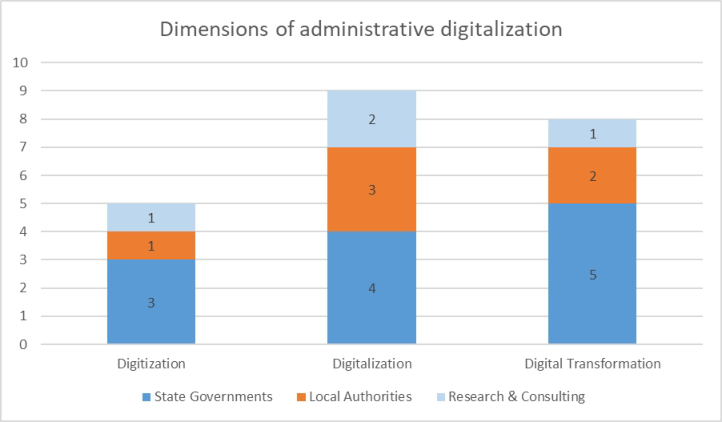
The first question in the interviews was about understanding what digital transformation in the public administration means, the interview participants were asked the question: “What does ‘Digital Transformation’ mean for public administration from your point of view?” Since the answers were very heterogeneous, they were grouped for evaluation into the above-mentioned conceptual dimensions. The numbers of mentions per dimension are shown in Figure 1. In some cases, there were multiple answers within one interview.
Figure 1: Grouping of mentions to the question: “What does ‘digital transformation’ mean for public administration from your point of view?”.
Measures for Human Design of Mental Stress Factors of Digital Work 5
The interviewees described perceiving the dimension of digitalization in the administrations rather than that is already possible to speak of a com- prehensive institutional change. In some administrations, the focus was still on transferring analogue data to digital storage formats. At the local- authority level there was still more talk of digitization and digitalization than of the implementation of new digital technologies as part of an extensive change.
It is obvious, that increasing digitalization will affect nearly every work- place in public administration. In the following, the challenges due to this development and specific to public administration are highlighted and measures for a human design of work tasks are identified.
RESULTS FOR THE HUMAN DESIGN OF WORK Stamer (2021) investigated the extent to which employees are considered in the process of digitalization from the perspective of HR managers. The results show that mental illness tends to increase when employees are not given suf- ficient consideration in the digitalization process (Stamer, 2021). Therefore, the question arises as to how employees can participate in the change process to shape the mental stress factors of digital work in a human-oriented way.
According to the interview participants, the increasing complexity and ongoing development of ICT in particular trigger uncertainty among public administration employees. They may feel that they have insufficient skills in dealing with (new) ICT. This is accompanied by the need to constantly deve- lop their competencies or learn new skills, which can be associated with a high expenditure of time (Gimpel et al., 2021). Furthermore, the stress factor “Information overload” was mentioned. The use of digital technologies can lead to a stressful experience since, e.g., the amount of information provided increases and there is a feeling of acceleration and increase in work (Gimpel et al., 2021). In the following, the results are classified according to the essen- tial criteria for human-centred work design in the digitalized working world for public administration according to Weber et al. (2022).
Variety of Requirements According to Mergel (2020), administrative processes will be partially auto- mated in the future so that tasks can be completed with less human interven- tion and proactively by machines (Mergel, 2020). The increasing demands in connection with work tasks are seen as a challenge for public admini- stration employees, as these will adapt to the possibilities of digital work design. It will therefore become increasingly unimportant, for example, to handle the processing of the applications in a traditional way. It will be much more about optimizing work processes and acquiring the knowledge of how ICT can support this. This also means that routines need to change. In the case of public administration, for example, it may be the introdu- ction of the ‘e-file’ at workplaces that leads to a change in routine working practices and initially causes uncertainty in administrations. This often ari- ses from the fact that work in the administration was ‘analogue’ for a very
long time. In addition, there is a very great deal of constancy in administra- tion. Employees are rarely confronted with a change of positions or working environments.
For the establishment of new ICT in the workplace, a central point that emerges from the interviews is that transparency and a structured imple- mentation process is an essential factor in being able to deal with the unfamiliar variety of requirements. It is important to have structured support during the implementation process and to be able to make decisions together based on the individual needs at the workplace. In the run-up, employees wish a transparent communication about the process. Employees should be appropriately prepared for the new requirements and given an appropriate familiarization phase. The amount and complexity of the provided infor- mation should also be workable for each employee (Weber et al., 2022). Consequently, individual interaction and learning opportunities are needed for personal, resource-dependent handling.
Promotion of Interaction and Learning The frequently changing use of digital work tools requires different forms of learning at work (Weber et al., 2022). A further necessity that interviewees consider as very important is that managers should ‘pick up’ employees at the workplace. This includes that employees want to be actively supported and feel that they are being paid attention to. Moreover, managers are also required to look at the competencies of the individual and offer appropriate development measures. A suitable learning environment, which can be crea- ted by the manager, helps to support work-integrated learning processes, and counteract to permanent underload or overload (Weber et al., 2022). To push digital work forward and increase the willingness to learn, it therefore makes sense, within the framework of human resources development, to provide individual training measures that fit the learning behaviour of the individual employee. It is important to the interview participants that there is a variety of learning opportunities, so that the individually different ways of acquiring knowledge can be considered.
In addition to the various learning formats that should be offered for indi- vidual continuing education and training, it is also useful to promote internal exchange among the employees. In some administrations, there are so-called ‘power users’ who have been intensively introduced to, e.g., new software and thus have specialist knowledge that they can pass on to their collea- gues. According to Hasenbein (2020), learning and development also take place through exchange with other people. Especially in today’s world, where people learn and interact more and more digitally, peer-to-peer learning, i.e., the structured learning between colleagues, will become more important (Hasenbein, 2020). This assessment is also evident from the interviews. Inte- raction and support among each other help employees to acquire new skills and abilities ‘uncomplicated’ and at short notice, which they need for their work with digital work tools. Time Resources should be created in the daily work routine for such new learning and interaction pathways.
Measures for Human Design of Mental Stress Factors of Digital Work 7
Elasticity of Time In the interviews it became clear that there is still little awareness at the individual level of the fact that the implementation of new techno- logies requires additional work at first before work proves to become easier.
The additional requirements (including familiarization with new techno- logy, participation in training courses) can often not be met due to a lack of time resources at the workplace. The interviews made clear that the lack of time to deal with innovations in addition to everyday tasks is seen as an obstacle to the implementation of new technologies. The introduction of the ‘e-file’, for example, was often introduced ‘on-top’ during regular working hours. There was usually training provided, but time to consolidate what had been learned in the workplace was rarely guaranteed.
The criterion of time elasticity, i.e., the integration of time buffers in work and time schedules, plays a central role in this case. To minimize hazards due to excessive workload, the relationship between the amount of work and working time should be balanced (Weber et al., 2022). The awareness that the implementation process of new technologies is perceived as an addi- tional workload and requires additional time resources from the side of the individual employee should be raised in public administrations. The intervi- ews reveal a desire to be given more time for employees in their day-to-day work to deal with new task. More time should also be invested in preparing employees for these new working tasks.
CONCLUSION
Overall, there are many challenges to be overcome in the digital transfor- mation process of public administrations. If the structures and mindsets that have evolved over time in public administrations are recognized and additi- onally the willingness to change them, there is a good chance to bring about positive changes. These changes will take time in two respects. On the one hand, the digital transformation is not a project that can be completed after a certain amount of time. Rather, a new variety of work task requirements will become established and work methods will constantly evolve to keep up with technological progress. This makes it clear that employees should con- tinuously develop their competencies (in process thinking, media handling, didactics, project management, readiness for change and problem solving). On the other hand, the transformation process also requires capacities in addition to the everyday tasks of the employees. Innovations and additional workload should not negatively impact employees’ health and consequently the administrations’ performance.
Based on the qualitative interview study, hypotheses will be developed in the further course of the research that are supposed to illustrate which measu- res for involving employees in the transformation process are significant for a human design of the digitalized working world. To this end, a quantitative online survey will be conducted amongst public administration employees in summer 2023.
REFERENCES
Adolph L, Kirchhoff B, Geilen J-H (2020). Sicherheit und Gesundheit in der digitalen Arbeitswelt. In: Maier GW, Engels G, Steffen E (Ed.) Handbuch Gestaltung digita- ler und vernetzter Arbeitswelten: Springer Berlin Heidelberg, Berlin, Heidelberg, pp. 21–34. Bogumil J, Kuhlmann S, Heuberger M, Marienfeldt J (2022). Bürgernahe Verwal-
tung digital? Digitalisierung und Automatisierung im Praxistest. Friedrich-Ebert- Stiftung, Bonn. Gimpel H, Berger M, Lanzl J, Regal C, Schäfer R, Wischniewski S, Certa M, Tegtmeier P, Kühlmann TM, Becker J, Derra ND, Eimecke J, Drees M, Bacherle P, Chung H-J, Ludwig D, Nübling M, Hüser S (2021). Prävention für sicheres und gesun- des Arbeiten mit digitalen Technologien.: Abschlussbericht des Verbundprojekts PräDiTec. Augsburg. Gimpel H, Lanzl J, Manner-Romberg T, Nüske N (2018). Digitaler Stress in Deutsch-
land: Eine Befragung von Erwerbstätigen zu Belastung und Beanspruchung durch Arbeit mit digitalen Technologien. Hasenbein M (2020). Der Mensch im Fokus der digitalen Arbeitswelt wirtschaftspsychologische Perspektiven und Anwendungsfelder. Berlin Springer. Heuermann R, Engel A, Lucke J von (2018). Digitalisierung: Begriff, Ziele und Steu-
erung. In: Heuermann R, Tomenendal M, Bressem C (Ed.) Digitalisierung in Bund, Ländern und Gemeinden: Springer Berlin Heidelberg, Berlin, Heidelberg, pp. 9–50. Mergel I (2020). Kompetenzen für die digitale Transformation der Verwaltung.
Innovative Verwaltung 16: 34–36. Mergel I, Edelmann N, Haug N (2019). Defining digital transformation: Results from expert interviews. Government Information Quarterly 36: 101385. Schlicher KD, Paruzel A, Steinmann B, Maier GW (2020). Change Management
für die Einführung digitaler Arbeitswelten. In: Maier GW, Engels G, Steffen E (Ed.) Handbuch Gestaltung digitaler und vernetzter Arbeitswelten: Springer Berlin Heidelberg, Berlin, Heidelberg, pp. 347–382. Stamer K (2021). Berücksichtigung der Beschäftigten im Prozess der Digitalisierung aus Sicht von Personalverantwortlichen. Zeitschrift für Arbeitswissenschaft 75: 105–116. Weber C, Tegtmeier P, Sommer S, Tisch A, Wischniewski S (2022). Kriterien einer
menschengerechten Gestaltung von Arbeit in der digitalisierten Arbeitswelt. In: Tisch A, Wischniewski S (Ed.) Sicherheit und Gesundheit in der digitalisierten Arbeitswelt: Nomos Verlagsgesellschaft mbH & Co. KG, pp. 11–45.
LISTED IN THE AHFE DIGITAL BOOKSTORE CATALOGUE
Explore the complete digital volume
Human Factors and Systems Interaction
Read this individual research paper free through the original publisher, or explore the full digital proceedings book.
ISBN 978-1-958651-60-5
Explore this ISBN in the AHFE Bookstore ↗Listed in the July 2026 bookstore catalogue; search by ISBN to confirm current availability · Digital book purchase optional