Bian Kun, Wang Yan, Dongnan Han (2023). Exploring Interactive Design Strategies of Online Learning Platform Based on Cognitive Load Theory. In: Human Factors and Systems Interaction. AHFE Open Access, vol. 84, pp. 9–17. https://doi.org/10.54941/ahfe1003585
In recent years, online learning has been increasingly popular due to its convenience and accessibility. To improve the quality of online learning, it is essential to understand the learners' cognitive load during online learning interaction. Cognitive load theory and teaching interaction hierarchy theory are employed to explore the impact of learners' cognitive load during online learning interaction. Based on these theories, this study utilizes EEG technology and subjective measurement to measure the cognitive load of learners' operational interaction and information interaction during online learning interaction. Six typical tasks were studied, including login, search, browse, share, and discuss. The results demonstrate that the login and search tasks have a higher cognitive load and the browse and share tasks have a lower cognitive load among the six typical tasks, virtual reality learning environments have a lower cognitive load than online learning environments. Therefore, by correctly identifying the cognitive load of tasks in operational and information interaction, optimization strategies can help to reduce the cognitive load of learners during online learning interaction and improve the quality of online learning.
With the continuous digitization and informatization of education, the way of accessing knowledge in life has changed fundamentally. Online learning has become the mainstream learning method nowadays. Interaction is regar- ded as a decisive and key component in the online learning process. (Mark et al. 2022). However, online learning platforms suffer from excessive redun- dant information and inadequate instructional interaction design, which led to low concentration and high dropout rates from learners. The learners are prone to excessive cognitive load during their interaction with the platforms. In fact, active and meaningful online learning interaction not only impro- ves learning effectiveness but also increases learning motivation and user satisfaction.
Online learning interaction is an important part of the learning process to improve the quality of learning, A lot of scholars have conducted relevant research. For example, Yang et al. (2012) proposed principles for the design
of interactive learning platforms in online learning. Wang et al. (2020) explo- red the patterns of students’ online collaborative behaviors when engaging with different multimedia by comparing the effects of three versions of media presentation (i.e., interactive version, video version, and text version) on cognitive load during online collaborative learning. Mu et al. (2020) constru- cted the interaction organization model and principles in online synchronous teaching from the perspective of remote interaction theory. Luo et al. (2017) explored how online interaction affects learners’ continued willingness to use online learning platforms.
In previous studies, researchers have adopted research methods such as literature reviews, theoretical studies, and statistical analysis to analyze online learning interaction activities. Different from the previous work, we combine EEG techniques and subjective questionnaires to measure the cognitive load of learners to reveal the cognitive patterns of learners during online learning interactions and provide support for the optimization of the online learning platform.
THEORETICAL FOUNDATIONS Cognitive Load Theory
Cognitive load is defined as the number of mental resources consumed by the learner in processing information, which was first introduced by Sweller in 1988 (Sweller, 1988). It consists of intrinsic cognitive load, extraneous cogni- tive load, and germane cognitive load (Sweller, 2010). The level of intrinsic cognitive load is mainly determined by the relationship between learners’ cognitive processes, capabilities, and prior knowledge. Extraneous cognitive load is related to the design and content of instructional activities and the presentation of materials. Germane cognitive load is triggered by the constru- ction and automation of schemas in the learning process, and it is explored to promote learning or cognitive development (Sweller, 2005). Online lear- ning platform interaction design is mainly related to extrinsic cognitive load, we focus on controlling and optimizing the cognitive load of learners’ online learning interaction process by decreasing extrinsic cognitive load.
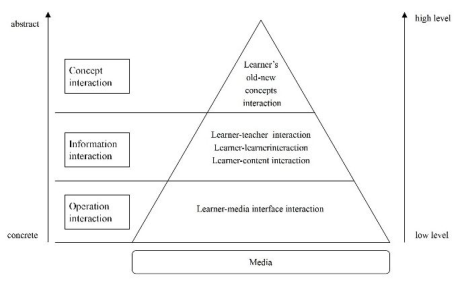
Teaching Interaction Hierarchy Tower In the previous work, Moore (1989) classified distance interaction into learner-content, learner-teacher, and learner-learner interaction. Moreover, Hillman et al. (1994) and Anderson (2003) added several types of learner interface, teacher-teacher, teacher-content, and content-content interaction. Differently, Chen divided online learning interaction into three layers: opera- tional interaction, information interaction, and conceptual interaction (see Figure 1). Operational interaction is the foundation and the key point of interaction design, which provides a visual learning environment for informa- tion interaction. Information interaction is the pivotal point of instructional design. Conceptual interaction is the highest level of interaction among them (Chen, 2004). Compared with Moore’s interaction classification, Chen’s hie- rarchical tower of instructional interaction not only encompasses theories of
Exploring Interactive Design Strategies of Online Learning Platform 11
previous studies but also conducts more systematic study of the hierarchy of interaction. Therefore, we adopt Chen’s hierarchical tower of instructio- nal interaction to analyze the online interaction process for online learning platforms.
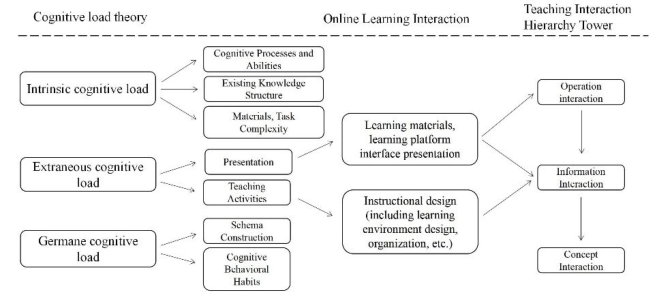
The Relationship Between Online Learning and Cognitive Load Among the three types of cognitive load theory, Extraneous cognitive load is related to the design of learning materials, environment, and the presenta- tion of the learning platform interface, these factors are closely related to the interaction design of the online learning platform. Therefore, the key of our study is to optimize the overall cognitive load by reducing extraneous cogni- tive load. In accordance with the teaching interactive hierarchy tower theory, the primary goal of the interaction design for online learning platforms is to directly facilitate operational and informational interaction and indirectly promote conceptual interaction (see Figure 2).
Figure 2: Research framework (drawn by authors).
METHODS
We proposed to utilize the cognitive load measurement method combining EEG techniques and subjective questionnaires to conduct the study. This method consists of two parts: measuring the cognitive load level of six typical tasks of university students during the operational interaction in the first part and then measuring the cognitive load of university students in two different learning environments during the information interaction in the second part. Finally, we suggest the optimal strategies for the online learning platform.
Part 1 Operational Interaction Experiment Design Experiment Equipment and Environment We adopted the 32-channel EEG recorder from the Neuroscan Company to constantly record the testers’ EEG. The reference electrode is the bilateral mastoid. The software suite used included E-Prime 3.0, CURRY 7.0, and MATLAB.
Experiment Platform and Objects We selected a massive open online course website (China University MOOC) as the experiment platform. The platform is one of the most popular MOOC platforms in China, covering most universities in China, with a lot of course categories and digital resources.
We publicly recruited 28 undergraduate university students. Considering the special requirements of the experiments, 26 students who had no prior learning experience with China University MOOC and had not taken the course “Basic Principles of Marxism”are selected as experimental subjects. In our experiments, four of these subjects’ data are excluded from the analysis, one because of an error in completing the task and three due to excessive EEG data artifacts. Therefore, there are 22 valid subjects, including 15 males and 7 females, all aged between 20 and 25, and all subjects were right-handed with normal bare or corrected visual acuity.
Selection of Subjective Measure Scale of Cognitive Load In our study, we used the NASA-TLX scale to measure the level of cognitive load of university students during the online learning process. NASA-TLX is one of the most adopted scales in cognitive load measurement and com- prises six dimensions: performance level, effort, time demand, psychological demand, physical demand, and frustration level. Each of these dimensions is divided into 20 levels, and weighting coefficients are used to calculate the cognitive load levels of the participants (Sun and Liu, 2022).
Experimental Tasks By observing the operational behavior of learners in Chinese University MOOC, we identified six typical interaction tasks in the operational intera- ction process, such as login, search, browse, download, share, and discussion (see Table 1). To ensure consistency in the cognitive load of participants, we asked that each task be completed within 1 minute during the experiments.
Exploring Interactive Design Strategies of Online Learning Platform 13
Table 1. Experimental tasks.
Table available in the original PDF paper.
Task Type Specific tasks in the experiments Login task Login to China University MOOC Search task Please use the keyword “traditional culture” to search for the course “Introduction to Chinese Culture” published by Wuhan University in China University MOOC, find the course and join it. Browse Task Please search for Python programming courses from the platform, read its outlines in the search results, and finally select the satisfactory course to join it. Download task Please search the “Introduction to Chinese Culture” course in My Courses from the platform, click on the course title, download chapter 1.1 and the chapter 1.2 presentation, and save them on your desktop. Share task Share the selected course in the browse tasks with your friends. Discussion task Find the discussion question in “The Publication of the Communist Manifesto and the Birth of Marxism” course, and answer the question.
In order to avoid the influence of the time difference of cognitive load, we required learners to finish each task within 1 minute during the experiments.
Part 2 Experimental Design of Information Interaction In the second part of the experiment, the learners were divided into two groups: the first group for online video learning and the second group for learning in a virtual reality environment. We used EEG technology to measure the cognitive load during information interaction between the two groups of learners. The experiment environment, devices, experimental subjects, and scales were kept consistent with those used in the first part of the experiment.
Experiment Platform and Materials In the comparison experiments, we chose Chinese University MOOC as the video learning environment and the national first-class undergraduate course developed by Tianjin University as the virtual reality learning environment. Five teachers were invited to select two learning contents in different learning environments, and then ten master students were asked to evaluate the diffi- culty of the experimental materials, The difference in difficulty degree of the materials was very small, which satisfied the experiment requirements.
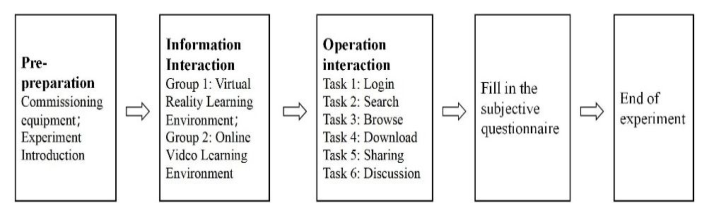
Experiment Procedure As is shown in Figure 3, the experiment included three stages: the information interaction stage, the operational interaction stage, and the subjective questi- onnaire stage. The first group of subjects finished the learning in the virtual reality learning environment and then performed operation interaction tasks. Similarly, the second group of subjects completed the online video learning and subsequently achieved the operation interaction tasks. Finally, they were asked to fill in the subjective questionnaire.
Figure 3: Experiment flow.
DATA PROCESSING EEG Data Pre-Processing and Data Calculation
We used MATLAB to pre-process the data obtained from the EEG experi- ments. At the end of each task, we segmented the part of operation interaction EEG data into 6 files for each person, yielding a total of 22 (participants) × 6 (tasks) = 132 EEG files, and then each EEG signal was divided into windows of 10s each with 5s overlap.
The pre-processed EEG signals were extracted for quantitative analysis. In EEG-based cognitive load analysis, the Theta-Alpha Ratio (TAR) is an analytical method that allows for the explicit calculation of cognitive load values.
TAR = ThetaFz
(1)
AlphaPz
where ThetaFz is the power spectrum of electrode Fz in the Theta band and AlphaPz is the power spectrum of electrode Pz in the Alpha band. The value representing the cognitive load of each task is the average of the TAR over all windows for each task.
In the second step, to address individual specificity, the data for each participant is normalized by using an algorithm as in Equation (2).
Normailized(Xi) = Xi −min(X) max(X) −min(X) (2) where X is a numerical signal, Xi is the signal X at position i, min(X) is the minimum value X for the subject to complete the task, and max(X) is the maximum value X for the subject to complete the task.
The third step is to average the normalized value of each task to obtain the cognitive load index related to each task.
It should be emphasized that the EEG data was not normalized because of the limited number of experimental tasks in Experiment 2.
RESULTS
Part I Experimental Results The results of the experiment show that the cognitive load of the different tasks varies. As demonstrated in Table 2, the login task had the highest cogni- tive load value, which may be due to the excessive choices of login pages. The
Exploring Interactive Design Strategies of Online Learning Platform 15
Table 2. Cognitive load results of typical tasks for operational interaction.
Table 3. Results of cognitive load measurements of learners in the two learning environments.
Table available in the original PDF paper.
Video Learning Environment Virtual Reality Environment
EEG 10.030 8.750 NASA-TLX 5.291 5.172
search task ranked second in the EEG and subjective measurement results. This could be because the search task not only necessitated subjects to focus their attention but also necessitated them to retain the keywords of the target course in order to complete the search task quickly and accurately. The low- est cognitive load was the sharing task. The key step of the sharing process was to locate the target for sharing, which was easy for subjects with Internet experience. The order of the measurement of the discussion task and the bro- wsing task in the EEG and the scale measurements is inconsistent. The reason for this result could be that we did not set a strict operational process in the browsing task and the discussion task, so the participants were required to think independently. As a result, the brain resources occupied by different subjects were different.
Part II Experimental Results The results of the information interaction experiment show the cognitive load of two environments exists differences. As shown in Table 3. The cognitive load in the video learning environment is higher than that in the virtual reality learning environment. The results of Buchner et al. (2022) also indicate that compared to traditional video media instruction, the virtual reality learning environment is less cognitively demanding and also can be better learning outcomes.
DISCUSSION
In this study, we explored the cognitive load of six typical operational inte- raction tasks and information interaction tasks in two different learning environments. The results showed that (1) the cognitive load of the six typical operational interaction tasks exists different significantly; (2) the login and search tasks required the highest cognitive load; (3) the sharing task requi- red the lowest cognitive load; (4) the virtual reality learning environment was superior to online video teaching in terms of cognitive load. In response to the obtained results, we propose the following optimal platform design strategies:
(1) Reduce redundant options in the operation process. During the opera- tion of the MOOC platform, the available login methods include phone number login, email login, own login and four QR code login meth- ods (WeChat, QQ, Weibo, and mobile China University MOOC). These seven login methods cause interference to the learners’ choice, so the number of options should be controlled. (2) Build search scenarios that can directly and quickly reach the learner’s goals. From the learner’s point of view, the more direct and clear infor- mation received, the easier it is to search for the target. The search box should be set in a more prominent position to make the search process smooth and natural; the way of course search should be varied, suppor- ting either a single keyword search or multiple keyword searches; the course arrangement in the search result list should be available for lear- ners to choose, with various options such as the number of participants in the course, or the name of the institution; To reduce the burden of users’ short term memory, the search history can be kept so that users can often return and reuse the previous search results. (3) Design of virtual reality learning environment. We should establish a mixed muti-source virtual reality learning environment with deep inte- raction. In the virtual reality learning environment, human-computer interaction is no longer sufficient to meet the teaching needs, and inter-personal interactions such as teacher-student interactions and student-student interactions need to be reflected in the virtual reality environment as well.
CONCLUSION
This study investigates the cognitive load of six typical operational tasks during online learning operational interaction and the cognitive load of lear- ners in two different learning environments during information interaction by combining an EEG experimental study and NASA-TLX measurement. Based on the experimental results, we propose an interaction design strategy for the online learning platform in terms of optimal interaction design, which can guide the future platform interaction design, and provide theoretical and practical implications for promoting the sustainable development of online learning. However, due to the limitation of conditions, our experiments were limited to the researcher’s university, and the gender and geography of the subjects were not taken into consideration, so further work should take these factors into account.
REFERENCES
Anderson, T. (2003). “Modes of interaction in distance education: Recent developments and research questions”, Handbook of distance education. pp. 129–144. Buchner, J., Buntins, K., & Kerres, M. (2022). “The impact of augmented reality
on cognitive load and performance: A systematic review”. Journal of Computer Assisted Learning. pp. 285–303.
Exploring Interactive Design Strategies of Online Learning Platform 17
Chen, L., (2004). “Instructional Interaction Model and Instructional Interaction Hierarchy Tower for Distance Learning”. Distance Education in China. pp. 24–28+78. Hillman, D. C., Willis, D. J., & Gunawardena, C. N. (1994). “Learner-interface inte-
raction in distance education: An extension of contemporary models and strategies for practitioners”. American Journal of Distance Education. pp. 30–42. Luo, N., Zhang, M., & Qi, D. (2017). “Effects of different interactions on students’ sense of community in e-learning environment”. Computers & Education. pp. 153–160. Mark, B., Eamon, C., Enda, D., & Xiao, J. H., (2022). “Five major trends sha-
ping online learning: a multifocal view of possible futures”. Distance Education in China. pp. 21–35. Moore, M. G. (1989). “Three types of interaction”. The American Journal of Distance Education. pp. 1–6. Mu, S., Wang, X. J., Feng, G. Z., & Zhang, H., (2020). “Interaction Design and
Implementation in online Synchronous Teaching”. China Educational Technology. pp. 52–59+66. Sun, C. Y., & Liu, D. Z., (2022). “Comparison of cognitive load subjective rating scales”. Journal of Psychological Science. pp. 194–201. Sweller, J. (1988). “Cognitive load during problem solving: Effects on learning”.
Cognitive science. pp. 257–285. Sweller, J. (2005).” Implications of cognitive load theory for multimedia learning”.
The Cambridge handbook of multimedia learning. pp. 19–30. Sweller, J. (2010). “Element interactivity and intrinsic, extraneous, and germane cognitive load”. Educational psychology review. pp. 123–138. Wang, C., Fang, T., & Gu, Y. (2020).”Learning performance and behavioral pat-
terns of online collaborative learning: Impact of cognitive load and affordances of different multimedia”. Computers & Education. p. 103683. Yang, Y. J., & Guo, S. Q., (2012). “A Study on the Interaction Design of E-learning Resources”. Modern Distance Education Research. pp. 62–67.
LISTED IN THE AHFE DIGITAL BOOKSTORE CATALOGUE
Explore the complete digital volume
Human Factors and Systems Interaction
Read this individual research paper free through the original publisher, or explore the full digital proceedings book.
ISBN 978-1-958651-60-5
Explore this ISBN in the AHFE Bookstore ↗Listed in the July 2026 bookstore catalogue; search by ISBN to confirm current availability · Digital book purchase optional