Miriam Maibaum, Marc-André Weber, Sascha Stowasser (2024). Participatory Approaches to Design Work in the Context of Digital Transformation: An Analysis of the Needs of Employees in Public Administrations. In: Human Factors and Systems Interaction. AHFE Open Access, vol. 154, pp. 85–92. https://doi.org/10.54941/ahfe1005356
Digital transformation is significantly changing work, especially in the public sector. It's increasingly important for employees to be actively involved in designing work processes and making decisions about new or changing ICT. This article focuses on comprehensive analysis of participatory approaches in work design in public administration at local and state level in Germany. It examines the extent to which public administration employees at local and state level are involved in the design and decision-making processes pertaining to ICT implementation in their work area. Additionally, the article underscores the role of employee participation in mitigating the stress associated with workplace technology. The methodological basis of the article is an online survey conducted in 2023 among employees of public administration at local and state level.
Since their emergence in the mid-20th century, digital technologies have significantly impacted human labour within organizations. Initially, these technologies were employed primarily for complex and time-consuming cal- culations across various industry sectors, leading to the widespread adoption of IT systems for planning and control. Subsequently, the evolution of more advanced and interconnected digital tools facilitated the development of sys- tems designed to enhance coordination and collaboration among different actors, including individuals, machines, and entire organizations (Stary and Oppl, 2019).
This evolution has also led to a significant increase in the use of Infor- mation and Communication Technologies (ICTs) in various sectors (Härtwig et al., 2023). The swift progression of technological innovation is profoundly
affecting the workforce, potentially escalating work stress among employees as a result of ongoing digital transformation (Gimpel et al., 2018). In this context, the study by Ayyagari et al. (2011) becomes particularly relevant, emphasizing the need to understand how specific aspects of ICTs contribute to stress and affect individual well-being. Their research underscores the crit- ical nature of this understanding, given the pervasive integration of ICTs in both professional and personal realms, and the subsequent effects for psy- chological health in technologically-driven environments. In this context, the study by Meyer et al. (2022) is important as it reveals how the use of mobile ICT devices, such as smartphones and tablets, is linked to a perceived increase in work intensity among employees. Furthermore, the study suggests that issues linked to these technologies, such as information overload and techni- cal disruptions, contribute to this heightened sense of work intensity (Meyer et al., 2022).
In the vein of enhancing workplace dynamics, Hartung (2011) posits that participation as a form of involvement in decision-making processes can positively influence the health-related resources of individuals. This find- ing aligns with empirical research, such as that conducted by Holman and Axtell (2016), which corroborates the positive impact of participatory prac- tices on individual well-being within corporate settings. In their 2017 study, ComTeam AG uncovered a significant trend where a vast majority of the par- ticipants expressed a strong preference for enhanced involvement, autonomy, and responsibility in the decision-making processes within their organizations (ComTeam AG, 2017).
Therefore, our research focuses on examining the relationship between employee involvement in decision-making and change processes related to the implementation of ICT and the measurement of factors that contribute to employee strain in digital work environments. This exploration aims to provide deeper insights into how integration and participation in ICT-related processes impact the well-being of employees.
This article focused on public administrative employees at the local as well as state level in Germany. Public administrations in Germany are fac- ing unique challenges, particularly in the realm of digital transformation. For instance, the enactment of the Online Access Act (German: Onlinezugangsge- setz, OZG), that ensured citizens’ online access to numerous administrative services, was scheduled to be completed by the end of 2022. However, by this deadline, only 19% of the services capable of being digitalized were avail- able online (Bundesrechnungshof, 2023). Established operational patterns and existing technical infrastructure are inadequate to address the digitaliza- tion demands of various services. This realization preceded the COVID-19 pandemic and gained traction within German political discourse, acknowl- edging the necessity for administrative digitalization. However, the legislation did not focus on reforming the administration’s internal processes. Conse- quently, there has been a lack of fundamental political discourse regarding the future design and structure of administrative operations (Markus and Meuche, 2022). The transformation process requires capacities in addition
Participatory Approaches to Design Work in the Context of Digital Transformation 87
to the daily tasks of the employees. Digital Innovations and additional work- load should not negatively impact employees’ health and consequently the administrations’ performance (Maibaum et al., 2023).
DATA COLLECTION Online Survey
Data were collected from late September to early December 2023 in a 10-week online survey. We collected data primarily through phone calls and emails to a random selection of municipalities, city administrations, and state authorities. Additionally, participation calls were posted on social net- works such as LinkedIn and Xing, specifically in groups relevant to public administration.
Sample Characteristics The initial dataset comprised 506 survey responses. Through the data cleans- ing process, responses that did not align with the targeted demographic criteria were excluded. Additionally, completed surveys with a total response time of less than five minutes were deemed potentially unreliable and were also removed from consideration. Following this cleansing process, the dataset was narrowed down to N = 425 valid cases, which formed the basis for the analysis. Due to the provision of a “No response” option, there was variability in the sample size. According to the demographic breakdown, one-quarter of the respondents were from state-level administrations, while the remaining three-quarters were from municipal administrations. In terms of job responsibility, one-quarter of the participants had leadership roles, whereas three-quarters were employees without leadership duties.
Examining the tenure within the administration, the data reveal a hetero- geneous distribution of employment duration (N = 359). A small segment, constituting 6.4%, had been working for under one year. Those with 1–3 years of experience made up 18.7%. Respondents with 4–7 years of expe- rience represented 17.5% of the sample. A smaller proportion, 7.8%, had served for 8–10 years. Those with 10–15 years of service comprised 9.7% of the sample. The largest portion of the sample, 39.8%, had been in the administration for over 15 years, indicating a significant level of experienced personnel.
The age distribution further highlights the diversity within the sample, 6.5% were between 18–24 years old, 8.2% were aged 25–29, the 30–39 age bracket included 29.0% of the respondents, those aged 40–49 constituted 25.6%, the 50–59 age group accounted for 22.0%, and 8.7% were 60 years or older.
Measures In order to assess the work stress scenarios due to the use of ICT among the participants, the items listed in Table 1 were evaluated using a four-point Likert scale. The scale ranged from 1 = ‘not applicable’, through 2 = ‘rather not applicable’, to 3 = ‘somewhat applicable’, and finally, 4 = ‘applicable’.
This metric allowed participants to quantify the extent to which each item reflected their experience with stress factors in the workplace.
Table 1. Items of work-related stress scenarios due to ICT use.
Table available in the original PDF paper.
ItemCode Statement Reference BL_01 I am concerned that information exchanged via ICT could be internally evaluated or monitored.
Own wording
Riedl et al. (2022) [modified] BL_02 I worry that my performance could be monitored by ICT.
Own wording BL_03 I find it exhausting that work processes become more complex due to the large number of ICT used.
Own wording
BL_04 I feel a strong pressure to constantly acquire new knowledge to work properly with ICT.
Own wording BL_05 It is difficult for me to recognize my work progress, as I am constantly receiving new work tasks through ICT.
Own wording BL_06 Using ICT makes it harder for me to estimate the scope of completed tasks, which reduces my sense of achievement.
Own wording BL_07 I am often distracted by non-urgent tasks triggered by ICT.
Own wording BL_08 My productivity is affected by interruptions from ICT.
BL_09 Too much of my working time is lost due to the unreliable ICT.
Riedl et al. (2022)
Riedl et al. (2022) [modified] BL_10 Daily frustrations with ICT weigh on me. Riedl et al. (2022) [modified] BL_11 I think that the requirements of my work are not well supported by the functions of the available ICT.
Own wording BL_12 ICT, which would make my work much easier, is not available to me.
BL_13 Because of the information provided by ICT, I have the feeling that I have too many tasks to complete.
Riedl et al. (2022) [modified] BL_14 ICT leads to a constant supply of information, often making me feel unable to keep up.
Riedl et al. (2022) [modified] BL_15 The use of ICT creates too high expectations to be always available and to react promptly.
Riedl et al. (2022)
Riedl et al. (2022) [modified] BL_16 My private life is negatively affected because work-related issues can reach me anywhere via ICT.
Own wording BL_17 The introduction of new ICT often takes place “on top” of regular work tasks.
BL_18 I do not manage to take enough time to learn the necessary skills to handle ICT properly.
Gimpel et al. (2018) [modified]
In the empirical examination of employee engagement within design and decision-making processes, particularly in the context of introducing or mod- ifying ICT in their work domain, a targeted inquiry was formulated. The question posed to assess the degree of involvement was: “To what extent are you involved in the design and decision-making processes concerning the introduction or modification of ICT in your area of work?” (SQ03_01). The response options provided to the participants were designed based on the framework established by Weber and Unterrainer (2015). These options
Participatory Approaches to Design Work in the Context of Digital Transformation 89
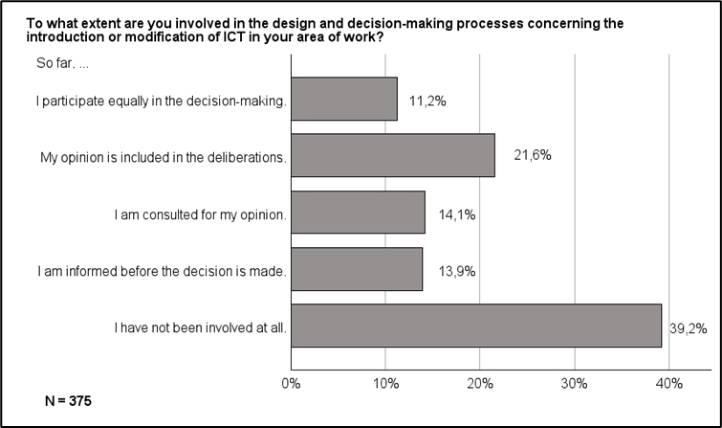
were structured to capture the varying degrees of employee involvement, see Figure 1.
Figure 1: Employee involvement in ICT decision-making processes.
The provided bar chart illustrates the levels of employee involvement in design and decision-making processes related to the introduction or mod- ification of ICT in their work area. It provides a significant insight into the participative dynamics within public administration in relation to ICT- related change. A substantial proportion of the workforce feels excluded from the decision-making process, with almost 40% not involved at all. On the contrary, only a small proportion feels fully involved in these processes. This distribution suggests that there is still much room for improvement for administrations in involving their employees in ICT decisions, which could lead to better results in terms of stress perception when introducing new technologies.
DATA ANALYSIS For the data analysis, the following hypothesis was posited: “There is a neg- ative correlation between the degree of involvement in design and decision- making processes and the items measuring stress factors.” To investigate potential relationships, a Spearman’s rank correlation analysis was conducted using the Statistical Package for the Social Sciences software (SPSS). This non-parametric test was chosen for its ability to identify monotonic relation- ships between ordinal variables, suitable for the Likert-scaled data collected in this study. The goal was to determine whether a higher level of partici- pation in decision-making processes is associated with lower reported stress levels among employees.
RESULTS
Table 2 shows the Spearman’s rho correlation analysis, which clarifies how employee involvement in ICT design and decision-making relates to their perceived work-related stress from ICT. The variable SQ03_01, reflecting the degree of employee involvement, ranged from no involvement to equal participation in decision-making, with options like “not involved at all” to “participate equally.”
Notably, the analysis revealed a set of significant negative correlations, indicating that as the level of involvement in ICT-related processes increases, the experience of certain stress factors decreases. Specifically, the strongest negative correlations were observed with the following items: BL_09, which indicated that a significant amount of work time was lost due to unreliable ICT, such as crashes or long loading times, had a correlation coefficient of −.203, suggesting that individuals who were more involved in ICT processes were less likely to report such stress.
BL_12, expressing the unavailability of helpful ICT, showed a correla- tion of −.246, indicating that greater involvement in ICT decisions could potentially lead to better access to supportive technologies.
BL_18, concerning the lack of time to learn necessary ICT skills, had a correlation coefficient of −.208, implying that employees who were more involved in the decision-making process might also have better opportunities or take more time to develop their ICT competencies.
Table 2. Spearman’s rho correlation coefficients between employee engagement in ICT-related changes and stress associated with ICT in the workplace.
**.Correlation is significant at the 0.01 level (1-tailed) *.Correlation is significant at the 0.05 level (1-tailed)
These findings highlight the importance of employee engagement in ICT- related changes and suggest that involving employees in such processes may mitigate some of the stress associated with ICT in the workplace. It’s worth noting that six items were not presented in the table due to their lack of significant correlation, focusing the discussion on the most impactful factors as determined by the analysis.
The strongest negative correlation was with BL_12, indicating that employees who have more influence in ICT matters may have better access to supportive technologies and have more impact which ICT should be implemented.
BL_18, as second strongest correlation, suggests that when employees are part of the decision-making process, are more likely to allocate time for skill acquisition and may demonstrate higher self-motivation to learn about digital technologies through scoping strategies.
Participatory Approaches to Design Work in the Context of Digital Transformation 91
Similarly, the negative correlation with BL_09, demonstrates that employ- ees are less likely to report excessive time lost due to ICT failures. This could be attributed to the possibility that involved employees may influence or advocate for more reliable systems or have better coping strategies due to their deeper understanding of the ICT environment.
Such involvement likely increases their sense of control and efficacy regarding the use of ICT, thereby reducing stress levels.
CONCLUSION
In conclusion, the empirical data from the Spearman’s rho correlation anal- ysis present a compelling narrative on the dynamics between employee involvement in ICT-related design and decision-making processes and the incidence of work-related stress. The evidence points towards a significant negative correlation, particularly noted in the three most impactful items: time lost due to ICT unreliability, lack of access to helpful ICT tools, and insufficient time to acquire necessary ICT skills.
Employee involvement in ICT decisions is not just a matter of good orga- nizational practice but also a potential buffer against the stress associated with technological demands in the workplace. By fostering an inclusive envi- ronment where employees are consulted and their opinions valued, public organizations can mitigate the negative impacts of ICT while enhancing productivity and job satisfaction. These insights should motivate leaders in public administrations to consider participatory approaches as a strategic imperative in the journey toward digital transformation.
REFERENCES
Ayyagari, Grover and Purvis (2011) ‘Technostress: Technological Antecedents and Implications’, MIS Quarterly, vol. 35, no. 4, p. 831. Bundesrechnungshof (2023) Umsetzung des Onlinezugangsgesetzes: Bericht nach
§ 88 Absatz 2 BHO Bericht nach § 88 Absatz 2 BHO an den Haushalt- sausschuss des Deutschen Bundestages [Online]. Available at https://www. bundesrechnungshof.de/SharedDocs/Downloads/DE/Berichte/2023/onlinezugang sgesetz-volltext.pdf?__blob=publicationFile&v=2 (Accessed 18 January 2024). ComTeam AG (2017) Eigenverantwortung: Wie es mit dem Wollen, Können und Dürfen von Eigenverantwortung in Unternehmen tatsächlich aussieht.: ComTeam Studie 2017. Gimpel, H., Lanzl, J., Manner-Romberg, T. and Nüske, N. (2018) Digitaler
Stress in Deutschland: Eine Befragung von Erwerbstätigen zu Belastung und Beanspruchung durch Arbeit mit digitalen Technologien 101. Härtwig, C., Sapronova, A. and Sigmund, N.-L. (2023) ‘Wer profitiert von der Digitalisierung? Deutschlandweite Follow-up-Studie zu Entwicklungsverläufen und Unterschiedseffekten bei Beschäftigten verschiedener Industriebranchen und Tätigkeitsfelder’, Zeitschrift für Arbeitswissenschaft, vol. 77, no. 4, pp. 578–592. Holman, D. and Axtell, C. (2016) ‘Can job redesign interventions influence a broad
range of employee outcomes by changing multiple job characteristics? A quasi- experimental study’, Journal of occupational health psychology, vol. 21, no. 3, pp. 284–295.
Maibaum, M., Weber, M.-A. and Stowasser, S. (2023) ‘Measures for human design of mental stress factors of digital work in public administrations’, Human Factors and Systems Interaction, July 20–24, 2023, AHFE International. Markus, H. and Meuche, T. (2022) ‘Die Öffentliche Verwaltung heute und in
der Zukunft’, in Markus, H. and Meuche, T. (eds) Auf dem Weg zur digitalen Verwaltung, Wiesbaden, Springer Fachmedien Wiesbaden, pp. 1–34. Meyer, S.-C., Meiners, F. and Hünefeld, L. (2022) Arbeitsbezogene IKT-Nutzung und Arbeitsintensität: Die Rolle mobiler Geräte. Riedl, R.; Fischer, T.; Reuter, M. (2022): Fragebogen zur Messung von digitalem
Stress im Arbeitskontext. In: Wirtsch. Inform. Manag. 14 (4), S. 262–272. doi: 10.1365/s35764-022-00418-2. Stary, C. and Oppl, S. (2019) Designing Digital Work, Springer Nature. Weber, W. G. and Unterrainer, C. (2015) ‘Arbeit in demokratischen Unternehmen: Ihr Potential für eine demokratische Gesellschaft’, Zeitschrift für Sozialpsychologie und Gruppendynamik in Wirtschaft und Gesellschaft, vol. 40, no. 130, pp. 20–39.
LISTED IN THE AHFE DIGITAL BOOKSTORE CATALOGUE
Explore the complete digital volume
Human Factors and Systems Interaction
Read this individual research paper free through the original publisher, or explore the full digital proceedings book.
ISBN 978-1-964867-30-4
Explore this ISBN in the AHFE Bookstore ↗Listed in the July 2026 bookstore catalogue; search by ISBN to confirm current availability · Digital book purchase optional