Jueun Shin, Woojin Choi, Sunwoong Kim (2024). Seat comfort evaluation method using X-ray : A case study in compact sedan. In: Advances in Human Factors of Transportation. AHFE Open Access, vol. 148, pp. 615–623. https://doi.org/10.54941/ahfe1005253
The aim of this research is to gather driver data to determine the comfort of a car seat by analyzing the correlation between various X-ray measurement variables and the satisfaction, comfort, and support of the seat, back, and cushion. The X-ray measurement variables include the seat angle at optimal posture, C7-SVA, Backset, the distance between Hip Joint and Head Centerline, height between Hip Joint and Head Centerline, cervical lordosis angle, thoracic kyphosis angle, and lumbar lordosis angle. The study was conducted on 17 participants using the Compact Sedan car. The results of the experiment showed that overall seat satisfaction was negatively correlated with the lumbar lordosis angle (r= -0.511, p< 0.05). The satisfaction of headrest support showed a negative correlation with the seat angle at the optimal posture (r=-0.597, p< 0.05). The comfort of the headrest support was negatively correlated with the distance between the hip joint and the head centerline (r=-0.609, p<0.01), the seat angle (r=-0.511, p< 0.05), and the lumbar lordosis angle (r=-0.502, p< 0.05). Headrest support satisfaction was negatively correlated with the distance between the Hip Joint and the head centerline (r=-0.486, p<0.05). In conclusion, the X-ray data analysis confirmed musculoskeletal variables that showed a significant correlation with seat comfort. However, this study is limited to Compact Sedan seats only, and it is expected that more meaningful data can be obtained if additional research is conducted on various class seats such as hatchbacks and SUVs in the future. Additionally, the study can include L3 of the spine, L4 of the spine, Thorax Angle, and Abdomen Angle variables in the future.
As a result of recent technological advancements such as autonomous driv- ing and purpose-based mobility (PBV), automobiles are transforming from a simple means of transportation to a new space. Users can now engage in various activities other than driving in their vehicles, allowing them to make the most of their time. Consequently, the importance of car seats, which are the devices that users interact with the most, is increasing. Nowadays, users are demanding a differentiated high level of comfort beyond the basic perfor- mance of the seat. The automobile industry is currently conducting various research activities to achieve a high level of comfort in car seats.
Chung et al. (2023) analyzed the comfort of slim seats according to seat material and ergonomic design through questionnaire evaluation and pressure distribution. Jun et al. (2014) presented a methodology related to deflection, body pressure distribution, and human body vibration to objec- tively evaluate seat comfort, and established an evaluation procedure by securing actual data. Kim et al. (2010) investigated the comfort evalua- tion items of car seats that had been previously studied and developed 36 evaluation items.
As such, researchers in the automobile industry are trying to secure the reli- ability of seat comfort by using various evaluation methods. Representative methods include using surveys and body pressure distribution data. However, these two methods were difficult to intuitively evaluate and had limitations in time and result reproducibility (Kim et al., 2021).
To provide comfortable seats, an advanced evaluation method that can numerically compare and judge seat comfort is needed. X-ray is a useful test that can be used to evaluate seat comfort because it can obtain mus- culoskeletal information and view the internal condition without any special preparation (Asan Medical Center, 2023). X-ray, also called a radiation test, refers to a test in which X-rays are transmitted through the human body. It is a highly reliable test method that has been used in the fields of diagnosis and treatment as the only technique that can obtain images of the inside of the human body for about 50 years since its discovery (Seoul National Univer- sity Hospital, 2023). Measures measured through radiography of the adult spine are correlated with disability and health-related quality of life. As the imbalance in spinal alignment worsens, muscle use increases, and fatigue and fatigue occur. It has been shown that it can cause pain and disability (Kim et al., 2021).
Research on using these X-ray measurements to develop car seats is ongo- ing, although minimal, both domestically and internationally. Choi et al. (2023) attempted to find items that could improve performance by measuring spine-pelvic variables in a standing state and while sitting in a car seat using X-rays. Yang et al. (2013) conducted X-ray imaging to analyze medical imag- ing images and identified the support position of the lumbar support most preferred by drivers. Bertil et al. (2007) used X-rays to compare and analyze the degree of neck reduction (cervical retraction capacity) in a comfortable and upright position when sitting in a car seat. As a result, it was found that the neck shrank more in a comfortable position than in an upright sitting position.
However, past studies were limited to simply measuring changes in drivers’ conditions through X-ray imaging. Research comparing and analyzing the correlation between X-ray measurement variables and seat comfort is very insufficient, so further research is needed, which can be greatly utilized in improving seat comfort.
Therefore, in this study, variables measured using X-ray (the seat angle at optimal posture, C7-SVA, Backset, the distance between Hip Joint and Head Centerline, height between Hip Joint and Head Centerline, cervical lordosis angle, thoracic kyphosis angle, and lumbar lordosis angle) and the
Seat Comfort Evaluation Method Using X-Ray: A Case Study in Compact Sedan 617
satisfaction, comfort, and support of each part of the seat, back, and cushion to obtain driver data to determine the comfort of the Car seat.
METHOD
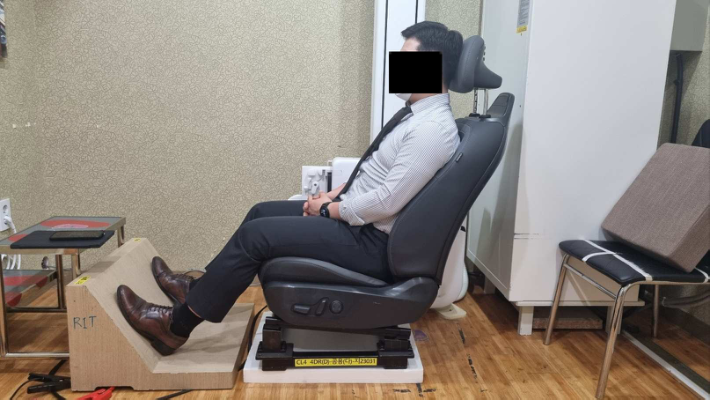
This experiment involved 17 volunteers (10 men, 7 women) with driver’s licenses, and X-ray data was measured and analyzed while sitting in the opti- mal position on the car seat. The average age of the volunteers was 36.4 ± 5.1 years, and their weight was 69.4 ± 12.2 kg. The car seat used for the research experiment was the driver’s seat of a compact sedan and was installed on a large jig with fixed wheels in a flat X-ray room. Experiment participants adjusted the seat to their desired optimal posture, including backrest angle, slide, and height.
Figure 1: Experiment environment.
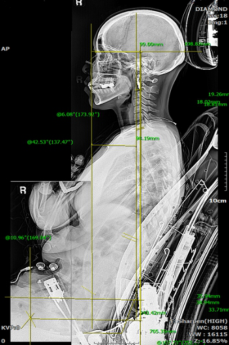
In the X-ray images obtained through the experiment, the seat angle at optimal posture, C7-SVA, Backset, the distance between Hip Joint and Head Centerline, height between Hip Joint and Head Centerline, cervical lordosis angle, thoracic kyphosis angle, and lumbar lordosis angle were measured.
The cervical lordosis angle measures the angle between the inferior border of the second cervical vertebra and the inferior border of the seventh cervical vertebra (Lee et al., 2014). The cervical lordosis angle measures the angle between the upper border of the 4th thoracic vertebra and the lower border of the 12th thoracic vertebra. The lumbar lordosis angle measures the angle between the superior border of the first lumbar vertebra and the superior border of the first sacral vertebra (Cho et al., 2016). C7-SVA refers to the distance between a line drawn vertically from the front of the body of the cervical 7th vertebra and the line connecting the rear end of the 1st sacral vertebra (Choi et al., 2023).
Figure 2: Sitting on an automotive seat by radiographic assessment.
After the measurement was completed, a survey was conducted. The survey questions were structured on a 10-point Likert scale. The survey questions consisted of overall seat comfort, headrest comfort, cushion overall comfort, back overall comfort, seat overall support, cushion support, back support, overall seat satisfaction, headrest satisfaction, cushion satisfaction, and back satisfaction.
Seat Comfort Evaluation Method Using X-Ray: A Case Study in Compact Sedan 619
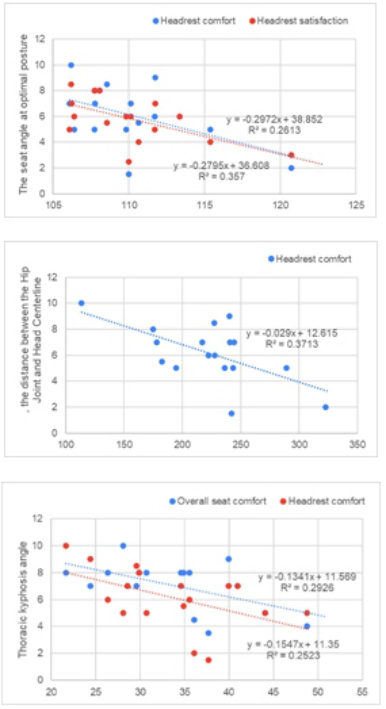
Correlation Analysis Among Variables Correlation Between Questionnaires and X-Ray Variables As a result of correlation analysis between Questionnaires and X-ray data variables, overall seat satisfaction showed a negative correlation with tho- racic kyphosis angle (r=−0.511, p<0.05). Satisfaction with the headrest showed a negative correlation with the seat angle at optimal posture (r=−0.597, p<0.05). Headrest comfort was measured by the distance between Hip Joint and Head Centerline (r=−0.609, p<0.01), the seat angle at optimal posture (r=−0.511, p< 0.05), and thoracic kyphosis angle (r=−0.502, p< 0.05) and a negative correlation was observed. Headrest sat- isfaction showed a negative correlation with the distance between Hip Joint and Head Centerline (r=−0.486, p<0.05)
Table 3. Correlation coefficient between X-ray measurement variables and questionnaires.
Table available in the original PDF paper.
Backset (mm)
C7- SVA (mm)
Cervical Lordosis Angle (
)
Thoracic Kyphosis Angle (
)
Lumbar Lordosis Angle (
)
Parameter Seat Angle At Optimal Posture (
)
Distance Between Hip Joint and Head Centerline (mm)
Correlation Analysis Among X-Ray Measurement Variables As a result of correlation analysis among X-ray measurement variables, the seat angle at optimal posture was C7-SVA (r=−0.597, p<0.01), the distance between Hip Joint and Head Centerline (r=−0.752, p<0.01) A positive cor- relation was found. C7-SVA showed a negative correlation with Backset (r=−0.483, p<0.05) and a high-level positive correlation with the distance between Hip Joint and Head Centerline (r = 0.836, p<0.01). Additionally, the cervical lordosis angle showed a positive correlation with the thoracic kyphosis angle (r = 0.523, p<0.05).
Correlation Coefficient Among Questionnaires As a result of correlation analysis among survey questions, a high level of correlation was observed in the comfort, support, and satisfaction surveys.
Table 4. Correlation coefficient among X-ray measurement variables.
Table available in the original PDF paper.
Backset (mm)
Cervical Lordosis Angle (
)
Thoracic Kyphosis Angle (
)
Lumbar Lordosis Angle (
)
C7- SVA (mm)
Parameter Seat Angle At Optimal Posture (
)
Height Between Hip Joint and Head Centerline (mm)
Distance Between Hip Joint and Head Centerline (mm)
1
Seat angle at optimal posture (
)
0.752** 0.836** −0.390 1
C7-SVA (mm) 0.646** 1 Backset (mm) −0.160 −0.483* 1 Distance between Hip Joint and Head Centerline (mm) 0.406 0.093 −0.252 0.153 1 Height between Hip Joint and Head Centerline (mm)
In this study, X-ray was used to determine the seat angle at optimal posture, C7-SVA, Backset, the distance between the Hip Joint and Head Centerline, height between Hip Joint and Head Centerline, cervical lordosis angle, tho- racic kyphosis angle, and lumbar lordosis angle was measured. Additionally,
Seat Comfort Evaluation Method Using X-Ray: A Case Study in Compact Sedan 621
the satisfaction, comfort, and support of the seat, back, and cushion were measured and analyzed.
As a result, a significant relationship was confirmed between the seat angle at optimal posture and headrest comfort and satisfaction. This is presumed to be because as the seat angle, or torso angle, increases, the head sup- port position changes as the driver bends his or her back to secure visibility. Additionally, there was a negative correlation between headrest comfort and H-Point distance. This is believed to have affected comfort as the head sup- port position changed depending on the degree to which the driver sat with his or her buttocks out.
A negative correlation was found between thoracic kyphosis angle and seat comfort and headrest comfort. According to Kendall et al. (2005), the thoracic kyphosis angle increases in the Forward Head Posture, where the head is excessively protruded. If the upper part of the body is bent in a sitting position, the position of the head and neck may change due to compensation, stress may be added, and discomfort may appear. This discomfort can be interpreted as affecting seat comfort and head restraint comfort.
Figure 3: Results of correlation analysis.
The study’s results have confirmed that the comfort of a seat decreases when the driver’s seat back angle is small, the distance to the H-point is long, and the thoracic kyphosis angle is small. These findings indicate that not just the seat itself, but also driving posture, affects seat comfort. Previous studies have suggested that factors such as the pad, frame, suspension, and spring also play a role (Ebe et al., 2001; Yusof et al., 2004). In the future, it is believed that a specific level of comfort can be predicted by comprehensively analyzing the seat itself factors, psychological factors (Dumur et al., 2004), and driving posture.
CONCLUSION
In order to quantitatively determine the comfort of the seat, this study analyzed the seat angle at optimal posture, C7-SVA, Backset, the distance between the Hip Joint and Head Centerline, height between Hip Joint and Head Centerline, cervical lordosis angle, thoracic kyphosis angle, and lum- bar lordosis angle measured on X-ray and, the overall seat comfort, headrest comfort, cushion overall comfort, back overall comfort, seat overall support, cushion support, back support, overall seat satisfaction, headrest satisfaction, cushion satisfaction, and back satisfaction collected through a survey.
In conclusion, musculoskeletal variables that showed a significant corre- lation with seat comfort were confirmed through X-ray data analysis. This study has the limitation of testing only compact sedan seats, but it appears that meaningful quantitative data can be obtained if additional research is conducted on seats of various car classes such as hatchbacks and SUVs in the future. Furthermore, in addition to the existing thoracic kyphosis angle and the seat angle at optimal posture, it is believed that L3 of the spine, L4 of the spine, Thorax Angle, and Abdomen Angle could also be included in the study.
REFERENCES
Cho KJ, Kim YT, Seo B and Shin J. (2016). Radiological evaluation and classification of adult spinal deformity. J Korean Orthop Assoc 2016, 51, pp. 1–8. Choi, W. J., Choi, S. Y., Ka, S., Kim, S., and Sohn, M. J. (2023). Analysis of Changes
in Spinal and Pelvic Parameters When Optimally Seated on an Automotive Seat Compared to Standing. Digital Human Modeling and Applied Optimization, pp. 81. Chung, H., Choi, J. W., Yang, S. W., Park, C. K., Kim, D. Y., Song, C. H. and Kim, H. S. (2023). Evaluation of Seat Comfort and Pressure Distribution According to the Ergonomic Design of Automobile Seats. Journal of Biomedical Engineering Research, 44(2), pp. 157–165. Dong Hyun Kim, Seung Won Park, Jun Won Choi, and Han Sung Kim (2021). An
Objective Evaluation Biomechanical Method of Seat Discomfort to Sedan Driver’s Seat During Long-term Driving. Journal of the Ergonomics Society of Korea, 40(4), pp. 221–233. Dumur, E., Barnard, Y., & Boy, G. (2004). Designing for comfort. Human factors in design, pp. 111–127. Ebe, K., & Griffin, M. J. (2001). Factors affecting static seat cushion comfort.
Ergonomics, 44(10), pp. 901–921.
Seat Comfort Evaluation Method Using X-Ray: A Case Study in Compact Sedan 623
Jonsson, B., Stenlund, H., Svensson, M. Y., and Björnstig, U. (2007). Backset and cervical retraction capacity among occupants in a modern car. Traffic injury prevention, 8(1), pp. 87–93. Jung A Kim, Ho Jun Na, Dong Hwan Cho, Yun Ho Shin, Se Jin Park, and Jin Ho Kim.
(2010). Development of Questionnaire for Automobile Seat Comfort Evaluation. Science of Emotion & Sensibility, 13(2), pp. 381–390. Kim, H. J., and Chang, D. G. (2021). Clinical and radiographic parameters for patients with adult spinal deformity. J Korean Med Assoc, 64(64), pp. 743–7. Kendall F, McCreary E, Provance P, Rodgers MM and Romani WA. (2005). Muscles
testing and function, with posture and pain 5th edition. Philadelphia: Lippincott Williams & Wilkins. pp. 71–4. Lee IS and Chung SG. (2014). Pathophysiology of degenerative spinal disease causing lumbar and cervical spinal pain. J Korean Med Assoc 2014, 57, pp. 300–307. Seoul Asan Medical Center. (2023). Test/Procedure/Surgery Information: X-ray.
Asan Medical Center Website: https://www.amc.seoul.kr/asan/healthinfo/ management/managementDetail.do?managementId=524. Seoul National University Hospital. (2023). Seoul National University Hospital Medical information: X-ray. SNUH Website: https://www.snuh.org/intro.do. Yang, J., Lee, J. and Choi, H. (2013). Study on Lumbar Spine Curvature and Lower
Back Discomfort with Design Parameter of Automotive Seat Lumbar Support. Journal of Korean Institute of Industrial Engineers. Korean Institute of Industrial Engineers. Yusof, M., & Abdul Rahman, R. (2004). Development of an automotive seat for ride comfort.
LISTED IN THE AHFE DIGITAL BOOKSTORE CATALOGUE
Explore the complete digital volume
Advances in Human Factors of Transportation
Read this individual research paper free through the original publisher, or explore the full digital proceedings book.
ISBN 978-1-964867-24-3
Explore this ISBN in the AHFE Bookstore ↗Listed in the July 2026 bookstore catalogue; search by ISBN to confirm current availability · Digital book purchase optional