Vesa Salminen, Matti Pyykkönen, Ari Saarinen, Nikolai Ylirotu (2026). Integrated Disaster Situation Management System with Domain-Specific Ontology Model. In: Intelligent Human Systems Integration (IHSI 2026): Disruptive and Innovative Technologies. AHFE Open Access, vol. 200, pp. 296–306. https://doi.org/10.54941/ahfe1007089
Disaster response and management in the era of climate change require seamless coordination across numerous agencies, systems, and stakeholders. A shared understanding of the situation is critical as responders from different organizations (e.g., fire, medical, military) must work in concert under high pressure. The common ontological definition is important for various stakeholders and expert groups to understand disaster during its different stages for controlling and managing salvation and recovery. Semantic interoperability works in practice between different organizations by creating a common language and meaning structure that enables information to be exchanged and understood without misunderstanding. This is achieved through a common ontology that defines key concepts unambiguously. This research examines the creation of common ontology and semantics aspects during nature disaster identification and management. In this study the MobiJOPA™ has been the use case environment system. It was created recently by the Start-up company Husqtec Corp., which is concentrating on situation and operational management. Use case has been a water flow disaster, which is a quite common type of disaster due to the influence of climate change. During the research has been answered to the following research questions: •How is the integrated situation awareness system dynamics structured and organized?•How is system functioning and human interoperability organized by the ontology interface?•How is data, information, and knowledge economy structured and managed?•How is stakeholder training organized, and knowledge gathered to create an ontology interface, routing common disaster understanding?Semantic infrastructure supports information integration by combining heterogeneous data sources, such as sensors and social media, into a unified information model. Semantic interoperability is not an abstract benefit; it operationalizes the data in ways that closely support the real tasks and decisions of emergency management. It creates a common operating environment where each piece of information is readily available to those who need it, in a form they can understand and trust. It moves the focus from low-level data wrangling to higher-level analysis and action. Building such interoperability requires understanding the real-world semantics, linking formal data to meanings that make sense to humans in their roles. In other words, the ontology must be grounded in the language and practice of emergency responders. This ensures that technology aligns with human thinking, further enhancing clarity and coordination. Semantic interoperability enabled by a common ontology and robust system architecture provides shared situational awareness and efficient coordination in disaster management. It reduces information fragmentation and miscommunication.
Disaster response and management in the era of climate change require seamless coordination across numerous agencies, systems, and stakeholders. A shared understanding of the situation is critical as responders from different organizations (e.g., fire, medical, police, military) must work in concert under high pressure. The common ontological definition is important for various stakeholders and expert groups to understand disaster during its different stages for controlling and managing salvation and recovery (Salminen et al., 2025/1). Semantic interoperability works in practice between different organizations by creating a common language and meaning structure that enables information to be exchanged and understood without misunderstanding. This is achieved through a common ontology that defines key concepts unambiguously.
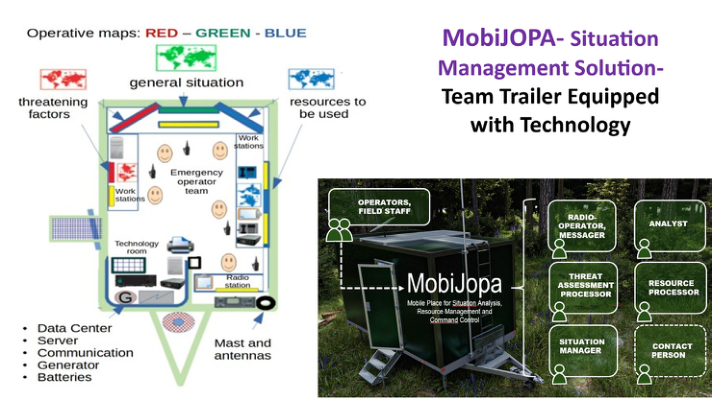
This article suggests that a human-oriented approach is necessary for capturing data from various sources and using it in businesses. In this article an analysis has been conducted on the various aspects of the developed framework of situation analysis, resource control and operation command process as targeting for better disaster management. The analyzed case study company is Husqtec Corp., a start-up company concentrating on situation and operational management. The created and developed product is MobiJOPA™, a solution on which the functionality of situation analysis, resource control and operation command management is implemented. The objective of this research has been to introduce an integrated situation awareness and management system and a model of the operative functional environment with ontology offered to involved stakeholders for training purposes before potential disaster situation. The use case is the MobiJOPA™ system developed by Husqtec Corp, which is a mobile and modular management unit (Figure 1).
Figure1: The MobiJOPA™- concept for the disaster management team.
The use case is natural disaster management. The article outlines the importance of human factors, team cohesion, integrated situation management system, domain-specific ontology model and data-driven approaches in solution to manage quick decision-making in a disaster crisis.
THEORETICAL FRAMEWORK ‘Situational awareness means understanding what is happening around us and recognized as a critical foundation for successful decision-making across a broad range of situations and leads to situation management’ (Stanton et al., 2009). ‘Situational awareness is presented as a predominant concern in system operation, based on descriptive view of decision making’ (Endsley, 1995). ‘Situational awareness is defined as the perception of entities in the environment, comprehension of their meaning, and projection of their status in near future’ (Munir et al., 2022).
‘Lundberg (2015) describes situation awareness (SA) system and process dependencies on system awareness states. He also describes situation system (SA) components as mediators and catalysts for SA, SA system properties (e.g. buffering SA), and dynamic SA system formation.’
‘The way that information is transferred through teams affects shared knowledge within the team about situations, their common ground’ (Artman 2000). ‘Babitski et al. (2009) demonstrated that an ontology-based integration of sensor data in a flood scenario significantly enhanced situation understanding for responders, improving both interpretation of data and coordination among teams.’ ‘Similarly, Elmhadhbi and Karray (2021) proposed a semantic framework for disaster management that enabled a holistic understanding of crisis information, resulting in better stakeholder coordination and decision- making in flood response case studies.’
‘OODA Loop created by John Boyd is a 4-step decision-making process (Observe, Orient, Decide, and Act) where the individual or group that makes it through all the stages the quickest is the most successful’ (McKay et al., 2023). ‘Disaster management ontology definition is the starting point in process harmonization for aligning how different agencies’ processes intersect’ (Salminen et al., 2025/2). ‘The common ontology serves as the backbone for semantic structure and information harmonization. In other words, all data that enters the system, whether from IoT sensors, GIS systems, databases, or human reports, is annotated or mapped to the ontology, enabling consistent master data management’ (Salminen et al., 2018).
‘Open communication, adaptability and regular situation assessment are key parameters in ensuring the alignment of roles and responsibilities with the evolving needs of the team, project, product and development’ (Salminen et al., 2024).
‘T-shaped individuals and experts have deep knowledge and skills in a particular area along with the capacity to collaborate across disciplines with a broad understanding of other areas. X-shaped professionals as commanders of team have broad skills and strong leadership qualities and ability to drive
Integrated Disaster Situation Management System With Domain-Specific Ontology Model 299 collaboration and innovation across an organization An X-shaped person is actually a T-shaped person who has good leadership abilities’ (Rahman, 2024).
RESEARCH QUESTIONS AND RESEARCH IMPLEMENTATION This research examines the creation of common ontology and semantics aspects during nature disaster identification and management. In this study the MobiJOPA™ has been the use case environment system. It was created recently by the Start-up company Husqtec Corp., which is concentrating on situation and operational management. Use case has been a water flow disaster, which is a quite common type of disaster due to the influence of climate change. During the research has been answered to the following research questions:
How is the integrated situation awareness system dynamics structured and organized?
How is system functioning and human interoperability organized by the ontology interface?
How is data, information, and knowledge economy structured and managed?
How is stakeholder training organized, and knowledge gathered to create an ontology interface, routing common disaster understanding?
This research has an action-based approach and uses a method based on grounded theory (Glaser and Strauss, 1999). It is partly constructive, conceptual, and analytical because it introduces a framework for Situation Analysis, Resource Control and Operation Command. Data for this concept creation has been continuously collected from the innovation and development phase of the case study start-up company Husqtec Corp. The created solution MobiJOPA™ is introduced on which the functionality situation analysis, resource control and operation command management is implemented. This action-type research approach may be seen as a type of applied science.
THE STRUCTURE OF DYNAMIC INTEGRATED SITUATION AWARENESS SYSTEM The system functionality of disaster management consists of two main functionalities, situation awareness and decision-making cycle. In the following is introduced how these functionalities can be integrated on solution level. The integration can be made on integrating the the core models Situational Awareness, SITAW, and Decision-Making framework OODA (Observe, Orient, Decide, Act) models into an effective operational framework for managing acute crises, especially under emergency conditions defined by the Finnish Emergency Powers Act (1552/2011). Situational Awareness, SITAW refers to the ability to detect, understand, and anticipate events in the environment. Its components are observation, comprehension,
and projection. It is applied in fields where rapid decision-making is critical. Decision-Making Cycle, OODA, consists of four phases: observe, orient, decide, and act. It is an iterative process where speed provides a strategic advantage. The model is suitable for acute disaster leadership and command purposes. Combined SITAW-OODA Model emphasizes maintaining ongoing awareness and acting swiftly in the case of natural disasters. The functioning consists of phases: broad observation, prioritized orientation, rapid decision- making for acute targets, immediate action and continuous updating of situational awareness.
In the cases of large-scale floods and wildfires, the combined model enables fast response, effective prioritization, flexibility, and optimal resource allocation. It enhances the ability to save lives and reduce suffering while maintaining a broader situational picture for future planning. In emergencies it can be used for situational picture formation and resource coordination.
Continuous Situational Awareness starts by making broad observation with continuous data collection from various sources (sensors, field units, authorities, media, verified social media). During comprehension phase it is made analysis and integration of data with prior knowledge to form a holistic understanding. Then during the projection phase developments and future needs are anticipated to guide long-term planning.
Rapid Decision-Making and Resource Coordination starts with observation phase. The data generated in situation awareness phase is used it monitor the situation and resources. Combining situational understanding with experience and goals to prioritize actions it is possible to orient on disaster situation and make quick decisions and allocate resources accordingly. Implementing decisions flexibly it is possible to act and adapt to changing conditions. Integration and Iteration happen so that SITAW continuously feeds updated awareness into the OODA cycle and feedback from actions is reintegrated into SITAW and it initiates a new OODA cycle. By this way the disaster management team maintains this continuous loop to ensure fast response and strategic planning. It is also possible to integrate on broader emergency systems by sharing situational picture, coordinating flexible actions and resources and use common processes and systems. SITAW and OODA enhance inter-agency information sharing by improving situational picture formation and decision coordination. SITAW focuses on broad data collection and projection, while OODA ensures decisions and actions are communicated clearly and quickly. The MobiJOPA™ concept ties all these together with clear processes and roles, ensuring effective and flexible management in changing situations.
INTEGRATED MANAGEMENT SYSTEM This research examines the creation of an integrated system common ontology and semantics aspects during nature disaster identification and management. In this study the MobiJOPA™ has been the use case environment system. It was created recently by the Start-up company Husqtec Corp., which is concentrating on situation and operational management.
Integrated Management System of MobiJOPA® creates a unified, real-time command and control environment for crisis and operations management
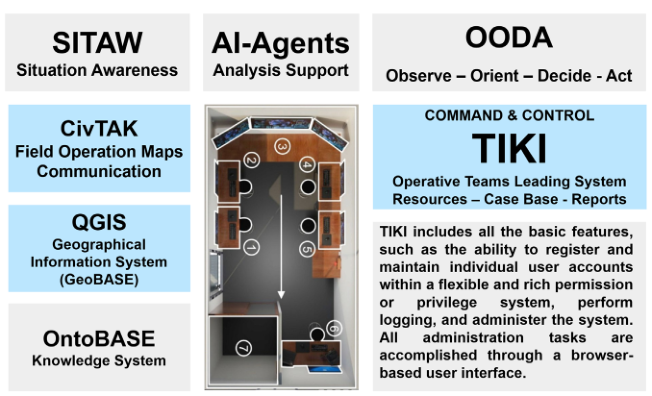
Integrated Disaster Situation Management System With Domain-Specific Ontology Model 301 (Figure 2). It integrates three key software systems under the operational framework of the MobiJOPA- concept: Command and Control System, CivTAK, Geospatial Analysis Platform, QGIS, and Information & Knowledge Management Repository, TIKI. The concept is functionally based on Situation Awareness, SITAW- and Decision- making Cycle, OODA- models, which were introduced earlier. The goal of this integrated management system is to ensure seamless flow of data, analysis, and decisions between the field, command staff, and information systems.
Figure 2: Integrated situation management system.
Command and Control System (CivTAK.org) is the dynamic and operational core of the architecture. It provides a shared Common Operational Picture (COP) that displays real-time unit locations, messages, and sensor feeds and supports OODA’s “Observe, Decide, and Act” stages enabling live tasking and tracking. Geospatial Analysis Platform (QGIS.org) is used by analyst and intelligent officers for in-depth geospatial studies (e.g., flood modelling, logistics optimization). Analytical results are published into CivTAK as data layers, enriching the shared situation picture. Information & Knowledge Management Repository (TIKI.org) stores operational procedures (SOPs), historical data, maps, and reports, and supports for “Orient” stage of OODA by providing strategic context and lessons learned.
Together, the team forms a real-time analysis- and decision-based ecosystem during a disaster crisis. CivTAK is used to answer to the question “What’s happening now? QGIS is used for analyzing and answering for question “What does it mean and what happens next?” and TIKI is used to give an answer to the question “What do we already know?” The MobiJOPA™ concept ties all of these together with clear processes and roles, ensuring effective and flexible management in changing situations.
Implementation consists of technical integration, creating a shared ontology to ensure semantic interoperability (consistent meaning of terms like resource, victim, task), operational integration, defining operational roles,
and establishing workflows and interface processes with stakeholders in the network, and integration through collaborative training and continuous development.
The MobiJOPA® integration represents a next-generation situational management framework that combines real-time tactical systems with analytical and semantic intelligence. It transforms isolated tools, CivTAK, QGIS, and TIKI, into a single coherent ecosystem supporting observation, understanding, decision-making, and coordinated action in complex and dynamic crisis scenarios.
ONTOLOGY MODEL SUPPORTING INTEROPERABILITY The common ontological definition is important for various stakeholders and expert groups to understand disasters during their different stages for controlling and managing salvation and recovery. Semantic interoperability works in practice between different organizations by creating a common language and meaning structure that enables information to be exchanged and understood without misunderstanding. This is achieved through a common ontology that defines key concepts unambiguously.
Semantic infrastructure supports information integration by combining heterogeneous data sources, such as sensors and social media, into a unified information model. Semantic interoperability is not an abstract benefit; it operationalizes the data in ways that closely support the real tasks and decisions of emergency management. It creates a common operating environment where each piece of information is readily available to those who need it, in a form they can understand and trust. It moves the focus from low-level data wrangling to higher-level analysis and action. Building such interoperability requires understanding the real-world semantics, linking formal data to meanings that make sense to humans in their roles. In other words, the ontology must be grounded in the language and practice of emergency responders. This ensures that technology aligns with human thinking, further enhancing clarity and coordination.
When creating a semantic infrastructure multiple interface layers are needed to integrate services on a common platform. Ontology Interface is built up from interface layers: Strategy, Process, Information/Data, Data Ownership/ Security, and Communication (Salminen et al., 2025/2). Ontology Interface is a routing platform for stakeholder partners working together in a flexible and controlled way.
Semantic infrastructure for disaster management requires building a comprehensive ontology capturing all relevant domains (environment, resources, processes, stakeholders). Then that ontology is used as the backbone for data integration and aligning it with process models of emergency management. The above-mentioned multi-layer system architecture (strategy, process, information, security, communication layers) integrates all participating entities, human or machine, interfaces through standardized protocols and semantics. This design ensures that semantic interoperability is baked into the integrated disaster situation management system from the ground up, providing the foundation for user-oriented services and AI tools to be built reliably.
Integrated Disaster Situation Management System With Domain-Specific Ontology Model 303 FUNCTIONAL ONTOLOGY MODEL-BASED TRAINING ENVIRONMENT
This article introduces an operative functional environment with an ontology model offered to involved stakeholders for training purposes. Training is supposed to be organized before a potential disaster happens. It is important to organize stakeholder training so that knowledge gathered during training partially creates at the same time the functionality of ontology interface routing common disaster understanding.
The MobiJOPATM concept is designed for multi-purpose use, and one form of use, along with operational activity, is educational use. GenAI solutions are also developed as part of the MobiJOPATM- concept, especially to support situational analysis, but also in connection with the training and training environment (Salminen et al., 2025/1).
The concept can be used by several target groups, including authorities, defense forces, police, rescue personnel and organizers of large events. The suitability of the system for training and simulations also refers to the consideration of training staff and practitioners (Salminen et al., 2025/1). Training is role-based for all systems. Regular exercises and feedback loops should be executed to improve both processes and integration. From the main functionality providers (Figure 1), commander of the unit is trained to make strategic decisions by using CivTAK-system. Situation managers are trained to maintain and analyze situation awareness by using CivTAK- and TIKI- systems. The resource coordinator is trained to allocate assets and track execution. A training coordinator plans and organizes training and exercises. The training is prepared so that participants face various scenarios and solve problems arising on that basis. A cooperation manager ensures that during the training, the team collaborates with various organizations and authorities. He/she faces the need for collaboration processes and available contracts. All participants in the unit are trained to establish workflows by following the OODA/SITAW-loop.
Decision support is provided by a unified real picture, for which the semantic infrastructure merges heterogeneous data (field reports, IoT sensors, social media, GIS analysis) into a shared operational view. Intelligent analysis and reasoning is trained to understand the system to infer secondary effects (e.g., if a road closes, a hospital becomes isolated) and propose preventive actions. An ontology-based model ensures that, by role-based information filtering, each actor receives only relevant information, reducing overload and improving accuracy. The intelligence and analysis expert is trained to use various tools (GIS, drones, AI, sensors) to form situational assessments. His/ her role remains consistent across crises but adapts in focus depending on the nature and phase of the crisis.
To ensure that all agencies understand and apply SITAW and OODA collaboratively, Collaboration and Communication (C2)- teams are organizing diverse training and exercises according to accepted guidelines.
Basic training in semantic technologies and ontologies: Staff should be provided with training on the fundamentals of ontologies, semantic interoperability, and standards. This helps in understanding how concepts and data are harmonized across different systems. The training should also cover the development of ontologies and their application in disaster situations.
Practical workshops and simulation exercises are essential for staff to practice using semantic systems, such as MobiJOPA®, in realistic disaster scenarios. This may include exercises that test the integration of information and the formation of situational awareness using ontologies and build customized ontology model for own team disaster purposes. Simulations can also help assess whether processes are being followed correctly and improve team cohesion.
Role-specific targeted training should be provided for different roles, such as logistics officers, medical personnel, and commanders, focusing on the knowledge and tools they need within the framework of the semantic infrastructure. For example, an ontology can help filter relevant information based on the role, and the training should teach how to utilize this.
Continuous support and update training are provided because standards and ontologies evolve and adapt to local conditions. This can include online courses, documentation, and helpdesk services that help staff stay up to date with changes and new tools. In addition, training should be provided on ethical aspects, such as the use of artificial intelligence and data privacy, to ensure responsible practice.
Educational and training programs should include collaboration with various stakeholders, such as meteorologists, emergency physicians, and logistics experts. This ensures that the training takes into account the needs and practices of multidisciplinary networks in the development and use of ontologies.
User-centered design emphasizes the need for iterative testing and feedback collection. Support resources should include channels through which users can report challenges and suggest improvements, as well as support teams that help resolve technical and functional issues.
Theoretical Training introduces SITAW and OODA models and their integration. Scenario-based exercises are formed so that they consist of simulations of crises requiring multi-agency cooperation, continuing by role and process reviews without real-time pressure. Functional exercises test communication and decision protocols, and full-scale exercises create realistic simulations with personnel and equipment. It is also important to practice communication by emphasizing shared situational awareness and clear messaging.
CONCLUSION
This article introduces an integrated disaster situation management system embedded by a domain-specific ontology model. The system environment of the use case is the MobiJOPA™ system developed by Husqtec Corp, which is a mobile and modular management unit created for disaster situation understanding, resource allocation and management. That generates a continuous and adaptive decision loop following the OODA model. That creates an environment for cross-system semantic understanding ensuring data consistency. The system creates opportunities for rapid reallocation of resources as conditions change and enables operational command and
Integrated Disaster Situation Management System With Domain-Specific Ontology Model 305 long-term learning. Modular and extensible architecture is adaptable to new threat types (e.g., pandemics, natural disasters).
Semantic interoperability enabled by a common ontology and robust system architecture provides shared situational awareness and efficient coordination in disaster management. It reduces information fragmentation and miscommunication.
This article introduces operative training environment based of MobiJOPA™ -Unit which can be used to collect regional ontology model with stakeholders involved.
REFERENCES
Artman, H. 2000. Team Situation Assessment and Information Distribution.
Ergonomics 43 (8): 1111–1128. doi:10.1080/00140130050084905 Babitski, G., Bergweiler, S., Trinh, T., Atkinson, M.,& Simonis, I. (2009). Ontology- Based Integration of Sensor Data for Disaster Management. Journal of Intelligent Information Systems, 33 (3), 233–253. Elmhadhbi, L., Karray, M. H. (2021). A Semantic Framework for Disaster
Management: Towards a Holistic Understanding of Crisis Scenarios. Computers in Industry, 128, 103432. Endsley, M., (1995) Towards a Theory of Situation Awareness. Human Factors. The Journal of the Human Factors and Ergonomics, March 1995, 37(1), 32–64. DOI: 10.1518/001872095779049543 Glaser, B., Strauss, A. (1999) Discovery of Grounded Theory: Strategies for
Qualitative Research. Aldine Transactions. Lundberg, J. (2015) Situation awareness systems, states and processes: a holistic framework, Theoretical Issues in Ergonomics Science, 16:5, 447–473, DOI: 10.1080/1463922X.2015.1008601 McKay. B., McKay K. (2023) The Tao of Boyd: How to Master the OODA Loop.
Behavior, Character, Featured November 6, 2020 ..Last updated: July 1, 2023. Munir, A., Aved, A., Blasch, E. (2022) Situational Awareness: Techniques, Challenges, and Prospects. AI, January 2022, MDPI., 3, 55–77. DOI: 10.3390/ ai3010005. Rahman, A. (2024) The Landscape of Skill Sets: T-Shaped, X-Shaped, and I-Shaped
Professionals. Retrieved from https://www.linkedin.com/pulse/landscape-skillsets- t-shaped-x-shaped-i-shaped-abdul-rahman-6mwqf/read 06.11.2025. Salminen, V., Niittymäki, S., Sanerma, P., Eklund, P. (2018) Semantic Infrastructure for Service Environment. Data Mining- Book Chapter 7, IntechOpen Publications. DOI: 10.5772/intechopen.76945. Salminen, V., Pyykkönen, M., Saarinen A. (2025/2) Disaster Situation Management
by Using Common Ontology and Semantic Infrastructure. I7th International Conference on Human Systems Engineering and Design: Future Trends and Applications, IHSED 2025, September 22–24, 2025, Juraj Dobrila University of Pula, Croatia. Salminen, V., Pyykkönen, M., Salminen, C. (2025/1) Human aspects in Situation Analysis, Resource Control, and Operation Command. Human Factors, Business Management and Society, Book, Vol. 176, 2025, 95–106. DOI: 10.54941/ ahfe1006307
Salminen, V., Pyykkönen, M., Salminen C., Pylvinen, J. (2024) Team, Unit, and Networked Cohesion in Start-Up Entrepreneurship. Human Factors, Business Management and Society, Vol. 135, 2024, 65–73. https://doi.org/10.54941/ ahfe1004931 Stanton, N.A., P.M. Salmon, G.H. Walker, and D.P. Jenkins. (2009) Genotype
and Phenotype Schemata and Their Role in Distributed Situation Awareness in Collaborative Systems. Theoretical Issues in Ergonomics Science 10 (1): 4368. doi:10.1080/14639220802045199 Open-Source Software: CivTAK: https://www.civtak.org/ QGIS:https://qgis.org/ TIKI:https://doc.tiki.org/
LISTED IN THE AHFE DIGITAL BOOKSTORE CATALOGUE
Explore the complete digital volume
Intelligent Human Systems Integration (IHSI 2026): Disruptive and Innovative Technologies
Read this individual research paper free through the original publisher, or explore the full digital proceedings book.
ISBN 978-1-964867-76-2
Explore this ISBN in the AHFE Bookstore ↗Listed in the July 2026 bookstore catalogue; search by ISBN to confirm current availability · Digital book purchase optional