Vesa Salminen, Matti Pyykkönen, Carita Salminen, Joonas Pylvinen (2024). Team, Unit, and Networked Cohesion in Start-up Entrepreneurship. In: Human Factors, Business Management and Society. AHFE Open Access, vol. 135, pp. 65–73. https://doi.org/10.54941/ahfe1004931
The success of start-up entrepreneurship is dependent on multidisciplinary, multidimensional (operation-based functions), and business-related human-, team-, unit- and network cohesion building. It is most important in generating results during start-up entrepreneurship. In business development, it is essential to use experience-based best practices and design patterns that have been recognized in team building and start-up case studies. A start-up company can create an impressive idea with value production when the company has committed people with the right competencies. It has to be understood that cohesion is also formed between users and producers, and between all members of the team, unit, and network partners. This research and article have concentrated on cohesion building during the start-up phase of the gaming business entrepreneurship. It introduces as a case study a four-stage framework of cohesion building during the progress of start-up phases of gaming entrepreneurship. As a result, it introduced a four-stage cohesion-creating concept for a dream team to build a distinct game product and support the start-up of a successful entrepreneurship.
The success of start-up entrepreneurship is dependent on multidisciplinary, multidimensional operation-based functions, and business-related human-, team-, unit- and network cohesion building on many levels. That is most important in generating results during start-up entrepreneurship. It is essen- tial to use experience-based best practices and design patterns in business development recognized in team building and start-up case studies. ‘An indi- vidual needs to outline one’s competence with the help of the Ikigai frame of reference. One can begin to outline one’s own competence with the help of the Ikigai frame of reference. In business life, the Ikigai concept is asso- ciated with the purpose of the company’s existence. (Levy, 2002)’ Human
self-motivation, orientation, and competence analysis according to the IKI- GAI methodology is important before building a dream team of founders and operative teams. A start-up company can create a distinct idea and understand its value production when the company has employees who are committed, motivated, and have the right competence. These are the build- ing blocks for cohesion creation in the start-up company. Cohesion is also formed between users and producers, and between all members of the team, unit, and network partners.
In this article the main aim is to understand three different viewpoints of start-up entrepreneurship. You need to have an inspirational and motivating idea to proceed systematically. You need to have a systematic approach to develop the idea into a successful product concept. During the idea develop- ment phase, the individual’s passion increases. A coherent and unified team with the right roles and competencies is important for forming cohesion. In gaming entrepreneurship, there are various expert actors with roles, such as game architects, graphical designers, programmers, or coders and producers. This is an example of a production team that is often called a studio team.
This research and article have concentrated on cohesion building during the start-up phase of the gaming business entrepreneurship.
THEORETICAL APPROACH ‘Ikigai is a concept consisting of two aspects: “sources or objects that bring value or meaning to life” and “a feeling that one’s life has value or meaning because of the existence of its source or object”. Inoue (2000) classifies ikigai into three directions – social ikigai, non-social ikigai, and anti-social ikigai – from a social perspective.’
‘A learning organization (Senge, 1990) is based on personal mastery, deep- ening personal vision and seeing reality objectively, forming common mental models, the capability of creating assumptions and generalizations, building shared vision as the big picture, team learning, and thinking together from the systems point of view.’ ‘Innovation is not successful unless the knowledge, data, and information developed are shared, deployed, and disseminated’ (Sudhakar, 2016).
‘Navigating a first-time leadership role often mirrors the balancing act of a tightrope walker. On one side, there’s a team seeking direction and inspi- ration, and on the other, higher-ups are scrutinizing each decision.’ (Laker et al., 2023) This does not mean just managing teams and coordinating projects; it also means caring about emotions that include joy, pride, anx- iety, fear, and occasional self-doubt. Instead of avoiding divisive issues, it is good to learn how to have thoughtful conversations that build mutual under- standing and respect. ‘They have the greatest opportunity to transform the dynamics of these interactions — to foster empathy instead of provoking fear and division’ (Yoshino & Glasgow, 2023). You must try to find similarities between you and your conversation partner. This will help make even the most inflammatory of subjects easier to discuss.
‘Those who are working on startup idea generation need to understand how to find new ways their skills can be adapted to the changing needs of
Team, Unit, and Networked Cohesion in Start-Up Entrepreneurship 67
the marketplace to reveal new, more satisfying career and life possibilities’ (Clark et al., 2012). It is important to understand business model thinking, figure out the current personal business model, articulate a vision for change, create a new personal business model that harmonizes with that vision, and most importantly, test and implement the new model.
‘The moment of truth is when the selected dream team with its expert roles and interested investors vote on whether to spend the necessary amount of money to execute the business model, or pivot the business idea to a completely different direction’ (Blank & Dorf, 2012). ‘Management and lead- ership of business co-evolution through cooperative innovation in a spiral way results in innovation automation. Team and unit cohesion is the glue pro- viding success when executing innovation automation and scaling up product and service offerings and aligning business’ (Salminen et al., 2023).
OBJECTIVES AND RESEARCH QUESTIONS The main objective of this applied research has been to analyze how team cohesion is formed in various phases of gaming entrepreneurship. This is important for committed team membership, as well as fast and effective exe- cution in start-up and production teamwork. The main research questions are
What are the different starting points for cohesion (social, task, collective, emotional, and structural cohesion)?
How can cohesion be strengthened and where can problem areas be circumvented?
How can the continuous formation of cohesion at different stages of game entrepreneurship (multi-entrepreneurship) be supported?
How does the division and responsibility of different expert roles arise at different stages of team cohesion?
The team cohesion concept is based on literature analysis and previ- ously conducted pilots and practical situations. The data for creating the team cohesion concept has been collected from several applied science and development projects. The case study environment has been the education program of Kajaani University of Applied Sciences concentrating on gaming entrepreneurship.
COHESION AS STARTING POINT FOR TEAM BUILDING First it is important to analyze the various starting points for cohesion. Cohe- sion refers to the degree of connectedness or unity within a group. Various starting points or viewpoints contribute to cohesion in different ways. ‘Cohe- sion can be divided into five types: social cohesion, task cohesion, collective cohesion, emotional cohesion, and structural cohesion’ (Forsyth, 2021).
Social cohesion starts with interaction and social relationship building among team members. Social cohesion is built/achieved through personal connections, shared interests, and a feeling of belonging within the team. Dur- ing task cohesion, team members decide on common goals and objectives to
be achieved. Team members start to build commitment to accomplish a spe- cific task or achievable mission. Their focus is on the team’s shared purpose and the successful execution of main objectives. During collective cohesion, the team explores their shared identity and how to create a sense of belong- ing to the team. Shared values and commitment are discussed and adapted as the purpose for feeling connected with each other and the larger entity of common entrepreneurship. Emotional bonds and connections are formed by emotional cohesion building. Team members share feelings of trust, team support and empathy.
An emotionally supportive climate is important for creating a sense of unity in a start-up company/team. On specific phases of launching the product, a start-up company needs structural cohesion and organizational structure. This can be achieved with roles, norms, and patterns inside the team. Well-defined roles and clear communication channels are important for business development and commercialization of products or services. The most popular way of building cohesion is combining these types of cohesion so that team members create commitment and trust in multiple forms and simultaneously find resilient team dynamics.
EVOLUTION OF COHESION IN THE START-UP PROCESS At the start of the research, an education and training program concen- trating on gaming business entrepreneurship was developed. Additionally, a methodology and a content platform were developed for supporting cohe- sion building when building entrepreneurship. The types of cohesion (e.g., social, task, collective, emotional, and structural cohesion) were analyzed in the context of a gaming business start-up.
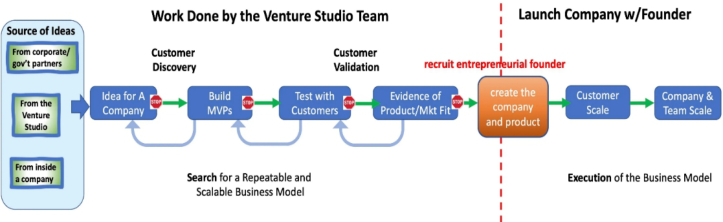
‘Venture studios create startups by incubating their ideas or ideas from their partners (Figure 1). The studio’s internal team builds the minimal viable product, then validates an idea by finding a product/market fit and early customers. If the idea passes a series of “Go/No Go” decisions based on milestones for customer discovery and validation, the studio recruits entrepreneurial founders to run and scale those startups’ (Blank, 2022).
Figure 1: The idea and phases of venture studio team approach (Blank, 2022).
Blank’s innovation process model is based on an organizational point of view. Human-centric team building is important in various phases of
Team, Unit, and Networked Cohesion in Start-Up Entrepreneurship 69
development. In this approach, ideas are created by individuals, and these ideas are then processed by teams consisting of persons with the right compe- tence, roles and mindset. According to the venture studio approach of team cohesion building (Figure 1), on the left side of the dotted line is the team cohesion building phase, and on the right side are the internal unit (startup company) and collaborative network partner cohesion building phases.
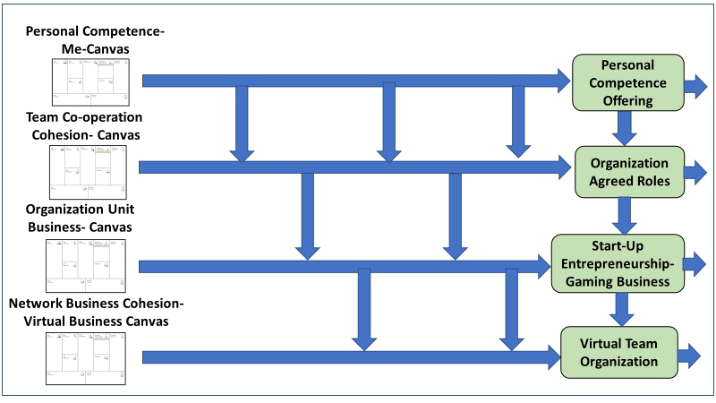
Various Canvas approaches (Figure 2) were developed for different phases of start-up forming and development (pre-start, incubation and acceleration phases). During the start-up of the business, a personal ME-Canvas with IKIGAI analysis, TEAM-Canvas, and UNIT-Canvas were developed accord- ing to (?) the analysis of the cohesive business building. UNIT-Canvas is a platform for leading key competencies on operational and business manage- ment levels. It also has to be remembered that orchestration of teams and virtual organization and cohesion have to be created again and again dur- ing the growth of the business. This article concentrates on introducing the cohesion-building concept in the case study environment, the education pro- gram of Kajaani University of Applied Sciences, concentrating on various stages of start-up gaming entrepreneurship.
Figure 2: Stages of team cohesion development in gaming entrepreneurship.
GAME ENTREPRENEURSHIP- FORMATION STAGES OF COHESION Gradual formation of cohesion at different stages of game entrepreneur- ship, particularly in a multi-disciplinary context, requires collaborative efforts of individuals with a diverse skillset of expertise, possibly interna- tional background culture and knowledge to develop games. It is crucial to maintain and support cohesion at various stages of game development and entrepreneurship.
During the early stages, and even before them, the main activity is for everyone to learn about themselves, such as their knowledge and behavior
model. The IKIGAI methodology is a good approach to understanding yourself and your behavior model.
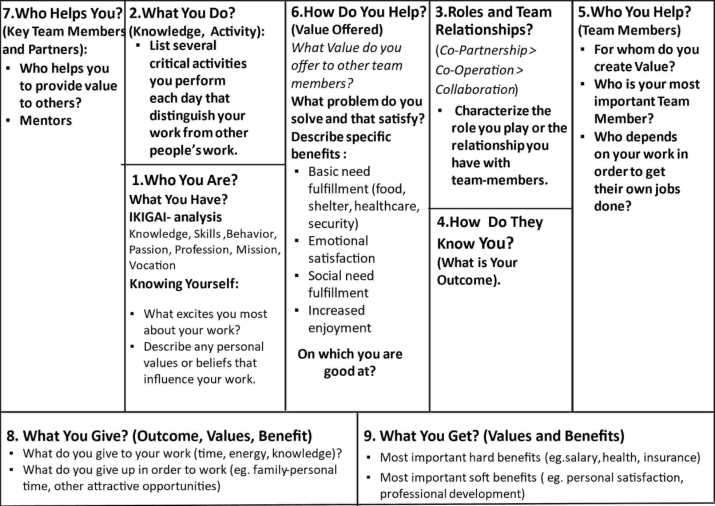
‘It is possible to use Canvas models (e.g., Clark, Osterwalder & Pigneur, 2012) to analyze a company’s/team’s current situation in business develop- ment and team cohesion’. In this research and article, the canvas models have been dynamically chained to enforce the generic scalability during product and business development work from ideas to commercialized business. It is essential to simultaneously develop personal skills and competences, both in cohesive team building and unit organization development. The personal ME- Canvas (Figure 3) provides a person with motivation and support to work according to their own purpose and values. It is possible to influence on common target professionally and individually. The first question you ask yourself is Who You Are? Are you capable of working in a team with oth- ers? What Are Your Skills and Competencies? ‘You can begin to outline your competence with the help of the Ikigai frame of reference.’ One can begin to outline one’s own competence with the help of the Ikigai frame of reference (Levy, 2002).
Figure 3: Personal ME-Canvas for supporting team cohesion building.
It is far too late in team building and team cohesion finding phase to recog- nize that you are not a team player, and the faces of the other team members disgust you. The Personal ME-Canvas helps you to dig deep into personal feelings and behavioral model and understand a big picture of himself in team co-operation.
It is possible to use different types of canvas- views (Figure 2) – team col- laboration cohesion canvas, organization unit business canvas, and network
Team, Unit, and Networked Cohesion in Start-Up Entrepreneurship 71
virtual business canvas – as methodology to support team cohesion building during various stages of start-up entrepreneurship in the gaming business.
Roles and role divisions are changing according to natural progres- sion during the different stages of start-up entrepreneurship and related team cohesion building. The team is optimizing its structure for efficiency and effectiveness. Open communication, adaptability, and regular situation assessments are key parameters in ensuring that roles and responsibilities align with the evolving needs of the team, project, product, and development of start-up entrepreneurship.
Continuous formation of cohesion throughout the start-up’s progress can be supported at different stages, roughly divided to three stages: early stage, cross-functional collaboration team stage and refinement/launch stage:
During the early stage, the definition of clear and inspiring and shared vision is very important. The gathered team should have complementary skills and expertise that forms a competence portfolio to be able to launch a successful business. Team members should have clearly defined roles and responsibilities according to individual members’ strengths and inter- ests. It is essential to create an atmosphere with open dialogue and an environment in which new ideas can be freely shared and discussed.
During the next team stage, cross-functional collaboration and under- standing between functions are growing and knowledge is shared. Team cohesion should increase. The team should make a habit of meeting reg- ularly to discuss progress, concerns, adapting roles, or sharing feedback information. Key achievements and successes should also be celebrated, and individuals rewarded.
During the refinement and launch stage, positive and comprehensive team culture should be reinforced, and a motivated work atmosphere sustained. To succeed in launching the gaming product, all aspects of game develop- ment should be ensured. In-depth testing and refinement should also be conducted based on user feedback. The whole team should have open dialogue on the lessons learned and areas of improvement. Cohesion is growing towards unit cohesion during this stage and its effect expands towards network cohesion in a sphere of influence with partners involved (Figure 2).
Expert roles might also evolve within the team over time. This is connected to the stages of emergent team cohesion. Tasks are changing, performance requirements are increasing, and roles become more specialized and orga- nized. During the early stage of cohesion, team members could try to assign themselves generalist roles while they explore interesting aspects of start-up project. During the next stage of cross functional collaboration, team mem- bers express interest for certain roles including related responsibilities based on their skills and competencies. During the refinement stage, team mem- bers settle into the roles that reflect their expertise (e.g., coding, visualizing, marketing).
It is essential to foster a resilient team culture during all stages, so that the team can adapt to unexpected situations. Potential issues, problems, new
technology or social trends need regular evaluation. This may influence the development of group dynamics. Skill development and just-in-time learning should be supported continuously. This is how game entrepreneurship teams can promote continuous cohesion, adaptability, and motivated team culture over the start-up phase and beyond.
CONCLUSION
The success of start-up entrepreneurship is dependent on multidisciplinary team building, step-by-step motivation, and the creation of team cohesion. That is most important in generating functionally superior and visually impressive games during start-up entrepreneurship. Human self-motivation and orientation and competence analysis should be made before building a dream team of founders and operative team members.
An impressive idea, value production understanding, and committed peo- ple with the right competences create start-up companies. It must be under- stood that cohesion is also formed between users and producers, and between all members of the team, unit, and network partners.
This research and article have focused on cohesion building during the start-up phase of the gaming business entrepreneurship. As a result, it is intro- duced as a case study a four-stage concept of cohesion building throughout the phases of the start-up process in gaming entrepreneurship. This approach is important in building dream team for creating a distinct game product and start a successful entrepreneurship. Continuous cohesion building, adapt- ability, and motivated team culture are needed over the start-up phase and beyond.
REFERENCES
Blank, S., Dorf, B. (2012) The Startup Owner’s Manual- The Step-by Step Guide for Building a Great Company. K&rS Ranch Publishing Division, California. Blank, S. (2022) Entrepreneurs, Is a Venture Studio Right for You? Harvard Business
Review, December 13, 2022, Boston. Clark, T., Osterwalder, A., Pigneur, Y. (2012) Business Model You: A One-Page Method For Reinventing Your Career. John Wiley & Sons Inc, October 2, New York. Forsyth, D. (2021) Group Dynamics. World of Books Limited. Laker, B., Weisz, N., Pereira, V., De Massis, A. (2023) The Emotional Landscape
of Leadership. MIT Sloan Management Review, December 07, 2023, MIT Press, Boston. Levy, B. R., Slade, M. D., Kunkel, S. R., & Kasl, S. V. (2002) Longevity increased by positive self-perceptions of aging. Journal of Personality and Social Psychology, 83. Salminen, V., Pyykkönen, M., Salminen, C. (2023) Spiral Innovation Automa-
tion and Team Cohesion. AHFE International Open Access Publishing, Human Factors, Business Management and Society, Vol. 97, Issue 97, 2023, 78–86. https://doi.org/10.54941/ahfe1003884 Senge, P. M. (1990), The Fifth Discipline, Doubleday/Currency, New York. ISBN 0- 385-26094-6.
Team, Unit, and Networked Cohesion in Start-Up Entrepreneurship 73
Sudhakar, G. P. (2016) Software Development Teams- Performance, Productivity and Innovation. PHI Private Limited, Delhi. ISBN-978-81-203-5179-0. Yoshino, K., Glasgow, D. How to Productively Disagree on Tough Topics. MIT Sloan
Management Review, Reprint #65213, 2023, MIT Press, Boston. Inoue, K. (2000). Psychology of Aging. Chuo Hoki Shuppan. pp. 80–99, 144–
145. ISBN 978-4805818954.
LISTED IN THE AHFE DIGITAL BOOKSTORE CATALOGUE
Explore the complete digital volume
Human Factors, Business Management and Society
Read this individual research paper free through the original publisher, or explore the full digital proceedings book.
ISBN 978-1-964867-11-3
Explore this ISBN in the AHFE Bookstore ↗Listed in the July 2026 bookstore catalogue; search by ISBN to confirm current availability · Digital book purchase optional