Vesa Salminen, Matti Pyykkönen, Ari Saarinen (2026). Ontology Platform Routing Disaster Information and Data for Decision Making. In: Human Factors, Business Management and Society. AHFE Open Access, vol. 215, pp. 275–285. https://doi.org/10.54941/ahfe1007608
Understanding the nature of the event and situation awareness during a natural disaster is crucial for survival and recovery. Management of the disaster event requires seamless coordination across numerous agencies, systems, and stakeholders. A shared understanding of the situation is critical as responders from different organizations (e.g., fire, medical, police, military) must operate under high pressure. This research examines the human-centered aspects of natural disaster management. The intelligent solution, MobiJOPA™ of start-up enterprise Husqtec Corp, served as an intelligent training environment for learning, collecting data, and describing a common event ontology for stakeholders involved with the situation and working together. The study focuses on collecting and describing disaster event information so that all related stakeholders can understand it in the same way. It is important to transform the data into an ontology platform to route it among stakeholders (presentation and sharing of the situational picture and threat assessment) so that main resources can manage the disaster situation? Data for the creation of this ontology platform have been continuously collected from regional training sessions, where participants practiced in virtual disaster-event scenarios.The study highlights the critical role of a common understanding among stakeholders involved in a disaster situation. This research highlights how cohesive teams enhance crisis response through effective communication, high morale, and trust. These factors enable quicker, more effective decision-making during critical situations. Generative AI, machine learning, and autonomous agents can greatly amplify our capabilities but without an ontology platform and semantic backbone analyzing of streams of data in real-time, predicting emerging threats, and optimizing resource distribution, the outputs could be erratic or opaque. With the ontology and knowledge graph in place, AI can reason in context and explain its conclusions using domain concepts that humans understand.
Flood disaster management requires continuous monitoring, contextual understanding, pattern recognition, and coordinated action. Event analytics transforms raw data into life-saving decisions.
Disaster response and management in the era of climate change require seamless coordination across numerous agencies, systems, and stakeholders. A shared understanding of the situation is critical as responders from different organizations (e.g., fire, medical, police, military) must work in concert under high pressure. The common ontological definition is important for various stakeholders and expert groups to understand disaster during its different stages for controlling and managing salvation and recovery (Salminen et al., 2025/1). Semantic interoperability works in practice between different organizations by creating a common language and meaning structure that enables information to be exchanged and understood without misunderstanding. This is achieved through a common ontology that defines key concepts unambiguously.
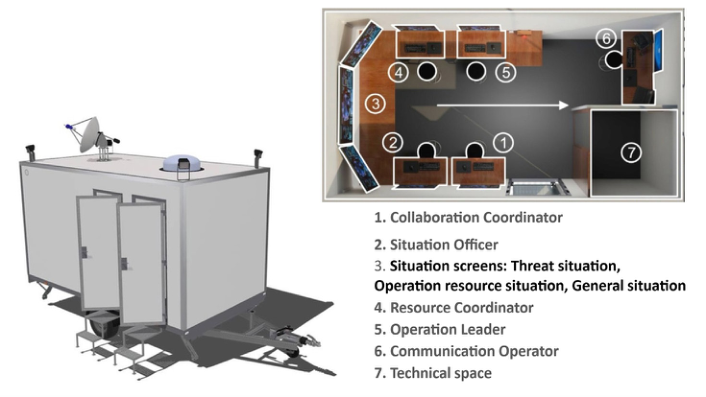
This article suggests that a human-oriented approach is necessary for capturing data from various sources and using it in businesses. In this article an analysis has been conducted on the various aspects of the developed framework of situation analysis, resource control and operation command process as targeting for better disaster management. The analyzed case study company is Husqtec Corp., a start-up company concentrating on situation and operational management. The created and developed product is MobiJOPA™, a solution on which the functionality of situation analysis, resource control and operation command management is implemented (Salminen et al., 2025/2). The objective of this research has been to introduce an integrated situation awareness and management system and a model of the operative functional environment with ontology offered to involved stakeholders for training purposes before potential disaster situation. The use case is the MobiJOPA™ system developed by Husqtec Corp, which is a mobile and modular management unit (Figure 1).
Figure 1: MobiJOPA ® - A portable situation and operation management system.
The use case is natural disaster management. The article outlines the importance of human factors, team cohesion, an integrated situation
Ontology Platform Routing Disaster Information and Data for Decision Making 277 management system, a domain-specific ontology model, and data-driven approaches in solving the problem of quick decision-making in a disaster crisis.
THEORETICAL FRAMEWORK ‘Situational awareness means understanding what is happening around us and is recognized as a critical foundation for successful decision-making across a broad range of situations and leads to situation management’ (Stanton et al., 2009). ‘Situational awareness is presented as a predominant concern in system operation, based on a descriptive view of decision making’ (Endsley, 1995). ‘Situational awareness is defined as the perception of entities in the environment, comprehension of their meaning, and projection of their status in the near future’ (Munir et al., 2022).
‘Lundberg (2015) describes the situation awareness system and process dependencies on system awareness states. He also describes the situation system components as mediators and catalysts for the situation.
‘The way that information is transferred through teams affects shared knowledge within the team about situations, their common ground’ (Artman 2000). ‘Babitski et al. (2009) demonstrated that an ontology-based integration of sensor data in a flood scenario significantly enhanced situation understanding for responders, improving both interpretation of data and coordination among teams.’ ‘Similarly, Elmhadhbi and Karray (2021) proposed a semantic framework for disaster management that enabled a holistic understanding of crisis information, resulting in better stakeholder coordination and decision- making in flood response case studies.’
‘OODA- Loop created by John Boyd is a 4-step decision-making process (Observe, Orient, Decide, and Act) where the individual or group that makes it through all the stages the quickest is the most successful’ (McKay et al, 2023).
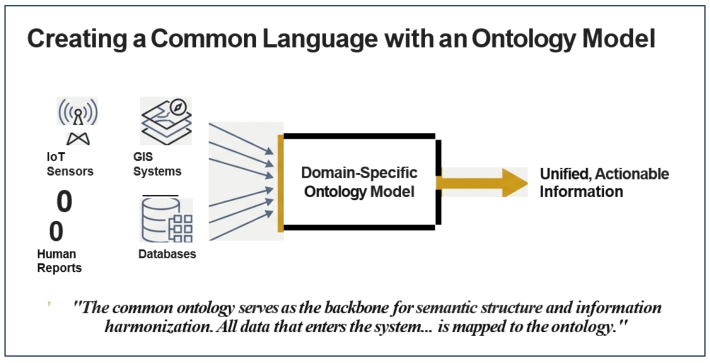
‘Disaster management ontology definition is the starting point in process harmonization for aligning how different agencies’ processes intersect’ (Salminen et al., 2025/2). ‘The common ontology serves as the backbone for semantic structure and information harmonization. In other words, all data that enters the system, whether from IoT sensors, GIS systems, databases, or human reports, is annotated or mapped to the ontology, enabling consistent master data management’ (Salminen et al., 2018).
‘Open communication, adaptability, and regular situation assessment are key parameters in ensuring the alignment of roles and responsibilities with the evolving needs of the team, project, product, and development’ (Salminen et al., 2024).
The individuals working in situation management unit have various type of knowledge and shape of understanding. ‘T-shaped individuals and experts have deep knowledge and skills in a particular area, along with the capacity to collaborate across disciplines with a broad understanding of other areas. X-shaped professionals as commanders of team have broad skills and strong leadership qualities and ability to drive collaboration and innovation across an organization An X-shaped person is actually a T-shaped person who has good leadership abilities’ (Rahman, 2024).
Building interoperability between stakeholders requires understanding the real-world semantics, linking formal data to meanings that make sense to humans in their roles. In other words, the ontology must be grounded in the language and practice of emergency responders (Salminen et al, 2026).
RESEARCH QUESTIONS AND RESEARCH APPROACH This research examines the formulizing of common ontology and semantics aspects during nature disaster identification and management. Understanding the nature of the event and situation awareness during a natural disaster is crucial for survival and recovery. Management of the disaster event requires seamless coordination across numerous agencies, systems, and stakeholders. A shared understanding of the situation is critical as responders from different organizations (e.g., fire, medical, police, military) must operate under high pressure.
During the research on the disaster event ontology has been answered to the following research questions:
How is information collected and described about a disaster event in a way that stakeholders can understand (situational picture and situational understanding)?
How is this data transformed into an ontology platform that routes information between stakeholders (presentation and sharing of the situational picture)?
How is information from different sources routed to increase disaster awareness and manage disasters using the ontology platform (threat assessment)?
How is the situational information of resources used to manage disaster situations utilized using the ontology platform and the management system (resource control)?
Data for the creation of this ontology platform has been continuously collected from regional training sessions, where participants practiced in virtual disaster event scenarios.
This research has an action-based approach and uses a method based on grounded theory (Glaser, A. Strauss, 1999). It is partly constructive, conceptual, and analytical. Use case has been flood disater. It introduces an ontology platform for event analysis and management. Data for this concept creation has been continuously collected from the innovation and development phase of the case study start-up company Husqtec Corp. The situation management unit MobiJOPA™ is introduced on which the situation analysis, resource control and operation command is executed. This action- type research approach may be seen as a type of applied science.
EVENT DESCRIPTION AND ANALYTICS IN FLOOD DISASTER Floods are complex, rapidly evolving events requiring early detection, situational awareness, coordinated response, and continuous learning. The
Ontology Platform Routing Disaster Information and Data for Decision Making 279 knowledge on earlier disasters occurred is an essential information source for understanding the possibility of new coming flood disaster.
Can floods be predicted? What early signals indicate rising risk? What environmental, infrastructural, and human factors trigger flood events? Event analytics enables authorities and organizations to understand flood dynamics, anticipate escalation, and act proactively. There are many contextual data sources e.g. rainfall intensity and duration, river and dam water levels, soil saturation data, weather forecasts, urban drainage capacity and population density and vulnerable groups available A flood event refers to the occurrence of rising water levels. A flood incident refers to situations causing immediate harm such as breach of embankments, submerged hospitals or power stations or evacuation emergencies. The communication opportunities between citizens and victims might be missing. Transport capabilities could also be insufficient. Incidents, when they occur require rapid, coordinated response.
Continuous heavy rainfall and river level raising are signaling undesirable change. Drainage overflow or unusual water accumulation in urban zones are showing deviation. If there are electric power generation failures or drinking water is contaminated, road traffic is disturbed, or similar types of problems and events it is time to act. The question is how to detect and recognize the situation and its degree of danger. It is important to model events and recognize them as patterns. The regional stakeholders can train common functionality before the disaster happens and build a domain-specific ontology model (Figure 2) by using roles and teamwork for interoperable communication between various stakeholders involved.
Figure 2: Common language with ontology-model.
Flood risk patterns emerge from climate-driven extreme weather, repeated seasonal rainfall trends and various urbanization effects. Improved drainage planning and use of smart flood sensors and early evacuation drills can be part of information gathered and routed between stakeholders. Pattern recognition enables prediction of high-risk zones and time windows.
It is important to analyze flood events within individual context through contextual reasoning according to geography and elevation, population vulnerability and infrastructure resilience. Understanding context and regional emergency preparedness levels allows accurate prioritization of rescue, relief, and recovery actions. Flood events normally occur so it is essential to analyze and understand the chain of events. The typical flood chain appears so that it starts by prolonged rainfall and continues with soil saturation. Then rivers start overflowing and influence urban flooding, infrastructure failures, and human displacements. Identifying pivotal points in the chain enables early intervention.
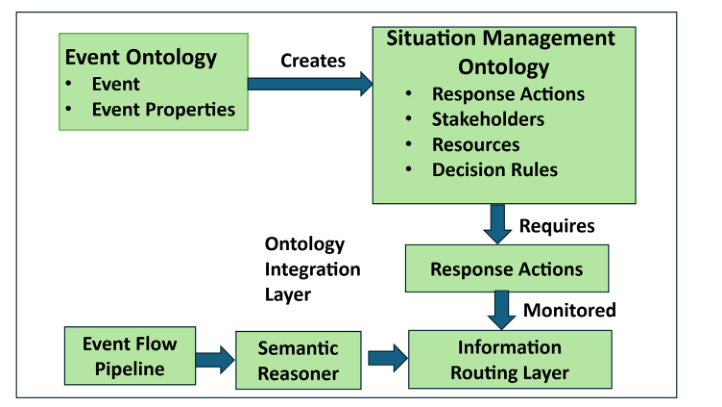
EVENT AND SITUATION ONTOLOGY ON A DOMAIN-SPECIFIC ONTOLOGY MODEL An event ontology defines types of events (e.g. flood, earthquake, cyberattack, fire), event properties e.g. (time, location, severity, magnitude) and event relationships (e.g. causes, triggers, precedes, escalates). Its role is to structure the raw facts of what is coming to or has occurred. It is essential to build up a structured approach to create and refine an event-related ontology model according to related modifications for managing disaster data and information flows and understand the content on the same way (Figure 3).
Figure 3: Integration of event and situational ontology on domain-specific ontology model.
A situation management ontology defines situations (states of the world created by events and context) It designates also impacts, risks and needs. It recommends response actions and workflows targeted to regional stakeholders and shows their responsibilities. It indicates resources, capabilities, and constraints and assigns decision logic, prioritization, and routing rules. Its role is to transform events into actionable situational awareness. Integration happens through semantic relationships and mapping rules.
Ontology Platform Routing Disaster Information and Data for Decision Making 281 These two ontologies must be integrated on the data and information routing platform, a domain-specific ontology model. The basic thinking logics (Figure 3) is formed by following way: Event creates situation (event and situation ontology)-> Event has impact (event and situation ontology)> Event triggers situation and response actions (situation ontology)> Situation is monitored by stakeholders or sensors (situation ontology)> Impact requires resources and actions (situation ontology). Events are then feeding the domain-specific platform and situations are driving team decisions.
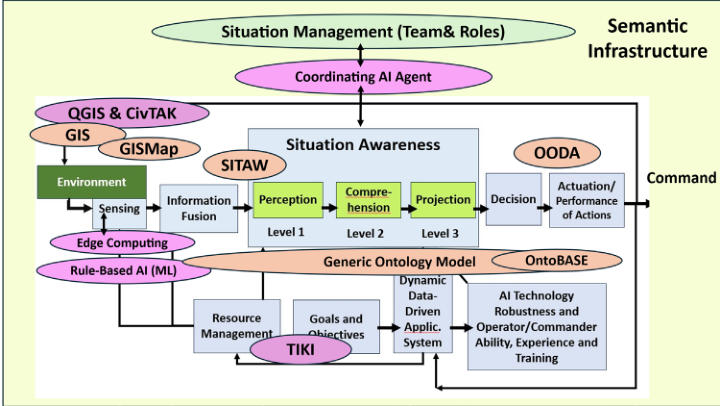
INTEGRATION ARCHITECTURE FOR SITUATION MANAGEMENT In Figure 4 are listed various technologies and systems related to situational awareness, information management in situational management, and artificial intelligence in support of the situational management team.
Figure 4: Integration architecture related to situation awareness and management.
The key elements (Figure 4) supporting situation awareness and the management process are
OODA loop: observe, orient, decide, act model for decision-making in operations management and resource management.
Artificial intelligence components: Rule-based domain-specific AI platform and language model (ML), coordinating, actor-role-based assistant AI agents; situational awareness (threat assessment and situation development) and command (resource control and operational management).
Models and systems: Generic ontology model (data models; vocabulary and concepts), SITAW (Situation Awareness, edge computing, situation management at the situation management site (situation team and actor roles).
Other tools: TIKI (reporting/information sharing; semantic infrastructure and operational organization interoperability), QGIS & CivTAK (transmission of location-bound situational information and operation management), GIS (geospatial information system; geospatial and infrastructure) OntoBASE (data repository of ontology models), semantic infrastructure and GISMap (geospatial information system generated; thematic maps and map-bound information visualization on a map).
These elements form a comprehensive approach and functionality to improving situational awareness and the use of situational information in decision-making.
The use of semantic infrastructure in situational awareness (such as in SITAW systems) offers several advantages, as it enables meaningful linking and analysis of information.
These two ontologies must be integrated on the data and information routing. First, it improves data interoperability between different systems, such as GIS (QGIS) and OntoBASE tools, by enabling automatic data fusion and inference. Second, it enhances situational management across teams and roles, reducing errors and accelerating decision-making in the OODA loop, where observation and orientation benefit from semantic processing.
Furthermore, semantic infrastructure supports edge computing and coordinating AI agents, leading to real-time situational understanding and better resource management in critical environments, such as emergencies or military operations.
The diagram shows the structure of a situation awareness system, where the central element is the OODA loop (Observe, Orient, Decide, Act), which integrates artificial intelligence, ontologies and spatial information systems to support decision-making. The structure consists of a layered or networked entity, where rule-based artificial intelligence (Rule-Based AI, ML) and auxiliary, user-role-coordinating AI agents (Coordinating AI Agent) enable automatic information processing, proactive communication, and inference together with command/situation management (Command).
The mutual importance of the elements is emphasized in their interaction: Generic, Domain Specific Ontology Models provide the semantic foundation for the SITAW system (Situation Awareness), which utilizes Edge Computing for real-time analysis. Situation Management, Team & Roles connects teams and roles, while tools such as TIKI, QGIS & CivTAK, GIS (Community Information System, Operations Management System and Geographic Information System), OntoBASE (Domain-specific ontology models), Operational Information Framework, Semantic Infrastructure and GISMap (thematic maps and geolocation data generated from a spatial data warehouse) enable information visualization, e.g. on map templates, merging and sharing situation and resource information between different system and operational parties. Overall, the diagram depicts a comprehensive ecosystem that improves situational awareness in critical environments, such as emergencies (natural disasters, major accidents, war, etc.) and operational operations, by enabling efficient information management, analysis, reporting, and decision-making.
The use of semantic infrastructure in situational awareness (such as in SITAW systems) offers several benefits, as it enables meaningful linking and
Ontology Platform Routing Disaster Information and Data for Decision Making 283 analysis of information. First, it improves data interoperability between different systems, such as GIS and OntoBASE tools, by enabling automatic data fusion, analysis, and inference. Second, it enhances situational management across operations actors, teams, and roles, reducing errors and accelerating decision-making in the OODA loop, where observation and orientation benefit from semantic processing. Furthermore, semantic infrastructure supports edge computing and coordinating AI agents, leading to real-time situational understanding and better resource management in critical environments, such as emergencies or military operations.
The SITAW (Situational Awareness) and OODA (Observe, Orient, Decide, Act) processes operate in an integrated hybrid model designed for situational awareness and situation management in exceptional circumstances, such as natural disasters. The model combines the three levels of SITAW (observation, understanding, and anticipation) with the four phases of the OODA cycle to form a continuous, iterative process that enables rapid response in acute crises, such as earthquakes, major floods, and wildfires. In the system, SITAW provides the basis for extensive observation and situational awareness: it collects information about the environment (e.g. sensors, reports), analyzes its significance based on previous information, and predicts future developments, such as the spread of threats.
OODA, in turn, enhances decision-making in a cycle: Observation collects data (aligned with SITAW observation), Orientation establishes context (integrated with SITAW understanding and anticipation), Decision selects a course of action prioritized for acute threats, and action implements measures, restarting the cycle to ensure continuous updating. This combination enables efficient resource allocation, prioritization, and adaptation to changing conditions, such as in an earthquake (collapsed buildings are prioritized) or a major flood (evacuations and infrastructure protection). The continuous cycle ensures updated situational awareness, rapid response, and comprehensive management, which improves efficiency in crises.
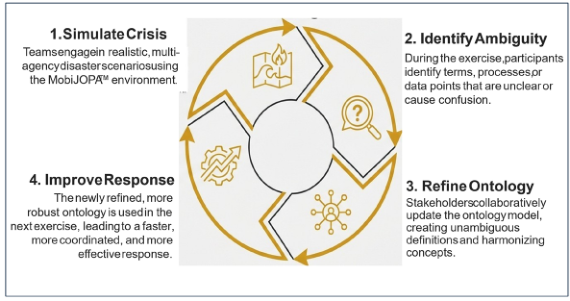
The SITAW (Situation Awareness) and OODA (Observe, Orient, Decide, Act) processes work in an integrated manner in the MobiJOPA® system to support situational awareness and decision-making, especially in natural disasters, such as major floods. SITAW focuses on different levels of situational awareness: observation (data collection from sensors, drones and other sources), understanding (data analysis and prediction, such as flood spread predictions) and proactive projection (threat prioritization). The OODA cycle, in turn, enhances decision-making by dividing it into phases: Observe (observation, which corresponds to SITAW data collection), Orient (orientation, analysis, and situation understanding), Decide (decision- making, such as resource allocation), and Act (action, such as evacuations). These processes are integrated into real-time data processing in MobiJOPA®, where a semantic infrastructure links data to ontologies, enables automatic alerts, and improves coordination between different actors. For example, sensor data can automatically trigger OODA cycle steps, such as identifying risk areas and reallocating resources. This integration ensures a continuous update of the situational picture and flexible adaptation to changing circumstances, enhancing collaboration across teams and roles. An adaptive learning cycle is essential to refine the ontology model (Figure 5).
Figure 5: The adaptive learning cycle to refine the ontology model.
The created ontology model has to be modified (Figure 5) according to the routed data and information available, and stakeholders related and engaged. When facing a new type of disaster, the generic ontology model can be configured and refined according to related data, information, and stakeholders involved. Training becomes a continuous feedback loop that improves both team cohesion and system intelligence. The adaptive training of stakeholder experts and participants becomes an essential continuity for refining the ontology model through practice.
CONCLUSION
Flood disaster management requires continuous monitoring, contextual understanding, pattern recognition, and coordinated action. Event analytics transforms raw data into life-saving decisions.
This article introduces an integrated disaster situation management system embedded by a domain-specific ontology model. The system environment for the use case is the MobiJOPA™ system developed by Husqtec Corp., a mobile and modular management unit designed for understanding disaster situations and resource allocation and management. That generates a continuous and adaptive decision loop following the OODA model. That creates an environment for cross-system semantic understanding, ensuring data consistency. The system creates opportunities for rapid reallocation of resources as conditions change and enables operational command and long-term learning. Modular and extensible architecture is adaptable to new threat types (e.g., pandemics, natural disasters).
Semantic interoperability enabled by a common ontology and robust system architecture provides shared situational awareness and efficient coordination in disaster management. It reduces information. The adaptive training of stakeholder experts and participants involved becomes an essential continuity for refining the ontology model through practice.
REFERENCES
Artman, H. (2000). Team Situation Assessment and Information Distribution.
Ontology Platform Routing Disaster Information and Data for Decision Making 285 Babitski, G., Bergweiler, S., Trinh, T., Atkinson, M., Simonis, I. (2009). Ontology-
Based Integration of Sensor Data for Disaster Management. Journal of Intelligent Information Systems, 33 (3), 233–253. Elmhadhbi, L., Karray, M. H. (2021). A Semantic Framework for Disaster Management: Towards a Holistic Understanding of Crisis Scenarios. Computers in Industry, 128, 103432 Endsley, M., (1995) Towards a Theory of Situation Awareness. Human Factors. The
Journal of the Human Factors and Ergonomics, March 1995, 37(1), 32–64 DOI: 10.1518/001872095779049543 Glaser, B., Strauss, A. (1999) Discovery of Grounded Theory: Strategies for Qualitative Research. Aldine Transactions. Lundberg, J. (2015) Situation awareness systems, states and processes: a holistic
framework, Theoretical Issues in Ergonomics Science, 16:5, 447–473, DOI: 10.1080/1463922X.2015.1008601 McKay. B., McKay K. (2023) The Tao of Boyd: How to Master the OODA Loop.
Behavior, Character, Featured November 6, 2020
Last updated: July 1, 2023 Munir, A., Aved, A., Blasch, E. (2022) Situational Awareness: Techniques, Challenges, and Prospects. AI, January 2022, MDPI., 3, 55–77. DOI: 10.3390/ ai3010005. Rahman, A. (2024) The Landscape of Skill Sets: T-Shaped, X-Shaped, and I-Shaped
Professionals. Retrieved from https://www.linkedin.com/pulse/landscape-skillsets- t-shaped-x-shaped-i-shaped-abdul-rahman-6mwqf/read 6.11.2025. Salminen, V., Niittymäki, S., Sanerma, P., Eklund, P. (2018) Semantic Infrastructure for Service Environment. Data Mining- Book Chapter 7, IntechOpen Publications. DOI: 10.5772/intechopen.76945. Salminen, V., Pyykkönen, M., Salminen, C. (2025/1) Human aspects in Situation
Analysis, Resource Control, and Operation Command. Human Factors, Business Management and Society, Book, Vol. 176, 2025, 95–106 DOI: 10.54941/ ahfe1006307 Salminen, V., Pyykkönen M., Saarinen, A., Ylirotu, N. (2026) Integrated Disaster Situation Management System With Domain-Specific Ontology Model Intelligent Human Systems Integration (IHSI), Vol. 200, 2026, 1–11 https://doi.org/10.54941/ AHFE-Paper-0118 Salminen V, Pyykkönen, M., Saarinen A. (2025) Disaster Situation Management
by Using Common Ontology and Semantic Infrastructure. AHFE International Open-Source Publishing. Human Systems Engineering and Design (IHSED2025), Vol. 198, 2025, 1–17 https://doi.org/10.54941/ahfe1006756, DOI: 10.54941/ ahfe1006756 Stanton, N.A., P.M. Salmon, G.H. Walker, and D.P. Jenkins. (2009) Genotype and Phenotype Schemata and Their Role in Distributed Situation Awareness in Collaborative Systems. Theoretical Issues in Ergonomics Science 10 (1): 4368. https://doi.org/10.1080/14639220802045199
Reference Material OODA-Loop: OODA loop - Wikipedia
LISTED IN THE AHFE DIGITAL BOOKSTORE CATALOGUE
Explore the complete digital volume
Human Factors, Business Management and Society
Read this individual research paper free through the original publisher, or explore the full digital proceedings book.
ISBN 978-1-964867-91-5
Explore this ISBN in the AHFE Bookstore ↗Listed in the July 2026 bookstore catalogue; search by ISBN to confirm current availability · Digital book purchase optional