Laura Maria Zambrano Rojas, Juan Diego Marquez Posso, Iván Andres Rivera Sánchez, Luis Andrés Saavedra, Oscar Bernal (2022). Ergonomics workplace assessment: differences between on-site and remote ergonomic evaluations under COVID-19 conditions. In: Safety Management and Human Factors. AHFE Open Access, vol. 64, pp. 152–158. https://doi.org/10.54941/ahfe1002640
The aim of Ergonomic workplace assessment (EWA) is to promote worker’s health due to identification, measurement and risk control related to the working conditions. Covid-19 pandemics forced workers to relocate their workplace from their offices to their homes. This fact headed the introduction of information technologies for the implementation of the EWA. This paper is focused in identifying the differences within both modalities. Seventeen health professionals answered three questionnaires regarding demographic information, EWA methodology they had applied, preference, advantages, disadvantages and opportunities of each methodology, discomfort and workload. Moreover, standard time was calculated for both modalities (Freivalds & Niebel, 2014).It was found that standard time for the execution only differed in one minute. Although, on- site modality is longer due to the transportation requirement. The difficulties in remote modality are related with the worker being alone and the verification of the proposed modifications for the workplace. Even so, remote modality optimizes time and coverage. To ensure the quality of the remote modality it is necessary to guarantee the internet connection of health professional and worker and also that the worker isn´t alone while the EWA.
Last decades, technological growth, information and communication techno- logy innovations have modified the way people usually worked. Telecommu- nication developments have allowed people to access to their workstations without being there. It has led to a new working modality called telewor- king (López & PérLópez, N., Pérez, M. C., Nagham-ngwessitcheu, E. G., & Vázquez, 2014). Business’ interest in telework is growing due to its poten- tial to increase flexibility in worker’s lifestyle and organizational structures (Montreuil & Lippel, 2003).
Teleworking is becoming popular not only by the advances in informa- tion technology but because it’s unclear about where and when the work
should be done and how to measure it (Allan et al., 2020). These facts, imply the necessity of rethink the health and security at work. It is clear that this modality is beneficial for businessman in so many ways, but also involves challenges related with ergonomics and preventive workplace design (Montreuil & Lippel, 2003).
At the beginning of 2020, during Covid-19 pandemic, teleworking took relevance because of all the containment measures around the world. It is estimated that, in Colombia, the number of remote workers increased to 3 million (Montreuil & Lippel, 2003). This wasn’t a concerted condition; people was forced to adopt telework because of the isolation instructions. This modality was rapidly adopted and in most cases without workplace adequacy protocols and guidance. As a consequence, people is working in inadequate conditions (Trujillo & Perdomo, 2020).
Isolation has shown the potential benefits in cost reduction, productivity increase and absenteeism decrease. Nevertheless, the raise of computer based works has led to higher musculoskeletal risk in neck, shoulders, wrists, hands and lumbar region (Elshaer, 2017) regarding the increase of static postures, repetitive movements, uncomfortable and extreme postures in the forearm and wrist (Montreuil & Lippel, 2003); being all of them risk factors for workers’ health (Vicente-Herrero et al., 2018).
In order to promote workers’ health, it is needed to identify, measure, evaluate and control work related risks (Espín et al., 2018). Therefore, pre- ventive strategies are usefully to design healthy and safe workplaces. EWA includes equipment, furniture, working tools and their disposals in the work- station. To ensure workers’ health, it is necessary to consider the environment and appropriate postures. This general evaluation should also contemplate level of physical activity, load lifting conditions and movements (Franco & Segovia, 2016).
Considering pandemic conditions, it is needed to evaluate telework work- places to identify risk conditions. EWA were usually done on site, but according with public health restrictions, it is necessary to introduce the remote modality. Remote EWA includes the same items, but it is unclear if it is as good as those performed on-site and if it’s worth it to continue with this modality after pandemic is over. Thus, the aim of this study is to identify differences, difficulties and advantages for both modalities and determine if remote modality should be included as an accepted modality.
METHODS
Sample The study sample was comprised 17 health professionals (16 Women) with at least 3 years of experience and occupational health license. When this study was performed, all of them had performed at least one of the EWA modalities within October 2020 and January 2021.
Auto-Report Questionnaires Questionnaires were tested by 5 of the most experienced professionals in the group. They were informed about the aim of the study. Once the
understanding of the questionnaires was verified, a meeting with all the potential participants was made to explain the objective of the study. Questi- onnaires were answered online.
Participants answered 3 questionnaires. The first one asked about the modality of EWA each professional had applied. It also included questions about personal data, estimated time in each section of the EWA, estimated completeness of each section of the report while de execution of the EWA,pre- ferred modality, difficulties, advantages and opportunities of each modality. This questionnaire was answered once.
The second questionnaire was the adapted Nordic questionnaire in which they answered about discomfort level in 17 body parts. It was answered for 5 consecutive days at the end of the labor day. They also specified which EWA modality was performed each day to evaluate the discomfort related to each modality.
NASA TLX questionnaire was applied to evaluate workload. It comprised two stages: Comparison of the importance of each dimension over the oth- ers and the evaluation of each dimension for the task. This method includes six dimensions: Effort, mental demand, physical demand, temporal demand, performance and frustration level. This questionnaire was answered once.
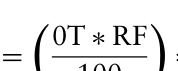
Standard Time Measurement Time study is useful to calculate the time required by a qualified worker to perform an activity at a normal pace (Freivalds & Niebel, 2014). Thus, stan- dard time (ST) is defined by the observed time (OT), rating factor (RF) and slacks or supplements (SS).
Equation reproduced from the original PDF.
100
For the standard time measurement, there were several observations of the EWA to define and standardize the different stages. Then, it was designed a registering sheet so each observer could fill it with the same informa- tion. Observed time was measured using a stopwatch and finally there were considered the RF and SS.
Remote modality observation was performed by teams platform. Obse- rved time was measured during the session by a third person. In the onsite EWA, the health professional recorded the execution of the EWA using a go pro positioned on his/her head. Then, another person watched the video and measured the times. Also, it was taken information of interruptions or any kind of incidentals.
RF was calculated using hierarchical process analysis (HPA). It is a multi- criteria decision making method were each pair of criteria is compared to give a qualification in a stablished numerical scale. For this study, four cri- teria were defined: Attitude with the customer, experience, reports quality and reports compliance. Three experts (The professionals that usually check EWA’s reports) participated in the qualification stage. First, they had to give the qualification of the relative importance of each criteria over the other, by pairs (scale 1 to 9). For example, if they assigned 1, that means both criteria
Ergonomics Workplace Assessment 155
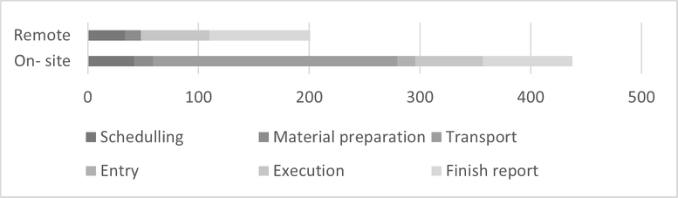
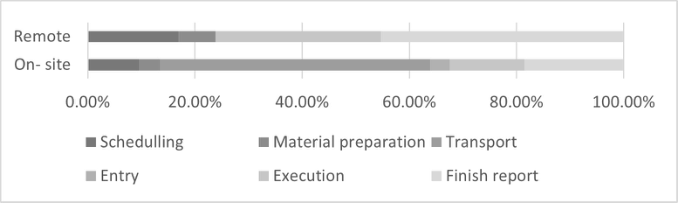
Figure 1: Estimated time.Figure 2: Distribution of estimated time.
have equal importance. Otherwise, if they assigned 9 when comparing atti- tude with customer over experience, it means that attitude with customer is much more important. Finally, they had to qualify each of the health profes- sional for each criteria using a Likert scale (1 = Deficient, 3 = Lower than average,5 = Average, 7 = over the average and 9 = Exceptional). Thus, RF is calculated with the criteria weighing and health professional qualifications.
SS are extra time added because human can’t work at the same rhy- thm all day long. For this study, SS considered are: personal needs, high concentration and monotony.
RESULTS
Auto-Report Questionnaires Health professional estimated that it takes 18.7% more time on-site EWA due to the time spent in transport (See Figures 1 and 2). If it is considered only the execution time, it only differs in one minute (61 minutes on-site and 62 remote). Moreover, they estimate that it takes 10 minutes more to finish the report in remote modality (91 minutes remote and 81minutes on-site).
Considering the estimations made by the health professionals, in on-site EWA, transport takes about 50% of the overall time.
Further, it was found that health professional estimated they are able to complete a higher proportion of all the questionnaires that compose the EWA in on-site modality. Although, 64.71% of them referred preference for remote EWA and 58.82% said it is easier. Some of the advantages they mentioned are: they are able to record all the execution of the assessment and this allows to complete the report, promotes time optimization, more population can be
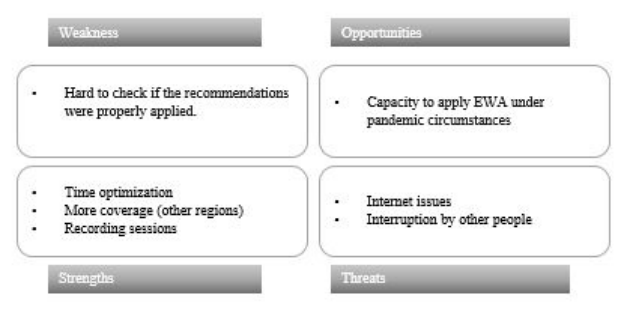
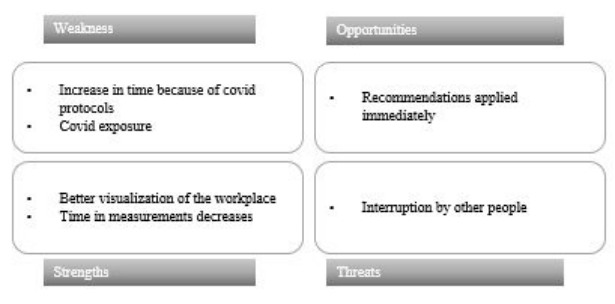
Figure 3: Identified weakness, strengths, opportunities and threats for remote modality.Figure 4: Identified weakness, strengths, opportunities and threats for on-site modality.
covered (other regions) and, specifically for pandemics, remote modality is safer. However, they said that it is difficult to check whether the recommen- dations they gave were properly implemented and they aren’t able to see the total workplace so they need to ask more questions.
Although, it was possible to identify weakness, opportunities, strengths and threats for each modality (See Figures 3 and 4).
Results in Nordic questionnaire suggested that there is no increase in discomfort levels along the week. Average discomfort level were lower than 2 for both modalities. Therefore, maximum values analysis was performed by day considering if the health professional did remote, on-site EWA or reports. It was found that, in on-site EWA, maximum value of 4 was reported in head, eyes, neck and low back. Also, for remote EWA, the maximum value repor- ted was 4 in eyes and low back. Finally, the values reported on the days the health professionals were dedicated to finish the reports, maximum value of 5 was reported in both shoulders and right wrist; 4 was reported in head, neck, middle back and low back.
NASA TLX results showed that they perceive high mental and performa- nce demand.
Criteria Weighing Attitude with the customer 27% Experience 49% Reports quality 9% Reports compliance 15%
Standard Time Measurement Mean OT was greater in remote modality (65 minutes) than on-site (42 minu- tes). Although, there were significate differences between estimated and measured time for both modalities.
After the expert session, the final HPA matrix was defined as follows: The final weighing is presented in Table 3. All the health professionals were evaluated for each criterion by the experts. Considering this qualification and the weighing given for each cri- terion the RF was calculated. Applying the equation (1), standard time was calculated for both modalities (remote 66.33 minutes, on-site 62.16 minutes).
CONCLUSION
As pandemics is lowering, some workers have returned to their offices and others are still at home. In both cases, having a proper workplace is crucial for health and performance. Thus, EWAs are still relevant.
Some of the differences found between both modalities are related with covid 19 exposure or increase of total time due to the covid protocols. Con- sidering that this study is focused on evaluating if it is worth it to continue
with remote EWA after pandemics, those facts aren’t decisive. Also, there was found that, indistinctly of the modality, other people interrupt.
Standard time calculated for the execution of the EWA (neither tran- sport nor finishing report included), is similar for both modalities. More- over, remote modality promotes time optimization between appointments. Nevertheless, health professionals said that it is easier to collect required information in on- site modality because they can easily watch the environ- ment. However, in remote EWA, they record the session which allows them to review information when is required.
It is easier to implement recommendations in on-site modality because they can do the modifications immediately but in remote EWAs they have to give the instructions to the worker. Nevertheless, remote promotes an inclusive approach reaching every region. In addition, health professionals prefer remote modality. Considering all above, it is possible to continue with this new modality but to ensure its effectiveness, it is necessary that the assessed worker isn’t alone at the time of the EWA (someone has to take pictu- res in normal working postures) and must have basic skills in information technology.
REFERENCES
Allan, T., Mac∧, M. De, Belo, A., Ralf, V., Medeiros, F. De, Pires, R., Souza, D., & Ant∧, M. (2020). Ergonomics and telework : A systematic review. Work, 66(4), 777–788. https://doi.org/10.3233/WOR-203224 Elshaer, N. (2017). Prevalence and associated factors related to arm, neck and shoul-
der complaints in a selected sample of computer office workers. J Egypt Public Health Assoc, 92(4), 203–211. https://doi.org/10.21608/EPX.2018.22041 Espín, C., Espin, M. L., & Zambrano, L. (2018). Evaluación de riesgos ergonómicos y su incidencia en la salud de los trabajadoresdel GAD parroquial rural Alliriquín. Boletín Redipe, 7(2), 166–173. Franco, C., & Segovia, M. (2016). Evaluación ergonómica de los puestos de trabajo
del personal administrativo de la FACE UC. Revista Ciencias de La Educa- ción, 26(47), 197–209. http://servicio.bc.uc.edu.ve/educacion/revista/47/vol26n 472016.pdf Freivalds, A., & Niebel, B. (2014). Ingeniería industrial Métodos y Estándares (13th ed.). McGraw-Hill. López, N., & PérLópez, N., Pérez, M. C., Nagham-ngwessitcheu, E. G., & Váz-
quez, M. (2014). Teletrabajo, un enfoque desde la perspectiva de la salud laboral. Medicina y Seguridad Del Trabajo, 60(236), 587–599. Montreuil, S., & Lippel, K. (2003). Telework and occupational health: a Quebec empirical study and regulatory implications. Safety Science, 41(4), 339–358. https: //doi.org/10.1016/S0925-7535(02)00042-5 Trujillo, A., & Perdomo, M. (2020). Teletrabajo vs. trabajo en casa. El Espectador. Vicente-Herrero, M. T., Torres Alberich, J. I., Torres Vicente, A., Ramirez, M. V.,
& Capdevila Garcia, L. (2018). Telework and occupational health: medical-legal and labor aspects. Revista Ces Derecho, 9(2), 287–297.
LISTED IN THE AHFE DIGITAL BOOKSTORE CATALOGUE
Explore the complete digital volume
Safety Management and Human Factors
Read this individual research paper free through the original publisher, or explore the full digital proceedings book.
ISBN 978-1-958651-40-7
Explore this ISBN in the AHFE Bookstore ↗Listed in the July 2026 bookstore catalogue; search by ISBN to confirm current availability · Digital book purchase optional