Hiroki Obara, Taro Kanno, Kazumi Kajiyama, Haruka Yoshida, Misumi Yamazaki, Sachika Sharikura, Michihiro Tsubaki (2024). Data Collection and Analysis of Inter-Area Communication During a Disaster Exercise at a Large Hospital. In: Human Error, Reliability, Resilience, and Performance. AHFE Open Access, vol. 132, pp. 98–102. https://doi.org/10.54941/ahfe1004885
Hospitals, especially regional disaster base hospitals, play a critical role in saving lives during a disaster. Therefore, it is important for the hospitals to conduct disaster response exercises and thoroughly evaluate the results to understand the current level of response capability and to identify potential problems in disaster response and hospital business continuity. However, because data collection and analysis of disaster exercise requires a lot of manpower and time, such evaluation has not been well conducted so far. Aiming to develop evaluation indices of exercise performance, we collected data on patient and document flow, inter-departmental communication, and exercise participant behavior using video cameras, voice recorders, and NFC tags. Focusing on inter-departmental communication, this paper describes the data collection using voice recorders attached to PHS and reports on an attempt to use a large-scale language model to automatically classify the verbal data into several performative verbs.Methods: We collected data during disaster response exercises conducted at a major hospital in Kanagawa Prefecture, Japan, in 2022 and 2023. This hospital is designated as a regional disaster base hospital, which is expected to play a central role in regional disaster medicine. These two exercises were both designed to accommodate mass casualties caused by a major earthquake. We used a voice recorder that can record a conversation via PHS/smartphone; we can record the voice from both sides with a single voice recorder. We attached this voice recorder to several exercise players in different departments to collect communication data on information sharing and command and control. The conversation data was transcribed and used for the further analysis. We analyzed the conversation content from the viewpoint of performative verbs to calculate the anticipation ratio of inter-departmental communication. Usually, this kind of analysis is done manually, which requires a lot of man-hours. On the other hand, in this analysis, we applied the GPT-4.0 language model to automatically classify the conversations into nine performative verbs: greet, inform, acknowledge, request, query, accept, declare, confirm, and suggest. Results and Discussions: We compare the results obtained by GPT with those of human analysts to evaluate the reliability of the classification. We confirmed that the kappa value is 0.73, which indicates that there is substantial agreement between the GPT and manual classification. Then, we calculated the anticipation ratio, which is the ratio of push to pull information, and is often used as a rough indicator of efficient information sharing. By comparing the ratio between 2022 and 2023, we found that the ratio was higher for the command post in 2023, indicating that the command post in 2023 proactively provided information to other departments in advance before they were asked. Conclusion: Through this study, we confirmed that inter-departmental conversations in the exercise can be clearly recorded with the voice recorder attached to the PHS. We also confirmed that a large language model can be used for the classification by performative verbs, thus saving man-hours in calculating the anticipation ratio.
Hospitals, especially regional disaster base hospitals, play a critical role in saving lives during disasters. Therefore, it is important for them to conduct disaster response exercises and thoroughly evaluate the results to understand the current level of response capability and to identify potential problems in disaster response and hospital business continuity. However, because data collection and disaster exercise analysis requires substantial manpower and time, such evaluations have not been well conducted. Thus, aiming to develop evaluation indices of exercise performance, this study collected data on patient and document flow, inter-area communication, and exercise partic- ipant behavior using video cameras, voice recorders, and NFC (Near Field Communication) tags.
Data Collection and Analysis of Inter-Area Communication 99
on the analysis of the inter-area communication, including an attempt to use a large-scale language model to automatically classify the verbal data with several performative verbs.
DATA COLLECTION The data used in our analysis were collected during disaster response exer- cises conducted in 2022 and 2023 at a disaster base hospital in Kanagawa Prefecture and (Ideguchi et al., 2023; Kanno et al., 2023). This hospital, des- ignated as a regional disaster base hospital, is expected to play a central role in regional disaster medicine. These two exercises were both designed to deal with mass casualties caused by a major earthquake.
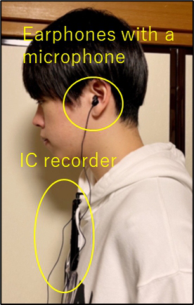
To analyze the communication among different areas and departments in the hospital during the disaster response and business continuity, we attached a voice recorder to the key players in different areas who use the PHS, including the command post, the headquarters, and each first-aid sta- tion. Figure 1 shows the voice recorder with an earphone, through which we recorded voices on both ends. The voice data were transcribed and used for the analysis. Table 1 shows the summary of the recorded data.
We conducted the data collection with the approval of the Ethics Commit- tee of the School of Engineering at the University of Tokyo (KE22-75).
Figure 1: Voice recorder with a microphone for PHS.Table 1. Summary of the voice data collected.
Table available in the original PDF paper.
Player Total Call Word Counts* Chief of the command post 0:05:56 41,908 Chief of surgical scheduling at the command post 0:15:03 33,301 Red area (leader doctor) 0:04:43 46,750 Operating room (leader nurse) 0:10:14 30,776 Headquarters 0:04:43 35,125
*In Japanese
ANALYSIS METHOD We analyzed the conversation content from the viewpoint of performative verbs to calculate the anticipation ratio of inter-area communication. Usu- ally, this kind of analysis is done manually, which requires many manhours. In this study, we applied the GPT-4.0 language model (OpenAI, 2023) to auto- matically classify the utterances into nine performative verbs: greet, inform, acknowledge, request, query, accept, declare, confirm, and suggest. Table 2 shows the definitions of these nine performative verbs. For the analysis, we first validated the accuracy of the classification by the GPT-4.0. Then we calculated the anticipation ratio of the communication between the com- mand post and other areas/departments to evaluate the efficiency of the communication.
Table 2. Performative verbs used for the analysis.
Table available in the original PDF paper.
Performative Verb Definition Greet Refers to the exchange of ceremonial words when making a call, such as the initial "hello," the concluding "excuse me," or stating one’s own name to the other party. Inform Refers to the act of conveying new information to the recipient. Acknowledge Involves recognizing and accepting the other party’s statements or actions, with responses such as "yes," "understood," or "I see" being typical examples. Request Refers to utterances that involve asking the other party for some action or provision of information. Query Refers to the act of asking questions or confirming pros and cons in order to seek information. Accept Refers to utterances that show agreement with and readiness to act according to the other party’s suggestions or opinions. Declare Refers to utterances that convey a clear intention or decision to the other party. Confirm Refers to utterances that involve repeating what the other party has said or verifying information that has already been provided. Suggest Pertains to the act of expressing suggestions or opinions to the other party.
Validation of the Classification of Performative Verbs Using GPT-4.0 To evaluate the accuracy of the classification by GPT-4.0, we manually cat- egorized 296 utterances during the 2022 exercise into the nine performative verbs and used the results as a gold standard. In this manual classifica- tion, two analysts first performed the classification individually and then determined the final classification through discussion, referring to their clas- sifications. Cohen’s kappa was 0.83 in the first analysis, indicating that the classification by the two analysts has high agreement and the gold standard is fairly reliable.
Data Collection and Analysis of Inter-Area Communication 101
In the GPT-4.0 classification, as prerequisite knowledge, we first entered an overview of the hospital disaster response exercise, the definitions of the performative verbs, and the format for input/output of the sentences. We then asked GPT-4.0 to classify each sentence into the nine performative verbs. Since GPT’s classifications were somewhat inconsistent, we performed this automatic classification five times and determined the final categorization on a majority basis. The Cohen’s kappa against the gold standard was 0.73, indicating that there was substantial agreement between the automatic and the manual classifications. In the following analysis, we used the GPT-4.0 classification with minor manual corrections.
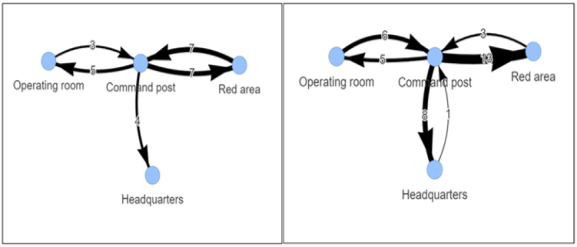
RESULTS AND DISCUSSIONS We analyzed 666 utterances of PHS communication between the command post and other areas. Figure 2 shows the frequency of calls between various areas in the 2022 and 2023 exercises. Table 3 provides a summary of the classification by performative functions.
Next, we calculated the anticipation ratio—a ratio of “push” to “pull” communication often used as an indicator of efficient information-sharing of the verbal communication—between different areas (Johnson et al., 2023). The higher the anticipation ratio, the more an actor pushes more information than pulls, suggesting that they share information efficiently. Among the nine performative verbs used in this study, “inform” corresponded to “push” and “query” corresponded to “pull.” We calculated the anticipation ratio using the counts of utterances categorized to these performative verbs.
Table 4 shows the anticipation ratios in the 2022 and 2023 disaster exer- cises. A comparison of the ratios between 2022 and 2023 revealed that the ratio was higher for the command post in 2023, in particular from the com- mand post to the red area (1.84-> 3.00) and headquarters (2.21-> 6.99), indicating that the command post in 2023 proactively provided information to these areas in advance before they were asked for the information.
Table 3. Summary of the GTP-4.0 classification by performative verbs.
* CP: command post, OR: operating room, Red: red area, HQ: headquarters
Table 4. Anticipation ratios in the 2002 and 2023 exercises.
Table available in the original PDF paper.
Year CP -> OR OR -> CP CP -> Red Red -> CP CP -> HQ HQ -> CP 2022 1.00 1.50 1.00 1.20 1.40 0.89 2023 1.45 2.17 1.36 1.11 4.00 NA
Figure 2: Frequency of calls in 2022 (left) and 2023 (right).
CONCLUSION
This study confirmed that inter-area conversations in a disaster exercise can be clearly recorded with a voice recorder with a microphone attached to an exercise participant. We also demonstrated that a large language model can be used to classify data according to performative verbs, thus saving man- hours in calculating the anticipation ratio. The analysis of the anticipation ratio suggests that the communication in the command post improved in the 2023 exercise compared to the 2022 exercise. The major contribution of this study is it provides a reliable automated classification method to conduct a task that was previously performed manually, thus speeding up the analysis of exercise recordings to find clues for better communication and ultimately a more disaster resilient hospital.
REFERENCES
Ideguchi, T., Kanno, T., Umemoto, M., Kajiyama, K., Ikari, R., Yamazaki, M.
and Sharikura, S. (2023). Extensive Data Collection in an In-Hospital Disaster Response Exercise for Evaluating Disaster Resilience, Safety Management and Human Factors, Volume 105, pp. 42—46. Johson, C. J., Demir, M., McNeese, N. J., Gorman, J. C., Wolff, A. T., and Cooke, N. J.
(2023). The Impact of Training on Human-Autonomy Team Communications and Trust Calibration, Volume 65, No. 7, pp. 1554–1570. Kanno, T., Harada, J., Mitsuhashi, D., Kajiyama, K., and Sharikura, S. (2023). Workas-Imagined vs. Work-as-Done during a Hospital Response to a Disaster, Proc. Int’l Symposium on Resilience Engineering (RE10). Open AI. (2023), GPT-4 Technical Report.arXiv.
LISTED IN THE AHFE DIGITAL BOOKSTORE CATALOGUE
Explore the complete digital volume
Human Error, Reliability, Resilience, and Performance
Read this individual research paper free through the original publisher, or explore the full digital proceedings book.
ISBN 978-1-964867-08-3
Explore this ISBN in the AHFE Bookstore ↗Listed in the July 2026 bookstore catalogue; search by ISBN to confirm current availability · Digital book purchase optional