Sumie Cho, Taro Kanno, Kazuo Furuta (2022). Simulation of Three-person Cooperation - Effect of Mutual Beliefs on Team Performance. In: Intelligent Human Systems Integration (IHSI 2022): Integrating People and Intelligent Systems. AHFE Open Access, vol. 22. https://doi.org/10.54941/ahfe1001056
Many human factor studies have explored the cognitive and behavioral factors that affect team performance by verbal protocol analysis and behavioral analysis. However, since the measurements used in these studies focused only on observable and recordable data, there is a fundamental limitation for understanding cognitive mechanisms behind those data. Computer simulation is an alternative method for exploring the cognitive aspects of human factors in team cooperation. In our previous study, therefore we developed an agent-based simulation of team cooperation using a team cognition model based on the concept of mutual beliefs and investigated how mutual beliefs affect better team performance. While the previous study modeled and focused only on a two-person team, the actual team in the real world often consists of three or more people, where more complicated cognitive processes are required than those in two-person cooperation. In this study, we developed an agent-based simulation of three-person team cooperation, employing the extended team cognition model considering mutual beliefs and mental subgrouping. This extended model describes cognitive processes in a team of three or larger with three different layers namely self-cognition, direct belief, and projected belief. We applied this model and simulation to the cooperative diagnosis problem of car failures and observed how a team collaboratively collects information on car parts, shares with other members, and identifies broken car parts. The results showed that the teams could share information effectively and identify the correct failures. The results also suggested that the communication generated by the mutual beliefs worked effectively and enhanced the team performance. We believe that our simulation is a promising method to compensate for the limitations of conventional human factor methods and explore cognitive aspects of team cooperation.
Many human factors researchers have investigated the cognitive and behavioral factors that affect team performance. Protocol analysis and behavior analysis are the major methods used in these studies as measurements of cooperative behavior in team processes (Cooke, Salas, Cannon-Bowers, & Stout, 2000) . For example, Prenston et al.developed several automatic methods for analyzing communication data for measuring team cognition.(Cooke&Gorman, 2009). However, these measurements are only focused on observable data, making it difficult to efficiently and precisely extract the underlying cognitive mechanisms. An alternative approach for exploring different cognitive aspects in team cooperation exercises is through the use of computer simulations that can test various hypotheses regarding team cognition. However, the computational approach for team cognitive studies is still in its infancy. For example, Grand et al. proposed a theory based on knowledge emergence in teams, translated this theory into a computational model, and performed an agent-based simulation(Grand, Braun, Kuljanin, Kozlowski, & Chao, 2016). In this simulation, when an agent communicates with the others, the partner is determined using a static probability, and the content is randomly assigned. However, the model did not consider the mechanisms’ underlying communication, such as utterance intentions. In a previous study, Yojima et al. developed an agent-based simulation for cooperative behavior analysis based on a team cognition model proposed by Kanno et al, by employing the concept of mutual beliefs that explains the cognitive mechanisms behind dyadic team cooperation. (Kanno et al. 2013, Yojima et al. 2018) It was concluded that mutual belief played an important role in improving team performance, regardless of the domain knowledge structure. While the previous study modeled and focused only on a two-person team, an actual team in the real world often consists of three or more people, where more complicated cognitive processes are required than those in two-person cooperation (Bosse, Majdanik, Boersma, & Ingibergs, 2013). In this study, to investigate the effect of team cognition on the team performance in a three-person team, we developed an agent-based simulation for three-person team cooperation by employing an extended team cognition model that considers mutual beliefs and mental subgrouping. This extended model describes the cognitive processes in a team of three or more members, using three different layers. We applied this model and simulation to the cooperative diagnosis problem of car failures. We then observed how a team collaboratively collected information on car parts, shared information with other members and identified broken car parts.
Intelligent Human Systems Integration (IHSI 2022): Integrating People and Intelligent Systems https://openaccess.cms-conferences.org/#/publications/book/978-1-7923-8988-7
THEORETICAL AND SIMULATION MODELS Extended Mutual Belief Model
Dipta et al. proposed a team cognition model called the extended mutual belief model (EMBM)( Mahardhika, Kanno, & Furuta, 2016). This model consists of the following three layers: a self-cognition layer, a direct belief layer, and a projected belief layer. The EMBM of a three-person team is shown in Figure 1. The self-cognition layer contains any possible cognitive processes or mental statuses. The second layer, or the directed belief layer, contains two cells representing one’s belief about each partner’s cognition. The third layer, or the projected belief layer, contains four cells and represents one’s belief about one’s own cognition, and also one’s belief in the partner’s belief about the other partner’s cognition.
Self-cognition
M’(B): Belief about B’s cognition M’(C): Belief about C’s cognition
M’’(B, A): Belief of B’s belief about A’s cognition M’’(C, A): Belief of C’s belief about A’s cognition M’’(B, C): Belief of B’s belief about C’s cognition M’’(C, B): Belief of C’s belief about B’s cognition
Figure 1. Extended mutual belief model in the case of a team consisting of three members: A, B, and C (in A’s mind). The first layer represents the self-cognition of A. The second layer represents M’(B) (A’s belief about B’s cognition) and M’(C). The third layer represents M’’(B, A) ( A’s belief of B’s belief about A’s cognition), M’’(C, A), M’’(B, C) and M’’(C, B).Domains of human systems integration. (Adapted from U.S Air Force, 2005) Simulation Model
Figure available in the original PDF paper.
The same task used in the car diagnosis was used for the simulation, as was the case in the previous study. The goal of the task is to collaboratively use three agents to diagnose car failures. In this task, each agent can only see a part of the car; thus, the agents need to cooperate with each other to acquire the correct and complete situation awareness (SA). The three agents are used to recognize who can observe which of the nodes are part of their team’s knowledge. An agent has an EMBM, wherein each cell is implemented using a single Bayesian belief network (BBN). BBNs represent the agent’s domain knowledge structure and cognitive and inference mechanisms. The probabilities of a node in a BBN represent the degree of an agent’s belief about a state occurrence. A set of nodes representing the conscious recognition of the state
Intelligent Human Systems Integration (IHSI 2022): Integrating People and Intelligent Systems https://openaccess.cms-conferences.org/#/publications/book/978-1-7923-8988-7 occurrence is defined as as 𝑈, and is formulated using Equation (1), where 𝑃𝑖 is the probability of state 𝑖 and 𝑇 is the threshold for “state occurrence.” When new information is entered into a specific node, the probability of the other nodes is updated. BBN can represent a building SA in a situation where information is uncertain and limited.
. (1)
𝑈= ∑ { 𝑖 |𝑃𝑖 ≥𝑇} 𝑛𝑜𝑑𝑒
In the simulation model, agents perform the following four types of actions: observation (Look at) and three types of communication (Query/Inform/Make Clear). Look at is an action to obtain the state of a component by perceiving the environment. In contrast, communications are actions by which an agent resolves the contradictions between self-cognition and mutual beliefs. Query is a communicative action that notifies the partner "Unknown" and requests the partner's SA. Inform is an action that reveals the agent's own SA to the partner and ensure the partner’s SA matches the agent's own SA; while Make Clear is an action that reveals the agent's own SA to the partner to remove misunderstandings on the agent’s own SA. The processes of updating one’s own cognition and inferences about others’ cognition or mutual beliefs are interdependent. We assume that these processes are bridged by metacognitive operations and are modeled as interlayer interactions in the simulation model. When an action is taken, several cells in the EMBM are updated using interlayer interaction. All communication takes place between two agents, but information on the agents participating, the type of action, and the contents of the communication are open. Therefore, an agent that is not participating can also obtain information about the communication and update the mutual beliefs based on the information. The action rules of the agents are listed in Table 1. We evaluated the team performance using Team Accuracy that was formulated using Equation (2), in which 𝑈0 represents a set of states for all nodes in the BBN of the car model, and 𝑈𝐴1 represents a set of states for all nodes in the BBN of agent A’s first layer.
1
|𝑈0∩𝑈𝐵1| |𝑈0∩𝑈𝐴1| |𝑈0∩𝑈𝐶1| 𝑇𝑒𝑎𝑚 𝐴𝑐𝑐𝑢𝑟𝑎𝑐𝑦 = (
3 . (2)
|𝑈0| +
|𝑈0| +
|𝑈0| ) ×
Table 1. Action Rules Table 1 summarizes the action rules for agent A. The other two agents followed the same action rules. C (A) represents A’s self-cognition and “Inform B” implies that agent A performs an Inform for agent B. In the case of the first row, when an agent recognizes the contradiction of C(A)≠M’(B), agent A first performs Look at if the node is observable for agent A, and then, if self-cognition changes, agent A performs an Inform for agent B. If the node is not observable, then agent A performs Query on B. In this table, the cases of contradiction between C(A) and M’(C), M’ (C, A), and M’’ (C, B) are not listed. Contradiction Action
Table available in the original PDF paper.
Intelligent Human Systems Integration (IHSI 2022): Integrating People and Intelligent Systems https://openaccess.cms-conferences.org/#/publications/book/978-1-7923-8988-7
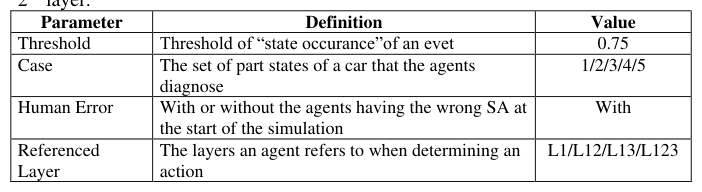
SIMULATION A flowchart for the simulation is presented in Figure 3. First, the model parameters shown in Table 2 were set. Next, the agent that takes the action is randomly determined. Then, the target node is selected from among the nodes where the agent is unsure of its state or where there is a contradiction in the cells. If more than one node is selected, nodes are chosen in order of their impact on the other nodes. After selecting the target node, the action was determined according to the action rules. When an agent performs the action, each cell of the EMBM is updated. Subsequently, it was confirmed whether the termination condition formulated by Equation (3) was satisfied. In Equation (3), 𝑈𝐴𝑙𝑙−𝐶𝑜𝑛𝑓𝑙𝑖𝑐𝑡𝑠 refers to the set of nodes in which at least one agent has a contradiction and 𝑈𝐴𝑙𝑙−𝑈𝑛𝑘𝑛𝑜𝑤𝑛 refers to the set of nodes, in a state of which at least one agent is uncertain. If this is true, then the simulation ends. The simulation was conducted 100 times under the same parameter settings.
Intelligent Human Systems Integration (IHSI 2022): Integrating People and Intelligent Systems https://openaccess.cms-conferences.org/#/publications/book/978-1-7923-8988-7
Equation reproduced from the original PDF.
. (3)
{
𝑜𝑟 𝑇ℎ𝑒 𝑡𝑜𝑡𝑎𝑙 𝑛𝑢𝑚𝑏𝑒𝑟 𝑜𝑓 𝑎𝑐𝑡𝑖𝑜𝑛 ≥100
Start
Set model parameters
Select agent to act
Select target node
Determine and perform action NO
Update cognition and belief
Terminal condition?
YES End
Figure 3. Simulation model flowchart.
Figure available in the original PDF paper.
Table 2. Parameter setting of Simulation When the referenced layer is L1, the agent refers to only the 1st layer, and when it is L12, the agent refers to the 1st and 2nd layers when determining an action. When the reference layer is L12, agents can only recognize the conflict between 1st and 2nd layer. Parameter Definition Value Threshold Threshold of “state occurance”of an evet 0.75 Case The set of part states of a car that the agents diagnose With Human Error With or without the agents having the wrong SA at the start of the simulation
RESULT AND DISCUSSION
The results of the simulation with human errors are shown in Figure 4. We repeated the simulation 100 times under the same conditions, sorted the obtained Team
Intelligent Human Systems Integration (IHSI 2022): Integrating People and Intelligent Systems https://openaccess.cms-conferences.org/#/publications/book/978-1-7923-8988-7
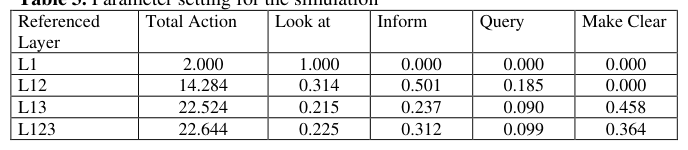
Accuracy in descending order, and constructed a scatter plot of the Team Accuracy with the same rank as those obtained when the referenced layer was L1. A plot that is above the dotted blue line in Figure 4 indicates that the team performance is improved by mutual beliefs and interlayer interactions triggered by meta-cognition. In the graphs, all the plots are above the dotted line, and it was observed that communication generated under the condition of the referenced layers L12, L13, and L123 improved Team Accuracy. This suggests that mutual belief is one of the major factors and driving forces for better team cooperation. This finding, which was also pointed out in the previous study, was confirmed in three-person cooperation. Table 3 summarizes the number of total actions and the average percentage of each action with respect to all actions in one simulation. Under the conditions of L1, communication does not occur, and under the conditions of L12, Make Clear does not occur. This is caused by the following action rules. From Table 3, it can be concluded that the action distributions of L13 and L123 have similar tendencies in that communication is mainly through Inform and Make Clear, and Query rarely occurs.
Figure. 4. A Comparative analysis of the result with Human Error. The horizontal axis represents the Team Accuracy when referring only to the first layer, and the vertical axis represents the Team Accuracy obtained when referring to the first and second layers (L12), the first and third (L13), and all three layers (L123), respectively.
To investigate the effect of the cooperative behavior generated by mutual beliefs on
Intelligent Human Systems Integration (IHSI 2022): Integrating People and Intelligent Systems https://openaccess.cms-conferences.org/#/publications/book/978-1-7923-8988-7 the team performance, we developed an agent-based simulation for three-person team cooperation by employing the extended mutual belief model. This model contains three layers and captures the human ability to infer the psychological states of others. We applied this model and simulation to the cooperative diagnosis problem of car failures and observed how a team collaboratively collects information on car parts, shares the information with other members, and identifies broken car parts. From the simulation results, we found that mutual beliefs played an important role in improving team performance, and the communication generated by mutual beliefs worked effectively and enhanced team performance. These findings, which were also reported in the previous study, were confirmed in three-person cooperation. The communication in this simulation model is reduced to updating the cognition and mutual beliefs of each agent, and does not include the exchange of information between the agents. One direction for future research is the development of a communication model that includes the exchange of information. Although further improvements are necessary, we believe that our simulation is a promising method for compensating for the limitations of conventional human factor methods by exploring the cognitive aspects of team cooperation.
REFERENCES
The dynamics of team cognition: A process-oriented theory of knowledge emergence in teams. The Journal of applied psychology, 101(10), 1353–1385 Kanno, T., Furuta, K. & Kitahara, K. (2013) A model of team cognition based on mutual beliefs,Theoretical Issues in Ergonomics Science, 14:1, pp.38-52 Mahardhika, D., Kanno, T. & Furuta, K. (2016) Team cognition model based on
mutual beliefs and mental subgrouping. J Interact Sci 4(1). Yojima, S., Kanno, T., Furuta, K.: Simulation of Team Communication and Shared Situation Awareness, 18th Asia Simulation Conference (2018)
Intelligent Human Systems Integration (IHSI 2022): Integrating People and Intelligent Systems https://openaccess.cms-conferences.org/#/publications/book/978-1-7923-8988-7
LISTED IN THE AHFE DIGITAL BOOKSTORE CATALOGUE
Explore the complete digital volume
Intelligent Human Systems Integration (IHSI 2022): Integrating People and Intelligent Systems
Read this individual research paper free through the original publisher, or explore the full digital proceedings book.
ISBN 978-1-7923-8988-7
Explore this ISBN in the AHFE Bookstore ↗Listed in the July 2026 bookstore catalogue; search by ISBN to confirm current availability · Digital book purchase optional