Ucchita Sharma, T Bangar Raju (2024). Mitigating Human Error in Civil Aviation: A Cognitive Analysis of Job tasks Using Success Likelihood Index Method (SLIM). In: Human Error, Reliability, Resilience, and Performance. AHFE Open Access, vol. 132, pp. 103–111. https://doi.org/10.54941/ahfe1004886
Ground Handlers are responsible for managing the critical operations that take place for the airlines and airport. The efficiency and success of the operations are highly dependent on ground handlers and how they can perform the tasks. Any small accident or a minor incident can also result in huge losses in civil aviation. Previous studies show that one of the leading causes of occurrence of accidents or incidents is human error. Therefore, it is necessary to tackle and understand the probability of occurrence of human error, also known as Human error probability (HEP).Purpose of study: The study wishes to understand which tasks amongst the critical ones performed at the airside have higher HEP, and also to identify the factors that are responsible for the same. This is being done because Human error can have an impact on how the individuals perceive the task. The study is therefore studying the factors that impact the cognitive resilience of individuals leading to human error. Methodology: The study uses the Success Likelihood Index Methodology ( SLIM) along with Fuzzy-AHP to calculate the HEP. Ten experts who have had a minimum amount of seven years of experience in managing ground handlers and safety were screened for the data collection process. Conclusion: The study has found that maintenance tasks have a high probability of human error to occur. It was also found that the experience attached to tasks being performed, along with the time constraints and pressure of performing the task efficiently are factors responsible for the human error to occur while performing the tasks. Therefore, it is essential that the organization is able to allocate rosters accordingly and elevate the experience of the tasks that are being performed.
The civil aviation industry has been seeing rapid growth in the market, espe- cially in the context of the Indian Peninsula region. The growth has therefore resulted in the need for airlines and airports to perform efficiently to stay and be in the competition. This creates a pressure-based environment for the employees that are at the backend managing the operations of airlines and airports. Therefore, making the ground handlers the backbone of the airline and airport operations (O’Hare, 2006).
The work environment for the ground handlers is one of the high-pressure environments. Because of the time constraints and the need for efficiency in the job the job profile of ground handlers is considered to fall in the cate- gory of grinding jobs. The job environment and the pressure create the task to be prone to accidents and incidents. It has been found from the previous studies that the leading cause for accidents and incidents in airside operations and tasks performed by ground handlers is human error and human factors. Therefore, it is important to study the relationship and interaction between humans and the system that they work in. This is essential because the acci- dents and incidents that occur due to human errors show disproportionate results. Therefore, even a minor error can cause catastrophic accidents which can be fatal to both the personnel and the customers, or it can be hefty on the cost of operations (Nagel, 1988).
This makes it important to identify the factors that influence the success of operating the tasks in ground operations. It is also important to under- stand how these factors cause human error. Therefore, the study has tried to identify the various performance shaping factors for the ground handlers and the tasks critical for successful operation with high human error probability (Miranda, 2018). The study has therefore identified the tasks that have a high probability for human error to occur. This has helped in understanding how the ground handlers have been impacted which resulted in human error.
The study uses the Success Likelihood Index Method (SLIM) in hybrid with the fuzzy-AHP process. This helps in reducing subjectivity and finding the probability of human error in a quantifiable method. The study hopes to identify the tasks and the causes of human error to help reduce the pressure increment on the ground handlers (Erdem & Akyuz, 2021). Since the ground handlers’ job profile and responsibilities are of high critical value the performance of the tasks relies heavily on the cognitive functioning of the individuals. Therefore, any task which shows a substan- tial probability of human error to occur can have a damaging impact on the cognitive resilience of the individual. Hence, the study has also given an important focus to the performance-shaping factors that deal with the cogni- tive resilience of individuals when performing the tasks, they are responsible for.
Motivation of the Study The Indian civil aviation industry has seen drastic growth and expansion with an average of 6.2 million tourists travelling to India from interna- tional borders, along with an exponential increase in the flights managed both internationally and domestically. The throughput and heavy reliance of tourism on the aviation industry shows a need for efficient performance of airlines and airports. However, this results in putting pressure on the ground handlers who are managing the backend operations. Therefore, cre- ating a need to address the methods of training and the environment they are working in to maintain high efficiency with minimal scope of error (Ancel et al., 2015).
Mitigating Human Error in Civil Aviation: A Cognitive Analysis of Job Tasks 105
MATERIALS AND METHODS
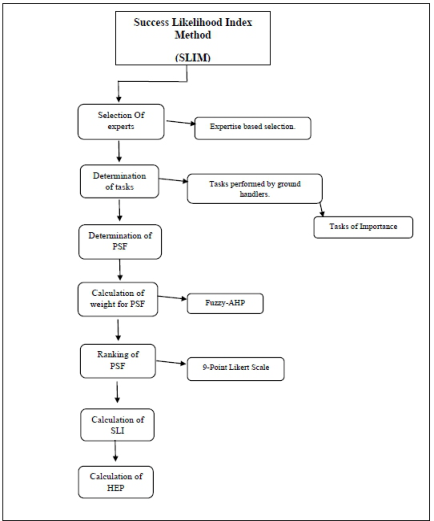
The study uses a hybrid of SLIM and fuzzy-AHP to calculate the human error probability (HEP). The success likelihood index methodology (SLIM) has multiple steps which allow for calculating the HEP in a quantifiable manner with a minimum amount of subjectivity (Santiasih & Ratriwardhani, 2021). SLIM methods consist of the following steps:
1. Selection of Experts 2. Determining the tasks that are to be analysed 3. Determination of appropriate Performance Shaping Factors (PSFs) 4. Calculation of weightage of PSFs 5. Ranking of PSFs 6. Calculation of SLI (Success Likelihood index) 7. Calculation of Human Error Probability (HEP) Fig. 1 shows the steps covered in SLIM briefly.
1. Selection of experts: Using snowball and purposive sampling techniques, the study has screened ten experts. The experts selected for the study had to have at least seven years of experience in the airside operations of the civil aviation industry in India. The experts are the ones who have been involved in the training and managing the ground handlers, therefore hav- ing an in-depth understanding of what the tasks of ground handlers entail (Bona et al., 2021).
Figure 1: SLIM.
106 Sharma and Raju
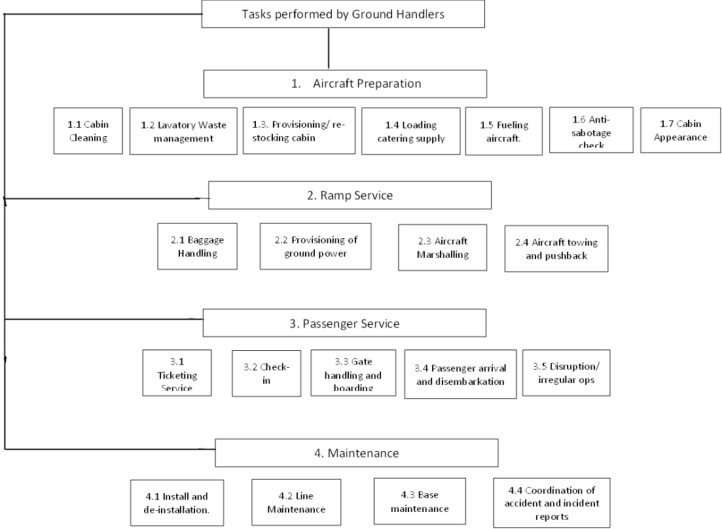
2. Determination of tasks: The tasks handled by the ground handlers are all of a critical nature. The tasks handled by the ground handlers has been divided into four major categories. They are: a. Aircraft Preparation b. Ramp Service c. Passenger service d. Maintenance
These tasks have further been divided into sub-tasks, that are performed daily in shifts. These have been described briefly in Fig. 2. Each of the tasks that the ground handlers deal with are performed parallelly and need to be efficiently performed, with minimum error. A small amount of error can lead to major disproportionate results with operational and human loss. There- fore, it becomes essential to analyse and understand which of these tasks has a higher HEP (Tabares & Mora-Camino, 2017).
3. Determination of appropriate PSFs: The PSFs are the factors that are responsible for the efficient and successful performance of the tasks. These PSFs are studied to understand the overall cause of human error and var- ious factors due to which human error could occur. the following PSFs have been identified from the previous studies to understand what factors can create intrinsic motivational factors for the successful performance of the tasks (Franciosi et al., 2019). The PSFs identified are as namely: e. Procedure f. Complexity g. Training h. Fatigue i. Experience.
These five PSFs are responsible for the overall success and efficient per- formance of the tasks in airside operations. The Procedure talks about the various procedures and tasks established in the organization to understand how to perform the tasks. The well-established procedures help in motivat- ing the employees to perform accordingly. Therefore, making the procedures established by the organization becomes an important factor to study for the successful completion of the operations. The PSF of Complexity deals with understanding how complex the task can be perceived by the individual per- forming the task. The concept of complexity deals with the time constraints and pressure to perform the tasks one after the other, with multiple disrup- tions that occur during the tasks. Training talks about the various methods and the type of training that is provided to individuals to achieve the effi- ciency in performance of tasks. This is important to understand whether there is a need to change the current procedures, and also helps in understand- ing the processes incorporated to provide the training is of optimum level. Along with the previous mentioned PSF it is clear that the employees can be experiencing Fatigue as the complexity, and training as well as inducing the procedures in the method is cognitively stimulating (Sadeghniiat-Haghighi & Yazdi, 2015). Therefore, the PSF of fatigue becomes important to deal with
Mitigating Human Error in Civil Aviation: A Cognitive Analysis of Job Tasks 107
as it helps in discerning the impact that the tasks and procedures can have on the individual ground handlers. This results in bringing out the PSF of Expe- rience where the emotions being attached to the tasks play an important role. The motivation factor gets influenced by the emotions attached to the task. It also adds to the relatedness and helps in understanding how the cogni- tive resilience of the individual ground handlers gets impacted. Therefore, resulting in the increased HEP.
Figure 2: Ground handlers task.
4. Calculation of weightage of PSFs: The calculation of PSFs was done using Fuzzy-AHP. This was done to reduce the subjectivity and bias in the result. The ten experts were asked to weigh the PSFs relatively on a 9-point scale of fuzzy-AHP (Tu et al., 2015). The linguistic variables used were: j. Absolute k. Very strong l. Fairly Strong m. Weak n. Equal
5. Ranking of PSFs: The PSFs that were identified, have been ranked for each of the tasks that the ground handlers perform. The ranking was done by the ten experts who gave data for the weights of PSFs. The ranking was done using a 9-point Likert scale. Each PSF was ranked from 1 to 9 depending upon how high or low the PSF had an impact on the individual tasks that were being performed by ground handlers. The ranking was done in a way where 1 was the highest and the 9th rank was considered to be the lowest. Therefore, if a task had a high level of fatigue it would be
108 Sharma and Raju
ranked close to a value of 1, and similarly, if the task was found to have a minimal amount of fatigue attached to the task it would be ranked as 9. Similarly, the rankings for complexity were also performed. The PSFs of procedure and training 1 showed perfection in the tasks and 1 to 5 was the positive experience attached to the tasks. The final ranking was done using geometric mean for all the responses (Erdem & Akyuz, 2021). 6. Calculation of SLI: From the weights and the ranks that were obtained from the 10 experts, the Success Likelihood Index (SLI) value was calculated. The SLI was calculated using the formula in Eq 1.
Equation reproduced from the original PDF.
7. Calculation of HEP: The HEP values were calculated after the compu- tation of SLI values. The formula used for the HEP values is shown in Eq 2.
log(HEP) = a.SLI + b (2) The values a and b are constants that have been used to calibrate the values of SLI for ease of calculation of HEP. The value of a and b by calculating the HEP in the best case scenario and worst case scenario, through an experts opinion (Tunçel et al., 2023).
RESULTS AND DISCUSSION
The relational weights and ranks of the PSFs using the fuzzy-AHP method are seen in Table 1. It can be seen that PSF Fatigue holds highest weigh- tage amongst all the PSFs, therefore, showing that the factor of fatigue is highly influential in the occurrence of human error, by ground handlers when performing airside operations.
It is also seen that complexity plays an important role in the occurrence of human error in airside operations.
The ranking of PSF for each of the tasks can be seen in Table 2. The table shows that although there are various tasks which portray high fatigue, it does not necessarily mean that the tasks are complex. therefore, showing that the time constraints and the pressure to complete the task efficiently makes it taxying and in turn creates fatigue for the individual ground handler working on the job tasks.
Mitigating Human Error in Civil Aviation: A Cognitive Analysis of Job Tasks 109
Table 2. Ranking of PSF.
Table available in the original PDF paper.
Tasks/ Sub Performance Shaping Factors Procedure Complexity Training Fatigue Experience
From these weights and ranks the SLI and HEP values for each of the tasks performed was calculated. Along with HEP the study also calculated the human success probabilitly. The values can be seen in Table 3. This shows that the task number 4.3 which is part of the maintenance tasks has a signifi- cant amount of HEP. Therefore, it can be seen that most of the Human error is probable to occur in the maintenance tasks. This is mostly seen because of the experience and how tiring the overall task can be for an individual. It also uses multiple faculties of an individual, though therefore, it can be stim- ulating for an individual the pressure to perform the task in a limited time period and accurately adds onto the pressure making it prone to an accident or an incident due to human error.
Highlights of the Study Some of the major findings from the study are as follows:
Fatigue as a PSF holds a major weightage which isn’t just due to complex tasks but mostly seen to be present because of the pressure and the time constraint that the individual has.
The maintenance tasks are the ones with significant human error proba- bility. These tasks show the lowest experience and high amount of fatigue and complexities.
It has been seen that for the ground handlers although the fatigue as a factor has the maximum weightage, on an overall HEP the tasks that is more complicated and lesser fatigue, chance of human error to occur increases. This is because of the stress and pressure that comes in dealing with multiple tasks creating and increasing the complexity of the overall tasks.
CONCLUSION
The study therefore identifies that it is essential for the ground handlers to have a proper schedule which they can follow thoroughly. This will help in reducing the complexity of the task and also help in improving the overall experience that is attached to performing the task.
The rostering patterns and the way the organization deals with cases of human error become highly important. The ground handlers, therefore, require proper resting periods and the tasks shift should be in a way which does not add to the pressure but helps in dealing with difficulties in the most efficient manner allowing the individual to be cognitively aware of his/ her work surroundings.
Mitigating Human Error in Civil Aviation: A Cognitive Analysis of Job Tasks 111
Although the procedure and training for the performance of each task indi- vidually seems to be seamless, the study suggests that it is important for the organization to study the tasks performed by an individual in multiple sequences.
REFERENCES
Ancel, E., Shih, A. T., Jones, S. M., Reveley, M. S., Luxhøj, J. T., & Evans, J. K.
(2015). Predictive safety analytics: Inferring aviation accident shaping factors and causation. Journal of Risk Research, 18(4), 428–451. https://doi.org/10.1080/ 13669877.2014.896402 Bona, G. Di, Falcone, D., Forcina, A., & Silvestri, L. (2021). Systematic Human Reliability Analysis (SHRA): A New Approach to Evaluate Human Error Probability (HEP) in a Nuclear Plant. International Journal of Mathematical, Engineering and Management Sciences, 6(1), 345–362. https://doi.org/10.33889/IJMEMS.2021.6. 1.022 Erdem, P., & Akyuz, E. (2021). An interval type-2 fuzzy SLIM approach to predict
human error in maritime transportation. Ocean Engineering, 232. https://doi.or g/10.1016/j.oceaneng.2021.109161 Franciosi, C., Di Pasquale, V., Iannone, R., & Miranda, S. (2019). A taxonomy of performance shaping factors for human reliability analysis in industrial main- tenance. Journal of Industrial Engineering and Management, 12(1), 115–132. https://doi.org/10.3926/jiem.2702. Miranda, A. T. (2018). Understanding Human Error in Naval Aviation Mishaps.
Human Factors, 60(6), 763–777. https://doi.org/10.1177/0018720818771904 Nagel, D. C. (1988). Human Error 9 in Aviation Operations. O’Hare, D. (2006). Cognitive functions and performance shaping factors in aviation accidents and incidents. International Journal of Aviation Psychology, 16(2), 145–156. https://doi.org/10.1207/s15327108ijap1602_2 Sadeghniiat-Haghighi, K., & Yazdi, Z. (2015). Fatigue management in the work-
place. Industrial Psychiatry Journal, 24(1), 12. https://doi.org/10.4103/0972- 6748.160915 Santiasih, I., & Ratriwardhani, R. A. (2021). Human error probability analysis using Success Likelihood Index Method (SLIM) approach in grinding activities. IOP Conference Series: Materials Science and Engineering, 1072(1), 012027. https: //doi.org/10.1088/1757-899x/1072/1/012027 Tabares, D. A., & Mora-Camino, F. (2017). Aircraft ground handling: Analysis
for automation. 17th AIAA Aviation Technology, Integration, and Operations Conference, 2017. https://doi.org/10.2514/6.2017-3425 Tu, J., Lin, W., & Lin, Y. (2015). A Bayes-SLIM based methodology for human reliability analysis of lifting operations. International Journal of Industrial Ergonomics, 45, 48–54. https://doi.org/10.1016/j.ergon.2014.11.004 Tunçel, A. L., Erdem, P., & Turan, O. (2023). Estimation of Human Errors During
Cargo Unloading Operations on Bulk Carriers Using SLIM and Interval Type 2 Fuzzy Sets. Journal of Eta Maritime Science, 11(3), 198–208. https://doi.org/10. 4274/jems.2023.92260
LISTED IN THE AHFE DIGITAL BOOKSTORE CATALOGUE
Explore the complete digital volume
Human Error, Reliability, Resilience, and Performance
Read this individual research paper free through the original publisher, or explore the full digital proceedings book.
ISBN 978-1-964867-08-3
Explore this ISBN in the AHFE Bookstore ↗Listed in the July 2026 bookstore catalogue; search by ISBN to confirm current availability · Digital book purchase optional