María Del Carmen Rey Merchán, Antonio López Arquillos, Juan Antonio Fernández Madrigal, Jesús Manuel Gómez De Gabriel (2024). Use of smartphones in construction projects: Proposal for a worker monitoring system to avoid safety risks. In: Safety Management and Human Factors. AHFE Open Access, vol. 151, pp. 109–114. https://doi.org/10.54941/ahfe1005307
Smartphones can play a significant role in enhancing safety at construction sites. They can contributes to safety in Communication and Emergency Response, access to safety Information, navigation and Location Services, or wearables technologies. Although smartphones can greatly contribute to safety, it's important to establish and enforce policies regarding their use to ensure that they do not become distractions that compromise safety on the construction site. In the current research, a safety system to monitor smartphone use by construction workers has been developed. The system detects the use of smartphone through an Inertial Measurement Unit, to track the motion and orientation of workers, providing valuable data for safety monitoring. The system was shown to be easy to configure and highly robust and reliable.
Smartphones and new technologies can offer several advantages in terms of safety on construction sites (Nnaji et al., 2019; Rey-Merchán et al., 2020). They can enable instant communication among construction workers, super- visors, and other actors (Hasan et al., 2019). In emergencies or critical situations, quick communication can be crucial for coordinating responses and ensuring everyone’s safety; in this sense smartphones can be used to track the location of workers in real-time (Sulaiman & Yong, 2015). In case of an emergency, this information can be invaluable for emergency response teams to locate and assist individuals quickly (Kim et al., 2017). Some construc- tion companies also use smartphone apps to monitor worker’s health and well-being, and they can be valuable tools for safety risk recognition on con- struction sites when equipped with the right applications and features (Duan et al., 2023; Rey-Merchán et al., 2021).
Although smartphones offer numerous benefits in construction projects by improving management and the communications between workers, their use
can also pose safety challenges if not managed properly. Different authors have identified some potential safety issues associated with the use of devices in construction, as follows.
Distractions Workers using smartphones for personal calls, texting, or browsing may become distracted from their tasks, leading to an increased risk of accidents and injuries: they are not fully attentive to their surroundings, machinery, or potential hazards, putting themselves and others at risk. These add to other sources of distractions, such as mental stress, poor working conditions and lack of safety initiative (Nnaji & Gambatese, 2016), noises at construction site (Ke et al., 2021), and people and external activities (Gupta et al., 2022).
Proximity to Hazardous Areas In certain situations, workers might use smartphones in close proximity to hazardous areas, which can lead to potential dangers around them (Rao et al., 2022).
Communication Overload Additionally, excessive communication through smartphones can lead to information overload, causing workers to miss critical messages or updates (Jiang et al., 2022).
All these cited risks are commonly associated with incidents, accidents, and mental fatigue. However distraction is considered the main cause of unsafe behaviour and safety performance degradation (Ke et al., 2021). Distractions lead workers to recognize a smaller proportion of safety risks, and haz- ard recognition performance is lower compared with non-distracted worker (Namian et al., 2018).
Then, to mitigate construction accidents, the reduction of distractions at the construction sites is a key factor. Previous authors proposed monitoring construction workers’ attention using electroencephalography system (Wang et al., 2017). Aligned with these preventive strategies, other monitoring sys- tems have been demonstrated as effective tools to reduce and mitigate safety risks in construction sites (Gomez-de-Gabriel et al., 2019; Gómez-de-Gabriel et al., 2023; Rey-Merchán et al., 2021).
Based on previous findings, in this work, a safety system to monitor smart- phone use by construction workers has been developed in order to control the properly use of smartphone by workers in construction environments.
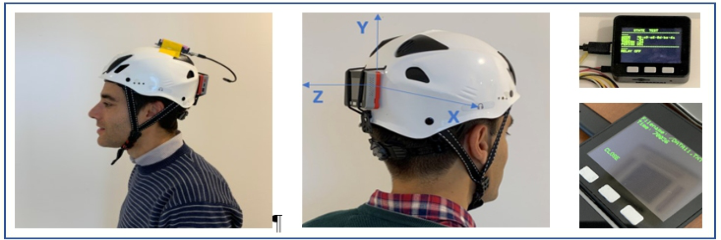
PROPOSED APPROACH In this section we describe the different components of the proposed system. It is composed of a microcontroller module (M5Stack with ESP32 processor and sensors) integrated in a safety hard hat plus a battery.
The M5 stack is a modular development kit based on the ESP32 micro- controller. It is known for enabling versatile and easy-to-use development platforms that integrate various sensors, displays, and input devices into a compact and stackable design system. The core of the module, a powerful
Use of Smartphones in Construction Projects: A Proposal for a Worker Monitoring System 111
microcontroller that includes Wi-Fi and Bluetooth connectivity. The ESP32 microcontroller is widely used in IoT (Internet of Things) projects due to its features and capabilities. In our case, the module, includes an inertial mea- surement unit (IMU). The 6-Axis IMU Unit from M5Stack (MPU6886) is a six-axis altitude sensor comprising a three-axis gravity accelerometer and a three-axis gyroscope, capable of calculating real-time inclination angle (pitch, roll and yaw) and acceleration (x,y,z). The signals received were processing by the system using a Bayesian filter and the system provides the probability of the worker is handling and looking the smartphone.
Figure 1: Different captions of the components of system composed by hard-hat, M5Stack, and battery.
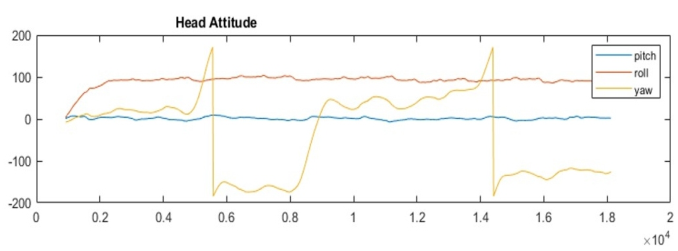
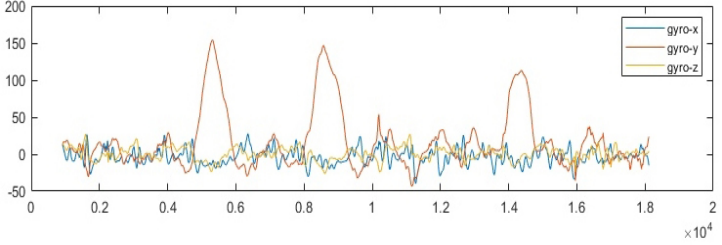
EXPERIMENTAL RESULTS The system has been tested in a controlled environment in a laboratory where the worker was not exposed to any occupational risks. The worker walked some meters in a corridor both using and not using the smartphone. Our system, processing the different variables provided by the IMU (acceleration and gyro) detects whether the worker has stopped and if he is looking at the smartphone display or not. If the worker is walking and looking at the smartphone simultaneously, a warning signal is generated.
Figure 2: Plot results of the pitch, roll and yaw angles provided by the system in Experiment 1.Figure 3: Plot results of the gyros provided by the system in Experiment 1.
The results have been positive in the five experiments. Based on the sig- nals of the IMU. The system detects with a probability higher of 80%, if the worker was looking the smartphone while he was walking.
LIMITATION OF THE STUDY In order to improve its development, additional experiments in different real situations should be carried on. Another limitation of this research is the no risk environment were the samples were obtained. Real construction sites include multiple risk and danger situations which have diverse influences in the data obtained. Although it is not admissible to test the system expos- ing the worker to real risks, some simulated ones could be considered in a controlled environment for future field tests.
CONCLUSION
The system detects the use of smartphone through an inertial measurement unit in order to track the motion and orientation of workers, providing valu- able data for safety monitoring. The system has been shown to be easy to configure and highly robust and reliable. It respects the privacy of the worker because it does not collect any personal information, and it detects the use of any smartphone (personal or company device) without invading or using the software of the phone. Although the proposal shows robustness, it could be confused in fuzzy situations. Then it is important to increase the number of experiments and measures for a more accurate development of the system in a diversity of situations. In future research higher number of real situations should be tested.
ACKNOWLEDGMENT
The research was funded by Universidad de Málaga through the call “B.1.- Ayudas para proyectos dirigidos por jóvenes investigadores en la Universidad de Málaga” as a part of the project titled “Monitorización del uso del smart- phone para la mejora de las condiciones de seguridad laboral en el sector de la construcción”.
Use of Smartphones in Construction Projects: A Proposal for a Worker Monitoring System 113
REFERENCES
Duan, P., Zhou, J., & Tao, S. (2023). Risk events recognition using smartphone and machine learning in construction workers’ material handling tasks. Engineering, Construction and Architectural Management, 30(8). https://doi.org/10.1108/EC AM-10-2021-0937 Gomez-de-Gabriel, J. M., Fernández-Madrigal, J. A., Lopez-Arquillos, A., & Rubio-
Romero, J. C. (2019). Monitoring harness use in construction with BLE beacons. Measurement, 131, 329–340. Gómez-de-Gabriel, J. M., Fernández-Madrigal, J. A., Rey-Merchán, M. del C., & López-Arquillos, A. (2023). A Safety System based on Bluetooth Low Energy (BLE) to prevent the misuse of Personal Protection Equipment (PPE) in construc- tion. Safety Science, 158, 105995. https://doi.org/10.1016/j.ssci.2022.105995 Gupta, K., Miglani, P., Dua, P., Agarwal, A., & Chakrabarty, N. (2022). Distraction
of Experienced Drivers at a Construction Site Using Eye Tracker. Lecture Notes in Electrical Engineering, 939. https://doi.org/10.1007/978-981-19-4364-5_31 Hasan, A., Ahn, S., Rameezdeen, R., & Baroudi, B. (2019). Empirical Study on Implications of Mobile ICT Use for Construction Project Management. Journal of Management in Engineering, 35(6). https://doi.org/10.1061/(asce) me.1943– 5479.0000721 Jiang, S., Ma, G., Jia, J., Wu, M., & Wu, Z. (2022). Mobile ICT Overuse in the Con-
struction Industry: Effects on Job Burnout of Project Managers. Journal of Con- struction Engineering and Management, 148(6). https://doi.org/10.1061/(asce) co.1943–7862.0002274 Ke, J., Zhang, M., Luo, X., & Chen, J. (2021). Monitoring distraction of construction workers caused by noise using a wearable Electroencephalography (EEG) device. Automation in Construction, 125. https://doi.org/10.1016/j.autcon.2021.103598 Kim, Y. C., Yu, S. W., & Kim, B. J. (2017). Design and implementation of the beacon-
based safety management system for construction industries. Advanced Science Letters, 23(10). https://doi.org/10.1166/asl.2017.9802 Namian, M., Albert, A., & Feng, J. (2018). Effect of Distraction on Hazard Recognition and Safety Risk Perception. Journal of Construction Engineering and Management, 144(4). https://doi.org/10.1061/(asce) co.1943–7862.0001459 Nnaji, C., & Gambatese, J. A. (2016). Worker Distraction Impacts on Safety and
Work Quality: An Energy Component. Construction Research Congress 2016: Old and New Construction Technologies Converge in Historic San Juan - Pro- ceedings of the 2016 Construction Research Congress, CRC 2016. https://doi.or g/10.1061/9780784479827.299 Nnaji, C., Gambatese, J., Lee, H. W., & Zhang, F. (2019). Improving construction work zone safety using technology: a systematic review of applicable technologies. Journal of Traffic and Transportation Engineering (English Edition). Rao, A. S., Radanovic, M., Liu, Y., Hu, S., Fang, Y., Khoshelham, K., Palaniswami,
M., & Ngo, T. (2022). Real-time monitoring of construction sites: Sensors, methods, and applications. In Automation in Construction (Vol. 136). https: //doi.org/10.1016/j.autcon.2021.104099 Rey-Merchán, M. del C., Gómez-de-Gabriel, J. M., Fernández-Madrigal, J. A., & López-Arquillos, A. (2020). Improving the prevention of fall from height on con- struction sites through the combination of technologies. International Journal of Occupational Safety and Ergonomics. https://doi.org/10.1080/10803548.2020. 1815393
Rey-Merchán, M. del C., Gómez-de-Gabriel, J. M., López-Arquillos, A., & Fernández-Madrigal, J. A. (2021). Virtual Fence System Based on IoT Paradigm to Prevent Occupational Accidents in the Construction Sector. International Journal of Environmental Research and Public Health 2021, Vol. 18, Page 6839, 18(13), 6839. https://doi.org/10.3390/IJERPH18136839 Sulaiman, H. A. Bin, & Yong, S. K. (2015). Safety alert system using android
smartphone via internet connectivity. ARPN Journal of Engineering and Applied Sciences, 10(3). Wang, D., Chen, J., Zhao, D., Dai, F., Zheng, C., & Wu, X. (2017). Monitoring workers’ attention and vigilance in construction activities through a wireless and wearable electroencephalography system. Automation in Construction, 82. https: //doi.org/10.1016/j.autcon.2017.02.001
LISTED IN THE AHFE DIGITAL BOOKSTORE CATALOGUE
Explore the complete digital volume
Safety Management and Human Factors
Read this individual research paper free through the original publisher, or explore the full digital proceedings book.
ISBN 978-1-964867-27-4
Explore this ISBN in the AHFE Bookstore ↗Listed in the July 2026 bookstore catalogue; search by ISBN to confirm current availability · Digital book purchase optional