Achim Elfering, Tobias Zimmermann (2024). Work interruptions and nearby-falls in geriatric nurses: attention failure as a mediator and job tenure as moderator. In: Safety Management and Human Factors. AHFE Open Access, vol. 151, pp. 115–124. https://doi.org/10.54941/ahfe1005308
In industrial countries, caring for the elderly in geriatric nursing homes is rapidly growing. Caregivers face intensive demands and often suffer from high workloads and frequent work interruptions. Not only in patients but also in geriatric nurses, slips, trips, and falls (STF) are frequent. We expect work interruptions to increase attentional failure, and attentional failure to increase the risk of STF (hypothesis 1). Moreover, we expect caregiver’s job tenure to moderate the indirect effect of work interruptions via attention failure on STF. The indirect mediation path should to be stronger in caregivers with less job tenure compared to caregivers who are rather tenured (hypothesis 2). With increasing job experience task regulation in many tasks has become automatic and less resource consuming and therefore more experienced caregivers attention capacity is less likely to be overcharged by work interruptions. Purpose: The current study tests a mediation model with attentional failure as a mediator between work interruptions and STF and job tenure as a potential moderator of such mediation. The sample comprised 45 geriatric nurses. Methods: All measures were self-report. Interruptions of work were assessed by a shortened version of the Instrument for Stress- Oriented Task Analysis (Semmer et al., 1995). Attention failure at work was assessed with the subscale of attention failure from the Workplace Cognitive Failure Scale (Wallace & Chen, 2005) in the German-validated translation). STFs at work were assessed with a scale from Elfering et al. (2013). Job tenure was assessed with a single item. The moderated mediation model was based on OLS regression analyses. The mediation tests were done using the PROCESS SPSS macro tool (Hayes, 2018). Results: The test of the mediation model showed significant path coefficients for the path between task interruptions and attention failure and the path between attention failure and STF. Variance explanation in the prediction of attentional failure (33% variance explanation, p = 002) and prediction of STF (27% variance explained, p = .003) was satisfactory. Moreover, the strength of the indirect path (path a * path b) was significant for the mean of job tenure (B = 0.10, SE = .06, CI = 0.02 to 0.21), but higher with low job tenure and smaller with high job tenure. The indirect path for those participants with low job tenure was stronger (PR 16% or 1 year of job tenure: B = 0.16, SE = .09, CI = 0.04 to 0.32). For those participants with the highest job tenure (PR 84% or 5 years of job tenure), the indirect path was smaller and not significant anymore (B = 0.04, SE = .07, CI = -0.04 to 0.18). Hence, the strength of mediation did depend on job tenure, but the test of moderation failed to reach statistical significance, although the interaction of job tenure * task interruptions explained 4% of the variation in attentional failure (p = .085). In sum, the mediation model (hypothesis 1) was confirmed while the moderated mediation (hypothesis 2) was rejected but data showed a tendency that pointed in the expected direction. Conclusions: The study needs replication in a larger sample and preliminary evidence should be consolidated by use of a longitudinal and/or experimental design. The preliminary evidence suggests that interruptions should be targeted not only in the prevention of work stress and efforts to increase patient safety but also in the prevention of STF in geriatric nurses. Training should address nurses, managers, and residents on how to reduce interruptions and how to cope with task interruptions.
Slips, trips, and falls (STF) cause a large proportion of lost-workday nonfatal injuries in nursing care facilities in many countries (Bell et al., 2013). Among 2016 registered nurses working in private hospitals, STF account for 25% percent of all nonfatal occupational injuries causing one day of work absence or more among RNs second most prevalent after overexertion and bodily reaction. In Germany, the BGW reported STF as the leading cause of injury in nurses in 2017 (BGW, 2019). In Switzerland, STF amounted to 26% of nurses accidents in 2013 (EKAS, 2013). Often, geriatric care includes also home care in resident appartments. In Switzerland, in the decade from 2003 to 2012, the number of accidents rose from 69.2 to 76.1 accidents per 1000 full-time home care nurses (EKAS, 2016). Therefore, the risk of accident is higher than the average in geriatric health care (EKAS, 2016). STF accounts for 36% of all accidents in home care nurses (EKAS, 2016). Within STFs, most accidents occur on dry, even flooring, with no patient involvement (30%), followed by STF on stairways with no patient involvement (25%). STF of nurses with no patient involvement happen on wet or slippery surfaces inside the residency 6% of the time and outside of the residency 11% of the time (EKAS, 2016). The risk factors of STF in nursing are multifactorial, including high biomechanical demands (carrying heavy objects and persons, strenuous and screwed work positions as reported by the SWISS Bureau of Statistics to be significantly higher in nursing compared to the total of other occupations, BFS, 2021). Some risk factors for STF in nursing, like walking on wet or slippery surfaces, can be mitigated by wearing grippy shoes. A recent RCT of wearing safe shoes reported a 36% reduction in STF incidence in the UK (Frost et al., 2022). Beyond physical and biomechanical risks, there is evi- dence for task-related risk factors like common task interruptions related to stress and the safety of nurses and patients (Elfering & Grebner, 2008). Evi- dence increases that interruptions increase mental workload (Semmer et al., 2010; Zijlstra et al., 1999). In many work situations, interruptions distract attention from the task at hand, and caregivers must store in their working memory the intent to restart the interrupted operation and where to begin again (Grundgeiger & Sanderson, 2009; Weigl et al., 2011). The distraction from the task at hand includes distraction from current demands on body balance, e.g., getting interrupted while aiding a patient to stand up from a chair limits the cognitive resources to prevent an STF (e.g., by prior check- ing whether the floor is wet or slippery). The current study sheds light on that distractive cognitive process, following a claim of Rivera-Rodriguez and Karsh (2010), who postulated that “these cognitive implications of interrup- tions are at the heart of why the study of interruptions is important”(p. 309). Hence, the authors expect self-reported attention failure to be the critical link between task interruptions and STF. Self-reported attention failure is a cog- nitive failure and reflects fluctuations in cognitive capacity rather than pure ability (Carrigan & Barkus, 2016; Tams et al., 2015).
Work interruptions correspond to attention failure in surgical nurses (Pereira et al., 2015). Task interruptions should decrease attention and lead
Work Interruptions and Nearby-Falls in Geriatric Nurses 117
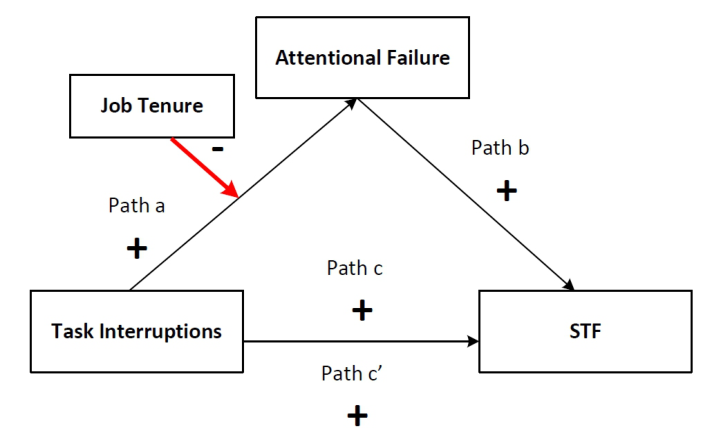
indirectly to STFs. Hence, the first study hypothesis is that attention failure mediates the link between task interruptions and STF (Figure 1).
In their review of self-reported cognitive failure, Carrigan and Barkus (2016) conclude that the antecedents and consequences of cognitive failure are moderated by a range of trait- and state-like factors. Likewise, the cur- rent study assumes job tenure to buffer the indirect path (Figure 1) because higher job tenure in demanding work includes grown expertise that helps to cope successfully with interruptions. For instance, Hacker, Sachse, and Seubert (2019) characterized such expertise–concerning age that is closely related to job tenure – to facilitate gains of task planning: “An example is to shift the preparation of means or materials that might become necessary during task execution to the beginning of the task in order to avoid criti- cal or time-consuming interruptions later on” (p. 186). Moreover, higher job tenure goes along with more prevalent automation in action regulation that is less resource-consuming. Therefore, in case of task interruptions that afford extra resources on task execution, more resources are left in tenured nurses. On the background of routinization, Hacker and coworkers (2019) also sug- gest that, with the increasing age of employees, some planning in advance is also shifted to more frequent detailed planning while doing the task. Hacker and colleagues postulate that this might become advantageous if conditions suddenly change during execution – likely by task interruptions. A previous result from our research group found an inverse correspondence of age and self-reported failure in action execution in health care nurses (Elfering et al., 2015). Hence, the second study hypothesis proposes a buffering effect of tenure on the mediation (Figure 1).
Figure 1: Working model of moderated mediation of the link between task interruptions and STF.
118 Elfering and Zimmermann
METHOD
Sample The survey was conducted in two long-term care institutions. The first care institution included an average of 137 residents in private apartments and employed 38 nursing staff. Here, the care needs ranged from fully inde- pendent residents who do not require any care services to those who are entirely dependent on care and can no longer live independently. Thus, the institution offers home care within private apartments that are all compara- ble and nearby. The second care institute had 178 residents and employed approximately 240 nursing staff. The care range was as extensive as in the first institution, but home care in resident apartments concerned half of the residents while the other half was in the institution’s hospital. In both insti- tutions, a questionnaire was distributed to 35 caregivers, randomly selected from employment lists. From Institution 1, a total of 26; from Institution 2, 22 persons returned the completed questionnaire. Thus, the overall response rate was 68.6%. Of the 48 people, 39 (81.2%) are women, and 9 (18.8%) are men. The average age was 40.9 years. The 48 caregivers come from ten different countries. Thirty-six caregivers are Swiss, representing the majority of the sample. On average, the nurses have more than five years of profes- sional experience. Most nurses were assistant nurses (39.5%, functional level 1), 29.2% were FaGe or diploma level 1 (functional level 2), and 31.3% were nurses with an HF or FH diploma (functional level 3).
Implementation A nursing assistant from Institution 1 sent 25 nursing staff members who were each given a questionnaire with a cover letter in their private fan. Each employee was contacted personally to maximize the response rate as high as possible. The employees had two weeks to fill in the questionnaire and either return it by mail with prepaid envelopes or drop it in a box installed in the wardroom. Since the response rate was still very modest after the two weeks, the deadline was extended by two weeks. For the survey in Institution 2, the ward managers of two nursing wards were informed about the study by information letter and asked to distribute the questionnaires to the nursing staff. Each questionnaire contained a cover letter informing staff about the study. The caregivers again had two weeks to return the questionnaire by mail using the enclosed prepaid envelope.
Measurements Interruptions of work were assessed by three items from a shortened ver- sion of the Instrument for Stress-Oriented Task Analysis (Semmer, Zapf & Dunckel, 1995). A sample question is, “How often are you interrupted by other colleagues during the course of your work activity?” With response options ranging from 1 (very rarely/never) to 5 (very often/several times an hour). Cronbach alpha was 0.87. Attention failure at work was assessed with the subscale of attention failure from the Workplace Cognitive Failure Scale (Wallace & Chen, 2005) in the German-validated translation (Elfering et al.,
Work Interruptions and Nearby-Falls in Geriatric Nurses 119
2011). The scale consisted of five self-report items with a 5-point Likert response format, ranging from 1 (very rarely/never) to 5 (very often). A sam- ple question is, “(How often do you daydream when you ought to be listening to somebody?” The internal consistency of the scale was satisfactory (Cron- bach alpha was 0.72). STFs at work were assessed using five items (Elfering et al., 2013). The five items asked about stumbling, slipping, and near-falling in the previous four weeks at work. The directions were “The following question refers to near-accidents occurring during work during the last four weeks. Near-accidents characterize situations in which you narrowly escaped experiencing an accident. For instance, near-accidents that occur while you are walking include stumbling on something without falling.” Items were “I stumbled,” “I slipped,” “I nearly fell on the stairs,” “I lost body balance,” and “I push myself (e.g., on a table or a chair),” with five response options from 1 (never) to 5 (very often). Cronbach alpha was 0.76. Job tenure was assessed with a single item asking “How long have you been working for this company?” and years as response format.
Data Analysis All statistical analyses were performed using SPSS 22. The moderated medi- ation tests were based on OLS regression analyses. The mediation tests were done using the PROCESS SPSS macro tool (Version 3.3), written by Andrew Hayes (2018), which estimates total, direct, and indirect effects and moder- ated indirect effects in Model 7 with a bootstrap test including 5000 sample estimations. As hypotheses were directional, one-tailed tests of significance are appropriate in the test of the paths within the moderated mediation model (Cho & Abe, 2013; Ludbrook, 2013).
RESULTS
Interruptions at work were moderate to frequent (M = 3.56, SD = 0.96). The mean level of attentional cognitive failures was 1.97 (SD = 0.50), comparable to the mean level of 323 participants from various occupations, as reported by Wallace and Chen (2.04) (2005). Mean values for STFs at work in the last four weeks were low (M = 1.73, SD = 0.58). The average job tenure was three years (SD = 1.6 years). Interruptions, attention failure, and STF were significantly related [r(40) ranged from 0.44 to .52, p between 0.004 and .001, two-tailed]. Job tenure was not significantly related to either task interruptions, attention failure, or STF [r(40) ranged from −0.13, p = .41 between job tenure and STF to 0.14, p = .40 between job tenure and task interruptions, two-tailed].
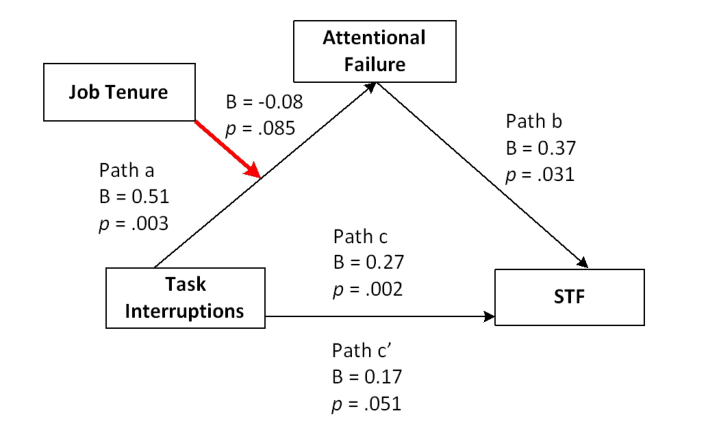
The regression-based test of the moderated-mediation model confirmed that the paths between task interruptions and attention failure (path a) and the path between attention failure and STF (path b) differ significantly from zero. Figure 2 shows the unstandardized linear regression coefficients. Variance explanation in the prediction of attentional failure (33% variance explanation, p = 002) and prediction of STF (27% variance explained,
120 Elfering and Zimmermann
p = .003) was satisfactory. The indirect path (path a * path b) was signif- icant for the mean of job tenure (B = 0.10, SE = .06, CI = 0.02 to 0.21). The estimates for those participants with low job tenure were higher (PR 16% or one year of job tenure: B = 0.16, SE = .09, CI = 0.04 to 0.32). For those participants with the highest job tenure (PR 84% or five years of job tenure), the indirect path was not significant anymore (B = 0.04, SE = .07, CI = −0.04 to 0.18). Hence, the strength of mediation did depend on job tenure, but the moderation test did not reach statistical significance. How- ever, the interaction of job tenure x task interruptions explained 4% of the variation in attentional failure (p = .085).
Figure 2: Unstandardized regression coefficients of the moderated mediation path model (p-values are one-tailed).
DISCUSSION
So far, in Switzerland, like in many other countries, the focus of prevention of STF in nursing in-home care is primarily on spatial and physical safety con- cerns (EKAS, 2013). Indeed, work redesign should address footwear, unclean or wet surfaces, change in elevation, insufficient light, and appropriate lifting aids (EKAS, 2013). However, as the current results of the mediation model test showed, interruptions should also be targeted to prevent STF. While the general risk of STF increases with nurses’ age (Dressner & Kissinger, 2018), the role of job tenure in action regulation seems to buffer the risk of STF from task interruptions that are linked to attentional failure. The mechanism behind this may be the more prevalent planning during action that is thought to be linked to age and job tenure, as proposed by Hacker and coworkers (2019). Prevalence planning during action might make the action regulation
Work Interruptions and Nearby-Falls in Geriatric Nurses 121
more resilient to unforeseen events during action exertion, like interrup- tions. Prevalence planning and other strategies probably help to maintain the quality level of task handling despite interruptions (Zijlstra et al., 1999).
Limitations The current study sample is small and includes only two nursing organiza- tions. Therefore, results can not be generalized to the population of geriatric nurses and the study needs replication in a larger and more representa- tive sample. Moreover, the current data is cross-sectional and can not shed deeper light on the direction of particular processes in action regulation. Experimental work should be done to address the question. An alternative explanation for tenure-related differences in action regulation might be the healthy worker effect: Many nurses do quit their work before retirement age, and those who stay might be those with a more resilient action regula- tion. Hence, longitudinal work across more extended periods combined with laboratory action regulation assessment may help disentangle tenure-related differences. Noteworthy, the current study has several other limitations. The hypothesized mediation model fits the empirical data well. However, this does not confirm causal mediation. Experimental work is necessary for this aim. A significant limitation arises from the cross-sectional nature of the data. Prefer- ably, our model would have been tested longitudinally using a prospective fall calendar (Mackenzie et al., 2009). Therefore, our study requires replication, as longitudinal event-sampling studies are better equipped to study the pro- cesses involved, including methods like ambulatory assessment (Klumb et al., 2009) and daily reports (Heijnen & Rietdyk, 2016). Experimental simulation approaches are also promising (Faes et al., 2023). Another limitation is that bias from common-source variance may have boosted the correlations in this study. Employees who perceive high task interruptions and attentional failure might also perceive and report more near-falls (Semmer et al., 2004). Further studies should also use methods other than self-reporting by including, for example, the reports of significant others working at the same place and mea- suring postural sway with force plates (Elfering et al., 2014) or standardized balance tests (Elfering et al., 2013).
CONCLUSION
Training nurses, managers, and clients on how to prevent task interruption by task design and to reduce the consequences of interruptions–e.g., by evidence- based interventions (Guo et al., 2021) - and how to cope better with task interruptions should be included in occupational prevention programs that address the environmental STF risk factors. In addition, team-based interven- tions in home care workers on safety communication and hazard correction in homes can be recommended (Olson et al., 2016).
REFERENCES
Bell, J. L., Collins, J. W., Tiesman, H. M., Ridenour, M., Konda, S., Wolf, L., & Evanoff, B. (2013). Slip, trip, and fall injuries among nursing care facility workers. Workplace Health & Safety, 61(4), 147–52.
122 Elfering and Zimmermann
Berufsgenossenschaft für Gesundheitsdienst und Wohlfahrtspflege, BGW (2019).
Pflegebranche: Arbeitsunfällen vorbeugen - BGW unterstützt ihre Mitgliedsbe- triebe. German Social Accident Insurance Institution for the Health and Welfare Services, BGW (2019). Care sector: Preventing accidents at work - BGW supports its member companies]. Retrieved January 2024 from: https://www.presseportal .de/pm/77149/4229163. Bundesamt für Statistik BfS (2021). Schweizerische Arbeitskräfteerhebung (SAKE) 2020, Arbeitsunfälle und andere arbeitsbedingte Gesundheitsprobleme. [Swiss Labour Force Survey (SLFS) 2020: Works-related accidents and health problems]. Retrieved January 2024 from: https://www.bfs.admin.ch/asset/de/19204488. Carrigan, N., & Barkus, E. (2016). A systematic review of cognitive failures in daily
life: Healthy populations. Neuroscience and biobehavioral reviews, 63, 29–42. Cho, H. C. & Abe, S. (2013). Is two-tailed testing for directional research hypotheses tests legitimate? Journal of Business Research, 66, 1261e6. EKAS (2013). Eidgenössische Koordinationskommission für Arbeitssicherheit ≪Unfall – kein Zufall!≫Arbeitssicherheit und Gesundheitsschutz im Gesund- heitswesen unter besonderer Berücksichtigung des Pflegefachpersonals in Spitälern und Kliniken, Ambulatorien, Arztpraxen, Pflegeinstitutionen und Heimen. [Federal Coordination Commission for Occupational Safety “Accident - no coincidence!” Occupational safety and health protection in the healthcare sector with special consideration of nursing staff in hospitals and clinics, outpa- tient clinics, doctors’ surgeries, care institutions and homes]. Retrieved January 2024 from: https://www.ekas.ch/download.php?id=6772. EKAS (2016). Eidgenössische Koordinationskommission für Arbeitssicherheit. Arbeitssicherheit und Gesundheitsschutz in der Hilfe und Pflege zu Hause (Spitex) [Safety and health prevention in home health care]. Luzern, Switzerland: EKAS. 2016. 132 p. Retrieved January 2024 from: http://www.ekas.admin.ch/redirect.php? cat1/4f%2BR3rLeQL4g%3D&id1/4675. Elfering, A., Arnold, S., Schade, V., Burger, C., & Radlinger, L. (2013). Stochastic
resonance whole-body vibration, musculoskeletal symptoms and body balance: A worksite training study. Safety and Health at Work, 4, 149–155. Elfering, A., Grebner, S., & Ebener, C. (2015). Workflow interruptions, cognitive failure and near-accidents in health care. Psychology, Health & Medicine, 20(2), 139–147. Elfering, A., & Grebner, S. (2008). Stress and Patient Safety. In J. R. B. Halbesleben,
(Ed.), The Handbook of Stress and Burnout in Health Care (pp. 173–186). Hauppauge, NY: Nova Science Publishers. Elfering, A., Grebner, S., & Boillat, C. (2013). Busy at work and absent-minded at home: Mental work load, cognitive failure and domestic falls. Swiss Journal of Psychology, 72, 219–228. Elfering, A., Grebner, S., & Dudan, A. (2011). Job characteristics in nursing and
work specific cognitive failure. Safety and Health at Work, 2, 1–7. Elfering, A., Grebner, S., Schwander, L., & Wattinger, M. (2014). Sports after busy work: Work related cognitive failure corresponds to risk bearing and athletic injury. Psychological Writings, 7, 43–54. Elfering, A., Kottwitz, M. U., Häfliger, E., Celik, Z., & Grebner, S. (2018). Inter-
ruptions, unreasonable tasks, and quality-threatening time pressure in home care: Linked to attention deficits and slips, trips, and falls. Safety and Health at Work, 9(4), 434–440.
Work Interruptions and Nearby-Falls in Geriatric Nurses 123
Elfering, A., Nützi, M., Koch, P., & Baur, H. (2014). Workflow interruptions and failed action regulation in surgery personnel. Safety and Health at Work, 5, 1–6. Elfering, A., Schade, V., Stöcklin, L., Baur, S., Burger, C., & Radlinger, L. (2014).
Stochastic resonance whole-body vibration improves postural control in health- care professionals: A worksite randomised controlled trial. Workplace Health & Safety, 64, 187–196. Faes, Y., Rolli Salathé, C., Herlig, M. L., & Elfering, A. (2023). Beyond physiology: Acute effects of side-alternating whole-body vibration on well-being, flexibil- ity, balance, and cognition using a light and portable platform A randomized controlled trial. Frontiers in Sports and Active Living, 5, 1090119. Frost, G., Liddle, M., Cockayne, S., Cunningham-Burley, R., Fairhurst, C., Torger-
son, D. J., & SSHeW trial team (2022). Relationship between age, workplace slips and the effectiveness of slip-resistant footwear among healthcare workers. Injury prevention : Journal of the International Society for Child and Adolescent Injury Prevention, 28(3), 256–258. Guo, J., Chen, T., Xie, Z., & Or, C. K. (2021). Effects of interventions to reduce the negative consequences of interruptions on task performance: A systematic review, meta-analysis, and narrative synthesis of laboratory studies. Applied Ergonomics, 97, 103506. Grundgeiger, T. & Sanderson, P., (2009). Interruptions in healthcare: Theoretical
views. International Journal of Medical Informatics, 78, 293e307. Hacker, W., Sachse, P., & Seubert, C. (2019). Action regulation across the lifespan.
In B. B. Baltes, C. W. Rudolph, & H. Zacher (Eds.), Work across the lifespan (pp. 179–213). Elsevier Academic Press. Hayes, A. F. (2018). Introduction to mediation, moderation, and conditional process analysis: A regression-based approach. New York, NY: The Guilford Press. Heijnen, M. J. H., & Rietdyk, S. (2016). Falls in young adults: Perceived causes and
envi- ronmental factors assessed with a daily online survey. Human Movement Science, 46, 86–95. Klumb, P., Elfering, A., & Herre, C. (2009). Ambulatory assessment in I/O Psychology: Fruitful examples and methodological issues. European Psychologist, 14, 120–131. Ludbrook J. (2013). Should we use one-sided or two-sided P values in tests of
significance?. Clinical and experimental pharmacology & physiology, 40(6), 357–361. Mackenzie, L., Byles, J., & D’Este, C. (2009). Longitudinal study of the Home Falls and Accidents Screening Tool in identifying older people at increased risk of falls. Australasian Journal on Ageing, 28(2), 64–69. Dressner, M. A. & Kissinger, S. P. (2018). Occupational injuries and illnesses
among registered nurses. Monthly Labor Review, U. S. Bureau of Labor Statistics, November 2018. Olson, R., Thompson, S. V., Elliot, D. L., Hess, J. A., Rhoten, K. L., Parker, K.
N.,... Marino, M. (2016). Safety and Health Support for Home Care Workers: The COMPASS Randomized Controlled Trial. American Journal of Public Health, 106(10), 1823–1832. Pereira, D., Müller, P., & Elfering, A. (2015). Workflow interruptions, social stressors from supervisor (s) and attention failure in surgery personnel. Industrial Health, 53, 427–433. Rivera-Rodriguez, A. J., & Karsh, B. T. (2010). Interruptions and distractions in
healthcare: Review and reappraisal. BMJ Quality and Safety in Health Care, 19, 304e12.
124 Elfering and Zimmermann
Semmer, N. K., Grebner, S., & Elfering, A. (2004). Beyond self-report: Using observational, physiological, and event-based measures in research on occupational stress. In P. L. Perrewé & D. C. Ganster (Eds.), Emotional and Physiological Processes and Positive Intervention Strategies. Research in Occupational Stress and Well-being, Vol. 3. (pp. 205–263) Amsterdam: JAI. Semmer, N. K., Grebner, S. & Elfering, A. (2010). “Psychische Kosten” von Arbeit:
Beanspruchung und Erholung, Leistung und Gesundheit. [The “psychological costs” of work: Workload, recovery, performance, and health. ] In U. Kleinbeck & K.-H. Schmidt (Hrsg.), Arbeitspsychologie. (Enzyklopädie der Psychologie, Bd. D-III-1, S. 325–370). Göttingen: Hogrefe. Semmer, N. K., Zapf, D., & Dunckel, H. (1995). Assessing stress at work: A framework and an instrument. In: Svane O & Johansen C (Eds), Work and health: Scientific basis of progress in the working environment. Office for Official Publications of the European Communities, Luxembourg, pp. 105–113. Tams, S., Thatcher, J., Grover, V., & Pak, R. (2015). Selective attention as a pro-
tagonist in contemporary workplace stress: Implications for the interruption age. Anxiety, Stress, and Coping, 28(6), 663–686. Wallace, J. C., & Chen, G. (2005). Development and validation of a work-specific measure of cognitive failure: Implications for occupational safety. Journal of Occupational and Organizational Psychology, 5;78, 615e32. Weigl, M., Müller, A., Zupanc, A., Glaser, J., & Angerer, P. (2011). Hospital doctors’
in- terruptions and activities: An observation study. BMJ Quality and Safety 20, 491e7. Zijlstra, F. R., Roe, R. A., Lenonora, A. B., & Krediet, I. (1999). Temporal factors in mental work: Effects of interrupted activities. Journal of Occupational and Organizational Psychology, 72, 163–185.
LISTED IN THE AHFE DIGITAL BOOKSTORE CATALOGUE
Explore the complete digital volume
Safety Management and Human Factors
Read this individual research paper free through the original publisher, or explore the full digital proceedings book.
ISBN 978-1-964867-27-4
Explore this ISBN in the AHFE Bookstore ↗Listed in the July 2026 bookstore catalogue; search by ISBN to confirm current availability · Digital book purchase optional