Oluwafemi Olatoye, Andrew Oyen Arewa, David Tann (2024). Role of Human Factors in Fall from Height Fatalities in the UK Construction Industry. In: Safety Management and Human Factors. AHFE Open Access, vol. 151, pp. 136–146. https://doi.org/10.54941/ahfe1005310
Globally, fall from heights remains incessant in the construction industry with recent statistics revealing that about 65% of fatalities are directly linked to fall from height in the UK construction industry. Moreover, the problem is exacerbated by the persistent and reoccurring nature of falls from height in the construction industry. Yet, research about the contemporary roles of human factors vis-à-vis falls from height across high-risk industries is scarce. Aim: The study aims to provide a robust analysis regarding the role of human factors in fatalities caused by falls from height in the UK construction industry. Research question: What is the relationship between human factors and persistent falls from height incidents in the construction industry? Method: Mixed research methods (Qual-Quan) concept and phenomenological research strategy were adopted for a better understanding of the research variables. The study relied on HSE archived data and data obtained through a response to a Freedom of Information (FOI) request sent to the Health and Safety Executive (HSE) UK for 10 years data on fall accidents in the UK construction industry. Also, a semi-structured interview was conducted with professionals in high-risk industries for better insight into the study. Result: The initial findings of the research show a range of human contributory factors such as workers fatigue, mental slips, hastiness, organisational pressures, etc are responsible for persistent falls among workers. Conclusion: The study findings reveal that 75% of falls from height cases in the UK construction industry are caused by human factors and it further underscores the significant role human factors play in falls from height incidents. Other findings from the study suggest that the use of bespoke and modernised airbag PPE by construction workers has the potential to significantly mitigate the effects of falls from height. The study is part of an ongoing PhD research that seeks to develop a conceptual framework aimed at managing dysfunctional safety practices among workers in the UK’s high-risk industries.
Globally, accidents caused by Fall from Height (FFH) in the construction industry remain a chronic problem, and contemporary studies that exam- ine the role of human factors on FFH are scarce. Zaini et al., (2019) assert
Role of Human Factors in Fall From Height Fatalities in the UK Construction Industry 137
that construction accidents and the prevalence of FFH remain high and mind- blogging. Moreover, a recent Health and Safety Executive (HSE, 2023) report claim that the UK construction industry recorded the highest fatalities of 45; and 29 of the casualties were caused by falls from height. It is pertinent to note that adverse safety incidents of falls from height are not entirely new occur- rences across high-risk industries (Samad, Hasmori, & Ismail, 2023). Besides, it is fair to acknowledge that the overall accident rates in the UK construction industry compare favourably with many other developed countries such as Spain, France, and Italy (HSE, 2020). However, despite the overall reduction of unsafe acts in most industries across European countries, fatalities caused by FFH remain stubbornly high. For example, HSE (2023) and IOSH (2019) claim that the construction industry is inundated with cases of accidents due to falls from height, with little research about the role of human factors on fatalities caused by FFH.
For example, the underlying influence of individual and collective workers behavioural factors in accidents relating to falls from height remain elusive. Thus, the significance of the study is to create awareness about the underlying influence of human factors vis-à-vis FFH fatalities in the UK construction sector. To enhance understanding of the research variables, there is a need for a thorough literature review about FFH.
LITERATURE REVIEW
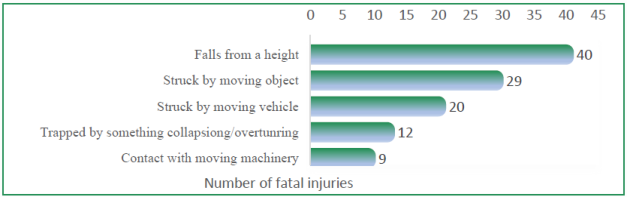
There is no universally accepted definition of the phrase “Fall from Height” (FFH). For emphasis, the study relies on Lohanathan et al. (2020) descrip- tion to deduce a working definition of FFH as injury to a person that occurs after landing on the ground falling from a high place, such as a ladder, scaf- fold, building, roof, or other elevated place or work area. Rothblum et al. (2002) argue that accidents are not often caused by a single failure or mis- take but by a collection of diverse, series, or chain of errors. Hence, accidents can be seen as a combination of casual factors and human factor errors from workers. The study conducted by Mustapha, Aigbavboa, and Thwala (2018) suggests that most accidents in the construction industry are due to human error, nonetheless, there is the absence of proactive safety management mea- sures of these chronic fatalities vis-a-vis the role of human factors in fall from height in the UK construction industry. Falls from height accidents have con- stantly been the cause of most fatalities to UK workers as illustrated in Fig. 1; and it accounted for over a quarter of the number of accidents each year (McDonnell, 2023). Moreover, HSE (2023) data reveal that about 40 deaths occurred because of falls from height making it the highest source of fatalities across industries as illustrated in Fig. 2.
Figure 1: Number of fatalities and causal factors in the UK construction industry (adapted from HSE, 2023).
Figure available in the original PDF paper.
Figure 2: Number of fatal injuries (adapted from HSE, 2023).
Nadhim et al. (2016) avow that in 2013 alone, it was estimated that falls from height incidents were responsible for 31% of occupational fatalities in the United Kingdom, and almost a decade after, in 2022, approximately 41% of deaths from construction sites are attributed to FFH (Thomas-Alexander, 2022). There is no gainsaying that the complex nature of construction projects exposes workers to severe hazards. Nadhim et al. (2016) affirm that most projects are often characterised by diverse activities with dangerous oper- ations that expose construction workers to adverse incidents. However, the numerous instances of persisting dysfunctional safety practices among workers in the construction industry are often attributed to human factors.
Similarly, the Building Society Group (2021) stresses that over 60% of deaths from working at heights are from falls from scaffolds, ladders, rough edges, fragile roofs, and working platforms. Also, it is estimated that falls from heights incidences account for 29 accidents, followed by struck by mov- ing vehicles 23 fatalities and struck by moving, flying, or falling objects led to 18 fatalities (Statista, 2022).
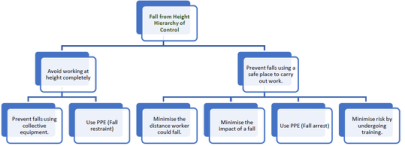
Furthermore, working at height has remained the single biggest cause of injuries and fatalities recorded mostly in small-scale projects in the construc- tion industry (HSE, 2022). Despite the eight hierarchy of control measures recommended by the UK’s Health and Safety Executive (HSE, 2022) for organisations to consider before working at height, however, there are no human factor considerations in the management of falls as illustrated in Figure 3. This gap provides the basis for more in-depth research on human factors as it relates to persistent fall from height fatalities in construction industries.
Figure 3: Fall from height hierarchy of control (researcher’s design, adapted from HSE 2022).
Role of Human Factors in Fall From Height Fatalities in the UK Construction Industry 139
Review of Causes of Fall From Height in Construction Industry Construction accidents are either caused by direct factors such as structural failures, and inadequate use of PPE, or indirect factors such as poor organ- isation and economic fears (Li & Poon, 2013). HSE (2022) is of the view that 22% of falls from height accidents are linked to falls through deli- cate surfaces, particularly from fibre-cement roofs and roof lights. Similarly, Rokooei et al. (2023) assert that roofing professionals who work on roofs are required to pay keen attention to the roof environment and to the kind of tools they use while roofing. However, the underlying roles of human fac- tors regarding FFH among construction workers remain vague. Fabiano et al. (2022) argued that human error is not only because of a lack of competence, motivation, or attention, it can also include several occurrences, situations, and environments. Besides, many researchers have focused on casual fac- tors of accidents and have not adequately addressed the contemporary roles of human factors vis-à-vis fall from heights incidents in the construction industry. Rey-Merchan et al. (2021) assert that human behaviours contribute significantly to FFH accidents in the workplace. Over 60% of fatalities at construction sites involve falls due to scaffolding, ladders, roof edges, and platforms (HSE, 2022); also, workers involved in the use of machines and plants are prone to falls from vehicles or machinery resulting in injuries or fatalities (HSE, 2022). British Safety Council (2023) suggests that falls from height remain the most frequent source of workplace death in the UK con- struction industry. Other contributory factors to FFH are adverse weather conditions on surfaces such as rain, snow, or winds (Rey-Merchan et al., 2021).
Review of Personal Protective Equipment in the Construction Industry Under the UK Personal Protective Equipment Regulations 1992, organisa- tions are legally obligated to provide personal protective equipment, includ- ing head protection for all workers (HSE, 2023). Personal fall protection equipment falls into two categories: Work Restraint Equipment and Fall Arrest Equipment (Lift and Escalator Industry Association, 2018). Despite the widespread use of safety harnesses, the construction industry still experi- ences a rising fatality rate due to falls. Technological advancements have led to the introduction of digital wearables like smart wristbands and exoskele- tons, which mitigate musculoskeletal injuries and safeguard workers during construction (McCoy & Yeganeh, 2021). Though, safety digital wearables and technologies are common in many sectors such as healthcare, and energy industries, findings show that its utilisation for preventing and protect- ing workers from accidents in construction sites is insignificant (Munoz-La Rivera, Mora-Serrano & Onate, 2021).
A study by Subramaniam, Faisal, and Jamal Deen (2022) reveals that dig- ital sensors such as pressure and inertial measurement in a single device can assist in simplifying wearable systems for fall detection. Also, non-digital fall arrest devices can be used as protection equipment for construction workers (Brodskiy, 2019). Arguably, there are no PPEs that are designed with airbags
for construction workers while working at height. Rather, bespoke integrated personal protective equipment with airbags for construction site workers is conceived to be effective in achieving a reduction in fall fatalities.
RESEARCH METHODS The study adopted a phenomenological research strategy. The research strat- egy allows respondents to express their perceptions and expectations based on their own experiences. Leedy and Ormrod (2015) claim that phenomeno- logical study brings to bear the experiences, understanding, and perceptions of individuals (about a phenomenon) from their perspectives. The study data were collected using Focus Group Discussions (FGDs) and scrutiny of archived data.
Quantitative Data Analysis Quantitative data about FFH was obtained via the UK Health and Safety Executive using a Freedom of Information (FOI) request, concerning 10 years data of FFH accidents in the UK construction industry. The quantitative data obtained are illustrated in Table 1 below. The data were analysed using SPSS version 29 and the findings are presented in scatter diagram and oscillatory graph as illustrated in Tables 2 and 3.
Qualitative Data Analysis A total of nine focus group forums were organised and intensively discussed issues about the human factor and their influence on falls from height at various times. Leedy and Ormrod (2015) believe that studying multiple per- spectives of a phenomenon could help in the development of a theory, and generalisation of findings from phenomenological studies. Krueger (2002) stated that 5 to 10 participants are acceptable for a typical FGD. Thus, this study adopted a minimum of five to ten participants per FGDs. Discussions and interactions in each FGDs were tape-recorded and transcribed. Microsoft Teams and Word 2022 versions were used to facilitate all transcriptions. A purposive and convenient sampling technique was used to select eight con- struction companies that operate in the UK with safety management records. Overall, the study participants were drawn from a poll of construction man- agers, health and safety officers, site operatives, site managers, engineers, and the company’s directors. Participants with a minimum of five years of construction and health and safety experience were considered for the study. Textual contents from each FGDs were inputted into Nvivo 12 software. All data captured were coded using keywords and phrases such as “human fac- tor”, “fall from height”, “fall from height fatalities”, “behavioural patterns” etc. Data obtained were analysed using content analysis. Reasons for using content analysis include the ability to easily extrapolate antecedents of inter- viewee’s discussions, concerning the study subject matter, it provides valuable insight about the research data, code/text allows for unobstructed means of analysing interactions and better examination of communications using captured texts that emanated from the FGDs.
Role of Human Factors in Fall From Height Fatalities in the UK Construction Industry 141
Validity of Qualitative Inquiry The researchers were mindful of endless theoretical arguments about validity of qualitative inquiry often defined as “truth” and credibility usually referred to as “integrity of research” (Gaskell & Bauer, 2000). To avoid philosophi- cal arguments about the validity of qualitative research, the authors accepted the standpoint of Kuzmani (2009) assertion that “there is a pure ‘form of truth’ which can be discovered (through the construct, external and internal validity) using appropriate and most importantly valid research methods. For straightforwardness, the authors inferred valid qualitative research (interview data) to represent credible social worlds (construct) or different interpreta- tions of words that constitute meaning to the study research variables. Thus, the validity of the phenomenological inquiry was addressed through three fundamental areas: production (design of interview questions, interview pro- cess, and recording of the data), presentation (replicability, valid inference, and arrangement of the data), and interpretation (meaningful discussion of data).
ANALYSIS AND FINDINGS Quantitative Data Obtained From the Fall fatalities of the Health and Safety Executive (HSE) Repository
The essence of the quantitative data was to examine the spate in the occur- rence of fall accidents in the last 10 years (2012–2021) on UK construction sites. Tables 1, 2, and 3, show a trend of fatalities from falls from height, the correlation of fatalities between employed and self-employed workers, and the geographical spread of the fall fatalities in the UK.
Table 1. Total fatalities to employee and total fatalities to self-employed.
Table 2. Fall from height correlation between fatalities to employed and self-employed workers
Table available in the original PDF paper.
Table 3. Fall from height fatalities by Location in the UK.
Table available in the original PDF paper.
Interview Data Analysis and Presentation of Findings Participants in the FGDs were asked to evaluate their views about two essential elements i.e., human factor behavioural patterns and fall from height. Some contents from the FGDs were subsequently trimmed for better understanding and spontaneity of the interaction between study partici- pants and the researchers. Some textual excerpts were expressed verbatim as illustrated below for a better understanding of participants’ viewpoints regarding the research variables. For example, when asked: Are there new behavioural patterns you observe among workers while working at height?
Study participants interviewed were asked questions about their per- sonal and professional views concerning construction workers unsafe human practices and behaviours that predisposes site operatives to fall from height. Subsequently, interview was conducted using MS Teams and data were analysed using Nvivo 12 software. Some textual contents of interview data obtained from the transcription were extracted for bet- ter interpretation and the interview textual excerpts are highlighted as follows.
Role of Human Factors in Fall From Height Fatalities in the UK Construction Industry 143
Table 4. Textual excerpts from FGDs interview.
Table available in the original PDF paper.
S/N Questions Response Number of times similar A Construction Supervisor
15
“... need to go up and solve that problem without necessarily thinking it through.”
1 Are there new behavioural patterns you observe among workers while working at height?
10
2 Probing question: So, are you of the view that workers are often in a hurry to work at height?
“...yeah, what I mean is that some workers tend to eagerly work for. instance on a roof without first thinking if they have the right equipment or whether they have got sufficient time to work on it and so they get to work at height without careful planning.”
B Health and Safety Site Supervisor
12
3 What do you consider as responsible for the continual fatalities among workers?
“A lot of the times some workers tend to ignore safety rules due to their foolhardiness.”
8
4 Probing question: Are you saying that workers are deliberate in flouting safety?
“In a way, I will say it is the absence of fear factor in workers makes them approach safety issues carelessly. This unfortunately has been emboldened by organisations emphasis on paperwork as against workers having a good understanding of the safety rules. This can also be linked with poor safety culture in the organisation.”
C Construction Manager
5
5 What do you think that employers can do to improve safety for workers who are working at height
“I am of the view that most organisations should ensure that they manage the working at height procedures more efficiently.”
7
6 Probing question: Will that be sufficient to reduce the spate of fatalities for workers working at height?
“Although, achieving a significant reduction in fall fatalities will require more efforts from employers, however; many safety procedures are too bulky and will need to be simplified for workers especially those working at height.”
D Construction Supervisor
10
7 Why do you think fatalities among workers in the high-risk industries are persistent?
“Largely due to pressures on global industyy economy which is cascaded on the workers”
12
8 Probing question: Are you saying that pressures from employers is exposing more workers to fatalities?
“Yes, pressures make workers hury and expose them to mistakes. These pressures lead to an increase in fatigue, mental slips, and lack of concentration on the part of the workers.”
DISCUSSIONS AND FINDINGS A 10-year fatality data of the Health and Safety Executive (HSE) from 2012 to 2021 revealed that incidences of falls from height in the UK construction industry abound. The statistical analysis of the fall data indicates a high cor- relation in the frequency of fall accidents among workers. In terms of UK
geographical spread Scotland and Wales had the highest number of fall fatal- ities among construction workers. Findings from the interview data suggest that several human factor issues certainly affect FFH. For instance, 75% of interviewees suggested that incidents of FFH were due to personnel human factors and organisational pressure. A recurring theme expressed among participants during the interview is underlying conditions such as fatigue, hastiness, distractions, mental slips, etc, were identified as triggers for fatal falls from height. The findings from the study are in line with Mohammadfam et al., (2021) assertion that fatigue reduces situational awareness of workers which leads to unsafe adverse safety.
Furthermore, these results suggest that human factors and organisational complicit actions of supervisors, and site managers pressures on workers con- tribute to a spate of FFH in the construction industry. Gomez-Salgado et al. (2023) argues that tight deadlines associated with construction projects, and deadline pressure on site workers and supervisors are also contributory fac- tors to FFH. Furthermore, Mohammadi and Tavakolan (2020) assert that continuous pressure on workers certainly affects their safety on construction sites.
CONCLUSION
A key deduction from the study is that fall from height remains chronic with devastating effects on workers in the construction industry. The study dis- covered that 75% of fall from height cases in the UK construction industry are caused by human factors and it further underscores the significant role human factors play in fall from height incidents. Other findings from the study show that there is a generic upward trend in the occurrence of FFH accidents. Besides, the study identified that human factors such as compla- cency, undue pressure, unsafe practices in the workplace, etc continue to play a dominant role in cases of FFH in the construction sector. The study recom- mends further research on the use of bespoke airbag PPE as part of solutions to cushion the effect of FFH.
Ultimately, the outcome of the study reinforces the essence of contin- ual awareness of health and safety guidelines in achieving a reduction in incidences of FFH.
LIMITATION The study is limited by inability to obtain fall from height data from other countries with comparative economic growth with the UK such as Organisa- tion for Economic Co-operation and Development (OECD) countries for the purpose of comparison.
REFERENCES
British Safety Council (2023). Falls top the causes of workplace deaths in 2023. Available [online]https://www.britsafe.org/safety-management/2023/falls- top-the-causes-of-workplace-deaths-in-2023.
Role of Human Factors in Fall From Height Fatalities in the UK Construction Industry 145
Building Society Group (2021). Working at Height breaches increase by 84% on construction sites. Available [online] https://www.bsgltd.co.uk/news/working-at -height-breaches-increase-by-84-on-construction-sites/. Brodskiy, V. (2019). Parameters of the safety and fall arrest nets in buildings under
construction. Available [online]https://doi.org/10.1051/e3sconf/20199703006. Chan, A. P., Guan, J., Choi, T. N., yang, Y., Wu, G., and Lam, E. (2023). Improving Safety Performance of Construction Workers through Learning from Incidents. International Journal of Environmental Research and Public Health vol. 20(5): 4570. Fabiano, B., Pettinato, M., Curro, F., Reverberi, A. P. (2022). A field study on human
factor and safety performances in a downstream oil industry. Journal of safety science. Vol. 153. Gaskell, G, Bauer, M. W. (2000). Towards public accountability: beyond sampling, reliability, and validity. In: Bauer MW, Gaskell G. Qualitative research with text, image, and sound. London: Sage; p. 336. HSE, (2023). Work-related fatality figures published. Available [online] https://pres
s.hse.gov.uk/2023/07/06/work-related-fatality-figures-published/. Kim, D., H., Woo, J., Jeon, Y, B., Cho, J., Jang, J. H, Choi, J, Y., and Choi, W, S.
(2023). Factors associated with the injury severity of falls from a similar height and features of the injury site in Korea: A retrospective study. Journal of Trauma and Injury vol. 36(3) page 187–195. doi: https://doi.org/10.20408/jti.2022.0042. Krueger, R. A, (2002). Designing and Conducting Focus Group Interviews. University of Minnesota publications. Kuzmani C M. (2009). Validity in qualitative research: Interview and the appearance
of truth through dialogue. Horizons Psychol 2009;18(2):39e50. Leedy, P. D., and Ormrod, J. E. (2015). Practical Research: Planning and Design (10th ed.). Edinburgh Gate: Pearson Education. Li, R. Y., and Poon, S. W. (2013). Why Do Accidents Happen? A Critical Review on
the Evolution of the Construction Accident Causation Models, In Construction Safety, Germany, Springer, pp. 13–23 Lift and Escalator Industry Association (2018). LEIA Safety Information Sheet Fall Protection. Available [online] https://www.leia.co.uk/wp-content/uploads/2018/ 02/22-Fall-Protection-1802.pdf Lohanathan, A, Hazra, D, Jyothirmayi, C. H and Kundavaram, A. P (2020). An Elu-
cidation of Pattern of Injuries in Patients with Fall from Height, Indian Journal of Critical Care Med. 2020 Aug; 24(8): 683–687. doi: 10.5005/jp-journals-10071- 23520. Mccoy, A. P., and Yeganeh, A. (2021). An Overview of Emerging Construction Technologies. NAIOP Emerging Construction Technologies. Muñoz-La Rivera, F., Mora-Serrano, J., Oñate, E. (2021). Factors Influencing Safety
on Construction Projects (fSCPs): Types and Categories. Int. J. Environ. Res. Pub- lic Health 2021, 18(20), 10884 Available[online] https://doi.org/10.3390/ijerph 182010884. Mustapha, Z., Aigbavboa, C., and Thwala, W. (2018). Assessment of Human Factors Analysis and Classification System in Construction Accident Prevention. International Conference on Applied Human Factors and Ergonomics. Mohammadfam, P., Mahdinia, M., Soltanzadeh, A., Aliabadi, M. M., and Solta-
nian, A. R. (2021). A path analysis model of individual variables predicting safety behavior and human error: The mediating effect of situation awareness. International Journal of Industrial Ergonomics. Vol. 84. Mohammadi, A., and Tavakolan, M. (2020). Identifying safety archetypes of construction workers using system dynamics and content analysis. Journal of safety science vol. 129.
McDonnell, K. (2023). Falls from height: Taking messages home. Available [online] https://www.shponline.co.uk/working-at-height-3/falls-from-height-taki ng-messages-home/. Nadhim, E, A., Hon, C., Xia, B, Stewart, I., and Fang, D. (2016). Falls from
Height in the Construction Industry: A Critical Review of the Scientific Liter- ature. International Journal of Environmental Research and Public Health vol. 13(7) page 638. Office of National Statistics, (2022). Construction statistics, Great Britain: 2022.
Available [online]https://www.ons.gov.uk/businessindustryandtrade/construction industry/articles/constructionstatistics/2022. Rothblum, A., Wheal, D., Withington, S., Shappell, S. A., and Wiegmann, D., A et al., 2002). Improving Incident Investigation through Inclusion of Human Factors. United States Department of Transportation -- Publications & Papers. 32. Rey-Merchan, M, C., Gomez-de-Gabriel, J., Lopex-Arquillos, A., and Choi, S, D.
(2021). Analysis of Falls from Height Variables in Occupational Accidents. Inter- national Journal of Environmental Research and Public Health vol. 18(24) page 13417. Rokooei, S, Shojaei, A., Alvanchi, A., Azad, R., and Didehvar, N. (2023). Virtual reality application for construction safety training. Journal of Safety Science. Vol. 157. Samad, N, A., Hasmori, M, F., and Ismail, R. (2023). Identification of fall event and
classification of the factors causing fall from height accidents in the construction industry. IOP Conf. Series: Earth and Environmental Science 1205 (2023) 012036 Subramaniam, S., Faisal, A. I., and Jamal Deen, M. (2022). Wearable Sensor Systems for Fall Risk Assessment: A Review. 14:4:921506. doi:10.3389/fdgth.2022.921506. Statista (2022). Number of fatal injuries to workers in Great Britain in 2022/23, by industry. Available [online] https://www.statista.com/statistics/292275/fatal-inju ries-at-work-great-britain-by-employment-by-industry/. Thomas-Alexander, T. (2022). Falls from height are still the biggest cause of death
on construction sites. Available [online] https://www.constructionnews.co.uk/hea lth-and-safety/falls-from-height-remains-biggest-cause-of-death-on-constructio n-sites-31-03-2022/. Zaini, N. Z., Salleh, M. A, Hasmori, M. F., and Abas, N., H. (2019). Effect of Accident Due to Fall From Height at Construction Sites in Malaysia. Zermane, A., Tohi, M, Z., Baharudin, M, R., and Yusoff, H, M. (2022). Risk assess-
ment of fatal accidents due to work at heights activities using fault tree analysis: Case study in Malaysia. Journal of Safety Science vol. 151.
LISTED IN THE AHFE DIGITAL BOOKSTORE CATALOGUE
Explore the complete digital volume
Safety Management and Human Factors
Read this individual research paper free through the original publisher, or explore the full digital proceedings book.
ISBN 978-1-964867-27-4
Explore this ISBN in the AHFE Bookstore ↗Listed in the July 2026 bookstore catalogue; search by ISBN to confirm current availability · Digital book purchase optional