Oluwafemi Olatoye, Andrew Arewa, David Tann, Ismaeel Husain (2025). Exploring the Effect of Wearable Digital Devices (WDDs) on Adverse Occupational Health and Safety Practices of High-Risk Workers. In: Human Interaction and Emerging Technologies (IHIET-FS 2025): Future Systems and Artificial Intelligence Applications. AHFE Open Access, vol. 196, pp. 23–32. https://doi.org/10.54941/ahfe1005951
Globally, workers in high-risk industries are often exposed to hazards with devastating effects, leading to occupational health infections, injuries, and fatalities. Despite the advent of Wearable Digital Devices (WDDs), contemporary research examining their influence vis-à-vis high-risk industry workers' health and safety practices is inadequate. Aim: The study explores the influence of wearable digital devices on managing adverse occupational health and safety practices among workers in high-risk industries. Research question: Does the use of wearable digital devices influence safety practices among high-risk industry workers? Methodology: A mixed (Quan+Qual) research method was followed for a holistic approach to the study’s variables. Besides, a semi-structured interview with senior managers and supervisors was conducted. Quantitative data was analysed using Microsoft Excel, and thematic analysis for qualitative data. Findings: 60% of the study’s participants agreed that WDDs such as smart watches, digital helmets, and airbag vests are critical to managing the prevalence of adverse safety practices among workers on high-risk projects, although a comprehensive utilisation of WDDs is envisaged to cause financial pressures on high-risk industries. Conclusion: The study revealed that despite the relevance and importance of WDDs in occupational health and safety management, workers' habits and practices may limit their effectiveness in curbing adverse safety incidents. Also, due to cost implications, small-sized high-risk companies may not be able to afford PPEs with digital functionalities. Thus, novel non-technological approaches, such as behaviour-based training, are recommended. This is a supplementary study and part of an ongoing PhD research that seeks to develop a conceptual framework for managing dysfunctional safety practices in high-risk industries.
Globally, the nature of work and environmental conditions in high- risk industries often predispose workers to occupational health infections, injuries, and fatalities. In many instances, workers have continued to be exposed to devastating injuries, and in some extreme cases, fatalities. The Health and Safety Executive (HSE) UK, in its 2023/2024 report, confirmed that 138 deaths occurred in work-related incidents, and over 50% of these fatalities occurred to workers in high-risk industries such as agriculture and construction (HSE, 2024). While the safety of workers is becoming more complex to achieve (Li et al., 2015), however, the advent of Wearable Digital Devices (WDDs) and other digital technologies has emerged as innovative applications for solving occupational safety and health challenges in many sectors, especially in high-risk workplaces. With several essential safety benefits of wearable digital devices, however, the gap in the influence of WDDs on adverse safety practices among workers in high-risk industries continues to exist in the literature.
Arguably, the staggering casualty of workers can be minimised with more acquisition and utilisation of digital technologies by high-risk industries. However, the absence of considerations for workers’ safety practices while using the wearable digital devices can be counterproductive. Consequently, to better understand the relationship between the influence of WDDs on occupational health and safety practices, the study aims to explore the impact of using wearable digital devices to manage adverse safety practices among workers in three high-risk industries: agriculture, construction, oil and gas industry. The decision was premised on the economic relevance and high number of fatalities in the selected high-risk industries. Therefore, to achieve its objective, the research question posed by the study is: Does the use of wearable digital devices influence safety practices among high-risk industry workers? The study’s findings offer practical knowledge as it attempts to uncover the effect of using WDDs vis-à-vis managing workers’ adverse safety practices.
LITERATURE REVIEW
Globally, high-risk industries are critical to the development of most booming economies. However, they are profound for frequent adverse safety incidents. Derdowski and Mathisen (2023) avow that safety is of utmost importance to individuals and companies operating in high-risk industries such as oil and gas or nuclear power. Besides, Chen et al. (2023) opine that the technology for wearable devices has developed extensively because they offer the benefits of real-time measurement, speed, and convenience. Consequently, to prevent the occurrence of accidents in these high-risk industries, the use of digital and intelligent technologies has become very attractive.
There is an array of recent literature (Buijs, Weller and Budan, 2023; Tam, Alajlani and Abd-alrazaq, 2023; Deng et al., 2023; Chen et al., 2023; Moon and Ju, 2024; Tucker et al., 2023) around wearable digital devices (WDDs). However, research that has examined the perceived influence of WDDs on adverse safety practices, particularly in high-risk industries, is scarce.
Exploring the Effect of Wearable Digital Devices (WDDs) on Adverse Occupational Health 25
Recently, many high-risk sectors such as healthcare, construction, manufacturing, oil, and gas have been deploying wearable devices on project sites. This can be linked to the rate of devastation that accidents could cause in such a volatile work environment. However, Velasquez et al. (2024) observed that wearable technology tends to have a moderate to high probability of being cost-effective. Also, Kim and Kang (2022) suggest that the high cost of digital devices renders them unaffordable to many individuals and growing organisations.
Indeed, high-risk organisations are expected to conduct risk assessments, cost-benefit analysis to determine the extent to which the intervention of WDDs would be needed. Thus, individual or person-specific risk assessments should be the leading factors to be considered, including cost implications, suitability of the wearable device for the worker, and nature of the task to be carried out.
Emerging studies have identified repetitive factors for unsafe acts, such as the absence of safety awareness among workers and an insufficient safety management system represent a major cause of safety accidents (Kim, Kim, and Rie, 2021). Therefore, the study’s literature section will not dwell on the technological design of WDDs, rather, it will examine adverse safety practices through relevant theories and models such as the Job Demands-Resources Theory, the Five-Factor Model of personality, and the Theory of Behaviour- Based Safety (BBS).
Job Demands- Resources Theory The Job Demands- Resources theory is predicated on two categories: job demands and job resources. While job demands are most predictive of feelings of exhaustion, job resources are predictive of disengagement from the job (Demorouti et al., 2001). Tummers and Bakker (2021) assert that the Job Demands Resources (JD-R) theory outlines the impact of the organisational environment on employee well-being and performance. Perhaps, the JD-R theory may explain persistent adverse safety injuries and fatalities despite the introduction and use of wearable digital devices in high-risk industries.
Five-Factor Model of Personality Individual workers have unique personalities and traits. McCrae and Costa (1997) opine that the personality of individuals follows the Five Factor Model (FFM), which includes extraversion, conscientiousness, neuroticism, agreeableness, and openness to experience. Widiger and Crego (2019) suggest that the FFM is predominant and provides the opportunity for a better understanding of personality structure. Consequently, employees with higher levels of neuroticism but reduced agreeableness, conscientiousness, extraversion, and openness to experience are most likely to experience job burnout (Angelini, 2023). Therefore, it becomes important for organisations to be mindful of workers’ personalities during job distribution and the allocation of tasks, as it could influence the effective use of wearable digital devices by the workers.
Theory of Behaviour-Based Safety (BBS) The theory of Behaviour-Based Safety (BBS) also aligns with the study while attempting to explore and understand the influence of wearable digital devices (WDDs). Fang et al. (2020) assert that Behaviour-Based Safety can be useful in observing and identifying unsafe actions of individuals. Tuncel et al. (2006) uphold that despite a series of approaches implemented by the industry to reduce the occurrence of injuries and fatalities, behaviour- based safety offers a promising approach. Despite evidence of scholarly articles on BBS’s benefits, however, behaviour-based safety intervention should be done with caution. Behaviour-based safety strategies should not be used indiscriminately but based on the organisation’s needs (Tuncel et al., 2006). Though BBS interventions are often subjected to criticism (Skowron- Grabowska and Soboci´nski, 2018), the moral lesson of the theory remains true and relevant because, although high-risk firms may provide WDDs for workers, however, some workers’ behaviours and practices may not allow them to achieve the safety benefits of the WDDs.
RESEARCH METHODOLOGY The study adopted a mixed research (QUAN+QUAL) method to understand the research variables better. Researchers conducted both quantitative and qualitative research in an explanatory sequential order. The study’s methodological decision is underpinned by the need to utilise the strengths of both research methods to fully uncover how Wearable Digital Devices (WDDs) impact adverse safety practices among workers in high-risk work environments. Dawadi, Shrestha and Giri (2021) avow that mixed methods provide rich insights into the research experiences that cannot be understood using either qualitative or quantitative methods alone. Consequently, going by the study’s epistemology, combining both methods will offer a suitable opportunity to unravel WDDs vis-à-vis adverse safety practices.
Quantitative Data Collection Technique The study’s systematic data gathering involved the administration of web- based questionnaire surveys across three high-risk industries, namely: Construction, Agriculture, and offshore Oil and Gas. The study had 67 returned questionnaires from participants in the selected high-risk industries. The main question asked was whether participants think that the design and use of integrated Personal Protective Equipment and wearable devices such as smart watch, digital protective helmet, airbag vest, etc., is sufficient to manage workers’ adverse safety practices.
Qualitative Data Collection Technique Semi-structured interviews were conducted with seven professionals with a minimum of 10 years of experience and expertise in the high-risk industries considered in the study. They were purposively sampled, and the interview was conducted using MS Teams. The study’s researchers adopted the use of
Exploring the Effect of Wearable Digital Devices (WDDs) on Adverse Occupational Health 27
probing questions to ensure the validity of interview data using a respondent validation approach.
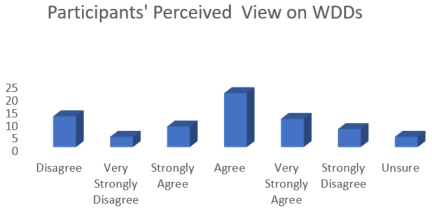
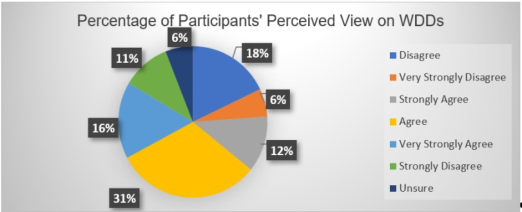
ANALYSIS AND FINDINGS Analysis of the study’s quantitative data was conducted using MS Excel for its descriptive frequency distribution and to gain a detailed assessment of the variables. In Figure 2, findings revealed that about 60% of participants agreed that Wearable Digital Devices (WDDs) have a sufficient impact in managing adverse safety practices among workers. As shown in Table 1, 34% disagreed on the effect of WDDs in curbing adverse safety practices, and 6% were unsure of the impact on workers’ safety practices.
Table 1: Distribution of participants’ responses on their perception of WDDs.
Table available in the original PDF paper.
Percentage of S/N Participants View Number of Participants Participants 1 Disagree 12 18 2 Very Strongly Disagree 4 6 3 Strongly Agree 8 12 4 Agree 21 31 5 Very Strongly Agree 11 16 6 Strongly Disagree 7 10 7 Unsure 4 6
Total 67 100
Figure 1: Participants’ perceived view on WDDs in high-risk industries.Figure 2: Percentage of participants’ perceived view on WDDs.
Analysis of Qualitative Data Findings The interview data were extracted, and excerpts were trimmed for concise interpretation and analysis. This was followed by conducting a thematic analysis of the textual data shown in Table 2.0. Question: Do you think the use of digital analytical tools or digital technology can reduce adverse safety?
“I think that digital technology could be used to show when approaching a high-risk period, and the multiplication of the hazard, so if technology could bring those together, they could flag up potential weaknesses which could be waiting to catch workers unawares” (Senior Safety Manager, Construction Industry. Similar view was expressed 7 times). Probing question: Do you consider any weaknesses in the use of digital devices on project sites?
The downside of digital technology implies carrying a mobile computer on a construction site where there could be rain, mud, and working at height. For instance, if a construction worker is walking and looking at the phone. Such a person could be walking into a machine pathway or trip hazards or something that is quite worse” (Senior Safety Manager, Construction Industry. A Similar view was expressed 5 times).
“Yes, digital devices can help in reducing incidences of fatalities if they are used correctly. However, if there are no checks to monitor if a digital device, such as digital video, was watched, it can be counterproductive” (Head, Health and Safety, Engineering Department. Similar views were expressed 6 times). “There have been a lot of technology and technological developments that can help reduce the number of injuries and fatal incidents. However, there are still a lot of farming operations that cannot be done without human intervention, for instance, livestock farming” (Farm Safety Advisor, Agriculture Industry. A Similar view was expressed 2 times).
“The use of technology is a generational change. But it can be a massive distraction to workers. So, there is always a reason an accident happened, and distraction using digital devices during site or farming operations can cause accidents” (Chief Executive, Agriculture Industry. A Similar view was expressed 2 times). Question: Do you think high-risk industries can benefit from devices such as integrated PPE and digital analytical monitors that can identify and predict workplace hazards?
“Yes, I think so, but the affordability will always be the big barrier. I think the uptake of PPE is higher and improving with protective footwear and clothing such as hi-vis vests or back supports. With digital solutions, mitigating risk and bringing more people home alive or uninjured should be explored” (Chief Executive, Agriculture Industry. A Similar view was expressed 4 times).
Exploring the Effect of Wearable Digital Devices (WDDs) on Adverse Occupational Health 29
Probing question: Do you think digital tools like virtual reality will be helpful in health and safety training?
“Yes, there are virtual realities that will make the user have a feel of what could happen. Also, by utilising gamification, the training will sink, and it will have a positive impact on the workers” (Senior HSE Manager, Oil and Gas Industry. A similar view was expressed 7 times).
“I think the use of virtual reality or augmented reality can be very effective in curbing workers’ unsafe practices. By using VR and AR training technologies, high-risk industry workers will be able to better understand the depth of unsafe practices in accident causation” (HSE Process Safety Manager. A Similar view was expressed 6 times).
Thematic Analysis The study identified three key themes from the interview data. The identified themes and the frequency of occurrence are shown in Table 2.
Table 2: Breakdown of key themes from participants.
Table available in the original PDF paper.
S/N Theme Frequency of Occurrence 1 Correct use of digital devices 11 2 Cost and affordability of digital devices 10 3 Adopting digital and virtual realities in
13
workers’ training
DISCUSSION
The study embarked on a detailed attempt to further investigate the use of wearable digital devices among high-risk industry workers. Subsequently, it utilised findings from the analysed data to explore whether WDDs will be influential in reducing the occurrence of adverse occupational health and safety practices among high-risk industry workers.
Findings from the quantitative data have shown that many workers agreed that WDDs are essential protective equipment in hazardous work environments. Conversely, outcomes of the qualitative data were cautiously circumspect considering the potential weaknesses of using WDDs, particularly in high-risk sectors such as Agriculture and Construction. Following the Health and Safety Executive (HSE) guidance in the hierarchy of control suggests that PPEs should be the last resort in risk mitigation. Therefore, high-risk industries should not over-rely on WDDs alone to manage adverse safety incidents; rather, considerations should be given to individual personal behaviours and peculiarities to achieve effective interventions. This result supports and adds to the works of Tucker et al. (2023), who noted that the characteristics of individuals within the high-risk work environment are more salient to the use of wearable digital devices.
Further outcomes of the study’s analysis indicate that the cost implications of PPEs with digital functions may be unaffordable for many small-sized high- risk companies. These findings uphold the view of Kim and Kang (2022) that the high cost of digital devices renders them unaffordable to users. Therefore, to mitigate against potential financial implications of WDDs, the study will recommend a varied dependence on digital devices by high-risk industries.
The adoption of training using digital devices such as virtual realities is also critical, to the expected to have a significant impact on the application of WDDs on workers’ adverse safety practices. Since factors that constitute unsafe acts and adverse safety practices are repetitive (Kim, Kim and Rie, 2021), therefore, training workers to appreciate the adverse implications of their behaviours in accident causation using virtual realities will be beneficial in making WDDs impactful among high-risk industry workers.
CONCLUSION
The study concludes that wearable digital devices are indeed revolutionary in safety management for many high-risk work activities. WDDs will continue to remain pivotal in harnessing data for early hazard detection and managing adverse safety incidents in high-risk industries. With adequate supervision of workers, WDDs should be used as the risk assessment suggests to prevent over-reliance on digital technologies.
High-risk industries, particularly small-sized firms, can better manage the financial implications of wearable digital devices through a robust safety cost- benefit analysis. Consequently, a dual utilisation in the use of wearable digital devices with non-technological approaches, such as behaviour-based training, would be recommended to manage workers’ adverse safety practices.
Although the study offers contemporary insights into the use of WDDs, however, it is limited by the absence of data on the use of WDDs among workers in major high-risk companies in the UK. Future research efforts should be given to aspects such as the ergonomic and health implications of long-term exposure to wearable digital devices on workers in high-risk industries.
ACKNOWLEDGMENT
The researchers would like to acknowledge the support of the Sustainable Occupational Safety and Health Research Group (SOSHRG), University of East London, for a critical review of the paper.
REFERENCES
Angelini, G. (2023). Big five model personality traits and job burnout: A systematic literature review. BMC Psychol 11, 49. https://doi.org/10.1186/s40359-023- 01056-y Buijs, S, Weller, J and Budan, A. (2023). When the measurement affects the
object. Impact of a multi-part head/ neck mounted wearable device on dairy cow behaviour, health and productivity.
Exploring the Effect of Wearable Digital Devices (WDDs) on Adverse Occupational Health 31
Chen, H., Mao, Y, Xu, Y and Wang, R. (2023). The Impact of Wearable Devices on the Construction Safety of Building Workers: A Systematic Review. Sustainability, 15(14), p. 11165. Available at: https://doi.org/10.3390/su151411165. Dawadi, S., Shrestha, S. and Giri, R. A. (2021). Mixed-Methods Research: A
Discussion on its Types, Challenges, and Criticisms. Journal of Practical Studies in Education, 2(2), pp. 25–36. Available at: https://doi.org/10.46809/jpse.v2i2.20. Demerouti, E, Bakker, A. B, Nachreiner, F, Schaufeli, W. B. (2001). The Job Demand- Resources Model of Burnout. Available at: https://www.wilmarschaufeli.nl/ publications/Schaufeli/160.pdf. Deng, Z. Guo, L., Chen, X. and Wu, W. (2023). Smart Wearable Systems for
Health Monitoring’, Sensors, 23(5), p. 2479. Available at: https://doi.org/10.3390/ s23052479. Derdowski, L. A. and Mathisen, G. E. (2023) Psychosocial Factors and Safety in High-Risk Industries: A Systematic Literature Review. Safety Science, 157, Article 105948. https://doi.org/10.1016/j.ssci.2022.105948 Fang, W, Love, P, Luo, H, and Ding, L. (2020). Computer vision for behaviour-
based safety in construction: A review and future directions. Available at: https:// www.sciencedirect.com/science/article/abs/pii/S1474034619305531. Health and Safety Executive (HSE) 2024. Work-Related Fatal Injuries in Great Britain. Available at https://www.hse.gov.uk/statistics/fatals.htm Kim, H., Kim, J., and Rie, D. (2021). A Study on the Application of the Safety Practice
Index to Reduce Safety Accidents in the Manufacturing Industry. Sustainability, 13(19), p. 10990. Available at: https://doi.org/10.3390/su131910990. Kim, J.-H. and Kang, E. (2022). The Role of Wearable Devices for the Success of the Healthcare Business: Verification from PRISMA Approach. The Journal of Economics, Marketing and Management, 10(4), pp. 13–24. Available at: https:// doi.org/10.20482/jemm.2022.10.4.13. Li, H., Lu, M., Hsu, S. C, Gray, M, Huang, T. (2015). Proactive behaviour-based
safety management for construction safety improvement. McCrae, R. and Costa, P. (1997). Personality Trait Structure as a Human Universal. The American Psychologist, 52, pp. 509–16. Available at: https:// doi.org/10.1037//0003-066X.52.5.509. Moon, J. and Ju, B.-K. (2024). Wearable Sensors for Healthcare of Industrial
Workers: A Scoping Review. Electronics, 13(19), p. 3849. Available at: https:// doi.org/10.3390/electronics13193849. Skorron-Grabowska, B and Sobocinski, M. D. (2018). Behaviour Based Safety (BBS)
- Advantages and Criticism. Available at: https://sciendo.com/article/10.30657/ pea.2018.20.03. Tam, W., Alajlani, M. and Abd-alrazaq, A. (2023). An Exploration of Wearable Device Features Used in UK Hospital Parkinson Disease Care: Scoping Review. Journal of Medical Internet Research, 25(1), p. e42950. Available at: https:// doi.org/10.2196/42950. Tucker, S., Jonnalagadda, S. Beseler, C., Yoder A, Fruhling, A (2023). Exploring
wearable technology use and the importance of health monitoring in the hazardous occupations of first responders and professional drivers. Journal of Occupational Health, 66(1). Available at: https://doi.org/10.1093/joccuh/ uiad002. Tummers, L. G. and Bakker, A. B. (2021). Leadership and Job Demands-Resources Theory: A Systematic Review. Frontiers in Psychology, 12. Available at: https:// doi.org/10.3389/fpsyg.2021.722080.
Tuncel, S, Lotlikar, H, Salem, S and Daraiseh, N. (2006). Effectiveness of behaviourbased safety interventions to reduce accidents and injuries in workplaces: critical appraisal and meta-analysis. Available at: https://www.ncbi.nlm.nih.gov/books/ NBK72330/. Velasquez, G. D., Borna, S, Maniaci, M. J, Coffey, J. D, Haider, C. R, Demaerschalk, B. M. and Forte, A. J. (2024). Economic Perspective of the Use of Wearables in Health Care: A Systematic Review. Mayo Clinic Proceedings: Digital Health, 2(3), pp. 299–317. Available at: https://doi.org/ 10.1016/j.mcpdig.2024.05.003. Widiger, T. A. and Crego, C. (2019). The Five Factor Model of personality structure:
An update. World Psychiatry, 18(3), pp. 271–272. Available at: https://doi.org/ 10.1002/wps.20658.
LISTED IN THE AHFE DIGITAL BOOKSTORE CATALOGUE
Explore the complete digital volume
Human Interaction and Emerging Technologies (IHIET-FS 2025): Future Systems and Artificial Intelligence Applications
Read this individual research paper free through the original publisher, or explore the full digital proceedings book.
ISBN 978-1-964867-72-4
Explore this ISBN in the AHFE Bookstore ↗Listed in the July 2026 bookstore catalogue; search by ISBN to confirm current availability · Digital book purchase optional