Taivo Kangilaski, Jaanus Kaugerand (2024). Occupational health and safety risk management with help of ARIS software: Case Study. In: Safety Management and Human Factors. AHFE Open Access, vol. 151, pp. 99–108. https://doi.org/10.54941/ahfe1005306
It is the responsibility of every company to support and ensure a safe and healthy workplace. To achieve this goal, companies require software that can assist in managing their occupational health and safety (OH&S) systems. Recognizing that procuring specialized software may not be cost-effective for all companies, this article proposes an alternative approach. We suggest configuring the basic functionality of Software AG's ARIS software, commonly used for Enterprise Architecture management, to meet the necessary requirements for OH&S management. This approach aims to provide an affordable solution for companies seeking to enhance workplace safety without the need for dedicated OH&S software.
Problem Formulation Occupational health and safety (OH&S) is a multidisciplinary field con- cerned with ensuring the safety, health, and welfare of people at work. To establish and manage a safe working environment the companies perform risk assessment of the working environment. During this process:
the hazards in the working environment are identified and if necessary, their parameters are measured,
risks to the health and safety of the organization positions or employees are assessed.
During the risk assessment, several factors must be taken into account:
age and gender characteristics of employees,
special risks for disabled employees, minors, pregnant employees, and breastfeeding employees, and
risks related to the use of workplaces, and work equipment and work organization.
Once the risk assessment is performed, employees must be informed about the identified hazards, the results of the risk assessment of the working environment, and the measures to be taken to prevent damage to their health.
Depending on countries, the time duration for which the risk assessment records must be kept in writing varies, but it typically exceeds 50 yrs.
Additionally, risk analyses must be conducted whenever there are changes in the working environment, legislation, or employee duties etc.
Every company must designate a person who serves as a working environ- ment specialist. In the absence of a competent employee, the employer must use a competent external service provider. The employee can fulfil the duties of a work environment specialist if he / she has the knowledge and skills related to the field of work environment. This specialist must be familiar with the legal acts governing occupational health and safety and the com- pany’s work conditions, monitor, and review them, and adopt measures for lessening the impact of hazards in the working environment.
Without support of common software tools, it can be very labour-intensive task to keep the risk assessment documents up-to-date. However, specific software solutions are often too expensive for many companies to maintain.
The current article proposes a custom approach implemented on top of Software AG’s ARIS (Software AG, 2023). Instead of using the software’s special module for risk management, this approach leverages its capabilities to reconfigure its models, objects, their attributes and connectors. ARIS has option to write and to execute custom scripts, providing a powerful means to develop solutions tailored to a company’s specific needs.
While ARIS product also offers an ARIS Governance, Risk and Compli- ance (GRC) tool for risk management, smaller companies may find this ARIS GRC module is not very cost-effective. However, a rather good an alterna- tive option exists in form of default ARIS Architect/Designer tool with ARIS Connect.
ISO 45001:2018 Quite often, companies strive for ISO 45001:2018 (ISO, 2018) to prove their safe working environment through an external certification process.
ISO 45001:2018 specifies requirements for an OH&S management sys- tem, and provides guidance for its use, to enabling companies to provide safe and healthy workplaces by preventing work-related injuries and ill health, as well as proactively improving its OH&S performance. Addition- ally, when implemented, it can help companies manage health and safety in the workplace for workers and other people affected by the company’s activities.
Implementing ISO 45001 standard helps companies improve OH&S man- agement, eliminate hazards, minimize OH&S risks, take advantage of OH&S opportunities, and address OH&S management system nonconformities associated with its activities.
The outcomes of implementing ISO 45001 includes:
Continual improvement of OH&S performance.
Fulfilment of legal requirements and other requirements.
Achievement of OH&S objectives.
Occupational Health and Safety Risk Management With Help of ARIS Software – Case Study 101
Companies are required to consider the internal and external issues they face, the relevant requirements of their interested parties, and the impact this may have on systems and processes when determining risks and opportuni- ties. The determination of risks and opportunities should be carried out at both strategic and operational levels.
OH&S management system planning is an ongoing activity - anticipating changing circumstances and continually determining risks and opportunities for both workers and the OH&S management system in accordance with the PDCA cycle (ASG, 2023).
Thus, when developing a solution, to help companies to handle OH&S related issues, it is reasonable to cover also requirements coming from ISO 45001. Quite often, ISO 45001 is implemented after the company has imple- mented ISO 9001:2015 – Quality management systems requirements (ISO, 2015).
CUSTOM APPROACH FOR OH&S RISK MANAGEMENT WITH ARIS SOFTWARE Human Resources Data
As the outcome of our proposed solution, a OH&S risk assessment document must be created for every position. To achieve this, we integrated ARIS soft- ware with company’s Human Resources (HR) software using a web service, that provides outcome in JavaScript Object Notation (json) format. Through this interface, we update the organization structure every night, presenting all position hierarchies and related employees. Additionally, each employee object includes a URL to the company intranet where their OH&S risk is presented based on ARIS models.
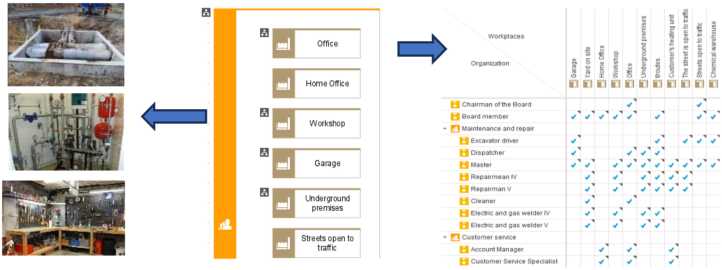
Locations As all OH&S risks are location-based, there is a need to document all the locations or location types where company employees work, along with pho- tos. Often, those locations are related to business process models because companies must do their business continuity risk analyses, and location infor- mation is mandatory. In our case we used ARIS model type “Organizational chart” to document all company-related locations, where their employees are working. To map positions and their workplace locations, the HR import script creates and updates the ARIS model type “matrix model”. From the HR webservice, the position information is taken, and from location clas- sifiers the locations info is presented. The matrix must then be fulfilled by OH&S specialist to map position workplaces (we used object “Location” for that purpose) (see Figure 1).
102 Kangilaski and Kaugerand
Figure 1: Locations and their mapping with positions.
Hazards According to the ISO 45001, the hazard is a source with the potential to cause injury and ill health (ISO, 2018). An OH&S hazard encompasses any aspect of a company’s activities that can have a negative effect on the health or safety of its employees, as well as any contractors or visitors to company facilities. These hazards can manifest in several ways, such as the use of harsh chemicals in the workplace affecting workers’ health, machinery with moving parts posing injury risks to operators, or repetitive actions leading to ergonomic strain issues with employees (Hammar, 2015). Depending on the country and the level of legislation, the main hazard groups with specific hazards are described – e.g. biological, psychosocial, physiological factors, chemical factors, physical, etc. hazards (Estonian Parliament, 2023).
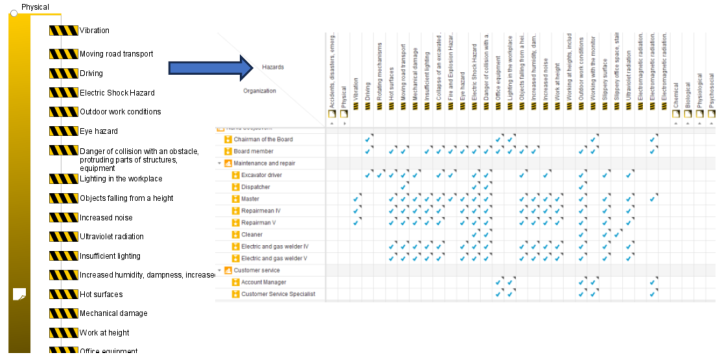
In our case we created a custom symbol called “Hazard group”, which connects via connector “consists of” all identified hazards belonging to that group. During workshops with subject matter experts and location analyses we identified the main hazards and modelled them.
Figure 2: Hazard and position mapping via matrix model.
Occupational Health and Safety Risk Management With Help of ARIS Software – Case Study 103
Our case, we used the model type “Bow tie diagram” to document all hazards that could appear in company workplaces. To map positions and their workplace-related hazards, the HR import script creates and updates the matrix model. From HR webservice, the position information is taken, and from hazard classifiers, the hazard information is presented. Then the matrix must then be fulfilled by OH&S specialist to identify position-related hazards (see Figure 2).
Risk Scenarios To handle OH&S risks, company must relate them to business processes, facilities, and workspaces. It is essential to identify all events where employee could partly or totally lose their capability to work, taking into account the documented hazards. Once this is done, the events that could cause such a risk-event must be analysed. These analyses should continue until the busi- ness risk-events from business risk-event analyses are identified. Sometimes there are several risk-events in the scenario before the business risk-event is determined.
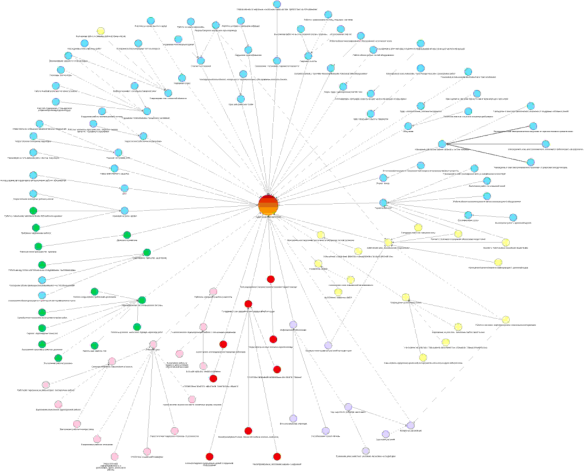
Documenting such scenarios will provide the company valuable systematic overview of all scenarios that could be covered based on company’s struc- tural unit. The central event is the one that states that an employee partly or totally loses their capability to work. All the outer cycle events come from the business risk-event analyses models (see Figure 3).
This model is meant to be used only by the OH&S specialist to analyse the working environment.
Figure 3: Risk events scenarios that lead to employee’s capability not to work.
104 Kangilaski and Kaugerand
To document risk scenarios we used bow-tie diagram and made custom setup to allow to connect two risk event symbols via connections “occurs before”.
Risk Analyses Having identified risk-event scenarios we have developed a script using ARIS scripting options. This script generates a separate bow tie diagram for each three-sequence risk-event object. Consequently, every generated model con- tains three risk-event objects, where the first is displayed as threat, the middle as risk-event and the last one as a consequence. In addition, the risk object is also created and named in the format <threat name>-<risk-event name>-<consequence name>.
Once the models are created, the OH&S specialist along with subject mat- ter experts, will document the threat barriers and recovery controls. Threat barriers are necessary to minimize probability that a threat, using the risk source hazards, will convert into the risk-event. Recovery controls aim to minimize impact that the risk event has on the consequence.
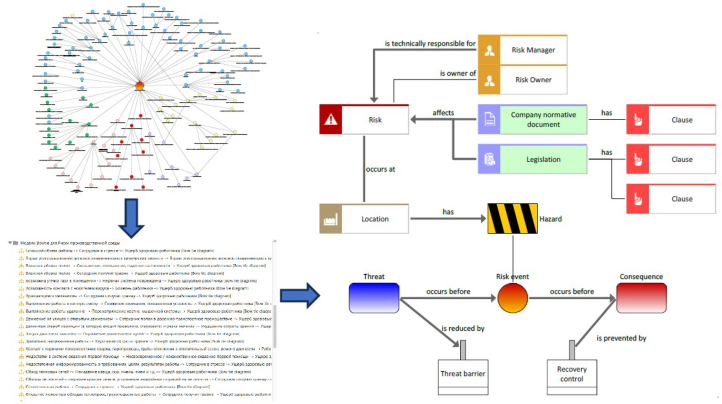
Furthermore, to demonstrate compliance to legislation, the corresponding legislative acts and their corresponding clauses related to the risk are docu- mented. Additionally, we have added the roles of risk owner and risk manager to document risk management responsibilities (see Figure 4).
Figure 4: Generated models and customized bow-tie diagram for risk analyses.
To achieve that result, we customize ARIS standard bow-tie diagram model allowing the diagram to consist of symbol types like:
Clause object – represents legislation clauses or requirements from com- pany normative documents.
Occupational Health and Safety Risk Management With Help of ARIS Software – Case Study 105
Risk – represents the risk object in the model.
Role – represents risk owner, risk manager and other stakeholders inter- ested in identifying and managing risks.
Activity - represents the process, its phase, activity or operation. In the current bow tie diagram this object is considered as risk source.
Location – represents physical location where employee is working.
From ARIS standard bow-tie diagram we used symbol types like:
Hazard – to identify the risk source vulnerability.
Threat – to identify event, that uses risk source vulnerability and could convert it into the risk event.
Risk event – represents unwanted event or opportunity.
Consequence – represents the consequence of a risk event.
Threat barrier – measure, that helps to determine or mitigate the proba- bility that a threat will not convert into the risk event.
Recover control – measure, that helps to minimize the impact of conse- quence, when risk event occurs.
In addition to default set up we added following connector logic (see Table 1):
Table 1. Extended connector logic.
Table available in the original PDF paper.
Description
Source object type
Connector type Target object type Risk to represent who is risk manager Role is owner of Risk to represent who is risk owner Role is technically responsible
affects Risk To represent normative document, that organization must consider related to risk
Risk leads to Role to represent the stakeholders who are interested that risk is identified and managed Legislation affects Risk To represent legislative acts, that organization must consider Company normative document has Clause To identify clause that must be considered Company normative document
Legislation has Clause To identify clause that must be considered Location occurs at Risk To identify location where risk occurs
All those object types are linked together in an Enterprise Architecture management approach, which can be handled with the help of Software AG’s product ARIS (Kangilaski et al., 2022). The threat barriers and recovery con- trols can be used as business process elements, while threats, risk events and consequences can serve as events in process models. Establishing risk inter- connections with processes (via locations or directly), allows organizations demonstrate its compliance with legislative requirements.
106 Kangilaski and Kaugerand
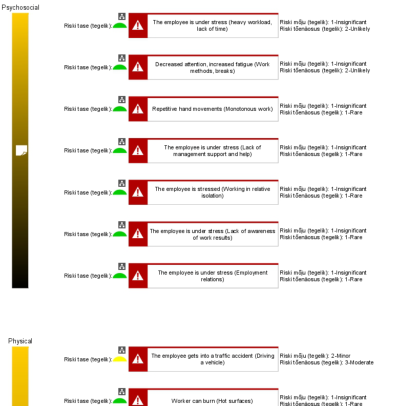
Risk Assessment After performing risk analyses, the position-based risk assessment must be conducted.
This means that based on identified risks, which correspond to position- related hazards and locations, an assessment must be carried out. When an employee spends the entire day in a hazardous environment and a man- ager only few hours, then it is obvious that the corresponding risks for the employee and for the manager are same, but their assessments differ.
To achieve that perspective, we create a script that generates it’s a bow- tie diagram type model for each position. In this model, all position-based risks, corresponding to position locations and determined hazards, are pre- sented (see Figure 5). These risks are grouped based on hazard groups and are assigned to the corresponding risk analyses.
For assessing the risk, the risk object has attributes such as “Risk prob- ability” and “Risk impact”. Then, the OH&S specialist along with subject matter experts can assess the risks for a certain position.
Based on those attribute values, we apply an ARIS script to automatically calculate the “Risk rank” value, which is presented in read-only mode to the end users.
Figure 5: Assessed position based risks.
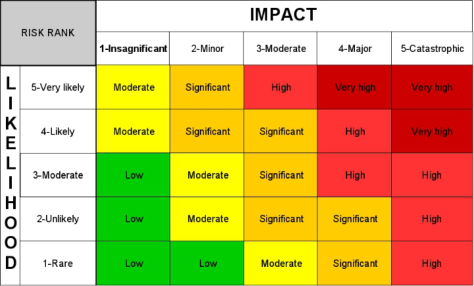
To be able to use our own risk matrix, which corresponds to legislative requirements, we use model type “Quick model”. By using objects such as “Quick object”, we were able to present each risk matrix cell as a separate object with corresponding colour, probability and impact value, which then could be used to identify risk rank, when assessing OH&S risks. These objects visually resemble a matrix (see Figure 6).
Occupational Health and Safety Risk Management With Help of ARIS Software – Case Study 107
Figure 6: Risk rank determination matrix.
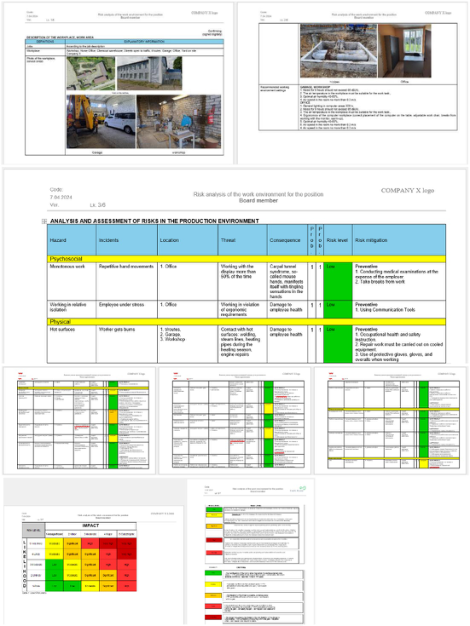
Risk Assessment Document To present risk assessment results to employees, we created a script, which generates an MS Word document containing the following information (see Figure 7).
Figure 7: Sample pages generated for position-based risk assessment.
108 Kangilaski and Kaugerand
Position metainfo.
Position workplaces with pictures and requirements to them.
Description of scales for probability, impact and risk rank.
List of employees who must sign the document in digitally or in the paper.
The same information is also made available for the employees via com- pany’s intranet. From an ARIS perspective, we created a script which gen- erates json type outcome files, which are then embedded via HTM files and iFrames into the intranet solution.
CONCLUSION
The solution introduced in the current article is implemented in two compa- nies that utilize ARIS software and operate in Estonia.
First company operates three oil-shale power plants, chemical indus- try, open- and underground minings, and logistics, has more than 1800 employees and is successfully obtained ISO 45001:2018 certification.
The second company is small district heating company, having 20 employ- ees, also operating in Estonia.
Both companies are satisfied with the proposed solution. By implementing that solution, the workload for companies’ OH&S spe- cialists has been significantly optimized. Contrarily handling OH&S risk assessments solely in paper or Word documents, working with matrix mod- els and generating documents proves to be less labour intensive and more efficient.
REFERENCES
ASG (2023), What is the plan-do-check-act (PDCA) cycle, Website: https://asq.org/quality-resources/pdca-cycle, last accessed 05.11.2023. Estonian Parliament (2023), Occupational Health and Safety Act (01.07.2023), http s://www.riigiteataja.ee/en/eli/506072023004/consolide. Hammar M. (2015), How to identify and classify OH&S hazards, Advisera, May
14, 2015, Website: https://advisera.com/45001academy/blog/2015/05/14/how-to -identify-and-classify-ohs-hazards. ISO (2015), ISO 9001:2015 - Quality management systems — Requirements, (2015). ISO (2018), ISO 45001:2018 - Occupational health and safety management systems.
Requirements with guidance for use, (2018). Kangilaski, T., Pappel, I., Sihvonen, M.; Weck, M. (2022) “Cross-border communication and service provision within silver economy domain: how to sustain a collaborative platform for seniors services”, in Human Factors, Business Man- agement and Society, proceedings of the 13th AHFE International Conference on Human Factors, Business Management and Society, New York, USA, July 24–28, AHFE Open Access, pp. 244–253. Software AG (2023), Transform your business with ARIS, https://aris.com (last
accessed 05.11.2023).
LISTED IN THE AHFE DIGITAL BOOKSTORE CATALOGUE
Explore the complete digital volume
Safety Management and Human Factors
Read this individual research paper free through the original publisher, or explore the full digital proceedings book.
ISBN 978-1-964867-27-4
Explore this ISBN in the AHFE Bookstore ↗Listed in the July 2026 bookstore catalogue; search by ISBN to confirm current availability · Digital book purchase optional