Achim Elfering, Volker Schade, Christian Burger, Lukas Stöcklin (2021). Stochastic Resonance Training at Work Reduces Musculoskeletal Pain in Nurses. In: Advances in Human Aspects of Healthcare. AHFE Open Access, vol. 13. https://doi.org/10.54941/ahfe100510
This randomized controlled trial (RCT) reports effects of a preventive intervention at worksite, namely stochastic resonance whole-body vibration (SR-WBV) training on musculoskeletal pain (MSP). SR-WBV is a form of whole-body vibration training with randomized low frequency vibration. The force-time behavior of the vibrations is not foreseeable and the body will be constantly challenged to adapt the muscle reactions. The experimental group (EG) performed an eight-week of SR-WBV. The control group (CG) received no intervention. The RCT was conducted in a large Swiss hospital. The 180 participants were between 18 and 63 years old (M = 43; SD = 11). The majority were female (88%) and were nurses (45%). MSP was measured daily in a diary. Participation possibilities and general health were assessed by self-report questionnaires before the RCT started. A longitudinal multilevel analysis showed a significant interaction of SR-WBV by time showed MSP to decline in the EG. Moreover, SWBV-training reduced pain to the largest extent in those with lowest participation possibilities and those who reported only moderate general health. Thus, SR-WBV was most effective in those reporting risk factors for musculoskeletal pain. SR-WBV may help to reduce the high prevalence of occupational musculoskeletal pain in hospital staff.
Musculoskeletal disorders (MSD: neck, shoulder and/or lower back pain) have become a growing individual and societal health problem in western industrialized countries and belong to the most serious pain problems of our time (Elfering & Mannion, 2008; Schneider, Lipinski & Schiltenwolf, 2006). In Switzerland, musculoskeletal disorders are reported to be the most frequent cause for impairment of health (Läubli & Müller, 2009) and represent prevalent reasons for decreased work performance and disability (Wieser et al., 2010). According to the Swiss Household Panel, 44% of employees suffer from MSD (Knecht & Hämmig, 2008) and lifetime prevalence has been estimated around 80% (Schneider et al., 2006). There are also substantial cost implications which are reported to be about 1% of the gross national product of a European country and about 85% are caused through indirect costs as lost productivity due to absenteeism and, of even greater importance, presenteeism (reduced productivity of employees who are working despite illness) (Kohlmann, 2003; Wieser et al., 2010).
Previous evidence suggests that physical strengthening exercises can be beneficial for prevention and treatment of musculoskeletal disorders (Podniece, 2008). Bigos et al. (2009) even inferred from their review, that only physical exercises were an effective intervention to prevent back pain compared to other interventions such as ergonomic/back education alone, stress management, lumbar supports or shoe inserts. However, there is still a lack of convincing evidence that any particular type of exercise is more effective than another in the treatment of low back pain (Airaksinen et. al., 2006; Burton et. al., 2006; Van Tulder, Malmivaara, Esmail & Koes, 2000).
STOCHASTIC RESONANCE WHOLE-BODY VIBRATION (SR-WBV) How SR-WBV works
Stochastic resonance is a phenomenon in nonlinear dynamic systems (as for example nervous systems), which is characterized by three conditions: 1. a kind of threshold; 2. a weak or low-threshold input and 3. a source of random and/or stochastic noise (Gammatoni, Hänggi, Jung & Marchesoni, 1998). Stochastic resonance vibrations are oscillations which are not predictable by the human body. They constantly figure new conditions of irritation which causes adaptations of muscle stiffness to fit to the muscular activation state. Because of the constantly changing conditions, the human body can’t adapt to it and habitual effects can be avoided (Haas et al., 2004).
SR-WBV at worksite As one of the first Burger et al. (2012) investigated the effectiveness of SR-WBV-training on prevention of musculoskeletal symptoms in their study. Employees of a metal manufacturing company completed a four-week long SWBV-training, exercising three times a week. Results indicated that SR-WBV-training was effective as a preventive method for reducing MSD and related function limitations and increasing musculoskeletal well-being at the end of the training period. Elfering et al. (2013) replicated the findings in four-week long SR-WBV-training in white-collar employees also showing improvement in balance control. There is, however, until now no RCT reported on worksite SR-WBV. Moreover, this RCT firstly tests SR-WBV to be most helpful in those with risk factors for chronic musculoskeletal impairment, i.e. those with low participation possibilities (Elfering et al., 2010) and those who report only moderate general health.
METHODS
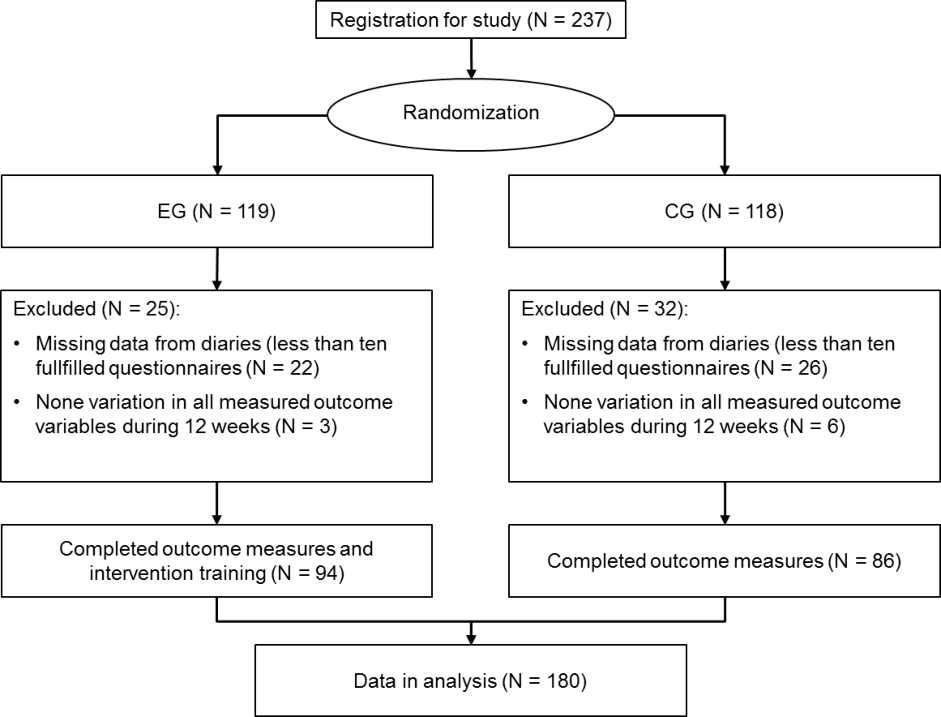
Sample In December 2009, the hospital employed 7255 persons, 75% women and 25% men. Every employee was informed about the study by a notice which they received with their monthly paycheck. All of them were allowed to take part as long as they did not meet in anamnestic interview any of the exclusion criteria which were: acute, past or chronic arthropathologies, troubles in the cardiovascular system, psychopathology, spondylolysis, spondylolisthesis, tumors, prolapse with neurological failure, rheumatism, articular gout, osteoporosis, activated arthrosis with inflammatory signs, stage 4 arthrosis, postural sway or being pregnant. 237 employees volunteered to participate in the study. An independent research assistant accomplished the randomization procedure where participants randomly assigned to the experimental group (with SR-WBV, n = 119) and the CG (no intervention, n = 118) using an online random number generator (www.random.org). Of those 237 persons, 48 persons dropped out because of incomplete fulfillment of the diaries (less than ten times out of a maximum of 82 diaries in 12 weeks), 9 people were excluded due to none variation in outcome variables during the twelve week registration phase. The dropout rate was in total 24% with similar rates for the EG (21%) and CG (27%). For a more detailed description of the sample selection process see the sample flow chart in Figure 1. The participants were between 18 and 63 years old (M = 43; SD = 11) and the majority of the remaining 180 subjects were female (88%). The average BMI was 24.1 (SD = 4.5) and 12% were smokers. Most of them worked as nurses (45%), but there were also subjects from different fields, such as laboratory technicians (18%), administrative staff (18%), physicians (3%), tradespeople and technical staff (2%) and other fields (14%) (e.g. psychologists). 38% were full-time employees (~42 hrs / week), 3% worked less than 50%. They have been working in the actual job position for 7.4 years (SD=7.2). The study was performed in consensus with recommendations outlined by the Declaration of Helsinki (2008) and with all requirements defined by the
Swiss Society of Psychology. The study has been approved by the Ethics Committee of the University of Bern, Bern, Switzerland (2009-04-0006).
Figure 1. Flow of study participants Note: EG = experimental group with SR-WBV, CG = control group without intervention
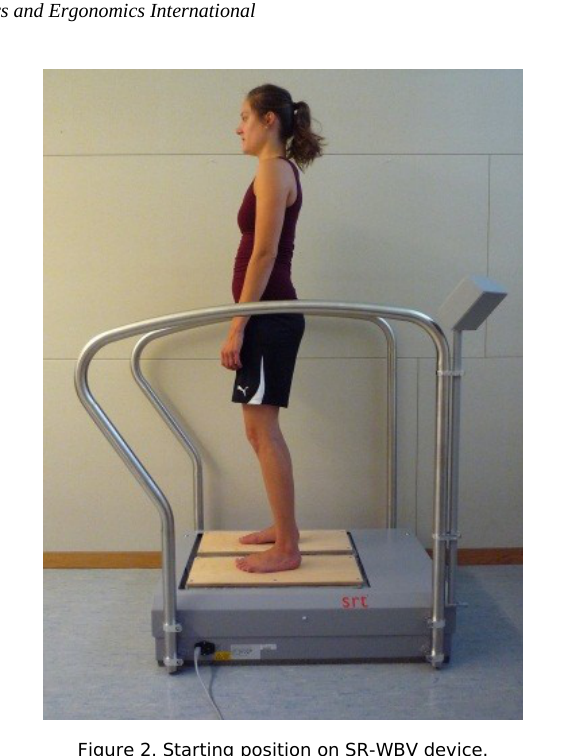
Intervention For SR-WBV, three Zeptor devices were used (SR Therapiesysteme GmbH & Co. Lifescience KG, Berlin). The main features were two independently and one-dimensional (up/down) stochastically vibrating footboards. The apparatus could produce vibrations at a frequency between 1.0 and 12.0 Hertz (Hz) with amplitude of 3 mm. Participants were instructed to stand on the footboard with loose-hanging arms at their sides and slightly bent knees (Figure 2). The first session began with training at a low vibration frequency (3 Hz). After that, they could increase the vibration frequency slowly to the level that they felt comfortable with, depending on their physical fitness. The study strived for a frequency between five to eight Hertz. All training sessions were supervised to make sure that the participants trained at a suitable frequency. If the vibration frequency was too high for the performing participant, the equipment started to make a knocking noise because of the person’s inability to coordinate and to follow the footboard moves. This knocking noise marked the individual's maximum frequency limit (Herren et al. 2009). The training was based on applying whole-body vibration in three to five series lasting one minute with a one-minute break in between (Madou & Cronin, 2008). Participants must not perform more than five series or longer than a minute in order to avoid an exhaustion of their nervous system (Haas, 2008).
Figure 2. Starting position on SR-WBV device.
Procedure In December 2009, employees of a large Swiss hospital were informed about the SR-WBV-training and their chance to take part in it. The SR-WBV-training was presented as a sport program to get ready for skiing. The workers could volunteer for training on a registration form, in which they could specify their favored time to perform exercises. According to this information, a training schedule was planned and opening times were defined. The participants had the possibility to exercise from Monday to Friday from 7 to 9 am, 12 to 1:30 pm and 4 to 7 pm. The exercises could be practiced in two places of the hospital area and subjects could freely choose on which equipment they wanted to exercise.
Measures This study used the same daily questionnaire as Burger et al. (2012) used in his trial which was based on items of the Chronic Pain Grade questionnaire (CPG) (Von Korff, Ormel, Keefe & Dworkin, 1992), with adjustments for time specification. The question on daily MSP was introduced by: “Throughout the day, how do you rate your personal sensation in muscles and joints (back pain, shoulder and neck pain, pain in leg muscles etc.)?” followed by “Pain in muscles and joints” and the corresponding ten point rating scale from “no pain” to “strongest imaginable pain”. The participants of both groups were asked to complete all six items every day, also on Saturdays and Sundays. The diaries could be filled in online, but there was also a hard copy of the diary available on request. These completed diaries, in paper form, were collected and distributed weekly during training time. At the beginning and end of the training period, the subjects completed a broad questionnaire to assess other possible influencing variables in their work environment. To measure participation possibilities at work participants before training were asked to comment on how much they felt they were involved in decision-making at work. The participants made a graded response ranging from ‘concerning decisions made at work ... I had no influence’ [1], ‘I only was informed’ [2], to ‘I could make suggestions’ [3], ‘I took part in decision-making’ [4] and ‘I had considerable influence on decision-making’ [5].
The question on participation was from the Instrument for Stress Oriented Task Analysis (Semmer, Zapf, & Dunckel, 1995) and was shown to be linked to occupational back pain (Elfering et al., 2010). General health was assessed with the item "How is your health in general?” (Simon, De Boer, et al., 2005). The single question ‘How is your health in general?’ is a widely used simple measure, as it is proved to be a powerful predictor for mortality; poor self-assessed health increases the mortality risk, even when other (more objective) indicators of health status have been controlled for (Idler & Benyamini, 1997). In this study the question was framed to the last four weeks “How would you rate your general health in last 4 weeks?“ with 5 response options (1 very poor – 5 very good).
Analyses The RCT included an experimental group (EG), performing an eight-week of SR-WBV, and a control group (CG), receiving no intervention. MSP was measured daily in a diary. Participation possibilities and general health were assessed by self-report questionnaires before the RCT started. A longitudinal multilevel analysis was used for data analyses. Especially due to the fact that missing data occurred primarily in the CG within the first four weeks of training, only the last four weeks of training were included into the data analysis and the time was centered at the endpoint which meant that the time range went from -28 (first day) to 0 (last day of training) and the intercept represented the outcome status at the end of the training duration. A random-intercept model was used, because the scope of study was on the effect of the training; and data collection was equal for all participants of the sample. According to this, the predictors training day (1-28), group of RCT effect and the interaction training day * group of RCT were set as fixed effects. The intercept was set as a random effect on both levels, because it was anticipated that there would be differences between participants and within a participant over last 28 days of training. The basic model was represented by following equation:
Daily musculoskeletal painij = β0ijconstant + β1ijtraining day + β2ijgroup(RCT) + β3ijgroup*training day β0ij = β0 + u0j + e0ij
The residual u represents the variance between the participants and the residual e the variance between the days. The subscript i indicates the level 1 (day) and j the level 2 (participant). General health and participation at work were tested as three-way-interactions with RCT groups and training day. Multilevel regression analyses were done with MLwiN software version 1.10 (Rasbash et al., 2000). The level of significance was p < .05 (two tailed). Although the relation between musculoskeletal disorders and body mass index (BMI) (measured as kilograms of body weight divided by height squared) still has to be clarified (Leboeuf-Yde, 2000), literature repeatedly linked body weight to musculoskeletal disorders (Deyo & Bass, 1989). Therefore, we controlled on our analysis for age, sex and BMI of the subjects.
RESULTS
A check of randomization showed the EG and CG did not differ significantly pertaining to demographic data as sex (p = .65), age (p = .08), body mass index (p = 0.27), smoking (p = .34), occupation (p = .19), employment status (p = .60) or having children (p = .39). No differences in musculoskeletal pain on first day of training were shown, too (p = .09). In multilevel regression of musculoskeletal pain on RCT group and training day the expected interaction was significant (Table 1). Participants performed on average 16 training sessions (SD = 5, min. = 2 sessions, max = 28 sessions). The practiced exercises showed an average frequency of 6.3 Hz (SD = 1.2, min = 1 Hz, max = 9 Hz, median = 6.2 Hz) and they completed on average 3.88 series of SR-WBV per session (SD = .87, median = 4). Overall, the SWBV-training was completed without any complications or side effects, with only a few exceptions. Two participants had to quit the training due to back pain, but these conditions already existed prior to the training. A few participants reported light nausea or dizziness immediately after their first SR-WBV session but no other side effects occurred during the subsequent sessions.
Table 1: Multilevel regression of daily musculoskeletal pain on RCT group and training day
Table available in the original PDF paper.
Musculoskeletal pain Fixed parameter estimates SE
Age -0.001 0.0 07 Sex 0.125 0.2 56
Body mass index 0.013 0.0 17 RCT group (EG vs, CG) 0.294 0.1 67
Training day 0.004 0.0 03 RCT group * training day -0.011** 0.0 04
Intercept 1.971 0.1 21 Variance between persons 0.860*** 0.1 04
Variance between days 0.830*** 0.0 20 2*loglikelihood(IGLS Deviance) = 10058.55, 3613 diary ratings from 180 participants
Note: Fixed parameter estimates = unstandardized multilevel regression coefficients; SE = standard error; significance levels were calculated by t-values (fixed parameter estimate/SE) with j-p-1 degrees of freedom, where j is the number of units on level 2 and p is the number of explanatory variables. EG = 1, CG = 0. IGLS = Iterative Generalized Least Squares. ***p<.001 ; **p<.01 ; *p<.05, two- sided.
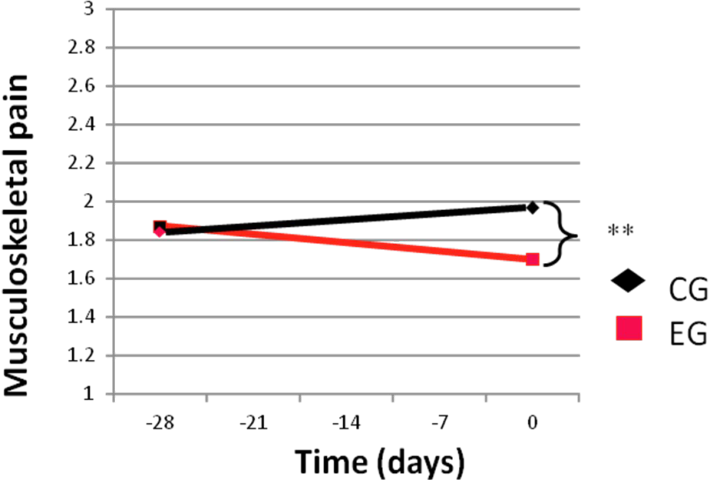
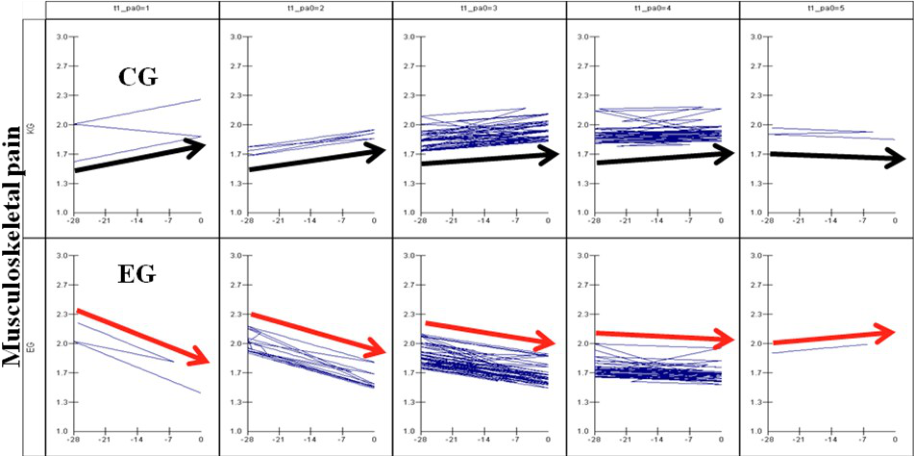
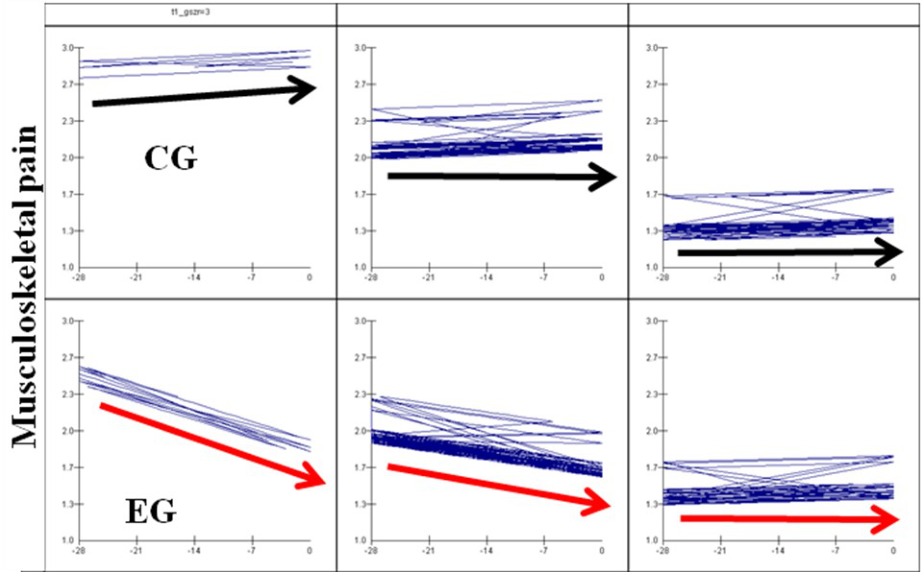
Figure 3 shows musculoskeletal pain to decrease linearly only in the EGEG. A lack of participation at work can be considered a risk factor for musculoskeletal pain. Thus, SR-WBV was expected to reduce musculoskeletal pain most in those participants who report lower participation possibilities than others. The test of the three-way-interaction between participation at work, RCT-group, and training day showed a significant regression estimate (p < .05). As expected reported musculoskeletal pain levels were higher in those with low participation possibilities at work. While there was no change of musculoskeletal pain across training days in the control group, SR-WBV training in the EG showed a decrease of musculoskeletal pain across training days that was steepest for those with smallest participation possibilities (Figure 4).
Figure 3. Daily musculoskeletal pain by RCT group across training daysFigure 4. Individual regression slopes of daily musculoskeletal pain by RCT-group (upper row: CG without intervention; lower row: EG with SR-WBV) and participation possibilities at work across training days. Arrows show the mean slope tendency.
SR-WBV was also expected to reduce musculoskeletal pain most in those participants who report only moderate or low general health compared to those who report good or very good general health. Responses to the question “How would you rate your general health in last 4 weeks?“ (1 very poor – 5 very good) showed no participants reporting very poor or poor health. The test of the three-way-interaction between self-reported general health, RCT-group, and training day showed a significant regression estimate (p < .05). As expected reported musculoskeletal pain levels were higher in those with only moderate reported general health. Again, there was no change of musculoskeletal pain across training days in the CG, while SR-WBV training showed a decrease of musculoskeletal pain across training days that was steepest for those with moderate general health (Figure 5).
DISCUSSION
After 8 weeks of SR-WBV, participants showed significantly less musculoskeletal pain compared to a CG which received no training. This result is consistent with several previous findings of MSP improvement after SR-WBV at worksite (Burger et al., 2012; Elfering et al., 2013). However, this is the first RCT study examining healthy nurses at work to find effects of SR-WBV on MSP. Thus, SR-WBV can be suggested as benefitial in prevention of occupational musculoskeletal complaints in health care. SR-WBV effects on muculoskeletal pain, however, also deserved a deeper analysis that tested whether SR-WBV was more clearly linked to reduced pain in those who reported a lack of participation possibilities. The results confirm the expectation that participation may help prevent employees suffering from musculoskeletal pain. Employees should participate in work issues, not only to maintain performance levels and work satisfaction but also to prevent musculoskeletal pain. Against the background of decreasing job ressources like time control or participation possibilities for many nurses (Semmer et al., 2005) this study highlights the role of participation in health care — also known as participatory ergonomics (Wilson, 2001) — as a way of increasing resilience and preventing occupational MSP (Rolli-Salathé et al., 2012 ; Rolli-Salathé & Elfering, 2013). The acute effects of SR-WBV include enhanced muscle activity in trapezius muscle, and proxies of microperfusion of the skin (blood flow, temperature and redness) that are accompagnied by feelings of increased muscle relaxation after SR-WBV (Elfering et al., 2013). The acute positive effects that improve or maintain one or more components of physical fitness could be especially beneficial in participants with only moderate general health given that a lack of physical fitness is often connected with health impairments. SR-WBV effects were also more expressed in those who reported only moderate general health compared to those who reported good or very good general health. Thus, SR-WBV – especially in those with moderate general health - increased physical resources and therefore the capacity to maintain and increase musculoskeletal well-being despite facing adverse and stressful situations at work.
“Moderate” general health “Good” general health “Very good” general health
Figure 5. Individual regression slopes of daily musculoskeletal pain by RCT-group (upper row: CG without interventioin; lower row: EG with SR-WBV) and self-reported general health across training days. Arrows show the mean slope tendency.
The limitations of this RCT are typical for intense worksite training studies. The dropout rate was larger than desirable but typical for large, long-lasting worksite training programmes involving physical activity (Robroek, van Lenthe, van Empelen, & Burdorf, 2009). The participation rate was also low and we cannot exclude bias here (Robroek et al., 2009). Another limitation of the present RCT is the absence of a placebo intervention. Such a second CG was initially planned but had to be omitted because of the low participation rate. With regard to generalizability, the fact that a variety of professions and age groups were examined is a strength of this study. On the other hand, the sample was selected from only one hospital and included comparably few males.
CONCLUSIONS
To the knowledge of the authors, it was the first RCT examining SR-WBV in health care employees. The RCT indicates that SR-WBV may help to reduce musculoskeletal pain especially in those who suffer from MSP or other health problems. SR-WBV during work may help to prevent occupational LBP in health care.
ACKNOWLEDGEMENT
The research reported in this article was supported by a grant from the Swiss National Accident Insurance Fund (SUVA, Project 100163).
CONFLICT OF INTEREST The authors declare no conflict of interest.
REFERENCES
Airaksinen, O., Brox, J. I., Cedraschi, C., Hildebrandt, J., Klaber-Moffett, J., Kovacs, F., Mannion, A. F., Reis, S., Staal, J. B., Ursin, H. & Zanoli, G. (2006).European guidelines for the management of chronic nonspecific low back pain. European Spine Journal, 15, 192-300. Bigos, Stanley J., Holland, John, Holland, Carole, Webster, John S., Battie, Michele & Malmgren, Judith A. (2009). High-quality
controlled trials on preventing episodes of back problems: systematic literature review in working-age adults. The Spine Journal, 9, 147-168. Burger, C., Schade, V., Lindner, C., Radlinger, L., & Elfering, A. (2012). Stochastic resonance training reduces musculoskeletal symptoms in metal manufacturing workers: A controlled preventive intervention study. WORK, 42, 269-78. Burton, A. K., Balagué, F., Cardon, G., Eriksen, H. R., Henrotin, Y., Lahad, A., Müller, G. & van der Beek, A. J. (2006).
European guidelines for prevention in low back pain. European Spine Journal, 15, 136-168. Deyo, R. A. & Bass, J. E. (1989). Lifestyle and Low-Back Pain: The influence of smoking and obesity. Spine, 14, 507-510. Elfering, A., & Mannion, A. F. (2008). Epidemiology and risk factors of spinal disorders. In N. Boos & M. Aebi (Eds.), Spinal disorders – Fundamentals of diagnosis and treatment (pp. 153-173). Berlin: Springer. Elfering, A., Arnold, S., Schade, V., Burger, C., & Radlinger, L. (2013). Stochastic resonance whole-body vibration,
musculoskeletal symptoms and body balance: A worksite training study. Safety and Health at Work, 4, 149-155. Elfering, A., Dubi, M., & Semmer, N. K. (2010). Participation during major technological change and back pain. Industrial Health, 48, 370-375. Elfering, A., Thomann, J., Schade, V., & Radlinger, L. (2011). Stochastic resonance whole body vibration reduces
musculoskeletal pain: A randomized controlled trial. World Journal of Orthopedics, 2, 116-120. Elfering, A., Zahno, J., Taeymans, J., Blasimann, A., & Radlinger, L. (2013). Acute effects of stochastic resonance whole body vibration. World Journal of Orthopedics, 4, 291-298. Gammatoni, L., Hänggi, P., Jung, P. & Marchesoni, F. (1998). Stochastic resonance. Reviews of modern physics, 70, 223-287. Haas, C. T. (2008, October). Vibratory stimulation and stochastic resonance therapy: results from studies in Parkinson’s disease
and spinal cord injury. Paper represented at the Technologies of Globalization Congress, Darmstadt, Germany. Haas, C. T., Turbanski, S., Schwed, M., & Schmidtbleicher D. (2004). Biomechanische und physiologische Effekte mechanischer Schwingungsreize beim Menschen. Deutsche Zeitschrift für Sportmedizin, 55, 34-43. Herren, K., Holz Hängärtner, C., Oberli, A. & Radlinger, L. (2009).Cardiovascular and metabolic strain during stochastic
resonance therapy in stroke patients. Physioscience, 5, 13–17. Idler, E. L., & Benyamini, Y. (1997). Self-rated health and mortality: A review of twenty-seven community studies Journal of Health and Social Behavior, 38, pp. 21-37. Knecht, M. & Hämmig, O. (2008). Mangelnde Work-Life Balance und Rückenschmerzen. Ausgewählte Ergebnisse einer
grossangelegten Betriebsumfrage. Retrieved February 2014 from: http://www.news.admin.ch/NSBSubscriber/message/attachments/16740.pdf Kohlmann, T. (2003). Die Chronifizierung von Rückenschmerzen. Ergebnisse eines internationalen WHO-Workshops.
Bundesgesundheitsblatt - Gesundheitsforschung -Gesundheitsschutz, 46, 327–335. Läubli, T. & Müller, C. (2009). Arbeitsbedingungen und Erkrankungen des Bewegungsapparates – geschätzte Fallzahlen und Kosten für die Schweiz. Die Volkswirtschaft. Das Magazin für Wirtschaftspolitik, 11, 22-25. Leboeuf-Yde, Ch. (2000). A systematic literature review of 56 journal articles reporting on 65 epidemiologic studies. Spine, 25,
226-237. Madou, K. H. & Cronin, J. B. (2008). The effects of whole body vibration on physical and physiological capability in special populations. Hong Kong physiotherapy Journal, 26, 24–38. Podniece, Z. (2008). Work-related musculoskeletal disorders: prevention report. European Agency for
Safety and Health at Work. Retrieved February 2014 from: https://osha.europa.eu/en/publications/reports/en_TE8107132ENC.pdf Rasbash, J., Browne, W., Goldstein, H., Yang, M., Plewis, I., Healy, M., … Lewis, T. (2000). A user’s guide to MLwiN. London: Multilevel Models Project, Institute of Education, University of London. Robroek, S. J. W., van Lenthe, F. J., van Empelen, P., & Burdorf, A. (2009). Determinants of participation in worksite health
promotion programmes: a systematic review. International Journal of Behavioral Nutrition and Physical Activity, 6, 26. Rolli Salathé, C., & Elfering, A. (2013). A health-and resource-oriented perspective on nonspecific lower back pain in working individuals. ISRN Pain, 2013, 1-19. Rolli Salathé, C., Kälin, W., Semmer, N. K., Roth, M., Müller, U., Melloh, M., Elfering, A. (2013). Comparison of a pain - resilient
group of working individuals to population – based Case Controls with and without acute Low Back Pain. European Pain Journal, 7, 1411–1421. Rolli Salathé, C., Melloh, M., Mannion, A. F., Tamcan, Ö., Boos, N., Mueller, U., & Elfering, A. (2012). Resources for preventing sickness absence due to Low Back Pain. Occupational Medicine, 62, 273–280. Schneider, S., Lipinski, S. & Schiltenwolf, M. (2006). Occupations associated with a high risk of self-reported back pain:
representative outcomes of a back pain prevalence study in the Federal Republic of Germany. European Spine Journal, 15, 821-833. Semmer, N. K., Grebner, S. & Elfering, A. (2010). „Psychische Kosten“ von Arbeit: Beanspruchung und Erholung, Leistung und Gesundheit. [The “psychological costs” of work: Workload, recovery, performance, and health.] In U. Kleinbeck & K.-H. Schmidt (Hrsg.), Arbeitspsychologie. (Enzyklopädie der Psychologie, Bd. D-III-1, S. 325-370). Göttingen: Hogrefe. Semmer, N. K., Zapf, D., & Dunckel, H. (1995). Assessing stress at work: A framework and an instrument. In O. Svane & C.
Johansen (Eds.), Work and health - scientific basis of progress in the working environment (pp. 105-113). Luxembourg: Office for Official Publications of the European Communities. Simon, J. G., J. B. & De Boer, et al. (2005). "How is your health in general? A qualitative study on self-assessed health." The European Journal of Public Health, 15, 200-208. Van Tulder, M., Malmivaara, A., Esmail, R., & Koes, B. (2000). Exercise therapy for low back pain. Spine, 25, 2784-2796. Von Korff, M., Ormel, J., Keefe, F. J. & Dworkin, S. F. (1992) Grading the severity of chronic pain. Pain, 50, 133-149. Wieser, S., Horisberger, B., Schmidhauser, S., Eisenring, C., Brügger, U., Ruckstuhl, A., Dietrich, J., Mannion, A., Elfering, A.,
Tamcan, Ö., & Müller, U. (2011). Cost of Low Back Pain in Switzerland in 2005. European Journal of Health Economics, 12, 455-467. Wilson, J. R. (2001). Ergonomics and participation. In J. R. Wilson & E. N. Corlett (Eds.), Evaluation of human work: a practical ergonomics methodology, (pp. 1071–1096). Bristol, UK : Taylor & Francis.
LISTED IN THE AHFE DIGITAL BOOKSTORE CATALOGUE
Explore the complete digital volume
Advances in Human Aspects of Healthcare
Read this individual research paper free through the original publisher, or explore the full digital proceedings book.
ISBN 978-1-4951-2093-0
Explore this ISBN in the AHFE Bookstore ↗Listed in the July 2026 bookstore catalogue; search by ISBN to confirm current availability · Digital book purchase optional