Hanneke JJ Knibbea, Nico E. Knibbea, A. Klaassenb (2021). Prevention of Pressure Ulcers: Exploring the Influence of Nurses, Equipment and Working Techniques. In: Advances in Human Aspects of Healthcare. AHFE Open Access, vol. 13. https://doi.org/10.54941/ahfe100474
Patient immobility remains to be one of the primary causes of pressure ulcers. In spite of the evidence supporting this, it still is a daily challenge to increase or at least stabilize patient mobility. In the process of activating and mobilizing patients the type of equipment and the working technique of nurses is crucial for success. At the same time these aspects are also crucial for the protection of nurses’ backs. Repositioning in bed is rated as one of the most physically demanding transfers for nurses. From an occupational health perspective these techniques have been designed in order to protect nurses backs, shoulders and arms. The bed itself, the type of mattress, but also transfer aids like lifters and sliding sheets influence the risk profile for both the patient (pressure ulcers and others) and the nurses (occupational health problems). Force- and pressure-measurements indicate that, in order to get the maximum primary or secondary preventive effect out of the equipment, the working technique of nurses plays an important part. An analysis was made of the three most common repositioning techniques. Measurements (MecMesin and X-Sensor) and calculations (3D SSPP 6.0) demonstrate that small differences in technique result in large differences in pressure distribution, contact-area, the risk of shear forces under the patient’s skin and the biomechanical load for the nurses. The conclusions drawn from these findings are partly contradictory when it comes to practical recommendations for the nurses. Even during the process of frequent repositioning, a procedure intended to reduce the risk of developing pressure ulcers, some of techniques currently taught in regular nursing training may be safe for the nurses to perform from an occupational health perspective, but in fact also result in an increase in risk for the patient instead of the intended decrease. In this study a cross-over is made between the field of biomechanics and ergonomics and the clinical research on the prevention and treatment of pressure ulcers. Such a cross-over, so far, although still in a developmental stage, seems to be relevant for daily practice and has led to a currently on-going process of re-design of transfer techniques.
One of the primary causes of pressure ulcers a very classical one: immobility. In spite of the evidence supporting this, it still is a daily challenge to increase or at least stabilize patient mobility. There is a multitude of options to promote patient mobility ranging from equipment to simple daily aspects of nurse-patient communication. But in the process of activating and mobilizing patients the type of equipment used is crucial for success. The bed itself, the type of mattress, but also transfer aids like lifters and sliding sheets are of influence. For prevention of pressure ulcers frequent (at least every 2-4 hours) repositioning is recommended in international guidelines for treatment and prevention of pressure ulcers (EPUAP, 2009). In these clinical guidelines lifting the patient and avoiding sliding the patient is recommended. Recent research suggests that tissue damage (especially the so-called ‘deformation change’) can occur very quickly and within minutes (Oomens et al., 2013).
For nurses these transfer techniques that actually involve lifting the patient free of the mattress are physically demanding and compliance with their use is limited. In addition to this there is no consensus as to the techniques and/or equipment that is best for doing this. There is, on the other hand, the ISO/TR 12296 stating that for the prevention of occupational back pain lifting in excess of 25 kg. should be avoided, f.e. by means of the use of lifting equipment and/or sliding sheets (Hignett et al., 2014).
This means that on one hand it is stated that lifting is recommended to reduce the risk of pressure ulcers, whereas from an ergonomic point of view lifting should be avoided and sliding is recommended to prevent occupational back pain in nurses. This can be seen as a very undesirable contradiction.
There is a lack of research into the optimum for both the patient (prevention of pressure ulcers) and for the nurses (ergonomic analyses). There are isolated studies in either field, but so far, to our knowledge no attempt has been made to combine both areas and take the step towards combined practical recommendations that nurse can follow. This study was an attempt to gain more insight into the most common lifting and repositioning techniques and equipment from two perspectives: the prevention of pressure ulcers and the occupational health of nurses. We performed a first analyses of the techniques and equipment and will present the results.
METHOD
Measuring the risks for pressure ulcers and physical overload We have analyzed the forces and pressure (distribution) occurring during three specified and commonly practiced transfers and repositioning activities with and without the use of equipment like powered beds and sliding sheets. Measurements were performed real time with force gauges (MecMesin) and the X-Sensor pressure mapping system and –software. All techniques were simultaneously recorded on film. Finally data were analyzed with the use of the 3D SSPP biomechanical model and SPSS 20.0.
The transfer and repositioning techniques studied were taken from a commonly used consensus manual: the Handbook of Transfers that is published in several languages and is in line with the Dutch guidelines and standards (Knibbe et al., 2000-2010).
The equipment used was a standardized hospital bed (multiple adjustable (4 parts) and powered), lifting equipment and sliding sheets. This is all in line with the requirements of the Dutch Guidelines for Practice (see for an English summary ISO/TR 2012) and therefore considered to be stat of the art for our country. The persons performing the techniques were very experienced and professional trainers who are considered to be skilled in performing the techniques. The patient was a standardized passive woman playing the part of the patient (1.68 m, 64 kg).
RESULTS
Our measurements and calculations on the three techniques demonstrate that small differences in technique result in large differences in pressure distribution, contact-area and the potential risk of shear forces for the patient and in (shear) back load for the nurse. Full findings will be presented at the conference. Even during the process of frequent repositioning, a procedure intended to reduce the risk of developing pressure ulcers, some techniques result in an increase in risk for pressure ulcer development instead of the intended decrease.
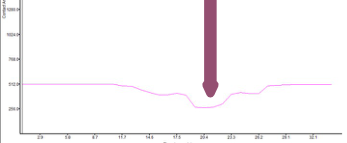
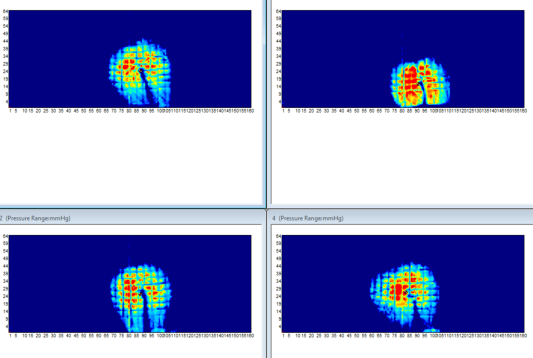
Figure 1. Undesired reduction of contact area during one of the transfersFigure 2. Differences in contact area and (associated) pressure (red is pressure in excess of recommended values) during the transfer from a supine to sitting on the side of the bed
CONCLUSIONS
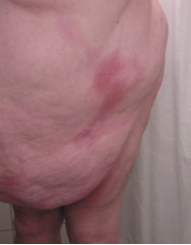
When modelling the effect on the patients’ tissue it becomes clear that with some techniques, the shear, tissue deforming forces within the patients’ body are large and can result in direct damage. For example when moving a patient sideways on top of a low friction sliding sheet, the forces for the nurse are acceptable from an ergonomic point of view. For the patient it means that the slack within his body is taken up layer by layer until he completely moves. This means that all layers (skin, subcutaneous layers, muscle etc.) are stretched to the maximum before the next layer will start to move. This can result in direct damage to the tissue as is sometimes reported in bariatric patients (see photo).
Figure 3. Example of skin damage following a transfer (Knibbe, 2014, reprint with permission of Huijbregts)
If after this procedure, the patient remains in this position, without a moment of off-loading the damage may increase further as perfusion and reperfusion may be endangered within minutes (Oomens et al., 2013). It goes without saying that this damage will occur more readily in elderly patients with multiple health problems who are at risk for developing pressure ulcers already.
In this research a cross-over is made between the field of biomechanics and ergonomics and the clinical research on the prevention and treatment of pressure ulcers. Such a cross-over so far seems to be relevant for daily practice, but it is also evident that there is a lot to be discovered in this field.
On some points a thorough redesign of techniques and equipment may be required. F.e. from an ergonomic perspective it is often recommended to push or pull instead of lifting. From a pressure ulcer prevention perspective the recommendation is the other way around: a preference for lifting instead of pushing or pulling. Practical recommendations for the redesign of techniques and equipment are made with this apparent contradiction in mind and with the intention to achieve both: the best care for the patient at risk for pressure ulcers and the optimum protection of nurses’ health. A few examples of combining the study outcome into practical recommendations are: Area enlargement
Offloading (opportunity for re-perfusion and re-alignment of tissue layers) after each transfer
Slow and gradual movements
Adding additional layers and leaving them under the patient like ordinary bedlinen
In this study we have taken a first step out of our ‘ergonomic comfort zone’ and found there are more and perhaps more important factors to take into account when choosing an optimum technique for patient and nurses. Besides the working technique of nurses the patients’ clothes and the use of incontinence pads can be of influence as well as are the size and dimensions of the patient (f.e. bariatric patients). The importance of these factors will depend on the level of functional mobility of the patient and his or her risk profile when it comes to developing pressure ulcers. It is evident that this type of research may point to evident gaps in our knowledge and contradictions in our training programs for nurses. In our view it is relevant to proceed in this direction and perform more in depth studies into this combined area and, depending on the results, make an attempt to integrate the currently apparently contradictory guidelines for clinical practice for patient and occupational health for nurses. After all, in our experience, when forced to make a choice between the patients’ health and their own health, nurses have the tendency to choose for the patient side. Research must take up the challenge to provide answers that will enable the option of protecting both patients and nurses.
REFERENCES
European Pressure Ulcer Advisory Panel and National Pressure Ulcer Advisory Panel (2009). Prevention and treatment of pressure ulcers: quick reference guide. Washington DC: National Pressure Ulcer Advisory Panel: .http://www.epuap.org/guidelines/Final_Quick_Prevention.pdf Hignett, S., Fray M., Battevi, N., Occhipinti, E., Menoni, O., Tamminen-Peter, L., Waaijer, E., Knibbe, H.J.J.,
Jäger, M. (2014). “International consensus on manual handling of people in the healthcare sector: Technical report ISO/TR 12296”; 44(1):191–195. Knibbe, H.J.J. (2013). “Decubitusrisico’s en transfers: dat kan en dat moet beter” (in Dutch), Gezond en Zeker Magazine, RegioPlus. pp. 12-15. Knibbe, H.J.J. (2014). “Glijzeilen, wel of niet” (in Dutch), Gezond en Zeker Magazine, Regioplus, in press. Knibbe, H.J.J., Panhuys, W. van, Vught, W. van (2008). “Handboek Transfers”, (published in Dutch, English and
German), Corpus, Tiel, Oomens, C.W., Zenhorst, W., Broek, M., Hemmes, B., Poeze, M., Brink, P.R., Bader, D.L., (2013). “A numerical study to analyse the risk for pressure ulcer development on a spine board”, Clin Biomech, 28(7):pp 736-42
LISTED IN THE AHFE DIGITAL BOOKSTORE CATALOGUE
Explore the complete digital volume
Advances in Human Aspects of Healthcare
Read this individual research paper free through the original publisher, or explore the full digital proceedings book.
ISBN 978-1-4951-2093-0
Explore this ISBN in the AHFE Bookstore ↗Listed in the July 2026 bookstore catalogue; search by ISBN to confirm current availability · Digital book purchase optional