Gustavo Desouzart, Ernesto Filgueiras, Rui Matos, Filipe Melo (2022). Human Body-Sleep System Interaction in Residence for University Students: Evaluation of Interaction Patterns Using a System to Capture Video and Software with Observation of Postural Behaviors During Sleep. In: Advances in Ergonomics In Design, Usability & Special Populations: Part I. AHFE Open Access, vol. 18. https://doi.org/10.54941/ahfe100780
Publisher statistics will load when you open Metrics.
AHFE OPEN ACCESS OPEN ACCESS CONFERENCE PROCEEDINGS PAPER
Human Body-Sleep System Interaction in Residence for University Students: Evaluation of Interaction Patterns Using a System to Capture Video and Software with Observation of Postural Behaviors During Sleep
The behavioral and postural habits and sleep rhythm of university students change depending on the academic period, either because it requires a different pace of study (academic activities) or other types of events but this has rarely been reported in the literature which would allow an analysis and evaluation of this behavior through sleep disorders. This paper presents a study whose objective was to investigate the human interaction with postural behaviors in the residences' bedroom of female university students during the periods in which the subjects were asleep, awake, out of bed, doing activities, using a pillow in different time periods and with ecological validation. A sample of 6964 observations, which corresponds to 196 sleep-hours of 12 university students, was classified into six Interaction Categories (IC). The results show that 28.7% of the participants presented the prone position as the most common postural behavior during sleep. During the image capture, participants answered a questionnaire about the perception of pain in the spine according to the Visual Analogue Scale (VAS). 100% of the students complained about back pain; 50% referred to the evening as the period in which the pain was more intense; 25% of participants reported that pain disrupted their sleep and; the biggest indication of median of pain was in the Lumbar region (3.33+ 1.231). This data is essential for health care professionals who can use this information to enable a reduction factor of complaints of back pain, to make recommendations with schools and universities to change the demands of academic activities by distributing them throughout the semester and not at the end of each period.
Ergonomics In Design, Usability & Special Populations I (2022) https://openaccess.cms-conferences.org/#/publications/book/978-1-4951-2106-7
Proceedings of the 5th International Conference on Applied Human Factors and Ergonomics AHFE 2014, Kraków, Poland 19-23 July 2014 Edited by T. Ahram, W. Karwowski and T. Marek
INTRODUCTION
Sleep disruption is a growing problem that may have serious health effects (Wright et al., 2007). In many Western societies, decreased time available for sleep and/or increased sleep disturbance is often associated with a demanding life style and is a growing problem, particularly for women (Wright et al., 2007; National Sleep Foundation, 2005; Rajaratman & Arendt, 2001; Soares, 2005).
Sleep and circadian rhythms, one of several biological rhythms found in humans, are produced jointly by the action of various structures of the nervous system and are influenced by various environmental factors. The importance of sleep as a restorative and homeostatic agent has evident influence on the waking state of the individual. Sleep disorders can bring various effects to humans, causing loss of quality of life , autonomic dysfunction , and decreased professional or academic performance (Danda et al., 2005) .
Humans spend approximately one third of their lives in bed, while a synergy of psychological, physiological, and physical conditions affects the quality of sleep. An insufficiently adapted sleep system (i.e., mattress + support structure + head cushion) or an incorrect sleeping posture may cause back pain or sleep disorders in general (Haex, 2005). The comfort and support of the sleep surface are related to problems of sleep quality and efficiency. Certain sleep surfaces have resulted in complaints of lower back discomfort, pain, or stiffness (Jacobson, Boolani & Smith, 2009; Addison, Thorpy & Roth, 1986). The risk of back pain has a multi-factorial nature and is one of the most compelling problems in the industrialized world (Silva et al., 2009; Vieira & Kumar, 2004; Geldhof et al., 2007; Haex, 2005).
Back pain is a leading cause of disability. It occurs in similar proportions in all cultures, interferes with quality of life and daily performance, and is the most common reason for medical consultations. Few cases of back pain are due to specific causes; most cases are non-specific. Acute back pain is the most common presentation and is usually self-limiting, lasting less than three months regardless of treatment. Chronic back pain is a more difficult problem, which often has strong psychological overlay (Ehrlich, 2003).
Sleep and rest are as essential for the musculoskeletal system as they are for the central nervous system. It would be illogical for the musculoskeletal system to remain fully operational during the body's rest periods (Gracovetsky, 1987). The behavioral and postural habits and sleep rhythm of university students change depending on the academic period, either because it requires a different pace of study (academic activities) or other types of events but this has rarely been reported in the literature which would allow an analysis and evaluation of this behavior through sleep disorders.
Curcio et al (2006) reported that many students of different educational levels suffer from sleep disorders. It was found that higher cognitive functions such as attention , memory, or performance of complex tasks are compromised when there are changes in sleep patterns. On the same theme, Ban and Lee (2001) reported that the deficiency or sleep disorders are known to have serious consequences in various ways. Particularly, causing problems such as decreased concentration, memory, decreased ability to perform daily tasks and decreased willingness and interpersonal relationships.
University students are recognized for having insufficient sleep on weekdays and sleeping long hours during the weekends. Two thirds reported occasional sleep disturbances, and about a third of these reported suffering regularly from severe sleep difficulties. These disorders are marked by gradually wake up late or more absences from classes, leading to poor academic performance and excessive sleepiness during the week (Brown, Buboltz & Soper, 2002).
Brown, Buboltz and Soper (2002) reported that University students are known for their very variable schedules. Such schedules along with other student practices (e.g., alcohol and caffeine), are associated to poor sleeping habits. Sleeping schedules, anxiety to go to bed, environmental noise and to the concern about falling asleep contribute to poor quality of sleep. Although sleep research has been around for almost a hundred years, there is still a huge need for studies that look at the influence of environmental effects on sleep, both from a physiological as well as a psychological point of view. In general, ergonomic sleep studies benefit from long-term monitoring in the home environment to cope with daily variations and habituation effects (Willemen et al., 2012). In sleep research and clinical settings, both subjective and objective measures are used widely to evaluate patients with sleeping problems (Devine et al., 2005; Kushida et al., 2005; Morgenthaler et al., 2007).
Video analysis has been used in many areas. This approach is also used in the sleeping posture analysis (Penzel & Conradt, 2000; Kuo et al., 2004; Rebelo, Filgueiras & Soares, 2011). Most methods are used only for a small set of postures. There are other general approaches to posture recognition (Wu & Aghajan, 2007; Liao & Yang, 2008).
The adoption of a systemic approach of an activity through the analysis of all possibilities of interactions in a real context is the main element for a good ergonomic research (Handrick & Kleiner, 2001).
Data regarding sleep analysis are collected normally in simulated laboratory conditions, and these kinds of studies can interfere with the tasks and with the natural behaviors in the sleep period (De Bruijn, Engels & Van Der Gulden, 1998; Engstrom & Medbo, 1997; Forsman et al., 2002).
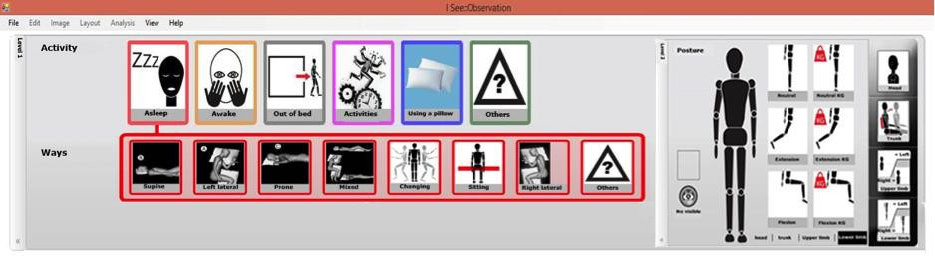
The evaluation of behavioral and postural habits and sleep rhythm of university students is complex and the observation of these in the environmental context is needed. However, the observation methodology based on ISEE software (Filgueiras, Rebelo & Moreira da Silva, 2012) allows the classification and registration of postural behaviors for long periods of time and can be applied in this context (figure 1).
The combination of some objective with subjective techniques, which generally are qualitative such as questionnaires, interviews and direct activity observation, make it possible to minimize the difficulties in applying these experimental methods in real context (Filgueiras, Rebelo & Moreira da Silva, 2012; Bergqvist, 1995; Fenety & Walker, 2002; Straker, Pollock & Mangharam, 1997).
Figure 1. Functional areas of the ISEE software interface
In this sense, the main objective of this study was to investigate the human interaction with postural behaviors during sleep in the residences' bedroom of female university students (sleeping positions, head posture, trunk posture, upper limb and lower limb posture) during the periods in which the subjects were asleep, awake, out of bed, doing activities, using a pillow (Interaction Categories - IC), in different time periods and with ecological validation, through digital video recording using a methodology proposed by Rebelo, Filgueiras & Soares (2011).
METHODOLOGY
This paper presents a part of a larger study which aims to analyze the relationship between the perception of Back Pain and the sleeping position and is based on the observation of the human interaction (with Visual Display Terminals [VDTs]) with postural behaviors in bed during the night period (8 hours/night) in the residences' bedrooms of female university students. We used the same group of equipment and the same model of bed, in order to analyze if there are similar patterns of interaction between users. This study started in April 2013 and finished in May 2013. Data were collected from Portuguese university students.
Twelve university students, studying in the healthcare domain (physiotherapy, occupational therapy, speech therapy, nursing, dietary therapy and, sport and wellness), aged between 19 and 22 years (19.75+ 1.138), residing in dormitories of the university were selected. The bedrooms were in dormitories with 2 beds in each bedroom with the same type of bed, mattress and pillow.
Ergonomics In Design, Usability & Special Populations I (2022) https://openaccess.cms-conferences.org/#/publications/book/978-1-4951-2106-7
Proceedings of the 5th International Conference on Applied Human Factors and Ergonomics AHFE 2014, Kraków, Poland 19-23 July 2014 Edited by T. Ahram, W. Karwowski and T. Marek 720 students (128 male and 592 female), aged between 17 and 30 years (20.27+ 2.31), belonged to the Polytechnic Institute of Leiria of Portugal when the research began. Of these, 89 students residing in dormitories answered a questionnaire about the perception of pain in the spine according to the Visual Analogue Scale (VAS) and 12 female (mean=19.75 years old + 1.138) were volunteers in this study.
Participants were informed about study’s goal through a group meeting and an individual approach on the day before each video recording. All video data collection was authorized by the participants through a consent form.
Finally, participants were instructed to perform their tasks as usual and not to change their schedules or habits due to the presence of cameras.
Participants’ interactions with the bedroom equipment were video recorded on a normal rest period day and were assessed using: a) one infrared digital camera (Wireless AEE Weather-proof - 2,5 GHz – color); b) one multiplexer video recorder (ACH MPEG-4 Realtime DVR) and c) DVD recorder HD (LG recorder). All devices’ lights were turned off or hidden and participants were informed about the placement of all cameras. However, they did not know the real video recording time.
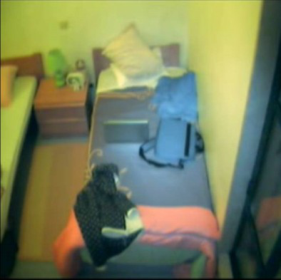
The digital video cameras turned on automatically from 12:00 a.m. to 8:00 a.m. and during the periods in which the subjects were asleep, awake, out of bed, doing activities, using a pillow, they were filmed using one plan (frontal superior) considering that it provided the best visualization of the participant and activity (Figure 2).
In order to ensure similar interaction times in the bedroom and not to interfere in the evening activity and sleep period, all volunteers were filmed during three days during ten hours continuously (starting at 12:00 a.m.). After the filming period for each participant, a quick analysis of the video was done in order to select the best two days, according to the following criteria:
Longer stay of students in the bed (preferred > 5 hours);
More than 60% of the video had a good visualization of the postural behaviors during sleep times.
Figure 2. Images of the first plan (Frontal superior) of the bed Observations
Data, collected through video using a methodology proposed by Rebelo, Filgueiras and Soares (2011), analyzed postural behavior in real situations in bed and resulted from software developed for this purpose (Figure 1).
The fundamental aspect of this analysis was the definition of interaction categories of behavior that will be quantified later. Following the analysis of the results of the previous phases and of the observation of the collected videos, the categories were defined.
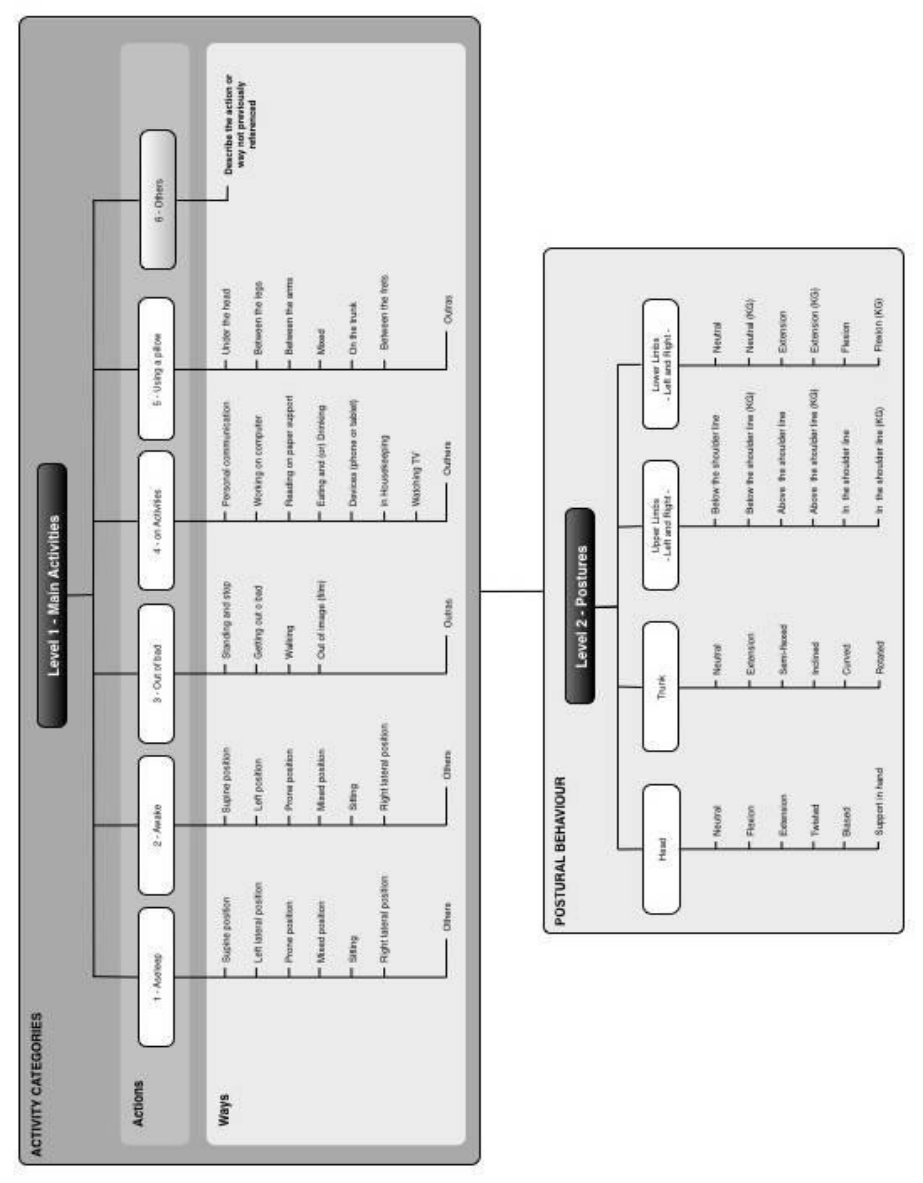
According to Filgueiras, Rebelo and Moreira da Silva (2012), as mentioned, the analysis was done using software developed for this purpose. It allows classifying the IC (through video analysis) in levels. Six (6) categories of behaviors were defined, that represent the night activity or posture behaviors in this residences' bedrooms (Figure 3).
Figure 3. Level 1 - Six categories of behaviors and Postural Behaviors
Ergonomics In Design, Usability & Special Populations I (2022) https://openaccess.cms-conferences.org/#/publications/book/978-1-4951-2106-7
Proceedings of the 5th International Conference on Applied Human Factors and Ergonomics AHFE 2014, Kraków, Poland 19-23 July 2014 Edited by T. Ahram, W. Karwowski and T. Marek
RESULTS
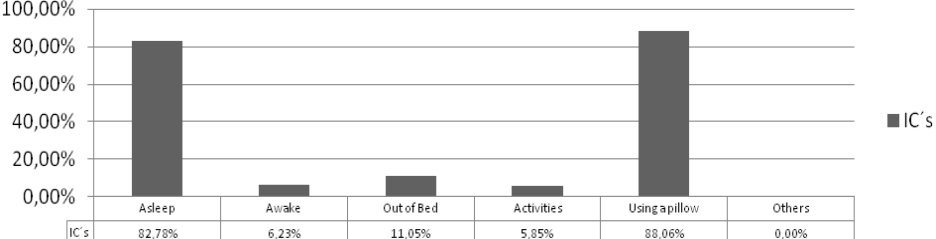
A sample of 6964 observations, which corresponds to 192 sleep-hours of 12 Portuguese university student participants, was classified into six (6) ICs. The results can be seen in Figure 4.
Figure 4. Results for Interactions Categories groups
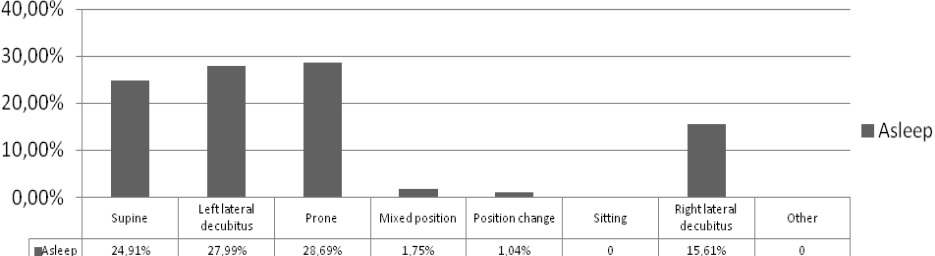
The results show that 43,6% of the participants presented the Lateral position (27,99% on the left and 15,61% on the right) as the most common postural behavior during sleep (Figure 5).
Figure 5. Results for Asleep category
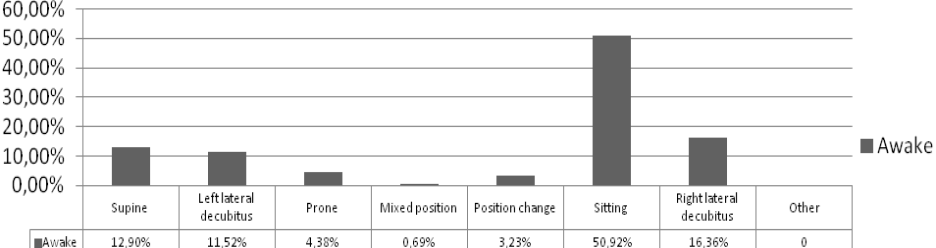
The category “Awake” presented the Sitting position as the most common postural behavior, with 50,92% of postural behavior (Figure 6).
Figure 6. Results for Awake category
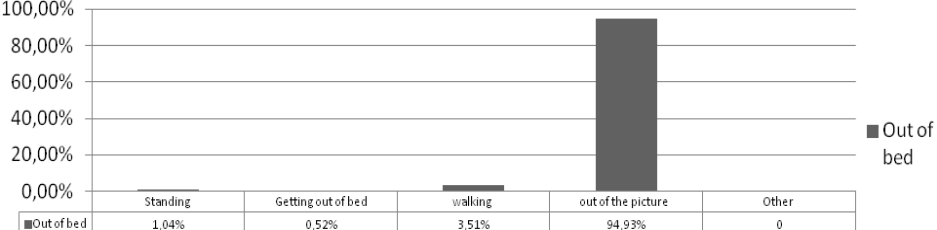
In the "Out of bed" category, the most common observation was the Out of the picture, with 94,93% of observation (Figure 7).
Figure 7. Results for Out of bed category
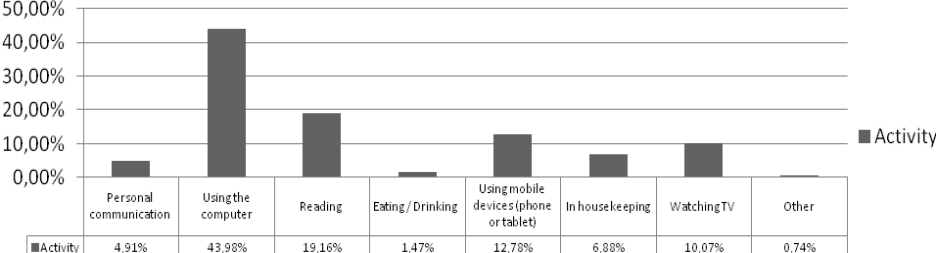
When the participant stood in the "Activity" category during the video capture, the most common activity was Using a computer, with 43,98% of observation, which corresponds to approximately 30 minutes of computer use per participant per night (Figure 8).
Figure 8. Results for Activity categoryFigure 9. Result for Using a pillow category
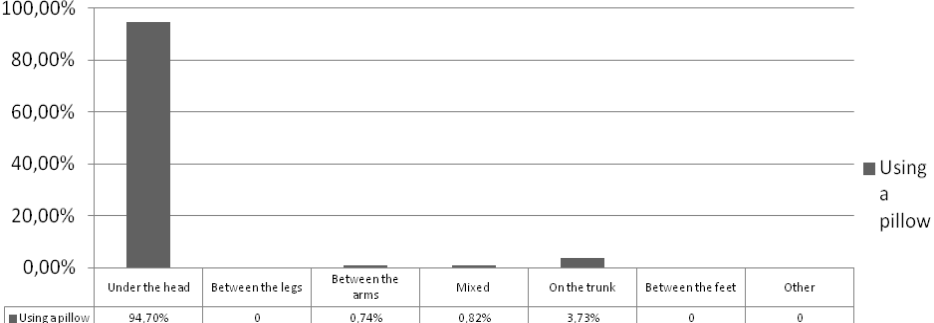
Concerning the "Using a pillow" category, 94,70% of participants used only one pillow under their head (Figure 9).
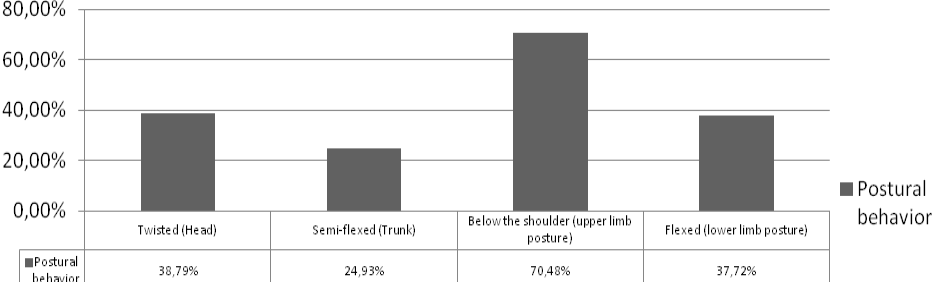
In the postural behaviors, which corresponds to ISEE software Level 2 (Figure 1), it shows the head posture, trunk posture, left or right upper limb posture and left or right lower limb posture (Figure 10). The maximum observation for head posture was round, with 38,79%, the trunk posture was semi-flexed, with 24,93%, the upper limb posture was below the shoulder, with a mean of 70,48% between right and left (69,13% and 71,81%, respectively), and the lower limb posture was flexed, with a mean of 37,72% between right and left (39,70% and 35,71%, respectively), as shown in Figure 10.
Ergonomics In Design, Usability & Special Populations I (2022) https://openaccess.cms-conferences.org/#/publications/book/978-1-4951-2106-7
Proceedings of the 5th International Conference on Applied Human Factors and Ergonomics AHFE 2014, Kraków, Poland 19-23 July 2014 Edited by T. Ahram, W. Karwowski and T. Marek
Figure 10. Maximum postural behaviors in each body classification
CONCLUSION
The ICs of Asleep (with more or less 6 hours and 37 minutes) and Using a pillow (with more or less 7 hours) are the largest periods of the postural behaviors in bed during rest period. The influence of the sleep position on the physiological damage in the period of rest with or without activities in bed is not very known (Desouzart et al., impress). The results obtained with this method of analysis of postural behaviors for long periods of continuous time are important to understand their influence on musculoskeletal conditions. This data can be associated to the increase of the musculoskeletal problems, which can be found among young Portuguese university students when these remain in bad postures for long periods of time in bed.
During the image capture, participants answered a questionnaire about the perception of pain in the spine according to Visual Analogue Scale (VAS). 100% of university students indicated complaints in back pain; 50% referred to the evening as the period in which the pain was more intense; 25% of the participants reported that pain disrupted their sleep and; the biggest indication of median of pain was in the Lumbar region (3.33+ 1.231).
Finally, this ISEE methodology was considered efficient for the proposed objectives and findings offer new challenges for future research. Our findings allow us to suggest what graphical interface designers must seek as new strategies and solutions for behavior change in posture in bed, exploring other peripheral equipments for the position of laptops; or, at least, to improve the posture of the participants when using the laptop in bed and if these Ergonomic changes influence the reduction of back pain indications.
These data are essential for health care professionals who can use this information to enable a reduction factor of complaints of back pain, to make recommendations to schools and universities to change the demands of academic activities by distributing them throughout the semester and not at the end of each period.
However, the ISEE software methodology defines the categories of observation, called categories of interactions, and the software to quantify them (Filgueiras, Rebelo & Moreira da Silva, 2012). This software is essential to analyze data. Without it, it would be necessary to directly observe the video with notes on paper or a computer record of every change without the application of categories for the purpose and with a loss of important information.
ACKNOWLEDGMENTS
The authors would like to thank Portuguese Polytechnic Institute of Leiria and in particular its School of Education and Social Sciences, School of Health Sciences and Social Work Service. The authors want to thank the in English Company workers, for their excellent contribution to the article literature review.
Applied Human Factors and Ergonomics International We would also like to thank the university student participants for their contribution of time and effort to the research. Without them, this study would not be possible.
REFERENCES
Addison, R., Thorpy, M. and Roth, T. (1986), "A survey of the United States public concerning the quality of sleep."
J Sleep Res. 16: 244. Ban, D. and Lee, T. (2001), "Sleep Duration, subjective Sleep Disturbances and Associated Factors among University Students in Korea." J Korean Med Se. 16: 475-80. Brown, F., Buboltz, W. and Soper, B. (2002), "Relationship of Sleep Hygiene Awareness, Sleep Hygiene Practices,
and Sleep Quality in University Students." Behavioral Medicine. 22. Curcio, G., Ferrara, M., De Gennaro, L. (2006), "Sleep loss, learning capacity and academic performance." Sleep Med Rev. 10 (5): 323-337. Danda, G., Rocha, G., Azenha, M., Sousa, C. and Bastos, O. (2005), "Standard sleep -wake cycle and excessive
daytime sleepiness in medical students." J.Bras Psichiatry. 54 (2): 102-106. Desouzart, G., Matos, R., Melo, F. and Filgueiras, E. (Impress). Effects of Sleeping Position on the Back Pain in Physically Active Seniors: A controlled pilot study. Work: A Journal of Prevention, Assessment and Rehabilitation. Devine, E., Hakim, Z. and Green, J. (2005), "A systematic review of patient reported outcome instruments
measuring sleep dysfunction in adults." Pharmacoeconomics. 23: 889–912. Ehrlich, G. (2003), "Low back pain." Bulletin of the World Health Organization. 81: 671-676. Filgueiras, E., Rebelo, F., and Moreira da Silva, F. (2012), "Support of the upper limbs of office workers during a daily work". Work: A Journal of Prevention, Assessment & Rehabilitation. IOS Press. Geldhof, E., Clercq, D., Bourdeaudhuij, I. and Cardon G. (2007), "Classroom postures of 8–12 year old children."
Ergonomics. 50 (10): 1571-1581. Gracovetsky, S. (1987), "The Resting Spine : A Conceptual Approach to the Avoidance of Spinal Reinjury During Rest." Phys Ther. 67: 549-553. Huang, A. and Hsia, K. (2010), "Multimodal sleeping posture classification." International Conference on Pattern
Recognition. Jacobson, B., Boolani, A. and Smith, D. (2009), "Changes in back pain, sleep quality, and perceived stress after introduction of new bedding systems." Journal of Chiropractic Medicine. 8: 1–8. Kazmierczak, K., Mathiassen, S., Neumann, P., and Winkel, J. (2006), "Observer reliability of industrial activity
analysis based on video recordings." International Journal of Industrial Ergonomics. 36 (3): 275–82. Kuo, C., Yang, F., Tsai, M. and Lee, M. (2004), “Artificial Neural Networks Based Sleep Motion Recognition Using Night Vision Cameras." Biomedical Engineering - Applications, Basis & Communications. 16(2), 79-86. Liao, W. and Yang, C. (2008), "Video-based activity and movement pattern analysis in overnight sleep studies." ICPR. 1-4. Morgenthaler, T., Alessi, C., Friedman, L., Owens, J., Kapur, V., Boehlecke, B., Brown, T., Chesson, A., Coleman,
J., Lee-Chiong, T., Pancer, J. and Swick, T. (2007), "Practice parameters for the use of actigraphy in the assessment of sleep and sleep disorders: an update for 2007." Sleep. 30: 519–529. National Sleep Foundation (2005), "Sleep in America Poll." National Sleep Foundation. 1–54. Penzel, T. and Conradt, R. (2000), "Computer based sleep recording and analysis." Sleep Medicine Reviews. Pter, J. (1990), "Sleep Apnea and Cardiovascular diseases." In: Guilleminaut, C. and Partinen, M. Obstructive sleep apnea syndrome: clinical no treatment. Ravem Press, Nova York. Rajaratman, S and Arendt, J. (2001), "Health in a 24-h society." Lancet. 358, 999–1005. Silva, A., Punt, T., Sharples, P., Vilas-Boas, J. and Johnson, M.. (2009), "Head posture assessment for patients with
neck pain: Is it useful?" International Journal of Therapy and Rehabilitation. 16 (1). Soares, C. (2005), "Insomnia in women: an overlooked epidemic?" Archives Women’s Mental Health. 8, 205–213. Spielholz, P., Silverstein, B., Morgan, M., Checkoway, H. and Kaufman, J. (2001), "Comparison of self-report, video observation and direct measurement methods for upper extremity musculoskeletal disorder physical risk factors." Ergonomics 44 (6): 588–613. Strauss, A. and Corbin, J. (1990), "Basics of Qualitative Research: Grounded Theory, Procedures, and Techniques."
Newbury Park, NJ: Sage. Vieira, E. and Kumar, S. (2004), "Working Postures: A Literature Review." Journal of Occupational Rehabilitation.
14 (2). Willemen, T., Van Deun, D., Verhaert, V., Pirrera, S., Exadaktylos, V., Verbraecken, J., Haex, B. and Vander Sloten, J. (2012), "Automatic sleep stage classification based on easy to register signals as a validation tool for
Ergonomics In Design, Usability & Special Populations I (2022) https://openaccess.cms-conferences.org/#/publications/book/978-1-4951-2106-7
Proceedings of the 5th International Conference on Applied Human Factors and Ergonomics AHFE 2014, Kraków, Poland 19-23 July 2014 Edited by T. Ahram, W. Karwowski and T. Marek ergonomic steering in smart bedding systems." Work: A Journal of Prevention, Assessment & Rehabilitation. 1985-1989. Wu, C. and Aghajan, H. (2007), "Model-based Human Posture Estimation for Gesture Analysis in an Opportunistic
Fusion Smart Camera Network." AVSS.
LISTED IN THE AHFE DIGITAL BOOKSTORE CATALOGUE
Explore the complete digital volume
Advances in Ergonomics In Design, Usability & Special Populations: Part I
Read this individual research paper free through the original publisher, or explore the full digital proceedings book.
ISBN 978-1-4951-2106-7
Explore this ISBN in the AHFE Bookstore ↗Listed in the July 2026 bookstore catalogue; search by ISBN to confirm current availability · Digital book purchase optional