Romulo Pinto, Ernesto Filgueiras (2023). Media appropriations of young consumers: Production and Consumption of Digital Content on Social Networks. In: Ergonomics In Design. AHFE Open Access, vol. 77, pp. 167–185. https://doi.org/10.54941/ahfe1003374
This is an investigation into how the technological appropriation of new media happens by a young audience, still in their first contacts with artefacts, technologies and digital social networks. It is a study based on data collected during a field activity carried out in 2019 with 289 young people aged between 11 and 17 years in the municipalities of Fundão and Gouveia, central region of Portugal. The analysis was developed from three experiments: directed interviews, participant immersion and surveys. During the investigation, we analyzed the behavior of 8 qualitative variables: gender, municipality, school, technical device, platforms, frequency of use, intensity of taste and importance of influencers in technological choices. Four analytical dimensions were observed: content, purpose of use, influencers and mode of access. Behavior patterns and usage habits associated with the production and consumption of digital content were identified in this public. Among the results obtained is a model of technological appropriation that considers social and cultural aspects of the investigated population, as well as the mode of existence of technical objects (Simondon, 2020). Faced with the innovation dynamics of the media industry, appropriation can also be defined as an unstable and non-uniform process. This process varies depending on the transformations imposed by changes in available technology and the material and sociocultural conditions of individuals. This article was adapted from the doctoral thesis entitled “Media Appropriations of Young Consumers: Production and Consumption of Digital Content on Social Networks”, prepared by the author at the University of Beira Interior, in 2022.
Appropriation design studies such as that by Tchounikine (2017), give us a highlight aspect related to the functional value of the artifact for the user as the determining factor for appropriation, as well as the distinction
between artifact and instrument. For the author, an artifact only becomes an instrument in the context of use by the user.
Pinto, Filgueiras and Moutinho (2020) discuss the context of appropria- tion in its raw state, demonstrating that in more controlled environments, such as education, it is possible to observe complex and multifaceted pheno- mena, in addition to questions about the simple daily consumption of social tools.
Carroll (2004) will emphasize the idea that the design process itself is only complete after appropriation by users, so that understanding the process of appropriation of these technologies is essential for explaining successes or failures of a social nature and/or marketing of products based on information and communication technology.
Venkatesh et al. (2003) developed a synthesis model called UTAT (Uni- fied Theory for Acceptance and Use of Technology) which, according to the authors, presented significant results in the ability to explain the acceptance and use of a given technology in an organizational context. The evolution of the UTAT model is related, among other aspects, to the observation of moderating elements of the technology introduction process, in this case a system, in a controlled environment (an organization or company), such as organizational context, user experience and demographic characteristics.
In the study on computer-assisted collaborative learning, Overdijk and van Diggellen (2006, p. 90) pointed out the importance of the idea of technologi- cal appropriation for the development of learners: “the notion of technology appropriation implies a construction process in which the user’s actions and thoughts are shaped by the technology, while the meaning and effects of the technology are shaped through the users’ actions”. This indicates that techno- logical appropriation is a phenomenon of the symbolic and material domain of the factors that define the individual’s position in the logic of the digital economy of content production and consumption.
In a broad review of the concept of appropriation, Batista (2018) conclu- ded that the subject’s relationship with the appropriated object is the result of: “... dynamic, inconstant and changeable because it refers to the construction of a being that is always transformed and that is part of an ever-changing world. In this way, the process of appropriation is very different from those of adaptation, assimilation, incorporation, interiorization and transmission”.
Thus, technological appropriation is characterized as a phenomenon resul- ting from actions arising from different spheres of individual activity. Appro- priation is also defined as something beyond isolated actions, that is, access to technologies, for example, is not enough for appropriation to occur (Pinto, Filgueiras and Moutinho, 2020). Not is enough to acquire skills and tech- nical competences for it to happen, only the confluence of these actions transformed into a driving force of technological modeling can lead to the appropriation of technologies by individuals.
Technical Objects The technical object is characterized from physical properties as something capable of human manipulation. In addition to being adapted to the body
Media Appropriations of Young Consumers 169
and strength of the individual, it is something that can be literally abandoned throughout its history and later found, maintaining a certain autonomy. It is something that is invented in the present time, but which brings in itself an immense past in which its manufacturing conditions reside. Simondon fur- ther separated them into two categories: open and closed. The closed object is one that has just left a factory and that soon goes through an aging process from its use. This use is the contact with the reality that demanded its produ- ction, particularly in the domestic and labor environments, but also spread through the spaces of human coexistence. The open object is becoming that is constituted from the gesture of the user, who can be more or less intelli- gent, in the effective use of it. The technical object is something physical, with certain material properties and mode of existence itself.
It turns out that technical evolution led to the manufacture of peculiar technical objects, defined by Hui (2012) as digital technical objects. These objects are possible only by coexistence with the sociotechnical artefacts that surround them, such as the technical norms that define, for example, compu- tational languages. Hui advances in understanding the digital technical object in an essentially cultural dimension: “Digital objects also assume the functi- ons of maintaining emotions, atmospheres, collectivities, memories and so on. This gives us a dynamic and energetic understanding of digital objects. I want to distinguish this process as individuation,” (Hui, 2016, p. 57). Alth- ough Hui, like Simondon, look above all at the properties intrinsic to the technical object (whether analog or digital), we find that, especially in digital artifacts, the questions that stand out for the understanding of their nature can be in the dimension of the meaning of the contents that emerge from the effective use that is made of the artifacts. It is the gesture of the user (in par- ticular, but not only) that shapes the digital technical object when someone contributes to a network or platform, be it a solitary user or acting in some collective. This gesture contributes both to the concrete transformations in the object itself (for example, changes in its rules of use, in language patterns, or in the inclusion of new functionalities) and to changes in the meanings of the contents arising from these collaborations. The social modeling of the network or platform in question derives from the gesture of the user, which in turn is the result of the pressures exerted by the social, economic and cultural forces of that user’s surroundings.
Simondon’s Concretization In Simondon (2020), the technical object evolves according to what he calls the law of concretization, in which “...they are continually redesigned to mul- tiply the functions supported by their components. They then produce ever higher degrees of embodiment”(Feenberg, 2015, p. 266). The realization evo- kes two paths of the object: one described by the author in which the object of departure undergoes a series of adaptations, corrections and incorpora- tion of new functionalities up to a saturation point as defined by Bontems (2017, p. 35): “When these minor advances optimize the elements, it is said that the object has become saturated: it is not possible to increase its per- formances in one sense without worsening them in another. To progress, a
170 Pinto and Filgueiras
global reconfiguration is necessary”. These advances are defined and develo- ped in the object’s invention environment, such as factories or design offices. The other path in which reconfigurations occur is through the modes of effe- ctive use of objectives. For example, since digital platforms are born as empty boxes (it is only a receptacle with predefined functionalities by designers) in the condition of a closed object, it is from its effective use that, in its course of implementation, the object goes through an addition of functions that are modeled by users.
The implementation results from the interaction of the technical object with its respective associated environment - which is the environment of effective use of the object. This allows conditions for technical innovation. For Simondon (2020), the technical being exists in a kind of fusion betw- een the object and the associated environment, at the same time that the medium is transformed by the presence of the object creating conditions of improvement and modeling of it to the point of saturation. Strictly spea- king, concretization is a process that leads to the industrial character of the object, that is, when it has reached the alignment between the knowledge inherent in the design of the object and the scientific knowledge associated with it. At this stage, the technical object is still able to substantially expand its possibilities for replication and distribution at scale - which in Simondon’s analog world occurs on an assembly line (associated with a communication effort to convince users, and distribution logistics so that the product reaches consumers).
However, with the digitization of artifacts and the fusion between har- dware, software and content, we observe a peculiar way of replicating technical objects of the digital type, such as platforms and social netw- orks, for example. In this dimension, the replication of the artifact occurs outside the production environment - which on the other hand maintains controls over the array object. For example, an online platform, maintai- ned on the servers of a player like Meta, only needs to make a single update of features in the main object so that all users inserted in it (registered pro- files) are contemplated with the adjustment from the next access after the “update”.
Thus, this type of digital object will always be concrete, and what will vary will be the speed with which new features or adjustments will be assimilated by users. The implementation now encompasses processes of transforma- tion of already industrial or digital technical objects that continue in their evolutionary rhythm towards their saturation point. The saturation point is the development stage of a technical object in which it is no longer possi- ble to add new features or improvements to it. However, saturation does not exactly mean obsolescence. An obsolete object implies that its functi- onalities have been surpassed by other objects in a dynamic of integration with other objects: to work satisfactorily, an object needs to interact with a set of other objects, but this whole may evolve to the point of rende- ring the object in question useless. A saturated object can remain useful for an indefinite period without becoming obsolete: everything will depend on the dynamics of innovation that occur in the context of the associated environment.
Media Appropriations of Young Consumers 171
Associated Context In the mode of existence of technical objects, the associated medium is the set of conditions and external elements that are necessary for the operation of a technical object. This includes the physical environment in which the object is inserted, the people who use it, the other machines and devices with which it interacts, and so on. It is through it that the object can perform its functi- ons. The associated environment is also important because it determines the possibilities of using the object, as well as its limitations and restrictions. The associated environment is susceptible to the forces that contribute to the genesis of the object, such as the economic conditions of the community in which the object is inserted, the educational, professional or individuals who can influence the choices of these users, the limitations of the elements them- selves (units or parts) that make up the object, in addition to the social forces of the institutions that surround it, such as school, family or government, although, according to Simondon (2020, p. 106):
“... this medium is not manufactured, or at least is not manufactured in its entirety: it is a regime of natural elements that surround the technical being, linked to a regime of the elements that surround the technical being”.
However, it is the human action of transformation of nature that manu- factures the associated environment that will allow the emergence of inno- vation. According to Feenberg (2015, p. 266): “The most sophisticated technologies employ synergies between their various means (milieux) to cre- ate a semi-artificial environment that underpins its own functioning”. The most sophisticated technologies today are essentially digital - hence the semi- artificial environment referred to by Feenberg (2015), and these technologies are not only installed in natural elements from which Simondon (2020) draws part of his examples, but also in a social environment, man and impregnated with forms, values, structures and human agency.
In the world of digital platforms widely distributed across homes, offi- ces and even individuals’ own pockets, social networks, software and video games, the environment associated with technical objects is an amalgam between the social circles of the individual in its various dimensions of opera- tion: family, neighbors, friends, school, work, the technical objects themselves and the digital contents projected in them from various sources, from the mainstream content industry, to the case of a young student from a village in the interior of Portugal, passing through digital influencers of the most diverse natures (Pinto, Filgueiras and Moutinho, 2020).
Social Shaping of Technology (SST) The vision in which technology and individual are in a systemic evolutio- nary dynamic is related, at least in part, to the social modeling of technology (Social Shaping of Technology - SST). This theory emerged in the mid-1980s with the work of Donald Mackenzie and Judy Wajcman. In general, SST was opposed in the social sciences to a deterministic view of technology that, as a rule, prevailed in studies on the subject. Mackenzie and Wajcman (1999)
172 Pinto and Filgueiras
supported the idea that to explain the development of a technology it is neces- sary to have a model of society that corresponds to this technology. In a study in which they reviewed investigations that used the theoretical framework of the SST, Williams and Edge (1996), stated that such theory was willing to investigate the way in which social factors were institutional, economic and cultural have been shaping both the direction and the rate of innovation and the shape of technology, as well as the content of artefacts, technological pra- ctices and the results of technological change for different groups in society. In a paper on SST and new media, Lievrouw and Livingstone (2003) stated that the then new approach proposed to study not the impacts of technology on society, but the influences of social on technology. By proposing that techno- logy is modeled by forces and actors in a complex and competitive scenario, SST explores new possibilities for understanding technological phenomena, namely socio-technical phenomena related to a key process: technological appropriation.
On the other hand, the artifacts are intrinsically associated with the con- tents that are embedded in them: the computer, the TV receiver, the mobile phone, the video game console, the tablet and other artifacts only make sense to users as they act as a means, as support for a diversity of content that are intertwined in order to cause a kind of fusion between hardware, software and content, that is, convergence. Thus, in the field known as new media, SST has been used in several studies on the most varied technologies. Lie- vrouw and Livingstone (2003, p. 7) discuss what is new in the media and thus characterize them as: “…products of a continuous hybridization of existing technologies and
innovations in interconnected technical and institutional networks”.
This implies a new situation of production, consumption and analysis of scenarios in which content and interactions are diversified and distributed by and to new audiences in a context of accelerated digital convergence.
METHODOLOGY
The methodology adopted in this study is qualitative and quantitative (Pinto, Filgueiras and Moutinho, 2020). It involved three data sets: the first con- sisting of two directed interviews. The second consists of ten field notes prepared from visits carried out in six schools distributed by the Portugal cities of Fundão and Gouveia. The third item of the data collection is for- med by the descriptive quantitative analysis of a cross-sectional study with 287 students who answered surveys on habits of use of technologies and platforms.
The option of combining qualitative and quantitative approaches has been used particularly in sociological research (Creswell and Clark, 2011), and its most common “label” is known as methodological triangulation, a concept that is not native to the Social Sciences, navigation and topography (Duarte, 2009). Denzin (2006) discusses the imprecisions of the concept and defines four possible types of combinations: data, researchers, theories and metho- dology. The object pursued is the phenomenon of technology appropriation,
Media Appropriations of Young Consumers 173
observable from the identification of behaviors of production and consum- ption of digital content captured by the techniques of data collection defined. The techniques were applied in sequence: first were the interviews that poin- ted to where we should look during the participant observation procedure. Then, the observations pointed out in a field notebook guided the defini- tion of variables to be investigated through the surveys distributed to the investigated public.
Directed Interviews The script for the interviews, as well as its subsequent analysis, was structured in themes focused on understanding the perspective that young people had regarding the technologies they used. Thus, we seek to know from the two interviewees (identified by the codenames Boy and Girl) what technologies, for what purposes and what type of content associated with them was to be sought. We also examine the control exercised by parents regarding the access of young people to technologies and the skills of students to deal with them. We were also interested in the look of these two older young people, already in secondary school, on the third cycle students. The interviews were recorded separately, in audio, on the same day, with a brief interval between the first (the girl) and the second (the boy).
Participant Observation The direct observations of the researcher in the target audience’s school envi- ronment were made between March and December 2019. The observations generated field notes in digital support and describe interactions between stu- dents. Subsequently the field notes were analyzed from the perspective of the categories platform, content, device and form of access.
Questionnaires Through the surveys the dimensions of analysis were synthesized. In this topic, a descriptive overview of the results considered fundamental for the understanding of the research problem will be presented. The variables defi- ned were grouped into two main categories of analysis: production of own content and consumption of third-party content. They define two categories of users: Prosumer and the pure consumer. Prosumer is the individual who appropriated the technology and has a greater potential to contribute to the modeling of this technology from the volume and impact of its activity. The pure consumer is the individual who never posts their own content, and their technological appropriation is limited by the absence of activities on social networks. But most respondents are located between these two categories that will be investigated in more detail. For the intensity measurement scales of each of the variables observed in the dimensions of analysis established, we chose to use, in the questionnaire, textual labels more easily assimilated by students, such as “very”, “little”, “nothing”, “sometimes” instead of a numerical labeling of type 1, 2, 3, 4. As this is an exploratory study based on ordinal qualitative variables, we used the Pearson test (Chi-square) to verify
174 Pinto and Filgueiras
the association between variables in the cross-reference tables used. We defi- ned that one for a value p < 0.001 there is a strong association between the variables; for a value p up to 0.500 there is an association within the expe- ctations; for values between 0.500 and 0.999 there is a weak association; and from 1 we assume that there is no significant association between the variables.
RESULTS
Interview Results Girl’s interview indicated the predominance of recreational use of technolo- gies and the possibility of interaction with colleagues as motivating elements for the use of technologies. It also drew attention to a moral concern with the younger people, of whom I wanted to mark a certain detachment. There were no references to Portuguese audiovisual production - only to YouTubers who, despite being Portuguese, express themselves in terms of a young culture typical of globalized entertainment. There was also no evidence of a content production attitude, on the contrary, the posture evidenced is of a consumer relatively attentive to the products of the mainstream industry. As for litera- cies for content production, Girl expressed a certain discontent of not having developed them in school and suggests that digital skills are important for “the future” but does not seem to miss them in the present. There was also no evidence that the interviewee felt part of a global community of interests, suggesting that the media world, although present, does not occupy a space for action or reflection in her life. Judging only by the interview granted, Girl cannot be characterized as a Prosumer.
The boy also believes that digital literacies are important for the future and that, for now, they are available on the net for when he decides to be inte- rested in them, which effectively came to do sometimes, apparently without success. In this sense, he complained, albeit discreetly, that the school does not give so much importance to these literacies. The interviewee says he is always connected, but attentive even to the contents of the networks only in approximately two hours a day. She still claims to publish little content - but seemed more active than Girl - despite a position of distancing from the interview questions. Their declared cultural references also do not include typically Portuguese content, except for YouTubers, and the focus seems to be on the mainstream industry as well, with mentions of Japanese manga as something particularly dear. The boy also has a considerable concern in “spending time” - which seems to be one of the main motivations for the use of technologies. As for influencers, the interviewee stressed that “outsiders” are important, like friends, when choosing content and technologies. Despite the statements about a certain online production activity, it was not possible, by the interview, to characterize the boy as a Prosumer.
Participant Observation Results In the classrooms of the schools visited, there is a box for storage of mobile phones by students (the device is forbidden to be used in the classroom),
Media Appropriations of Young Consumers 175
but not all teachers make use of the instrument or are strict in the tempo- rary confiscation of the devices. Thus, the direct observation of the effective use of the platforms most accessed by the students was performed during the breaks of the classes. Use during breaks is recurring and intense, either individually or in a shared mode (two or three colleagues sharing the same mobile screen). Here, content, device, platform and users formed an amal- gam in which interactions occurred between individuals (who talked to each other about content and technologies), or between individuals mediated by the device (sometimes an individual was next to each other, and the inte- raction occurred mediated by the device, either silently or ostensibly). The situation of the human-technical object dyad, in which an individual was isolated from colleagues using the mobile phone was not as recurrent as the situation in which the mobile phone was a mediator of social interactions. A strong presence among students is the casual video game, short games played individually against the system or in line with other remote players, provided they express immediate results and instant resolution of conflicts (after all, the breaks between classes are short). Videos only seem to be appreciated if they are short-lived, resolute and funny (hence the success of the Tik Tok platform, recently launched during fieldwork). There is an apparent gender segmentation in the preference for video games. Boys prefer combat games and girls prefer social or puzzle games. But that’s not a rule: those who play during breaks can be playing any kind of game as long as it’s fast and resolute. The use of mobile phones in the intervals is also influenced by the season: on cold days, when outdoor life is more uncomfortable, there is a higher inci- dence of using mobile phones than on days when you can be outdoors. On the other hand, most interactions in class intervals occur without the prese- nce of technical objects: there are many conversations about them, but they are not always present in interactions. The absence of mobile phones during breaks was more evident in schools away from the headquarters of small vil- lages, in Vila Nova de Tázem, Silvares and Alpedrinha (Pinto, Filgueiras and Moutinho, 2020).
It was also possible to observe several groups of three or four individu- als clustered around a student, usually boys, looking together for a single mobile phone device. In two of these groups, while the operator performed some tasks, the others were vibrating, cheering for him. This was a recur- rent mode of use in corridors, although observed with more incidence in the school of Gouveia (headquarters): it was more common to see these small gatherings around a mobile phone than students to use their devices alone. At the school bar, during the longer break, the use of mobile phones was practically non-existent.
Questionnaires Results We will present the results considered essential for understanding the pheno- menon of appropriation as to the behaviors of: a) predominant platforms; b) production and time dedicated to the content itself; e c) Importance of influencers in the choices for content and technologies.
176 Pinto and Filgueiras
Main Platforms To be effectively produced or consumed, digital content requires the user a time of dedication, an object and a platform. To identify these elements, two specific questions were asked about them in the questionnaire. The first was “from the devices below, check which ones you have access to”. It was offered a set of options from the data collection procedures previously applied and added another field for the student to indicate another device possibly not listed (only two unlisted devices were included, the Smartwatch and the television set). The answers are expressed in Table 1.
To be effectively produced or consumed, digital content requires the user a) time of dedication, an object and b) a platform. To identify these elements, two specific questions were asked about them in the questionnaire. The first was “mark the devices you have access to”. It was offered a set of options from the data collection procedures previously applied and added another field for the student to indicate another device possibly not listed (only two unlisted devices were included, the Smartwatch and the television set). The answers are expressed in Table 1.
With 98.95%, the mobile phone is the universal object of the respondents, followed by the laptop with 76.66. The data confirm the ubiquity of the mobile phone as the main technical object to be part of the life of respon- dents. TV was not among the answer options and the low citation suggests its irrelevance to the investigated audience - or its insertion in another category of devices. The question to identify the preferred device for use only allo- wed a single questionnaire answer. The following Table 2, generated from the question: “which is the most used electronic devices by you”? illustrates the distribution of the most cited artifacts as preferential.
With 87.11% of the preferred responses, the mobile phone was identified as the main device for access to content and platforms. Second, far away, with 4.88%, video game consoles. Still, the preference for the video game console was ahead of the laptop, with 3.48%. The most cited platforms were the subject of an issue in which students could reference options at will, with- out order of preference. In the questionnaire there was also an extra field for those who were unloved to indicate others, in addition to the 6 opti- ons offered (Instagram, Facebook, Twitter, Whatsapp, Youtube, Snapchat). There were 1063 mentions, and Youtube, Whatsapp and Instagram account for 70.74% of them, with a slight advantage for Google’s platform, Youtube, with 25.12%, followed closely by Instagram, with 24.27% of the quotes. Whatsapp, a platform for point-to-point instant messaging or in controlled
Table 1. Mark the devices you have access to.
Table available in the original PDF paper.
Device Students with access (%) Mobile phone 98.95 Notebook 76.66 Tablet 70.28 Videogame console 43.55 PC desktop 35.54 TV 2.09 Smartwatch 1.05
Media Appropriations of Young Consumers 177
Table 2. What are the most used electronic devices by you?.
Table available in the original PDF paper.
Preferencial Device % Mobile phone 87.11 Videogame console 4.88 Portátil 3.48 PC desktop 2.44 Tablet 1.05 Not answer 0.7 Instagram 0.35
groups, showed 21.35% of mentions. Surpassing Facebook that had only 5.93% of the quotes, was Snapchat, a platform for exchanging images that did not belong to the so-called big techs (large technology corporations, Goo- gle, Facebook, Twitter). A single educational platform was cited, and yet only once, denoting the lack of interest of respondents for educational content outside the platforms with entertainment appeal.
Own Content Production The variables of production of own content were named “You even post your contents?” and “How long can I take?” where it was considered to post own content as the act of publishing texts, images or audios created by the student himself on a public social network. These variables allow us to identify the purpose of using the platforms among the individuals in the sample. Table 3 show the records the posting of they own content by school and by gender.
Table 3. Answers to “You even post your contents?” and “How long can I take?”.
Table available in the original PDF paper.
School AEGX Silvares
Post own content
AEG Gou- veia
AEF João Franco
AEGX Serra da Gardunha
AEG Vila Nova de Tázem
Externato Cap. Santi- ago de Carva- lho never 8.93 7.5 0 16.37 7.5 14.29 little 35.71 27.5 66.67 0 25 14.29 sometimes 46.43 47.5 33.33 50 40 71.43 ever 8.93 17.5 0 33.33 27.5 0 Total 100% 100% 100% 100% 100% 100% never 30.56 24.14 0 57.14 6.25 0 little 38.89 48.28 40 28.57 56.25 37.5 sometimes 19.44 24.14 50 14.29 37.5 62.5 ever 13.89 3.45 10 0 0 0 Total 100% 100% 100% 100% 100% 100% never 17.39 14.49 0 38.46 6.94 9.09 little 38.04 36.23 50 15.38 38.89 22.73 sometimes 35.87 37.68 43.75 30.77 38.89 68.18 ever 9.78 11.59 6.25 15.38 15.28 0 Total 100% 100% 100% 100% 100% 100%
178 Pinto and Filgueiras
Table 4. Answers to “ Post own content?”.
Table available in the original PDF paper.
Daily time dedicated to publishing own content (%) Total%
Post own content?
More than one hou- r/day(%)
Zero (%) up to half an hour a day (%)
Between half and one hour/day (%)
never 81.58 18.42 0 0 100 little 50 46.08 3.92 0 100 sometimes 19.47 57.52 17.70 5.31 100 ever 3.23 32.26 35.48 29.03 100 Sempre 3.23 32.26 35.48 29.03 100 The table above showed an association between variables p = 0.148 for girls and p = 0.019 for boys. Statistical significance (p = 0.47) was considered as expected. Posting frequency is an indicator of how active the respondent is on social networks. Active, the individual produces content and contributes to the social modeling of the technology used. If nothing is posted, the indi- vidual is a consumer of digital content. The “always” value of the intensity scale is the only one among them that we can deduce a profile of Prosumer (Toffler, 1984) as the individual who produces, distributes and consumes digi- tal content. In this case, the profile of our Prosumer is predominantly female (80.64%) and located mainly in the municipality of Fundão (64.51%). When the relationship between the behavior of always posting own content and the age of respondents is established, it is identified that 63.33% are 13 years old, 20% are 12 years old, 13.33% are 14 years old.
A student is 15 years old and a student who claimed to always post their own content did not state their age. Thus, the Prosumer profile is between 12 and 14 years with a large majority within the declared median age. On the other hand, the Prosumer profile represents only 10.91% of the valid sam- ple. The statements of “sometimes” totaled 39.78% and indicate a presence of an intermediate profile between the producer and the consumer of digital content. The statements of “little” totaled 35.91% and indicate an inter- mediate profile between producer and consumer. The statements of “never” totaled 13.38% and indicate a pure consumer profile. The values are noth- ing, little, sometimes and always associated with user profiles, respectively pure consumer, participatory consumer and consumer with interest in content production (replicators) and Prosumer. The data also show a large majority (75.70%) of individuals located in the intermediate profiles that maintains some productive online activity on social networks. If we add to them the numbers of prosumers, we obtain 86.61% of active participation in social networks, which characterizes the “pure” consumer profile as a minority among respondents.
The second variable of production investigates the time dedicated to posting own content and, was introduced to increase the accuracy of the analysis both with regard to a measure of concrete time in hours, to verify any inconsistencies in the statements made by respondents. This variable was observed in Table 4 below, crossed with the variable of posting own content.
Media Appropriations of Young Consumers 179
The above table showed an association between variables p < 0.001. The numbers indicate that 29.03% of those who declared to always post their own content, dispense more than one hour a day to this activity. Those who declared simultaneously dedicate between half and one hour a day and post always represent 32.26%, and those who dedicate up to half an hour/day to always post their own content are 35.48%. There is an outlier in this table: a student of AEF - João Franco who says he always post but, does not dedicate any time daily to this activity.
Influencers in the Technological Choices The influencers represent the surrounding forces acting directly on the respondents. They have an undetermined weight in the choices about tech- nologies and platforms, however, they compete among themselves, without necessarily knowing it, for the attention of the respondents. The question in question was “before choosing a technology or content, how much influe- nces you...?”. To better visualize the comparison, graph 20 below presents, in absolute numbers, the overall result of this question in terms of the inten- sity of influence. In this dimension of analysis, we sought to investigate who they are and what the weight of these influencers in the choices about media and technology of the scrutinized public. One data considered relevant is the strong presence of the mother as a reference for respondents regarding the choices of content and technologies. The weight order of the influencers in the “Very Important”scale parameter is as follows: mother (192, or 66.90%), parent (187, or 65.16%), best friend (158, or 55.05%) and father (152, or 52.96%). In turn, regarding the parameter “Nothing Important”, appear in the last four positions, net general (87, or 30.31%), youtubers (109, or 37.98%), digital influencers (120, or 41.81%), in the category external influ- encers; and neighbors (122, or 42.51%), physically identified as the least influential in the process of choosing respondents.
When establishing the relationships between the type of influencer and the profile of Prosumer, the same sequence of general importance was identified: mother, best friend, father (we purged the parent in education because he is usually the father or mother). The last three elements among the influencers in relation to Prosumer are the same as the general sequence, but with a change in the order: YouTuber, digital influencers and net in general. On the other hand, when relations are established between the type of influencer and the pure consumer profile, a sequence was found in which father, mother and best friend exert a greater influence on pure consumers. Among those who influence the purest consumers are YouTuber, the digital influencer and tips from the net in general. The following Table 20 demonstrates the result of the above reported count in which the data of those who post always (prosumers) and those who never post (pure consumers) were crossed with the statements about the influencers that matter most to each of the respondents.
OVERALL ANALYSIS Technical Object
Regarding the technical objects it was possible to observe the ubiquity of mobile phones among the study participants. The mobile phone is an object
180 Pinto and Filgueiras
that in its dynamics of implementation integrates not only features of access to the consumption of digital content, but also to the production tools that are used by most respondents. However, even among the prosumers of the sample, no evidence of a form of greater use was found in the terms placed by Simondon (2020). The concretely identified action that came closest to an understanding of the inner workings of technical objects was captured by the field notes drawn up during school visits, when students made changes to the tablet configuration - which was interpreted as an attempt to communicate a message. We also found no evidence of saturation of the mobile phone as a technical object in evolutionary dynamics of implementation: the expected evolution for the object is related to an aspect of the associated environment, the connectivity standard of the 4G network for the 5G network. This change may allow the emergence of new objects and platforms - and it certainly will - but it is not possible to predict exactly the effects of it on particular mobile phones or their appropriation.
As for the data related to digital technical objects, the activity declared by the respondents of Prosumer profile, identified by the incidence of the values “more than one hour per day” and “always” to the variables “daily time dedicated to the posting of own content” and “frequency of posting own content”, there are indications of strong technological appropriation. The object is appreciated collectively in school, where its use was identi- fied, during visits, despite its character as an object of personal use, as an instrument to promote sociability. It was in the corridors and atriums of sch- ools that the agglomerations around mobile phones were formed, with wide exchange of experiences on the most diverse contents, under the purpose, identified in the directed interviews, of “spending time” or “entertainment”. These meetings in the breaks of classes around mobile phones fostered pro- cesses of identity construction with potential to be channeled to the posting of own content. In his study on the appropriation of mobile technologies, Wiredu (2007) reinforces the “portable” character as one of the main moti- vations for the appropriation of the mobile phone. In fact, the object that fits anywhere and concentrates so many features have significant potential to be appropriate, but what caught our attention was the collective use of an object of personal use. In addition to the data indicating that there are diffe- rent profiles of users and that one of them is active enough to generate digital content, this appropriation can only be considered as being simultaneous to both objects (physical and digital) that are merged. This action is relevant compared to the action of other profiles, but it was not possible to measure how relevant it is to the media ecosystem of which the platforms used are part. We can say that there is a hypothesis that the volume of this production contributes to the is not possible to measure this potential with these data - we can only confirm their existence and that it is greater among those who produce their own content than among those who only consume it.
Contents and Influences It was considered relevant the willingness of the female public to participate in a public and open social network such as Instagram with its own con- tent. This provision derives, at least in part, from the pressure exerted by an
Media Appropriations of Young Consumers 181
external force situated within an economy of visibility in which being in the media and platforms provides a gain of social capital to the producer of own content. However, it was not possible to identify the reasons for a marked difference between boys and girls in this provision. In addition, the exact correspondence between what was posted by the respondents at the time of the investigation, what was declared as its own content, and the processes of identity construction of these individuals, is still a hypothesis yet to be tested. Although the external influence on the choice of content and techno- logies is minimal, boys are more susceptible to YouTubers (they total 57% of those who declared to be very influenced by YouTubers, for example). The situation changes when it comes to digital influencers, the category in which celebrities find themselves. In this case, there are 66% of the total respon- dents who declared to be very influenced by digital influencers composed of women. When it comes to net influences overall, the numbers balance 44% for women and 55% for men. But when you look at the three categories of influencers for statements of “nothing influences,” the female audience of the sample is proportionally larger than the male, which implies a situation in which women are more active and less influenced by elements external to the basic family nucleus.
Among the surrounding forces that stood out most in the influence on the choice of contents and technologies, once again the feminine element predo- minates. It is mothers who say what is or ceases to be interesting - or what the family can offer in terms of technical objects - for their children. The figure of the best friend also appeared recurrently in the surveys, indicative of the strength of social interactions between peers as an agent of influence for the age group investigated. In addition, the data also makes it clear that certain profiles contribute much more than others to make it happen. What caught the most attention during the technical visits was the recurrent sharing of the screen of the mobile phones. Despite being an object of personal use, an unusual way of collective use stood out, not only in the sense of exchanging messages between individual users, but also in the act of sharing the screen in ritualized actions of collective entertainment.
The recurring pattern among the groups of boys, in all the schools visited, was: a) crowding (around the object), b) demonstrating (the object owner demonstrates something on the screen), c) solving (the crowded individu- als “explode” surprised in euphoria), and d) dispersing (individuals abruptly move away) after the outcome of the situation. This pattern of behavior was not identified as recurrent among female groups, where there was more discretion and restraint. Among them, the act of sharing the screen took place mainly in pairs, and, very rarely, a gathering of three people. This mode of collective use configures a particular form of appropriation of the techni- cal object that has no direct implication on the modeling of the devices that effectively are products developed for individual use. However, to the extent that the screens were expanded (for the comfort of the artefact owner) a new possibility of use emerged to contribute to the appropriation of both har- dware and software, so that the object’s own environment is influenced and transformed by unforeseen forms of use. This is a way of use close to what Messias and Mussa (2020) call “impromptu arrangement”(PT = gambiarra).
182 Pinto and Filgueiras
CONCLUSION
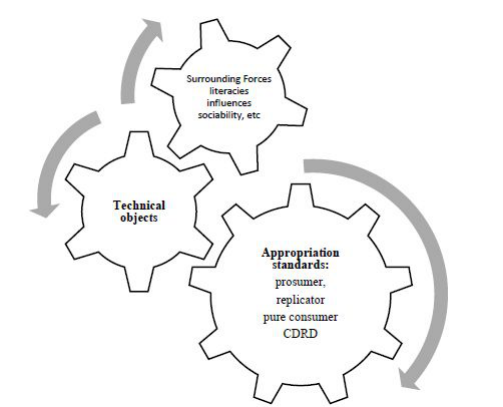
The technological appropriation of the media is an inevitable phenomenon in Western capitalist societies and occurs both by consumption and content production. However, it assumes nuances of intensity from specific group behaviors within the same population category - as in the case of our inve- stigation. The appropriation occurs by actions of individuals in contexts of effective use, in such a way that it is possible to identify the appropriation with the behavior. In this sense, 4 patterns of technological appropriation were identified that derive from behaviors directly related to the artefact, platform, social interaction, literacy and identity strategic concepts. The pat- tern agglomerate, demonstrate, solve and disperse (ADRD) is a pattern of collective behavior that reinforces the importance of the technical object for the development of integration and belonging dynamics. Another pattern of behavior is that of the individual who always posts and dedicates more than an hour a day to post their own content: Prosumer. Prosumer articulates diverse skills and competencies to generate and circulate your own content. Their behavior reveals a form of intense appropriation when compared to the behavior of non-prosumers - which expands their possibilities to contribute to the social modeling of technology. On the other hand, the pure consumer develops a less intense form of appropriation in which the technical functi- onalities of the devices are not fully used, which reduces their possibilities of contribution to the social modeling of technology. On the other hand, the pure consumer develops a less intense form of appropriation in which the technical functionalities of the devices are not fully used, which reduces their possibilities of contribution to the social modeling of technology. A fourth pattern identified was involved in the promotion of third-party content - the individual accustomed to reacting, repost or comment on content that did not produce, in order to contribute to the movement of social networks and, consequently, to their modeling, identified as replicators. These patterns of behavior are not necessarily exclusionary, and the same individual may pre- sent them in different circumstances at home or at school, for example. The
following figure illustrates the emerging technological appropriation model in which all elements are immersed in the associated environment: The elements that make up the model are in an interactive dynamic in which the condition of ubiquity of the technical object implies the fusion between the associated environment and the social environment. The emer- ging forms of appropriation destabilize the associated environment and pressure both the field of production of objects and the political field in which decisions about technical configurations, offers of functionality and regula- tions of use (whether at school, at home or in development companies) are taken. On the other hand, by examining each of the items that compose it (object, associated environment and surrounding forces), it was possible to identify stability components. For example, objects continue to be developed in a specific field that deals with modeling the technology and predicting its commercial success by methods and techniques of production and distribu- tion that drive the process of realization of the object towards its saturation point. In this process, media convergence is the factor that presses the object for its internal coherence: platforms tend to integrate and incorporate techni- cal functionalities of other platforms that in turn imply the incorporation of new content, new formats and new forms use that result, again, in the desta- bilization of the associated environment. Also, the surrounding forces show apparent stability: the social and geographical location of the school, the sch- ool itself, and the nearest family circle. These forces were instituted within a social order that originates at a specific time of the industrial revolution by the second half of the nineteenth century which, despite their updates, retains significant stable elements, such as the reduced household, the universal and centralized school curriculum, or the strong affective social bond with the “best friend”, the latter a pattern of universal sociability. The new force exer- ting pressure on the investigated public is the digital influencer: an individual simultaneously accessible, responsive, propositional and that positions itself as a reference in a widely distributed media ecosystem, the social environ- ment of the respondents. The empirical data point to a smaller role of this force on the investigated public when compared to traditional influencers, but it is a concrete force to act on 13-year-olds.
Still according to empirical data, there is a large majority of individu- als with the profile of third-party content replicator. The contribution of these young people to the media ecosystem shows little gain for themselves in an economy of visibility operated on digital platforms but, puts them in the condition of digital volunteer workers to contribute to the leverage of content produced by other people, brands or influencers. Replication, whe- ther by the gesture of putting taste, commenting or reposting, suggests the endorsement of the content, elevating it to the degree of relevant that can be negative (by derogatory comments or disapproving icons), or positive. For the automated system (algorithm) that computes user engagement with con- tent and its distribution among network members, at least at first, no matter the quality of what was liked, commented on or reposted: What counts is that there occurred an interaction, it was computed and will be considered in two dimensions, one intrinsic to the object and another outside it, beyond, including, the associated environment.
184 Pinto and Filgueiras
A set of reactions to any content outside the average standard defined as expected by the system developers can lead to a moderation of that con- tent (intervention of platform administrators) or, in the limit, a review of the rules on similar content. This is an intrinsic dimension to the technical object that is quantitatively pressured by the volunteer workers who, because they are not shareholders or designers of the platforms, make themselves heard organically when they escalate collective reactions to content produ- ced by third parties, at an elementary level of social modeling of the technical object. The product resulting from the action of this profile is absorbed by the system, quantified and transformed into a commodity to be traded within the platform itself as a “visibility asset”.
Finally, the other dimension is related to the effects of content on the beha- vior of the individual or groups that consciously make use of the platform in search of changes in the social environment. This superior use of technology was not found among the investigated public, as demonstrated by the low interest in the contents considered serious, that is, those that are more distant from the playful universe of the child public or in transition to the adolescent period. Although the cultural universe of fiction and entertainment allows a shaping action from, for example, a scale activity of enthusiastic fandoms, in the terms put by Jenkins, it is in the dimension of serious content that the greatest possibilities of effective transformation of the social environment are found, as well as a qualitative change in the vision that individuals have of themselves and of the groups of which they are part, which potentiates the processes of construction and strengthening of identities that contribute to the appropriation of technology and to the dynamics of the system whose elements remain in an unstable equilibrium.
ACKNOWLEDGEMENT
This work is financed by national funds through FCT - Fundação para a Ciência e a Tecnologia, I.P., under the Strategic Project with the references UIDB/04008/2020 and UIDP/04008/2020.
REFERENCES
Batista, C. L. (2018). Os conceitos de apropriação: contribuições à Ciência da Informação. Em Questão, 24(2), 210–234. https://doi.org/10.19132/1808-5245242. 210-234 Bontems, V. (2017). Por que Simondon? A trajetória e a obra de Gilbert Simon-
don. Revista ECO-Pós, 20(1), 30–46. DOI: https://doi.org/10.29146/eco-pos.v20i 1.10402 Carroll, J. (2004). Completing Design in Use: Closing the Appropriation Cycle. ECIS Proceedings. Paper 44. https://aisel.aisnet.org/ecis2004/44 Creswell, J. W., e Clark, V. L. P. (2011). Designing and Conducting Mixed Methods
Research. SAGE. Denzin, N. K., e Lincoln, Y. S. (2006). O planejamento da pesquisa qualitativa: teorias e abordagens. Artmed. Duarte, T. (2009). A possibilidade da investigação a 3: reflexões sobre triangulação
(metodológica). https://hdl.handle.net/10071/1319
Media Appropriations of Young Consumers 185
Feenberg, A. (2015). Simondon e o construtivismo: uma contribuição recursiva à teoria da concretização. Scientiae Studia, 13(2), 263–281. https://doi.org/10.1590/ S1678-31662015000200002 Hui, Y. (2012). What is a digital object? Metaphilosophy, 43(4), 380–395. https:
//doi.org/10.1111/j.1467-9973.2012.01761.x Hui, Y. (2016). On the existence of digital objects (Vol. 48). U of Minnesota Press. Lievrouw, L. e Livingstone, S. (2003). The Handbook of New Media. London, Thousand Oaks, Nova Dheli. Sage Publications. Mackenzie, D. e Wajcman, J. (1999). The Social Shaping of Technology. Berkshire,
England. Open University Press. Messias, J., e Mussa, I. (2020). Por uma epistemologia da gambiarra: invenção, complexidade e paradoxo nos objetos técnicos digitais. MATRIZes, 14(1). DOI: 10.11606/issn.1982–8160.v14i1p173-192. Overdijk, M., e Van Diggelen, W. (2006). Technology appropriation in face-to-face
collaborative learning. In Innovative approaches for learning and knowledge sha- ring, EC-TEL 2006 Workshops Proceedings (pp. 89–96). https://tinyurl.com/r5h zn853 Pinto, R., Filgueiras, E., Moutinho, K. (2020). Emotional Design and Gamification in Educational Processes: Predictor Model to Increase Video Game Efficiency. In: Marcus, A., Rosenzweig, E. (eds) Design, User Experience, and Usability. Case Studies in Public and Personal Interactive Systems. HCII 2020. Lecture Notes in Computer Science, vol. 12202. Springer, Cham. https://doi.org/10.1007/978-3- 030-49757-6_37 Simondon, G. (2020). Do modo de existência dos objetos técnicos. Rio de Janeiro:
Contraponto Editora, 383. Tchounikine, P. (2017). Designing for appropriation: A theoretical account. Human– Computer Interaction, 32(4), 155–195. https://doi.org/10.1080/07370024.2016. 1203263 Venkatesh, V., Morris, M. G., Davis, G. B., e Davis, F. D. (2003). User Acceptance
of Information Technology: Toward a Unified View. MIS Q., 27, 425–478. https: //doi.org/10.2307/30036540 Williams, R. e Edge, D. (1996). The social shaping of Technology. Research Policy 25p. 865–899. Amsterdão, Países Baixos. Elsevier Science B. V. https://doi.org/10. 1016/0048-7333(96)00885-2. Wiredu, G. O. (2007). User appropriation of mobile technologies: Motives, con-
ditions and design properties. Information and Organization, 17(2), 110–129. https://doi.org/10.1016/j.infoandorg.2007.03.002.
LISTED IN THE AHFE DIGITAL BOOKSTORE CATALOGUE
Explore the complete digital volume
Ergonomics In Design
Read this individual research paper free through the original publisher, or explore the full digital proceedings book.
ISBN 978-1-958651-53-7
Explore this ISBN in the AHFE Bookstore ↗Listed in the July 2026 bookstore catalogue; search by ISBN to confirm current availability · Digital book purchase optional