Yang Yunze, Pu Meng, Zhuoyue Diao, Xin Meng, Liqun Zhang (2024). A Model of Self-directed Learning Platform for College Students Based on User Experience Elements. In: Usability and User Experience. AHFE Open Access, vol. 156, pp. 456–464. https://doi.org/10.54941/ahfe1005456
With the comprehensive development of the Internet, a plethora of new products continue to emerge. Among these, online education products, serving as crucial tools for knowledge acquisition in the information age, have garnered significant public attention. This article delves into the present state of college students' engagement in online education, with a specific emphasis on the design strategy of self-directed learning platforms within online educational products. By delving into the theoretical underpinnings of the learning process and executing a qualitative analysis of users through Kahle's concept of the list of value (LOV), we have obtained the design model of the self-directed learning platform. Furthermore, we scrutinize and probe into the platform's requirement, function, behavior, structure, and form from a user experience standpoint, culminating in a design model for self-directed learning platforms. And combined with Choudary's platform canvas, the platform architecture of the self-directed learning platform was analyzed. Lastly, we analyzed several typical products, offering invaluable insights for future product development.
According to the latest 53rd Statistical Report on Internet Development in China, the number of Internet users in China has reached 1.092 billion (CNNIC, 2024). With the full arrival of the Internet era, online education products have become an important carrier of knowledge learning for peo- ple in the new era. Online education refers to a new educational model that disseminates educational resources through the use of the Internet and digi- tal technology as medium, providing learners with flexible, personalized and global learning opportunities (Lin, 2023). Online education is also consid- ered a revolutionary solution to the problem of educational inequality (Lee, 2017). In the process of implementing China Education Modernization 2035, China has made great efforts to develop online education, especially in the context of Covid-19 in recent years, online education has become a power- ful way to supplement offline education. According to UNESCO’s propose
A Model of Self-Directed Learning Platform for College Students Based 457
(UNESCO, 2020), online education platforms are mainly categorized as digital learning management systems, massive open online course(MOOC) platforms, self-directed learning platforms, mobile reading applications, online collaboration platforms, and digital learning content creation tools. For example, typical self-directed learning platforms are Khan Academy, Codecademy, etc. In this paper, we will focus on the self-directed learning platform, through analyzing the learning behavior of the college students and the learning theories. We will analyze the five design elements of the prod- uct from the perspective of user experience: requirement, function, behavior, structure, and form, and finally come up with the design model and plat- form architecture of the self-directed learning platform, which will provide a reference for the future related design.
COLLEGE STUDENTS’ ONLINE LEARNING BEHAVIORS AND LEARNING THEORIES College Students’ Online Learning Behaviors
Online learning is the process of utilizing the Internet to access learning mate- rials, interact with learning content, teachers, and other learners, acquire knowledge, construct personal meaning, and grow from the learning expe- rience (Ally, 2004). An online survey (Bi, Chen, 2023) by China Youth Net 2023 indicated that more than 90% of college students have had the expe- rience of learning on online learning platforms, and half of them use the Internet to learn knowledge or skills almost every day, which indicates that online learning has become an important channel for college students in the new era to acquire knowledge and information.
In contrast to offline classroom delivery mode, online learning is more student-centered, the evaluation of students in offline lectures is entirely car- ried out by teachers, while online learning relies more on students’ subjective initiative. Online education allows learners to learn at their own pace and provides personalized learning experiences based on their needs and abili- ties, thereby improving learning effectiveness. Qiao’s (Qiao, 2021) research indicates that the challenges faced by college students in online learning include “low learning efficiency”, “insufficient discussion with classmates”, and “failure to maintain focus during the learning process”. These character- istics of online learning for college students require attention in our design to improve the user experience of online education products.
Learning Theories The three main traditional learning theories widely accepted in the field of education, i.e., behaviorism, cognitivism, and social constructivism, all play a key role in the design and implementation of online education (Yang, 2020).
Behaviorism believes that the realization of learning lies in behavioral change under environmental stimuli. In the early stage of online education development, the guidance of behaviorism played a crucial role in building the basic platform of online education. This led to the construction of the
early online education platform focusing on the improvement of teaching objectives and the development of online teaching assessment tools.
Cognitivism focuses more on the internal formation of knowledge in stu- dents’ brains. Cognitivism has implications for online education in terms of how to effectively process content on the Web in order to make it easier for students to remember and think about it. A prime example of this is the way in which online education often cuts up an entire long instructional video into several shorter videos to help students learn the content in stages and in depth.
Social constructivism has also had a profound impact on online education, which recognizes that knowledge is not acquired through passive absorption, but needs to be actively created by students through practice and reflection. Students need to think and practice the content in different contexts and con- struct their own body of knowledge from the experience. As a branch of constructivism, the uniqueness of social constructivism is that it believes that knowledge is created through social interaction between people.
By understanding these theories we can promote active learner partic- ipation by providing appropriate learning tasks, interaction methods and assessment methods.
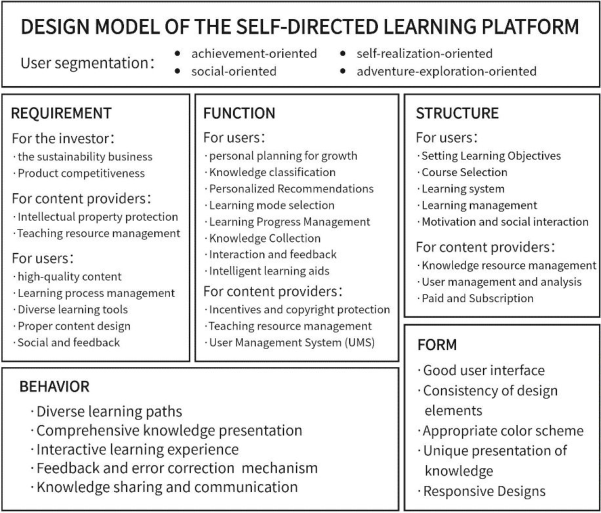
USER ANALYSIS Kahle proposed the concept of List of Value in 1988 (Kahle, 1988), in which it is stated that the ultimate value that users need mainly contains nine aspects, which are self-respected, sence of accomplishment, security, warm relation- ships with others, excitement, being respected, fun and enjoyment in life, self-fulfillment, and sense of belonging. Users use knowledge products for learning, with the basic purpose of acquiring knowledge and skills, prepar- ing for exams or promoting personal development. For users, the deeper value lies in finding their social positioning and sense of belonging or sat- isfying their sense of personal achievement. Learning is a crucial step in this process. Therefore, it can be said that users use self-directed learning plat- forms not only to achieve their basic goals, but also hope to realize their higher-level value pursuit through the process of learning with knowledge products. Based on this analysis, our article divides users into four cate- gories: achievement-oriented, social-oriented, self-realization-oriented, and adventure-exploration-oriented users.
Achievement-oriented users focus on personal achievements during the learning process and strive to reach their personal goals through learning.
Social-oriented users aim to acquire specific knowledge or skills to expand their social circles and integrate into organizations or groups. They actively engage in discussions and exchange activities.
Self-actualizing users are driven by their interests and seek to explore their passions and potential through learning, always pursuing innovation and breakthroughs.
Adventurous explorers are motivated by the pursuit of new experiences and the satisfaction of acquiring fresh knowledge. They seek to expand their cognitive horizons and explore the unknown, which serves as a compelling force driving their continuous learning journey.
A Model of Self-Directed Learning Platform for College Students Based 459
Online learning are different from traditional classroom education and online education in that their usage methods are more flexible and users have higher autonomy in the learning process. In the process of using self-directed learning product, a complete user behavior flow is: setting learning goals - selecting learning content - making learning plans - conducting learning - self-evaluation and feedback. During this process, the possible interac- tive behaviors of users include personal information and preference settings, browsing and searching for courses, planning learning goals and paths, con- ducting course learning, obtaining learning achievements, social interaction, course evaluation and feedback, creating learning notes and bookmarks. Therefore, the design of the products should take into account the value ori- entation of different users and meet their diverse needs through design as much as possible.
ANALYSIS OF THE DESIGN ELEMENTS OF SELF-DIRECTED LEARNING PLATFORM Requirement, function, behavior, structure, and form are the five key ele- ments in the early stages of product design strategy research. Defining products through these five elements is a necessary task in the early stages of design, and the design of self-directed learning platform is no exception. Next, we will analyze from these five aspects.
Requirement Analysis Requirement analysis is one of the important tasks in product design. The core value proposition of an self-directed learning platform is to provide users with learning resources and efficient learning strategies, and the core stake- holders in this process are platform investors, knowledge content providers, and users.
For the investor, in the design of the platform, the sustainability of its business model and market competitiveness need to be taken into account.
For content providers, the protection of intellectual property rights and effective management of teaching resources are the needs from self-directed learning platforms.
Users are key stakeholders in the product, prioritizing high-quality content and a user-friendly learning experience. Their needs encompass the supply of comprehensive knowledge content, personalized learning modes in line with cognitive laws, timely feedback mechanisms, and opportunities for inter- action with other users to enhance collaboration. Users also seek effective management of the learning process, diverse learning tools, and scientific learning programs that cater to different user types.
Based on this, it can be summarized that users’ needs include the following categories: first, the requirement for product content, including the supply of high-quality and comprehensive knowledge content; second, the requirement for effective management of the learning process to achieve efficient learning for users; third, diversified learning tools; fourth, the design of the content in line with the law of learning; and fifth, the requirement for socialization and learning feedback.
Function Analysis Function analysis is derived from requirement analysis, where product func- tions are designed to fulfill product requirements. Through requirement analysis, the core function of the product is identified as providing per- sonalized learning paths and content recommendations based on learners’ interests, goals, styles, and past performance. Hence, the product’s function- ality should cater to users’ needs for developing learning plans, personal competence planning, selecting learning resources, personalized learning functionalities, social interactions, motivation, and feedback. Additionally, it should address intellectual property rights protection, teaching resource management, and user administration functions.
Behavior Analysis In the design process of products, product behaviors refer to the way the product itself behaves or operates in order to achieve the corresponding func- tions. The design of these behaviors needs to take into account the learning habits and cognitive characteristics of users as well as the different purposes of knowledge learning. By designing product behaviors, self-directed learn- ing platforms can be made smarter and more user-friendly, enhancing user experience and learning outcomes. The product should encompass diverse learning paths, a comprehensive knowledge presentation, an engaging inter- active learning experience, a feedback and error correction mechanism, as well as facilities for knowledge sharing and communication.
Structure Analysis The structure of a product is closely related to its behavior, and refers to the organizational framework and layout adopted during the design and con- struction process of the product, so that users can easily use and access the information they need. The structural design of a product involves aspects such as information architecture, functional module division, and interface layout, aiming to provide clear navigation and a good user experience. Based on the above analysis, the basic structure of knowledge products is shown in the following table.
Table 1. Sample human systems integration test parameters.
Table available in the original PDF paper.
Structure Details Setting Learning Objectives Recommended Courses, Industry News, Expertise Capability Map, Learning Path Options Course Selection Classification of courses by subject, area and level of difficulty Learning text, images, video and audio; exercises and tests; social interaction Learning management History and Bookmarks Motivation and social interaction Achievement system and community Knowledge resource management Management of knowledge content by knowledge producers User management Management of users by knowledge producers
A Model of Self-Directed Learning Platform for College Students Based 461
Form Analysis The form performance of knowledge products is the direct interface for users to interact with the products, and the overall style of the product, interface interaction, responsive design and other aspects should be considered in the design. The overall style of the product should adopt a positive and lively style to create a learning atmosphere and a positive feeling. Combined with the use of different terminal equipment, the design process of knowledge products should pay attention to the interaction process and interaction logic of the product, to avoid excessive operation steps and operation processes that do not meet the user’s habits. In terms of colour performance, different learning processes and learning stages should be distinguished through certain designs, and courses of the same type should be marked with the same colour system.
DESIGN MODEL AND PLATFORM ARCHITECTURE CONSTRUCTION OF SELF-DIRECTED LEARNING PLATFORMS The self-directed learning platform discussed in this paper focuses on meeting the self-directed learning needs of university students. The platform serves as a bridge between educators and learners, offering a framework for knowledge generation and a learning path paradigm. Educators can use this platform to productize knowledge effectively. To facilitate efficient independent learn- ing, the platform includes clear planning functions for learning objectives and learners’ skill development. This allows learners to engage in person- alized learning with the platform’s assistance, which recommends suitable courses based on user preferences and characteristics. Knowledge produc- ers can leverage the platform for knowledge productization, while users can subscribe or purchase knowledge, creating a closed-loop business model. The following is a design model for self-directed learning platform.
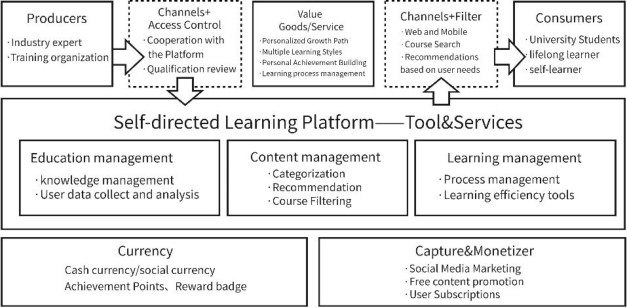
Paul Chaudhary, an expert in platform research, has developed the concept of the “platform canvas”, which suggests that the most basic structure of a platform is: Participants + Units of Value + Filters = Core Interactions
In this model, participants serve as both producers and consumers within the platform ecosystem. The value unit represents the products and ser- vices offered by the platform, with the platform facilitating the matching of producers and consumers through a filtering mechanism. Positioned in the middle layer of the architecture, the platform provides essential tools and services. Participants access the platform through various channels to engage with these tools and services, enabling core interactions.The platform’s tools and services are categorized into three main components: tools for value creation by producers, tools for content and user management by platform operators, and content and services for consumption by consumers. At the foundational layer of the platform, currency and realization components are situated. Combined with Choudary’s platform canvas theory, the platform architecture of an independent learning platform is shown below:
Figure 1: The design model of self-directed learning platform.Figure 2: The platform architecture of self-directed learning platform.
TYPICAL CASES STUDIES Through the previous analysis, it can be found that in the design process of the self-directed learning platform should fully take into account the needs of the learners in the learning process and the cognitive laws of the learn- ers themselves.Next, we will analyze several typical self-directed learning platforms.
Khan Academy Khan Academy is a nonprofit educational organization founded in 2008 with a vision to provide high-quality, personalized educational resources to
A Model of Self-Directed Learning Platform for College Students Based 463
students around the world through innovative educational models and tech- nologies. It is geared towards the self-directed learning needs of students, providing them with a wide range of free, high-quality content and enabling efficient learning through a simple and intuitive user interface. The following is an analysis of the design elements of Khan Academy.
Codecademy Launched in 2011, Codecademy is an online programming platform known for its interactive learning environment and user-friendly design. It features a split-screen layout that integrates tutorial content, a live code editor, and results presentation for seamless learning. With courses on popular program- ming languages and a step-by-step learning path, users can progress from basic concepts to advanced skills at their own pace. Table 2 provides an analysis of the design elements of Codecademy.
Table 2. Analysis of the design elements of codecademy.
Table available in the original PDF paper.
Design Elements Khan Academy Codecademy
Course Catalog
Requirement High-quality knowledge Programming learning Function Self-study tools Real time code compilation Behavior Suitable for self-study Split-screen design Structure Categorize knowledge by subject and grade level Form Distinguish courses by color Simple user interface
CONCLUSION
Online education is a hot topic in the future of education. Good design can promote users to use online education products. This paper takes self- directed learning platform as the research object, emphasizes the importance of user experience in design. It also proposes the functions that need to be included in self-directed learning platforms, including personalized learning paths, diversified learning modes, personal achievement management and learning process management. Overall, the article proposes a design model for an self-directed learning platform based on the five elements of design, and constructs the architecture of an independent.
REFERENCES
Bi, R. X., Chen, Y. L. (May 5, 2023), “Online ‘recharging’: university students learn by themselves through ‘surfing’ and ‘socializing’,” China Youth Daily, [Online]. Available: https://zqb.cyol.com/html/2023-05/05/nw.~D110000zgqnb _20230505_1-07.htm. CNNIC, (Mar 22, 2024)”The 53rd Statistical Report on Internet Development in
China,”Available: https://www.cnnic.net.cn/n4/2024/0322/c88-10964.html. K. Lee (2017). “Rethinking the accessibility of online higher education: A historical review,” The Internet and Higher Education, vol. 33, pp. 15–23, 2017.
L. R. Kahle and P. F. Kennedy, (1988) “Using the List of Values (LOV) to understand consumers,” Journal of Services Marketing, vol. 2, pp. 49–56, 1988. M. W. Lin, J. S. Xu, et al. (2023) “A review of emotion recognition of learners for
online education,” Control and Decision, vol. 39, no. 4, pp. 1057–1074, 2024. doi: 10.13195/j.kzyjc.2023.1400. Mohamed Ally (2004),”Foundations of Educational Theory for Online Learning.”in Theory and Practice of Online Learning, ed. Terry Anderson and Fathi Elloumi (Athabasca: Athabasca University, 2004): 3–31. T. X. Yang and J. Lei, (Aug 15, 2020) “Theoretical foundation and development
trend of online education,” Educational Research, vol. 41, no. 8, pp. 30–35. UNESCO (May 21, 2020)”Distance learning solutions,”. [Online]. Available: https://webarchive.unesco.org/web/20200521165003/https://en.unesco.org/covid 19/educationresponse/solutions. W. F. Qiao, W. T. Liu, and M. L. Li (2021), “Online teaching in the eyes of stu-
dents: Behaviors, effects, and challenges - Based on a survey of online learning behaviors of Tsinghua University students during the COVID-19 pandemic,” Tsinghua University Education Research, vol. 42, no. 1, pp. 57–66, 2021. doi: 10.14138/j.1001–4519.2021.01.005710.
LISTED IN THE AHFE DIGITAL BOOKSTORE CATALOGUE
Explore the complete digital volume
Usability and User Experience
Read this individual research paper free through the original publisher, or explore the full digital proceedings book.
ISBN 978-1-964867-32-8
Explore this ISBN in the AHFE Bookstore ↗Listed in the July 2026 bookstore catalogue; search by ISBN to confirm current availability · Digital book purchase optional