Krzysztof Fiok, Włodzimierz Choromański (2021). Lever Wheelchair for Disabled People: an Answer to the Increasing Demand for Wheelchair Mobility. In: Advances in Human Aspects of Transportation: Part II. AHFE Open Access, vol. 16. https://doi.org/10.54941/ahfe100673
Young, active disabled people with impairment of lower extremities tend to be as active, as possible considering their disabilities. For purposes of leisure and sport many wheelchair solutions have been already proposed, yet the struggle to provide efficient and economically rational means of transport that increase their mobility is still ongoing. According to various authors lever wheelchairs have certain advantages in the given field: ergonomic work conditions and high human work efficiency resulting from the lever drive concept. In our works we created a pre-prototype of such wheelchair. Our projects goal was to try to implement many different solutions which were to provide rich functionality: adjustment of levers’ length, adjustment of levers’ axis of rotation position, changeable gears including reverse gear, innovative brake mechanism. As a result we could assess which of the functional assumptions were reasonable and easy to implement and which could be useful however make the design very complicated, heavy and thus irrational. Our main conclusion was that if the lever driven wheelchair concept is to become popular, one of the key-issues in their design must be: simplicity. Additional functionality seems attractive during theoretical studies, but it’s implementation very often causes too much complication and weight gain.
Lever wheelchair concept is not a new idea. Already in 1970s in Germany this type of wheelchairs was not only known, but popular. According to a study (Blohmke F. et al, 1975) 52,3 % out of 3482 interviewed disabled people used lever wheelchairs. Later on however, the idea of using such wheelchairs was overthrown in favor of classic push-rim wheelchairs. What was the reason for this change? Obviously it had to do with strong and weak sides of both concepts and how they changed along with technical, material and social development of both wheelchairs and their users. As a result the present situation is, that 90% of all wheelchairs are classic push-rim wheelchairs (van der Woude LHV et al, 2001).
However, at the turn of centuries various people worldwide start again to bring up the idea of lever wheelchairs. Further changes in our communities, increasing demand for mobility of people with impairment of lower limbs, made the concept live again. And so we can observe various proposals for design of lever wheelchairs depending on their destination: from simple and cheap terrain-adapted wheelchairs dedicated for African societies (Massachusetts Institute of Technology MIT, 2014), through proposals of wheelchairs with complicated power transmission systems
(Taylor W. G., 1999), to compact, lightweight designs of wheels with levers that could be mounted on various wheelchair frames instead of classic wheels (Innovations Health Devices, 2012).
Figure 1. Various lever wheelchairs. From left to right: MIT design, Taylor W. G. design and Wijit wheelchair.
Analyzing figure 1 allows us to form a conclusion, that designs of lever wheelchairs can vary strongly depending on functional assumptions that were made in the beginning of their design process. While observing these differences we posed a question: which of these assumptions led to easily implementable solutions and which forced their designers to create sophisticated mechanisms that turned out to be too heavy, complicated or too expensive? Or maybe some of these assumptions are just, but haven’t been yet properly addressed? In order to try answering some of these questions we have built our own lever wheelchair pre-prototype.
FUNCTIONAL ASSUMPTIONS FOR OUR PRE-PROTOTYPE The functional assumptions for our lever wheelchair were derived from the purpose of constructing our pre- prototype: testing various ideas found in world-wide designs. Therefore the result-wheelchair was from the beginning condemned to become a test unit and not a real life wheelchair. As a result in our study we decided, that our lever-wheelchair will be:
1. Oriented for outdoor, terrain usage;
2. Dedicated for 50 percentile man (Polish);
3. Allowing ride in both front and rear direction achieved by the same move of pushing the levers;
4. Providing 3 changeable gears during ride in front direction;
5. Equipped with a brake that would work in 4 conditions: disallow rolling down a slope while allowing (at the same time) moving forward; disallow any movement (parking brake); allow movement backward while disallowing movement forward; allowing movement in both directions;
6. Allowing the user to control all brake and gear changes without moving hand from the grip;
7. Designed to allow slight modification in lever axis of rotation position (performed by a technician);
8. Designed to allow modification of levers’ length (performed easily, also by wheelchair user);
9. Providing the possibility of easy back wheel detaching and backrest folding for transport purposes.
DESIGNING THE LEVER WHEELCHAIR PRE-PROTOTYPE In order to bring to life sophisticated functional assumptions overcoming various design obstacles was necessary. Some issues regarding wheelchair design were solved with use of market-available parts (for instance gear mechanisms were bought from Shimano) whereas the wheelchair frame was designed and manufactured by Polish wheelchair company GTM-Mobil. However most of unique wheelchair mechanisms were of our original design. Because of the goal of the whole experiment, we didn’t focus on the wheelchairs appearance. Neither did we try to optimize shapes and precision of not important elements. During the design phase for us the key issue was if a given problem can be easily solved at a glance, requires longer consideration, or if even after considerable work spent on solving the problem it was hard to achieve success. For this reason some mechanisms were developed and successfully implemented, some were carried out, but with mediocre success and some were abandoned during manufacturing because of excessive design problems and complication.
Lever wheelchair pre-prototype overview
D
A
E
B
C
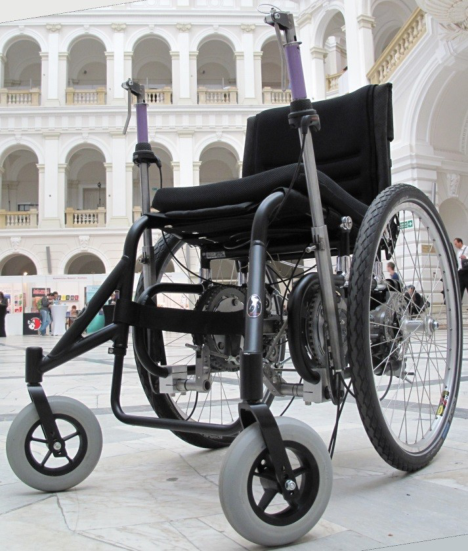
Figure 2. Overall view of the pre prototype.
The overall appearance of our wheelchair is dominated by main elements shown on figure 2: levers (A), big back (B) and front (C) wheels, typical wheelchair seat (D), frame (E) adapted to the wheels’ dimensions and to carry noticeable propulsion mechanisms.
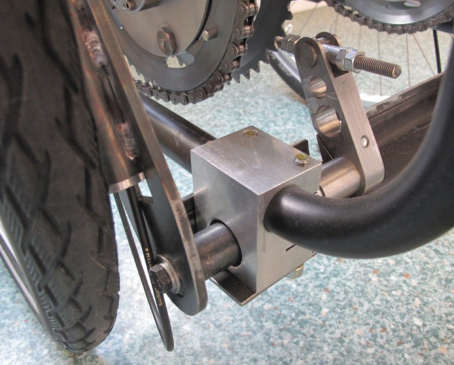
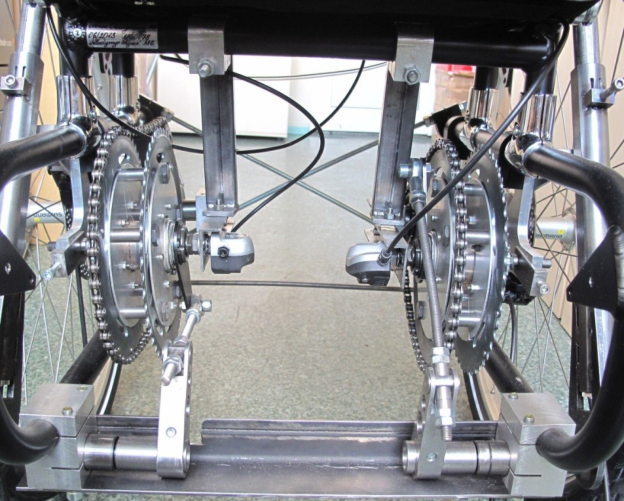
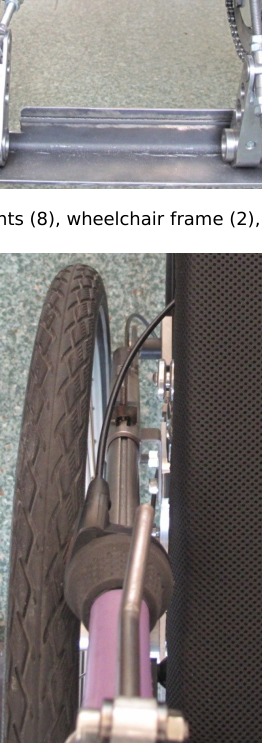
Wheelchair mechanisms A more precise look on the prototype allows inspection of various mechanisms implemented due to established functional assumptions. The mechanisms are presented in figures 3-5. Since the levers axis of rotation position was required by the functional assumptions to be moveable, it was placed in front of the back wheels axis. Such decision implied the necessity of placing the lever in between the back wheel and the seat (when looking from above on the wheelchair). Resulting geometrical dependencies are presented in figure 6.
1
B
4
3 2
Figure 3. Moveable mounting of the levers axis of rotation: lever (1); wheelchair frame (2); levers axis rotation fastening moveable along the wheelchair frame (3); back wheel (B); levers axis of rotation (4).
6
5
7
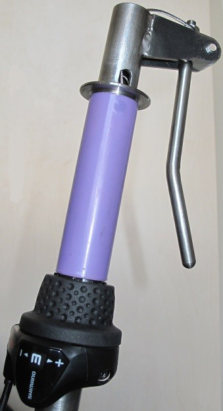
Figure 4. Grip with manipulation devices: service brake handle (5); grip with ride direction change (6);
Figure 6. View of the wheelchair from the top: geometrical dependencies between back wheel (B), lever (A) and wheelchair seat (D).The distances between lever and other elements are indicated on the figure.
DISCUSSION
Implementation of mechanisms realizing sophisticated functional assumptions was a hard task and was not always carried out with 100% success. In the studied case the setbacks were: Human Aspects of Transportation II (2021)
- Implementation of innovative braking system that could realize functional assumption nr 5. The braking system had to be invented specially for fulfilling this assumption. A special spring-based solution was proposed, which is now a subject of patent application. However the struggle to bring the invention to life demonstrated a serious of issues regarding control of the new mechanism which finally led to abandoning the concept in the discussed pre-prototype. It seems that even after overcoming encountered problems realizing this sophisticated braking system would require installing a significant number of small parts that on one hand would require precision in manufacturing and assembling and on the other hand would be probably characterized by low reliability. From our point of view at present even the positive impact of successful realization of functional assumption nr 5 would not pay for the design complication and loss of reliability. We recommend forming less demanding assumptions regarding lever wheelchair braking system;
- System for transmitting human push force from levers to driven wheels. Allowing adjustment of lever length and lever axis of rotation position required creating moveable parts and solutions which affected stiffness of the whole transmission system. As a result 2 iterations of adding elements increasing stiffness of the transmission system where carried out, however the results were still not fully satisfactory. Authors’ opinion on the issue is, that this problem must be solved and the solution should be optimized from the design complication and weight point of view. Stiffness of this system is way more important than providing the possibility of lever length and lever axis of rotation adjustments. This additional functionality should only be added in case if it doesn’t hinder the basic functionality. From our point of view it seems either very hard or impossible to maintain comparable systems stiffness without considerable weight growth while implementing assumption nr 7, therefore we recommend not to allow any adjustment of lever axis of rotation position;
- Implementation of functional assumptions nr 6 and 8. The possibility of manipulating gears and service brakes collided with possibility of easy changing lever length. The problem resulted from cords used to mechanically connect grip and manipulators with effectors (gears and service brakes). As a result changing lever length in the pre-prototype can be done with ease, however after performing such change the service brake and gear cords need to be adjusted in order to function properly. This cannot be done easily by the wheelchair user. Regarding changeable lever length: adding this functionality to a lever wheelchair design seems attractive and possible, however it requires clever design solutions not to hamper the more important functional aspect – manipulating gears and brake system without taking hand off the lever by the wheelchair user;
- System for forward-rear gear changing that would allow forward and back movement to be performed by pushing the levers (functional assumption nr 3). Authors of the pre-prototype tried to approach this issue in several ways, finally choosing, what seemed at the time, the best solution. In the end realization of this functional assumption caused major complication of propelling mechanisms and weight increase. Manufacturing and assembling parts without sufficient precision led to unsatisfactory performance of the mechanism. Namely one side of the wheelchair propulsion mechanisms worked almost correctly while second never managed to achieve the same performance. As a result during the alteration phase the mechanisms were uninstalled and substituted with a simpler version allowing only forward movement. In this case authors strongly recommend erasing this assumption. In case of lever wheelchairs designed for outdoor use the forward movement is dominating in 99% of the time. Moving backwards is only useful for maneuvers which do not require high speed or strength. Therefore in our opinion it is worth allowing the wheelchair user to pull levers during backward movement and pushing during forward movement: as a result the lever wheelchair gains simplicity, reliability and loses weight;
- Grip with ride direction change (6) shown on figure 4 didn’t work properly. The authors design was assuming that moving the grip up and down should change the ride direction. During tests it happened quite often that the user unwillingly changed the ride direction of one of the wheels because of the force exerted by the human arm that was aimed to push the lever. Unfortunately it appeared that it also moved the grip undesirably. Probably this issue can be solved and the gear changing mechanism can be integrated with ride direction change;
- Figure 6 demonstrates geometrical dependencies between wheelchair main elements shown in the view from the top. The distances between lever, back wheels and seat shown in the figure are small. Our tests shown that, in some cases necessary, exerting high force values (200-300 N) by the human arm and transferring it onto the lever caused slight “shaking” of the lever to the sides. This shows that the stiffness of the lever and the joints in the system for transmitting human push force was too low. Our conclusion in this case is that it might be hard to increase this stiffness in the given case. Increasing it in another design is possible, but will definitely cause weight gain.
Aside from negative conclusions, our experiment with constructing a lever wheelchair pre-prototype also led us to positive ones regarding some assumed functionalities:
- In the pre-prototype easily folded backrest was achieved by using a pre-designed market available solution (GTM-Mobil) and the possibility of detaching back wheels easily was achieved by our original design solution and worked in 100% as expected. Adding this facts led us to conclusion, that functional assumption nr 9 can be easily implemented without excessive complication of the design. Adding the fact that this functionality makes transport of a lever wheelchair much easier we highly recommend implementing this assumption;
- Designing the lever wheelchair as an outdoor transport mode seems just since its advantages are high human work efficiency and possibility to achieve high speeds (in comparison to classic push rim wheelchairs). As demonstrated in our pre-prototype, in a lever wheelchair it is not a problem to increase additionally front and back wheel sizes in order to make overcoming land obstacles easier. Performing tests on grass terrain showed how important these changes in design are. We strongly recommend adapting wheelchair tires and wheel sizes to the predicted terrain type of usage, as this does not hinder any other functionalities and fully compensates small increase of weight;
- Providing 3 changeable gears in the front ride direction required installing additional mechanisms in our wheelchair and mounting them onto the frame was a challenge. It complicated slightly the design and also added considerable weight (around 2,5 kg total). Nevertheless during test rides it proved to be worth installing. Building a lever wheelchair without changeable gears would either make it impossible to achieve any noticeable speed or make it very hard to start riding. Therefore we recommend implementing functional assumption nr 4 with the remark that it is positive to have wide spectrum of gear values (for example wider than found in some bicycles ranging from ~0,5 to ~2).
Our last and summing up conclusion was that probably designing lever wheelchair with levers axis of rotation position in the back wheels axis of rotation might be the right choice. Such solution would allow not to install many supporting, stiffness increasing elements. This would considerably decrease weight of the whole design. Also, implementing such idea would solve the problems shown on figure 6 – the lever can be placed simply “outside” the wheelchair, not in between of the back wheel and seat. In order to fulfill this proposal a designer willing to have changeable gears in the wheelchair will need to propose original gear mechanisms. Also, this approach would require original braking mechanism. Nevertheless, the work dedicated to realize this idea should pay out in a lightweight, compact design. From our point of view the Wijit design shown in figure 1 seems to be a proof that realizing this concept is possible.
ACKONWLEGMENT The described research was financed from the ECO-Mobility project WND-POIG.01.03.01-14-154/09. The project was co-financed from the European Regional Development Fund within the framework of Operational Programme Innovative Economy
REFERENCES
Blohmke F, Boenick U, Grazianski T, Nietert M. (1975), “Result of a user inquiry for the improvement of hand propelled wheelchairs” (author's transl). Zietschrift fuer Orthopaedie und ihre Grenzgebiete. pp. 264-270. Innovations Health Devices (2012), Wijit project website http://www.wijit.com
Massachusetts Institute of Technology (2014) website http://web.mit.edu Taylor W. G. Patent USA. 5865455. (1999) van der Woude LHV, Dallmeijer AJ, Janssen TWJ, Veeger D. (2001), “Alternative Modes of Manual Wheelchair Ambulation: An
Overview.” American Journal of Physical Medicine & Rehabilitation; Volume 10 No. 80 pp.:765-777.
LISTED IN THE AHFE DIGITAL BOOKSTORE CATALOGUE
Explore the complete digital volume
Advances in Human Aspects of Transportation: Part II
Read this individual research paper free through the original publisher, or explore the full digital proceedings book.
ISBN 978-1-4951-2098-5
Explore this ISBN in the AHFE Bookstore ↗Listed in the July 2026 bookstore catalogue; search by ISBN to confirm current availability · Digital book purchase optional