Mohamed ELLEJMI, Stephane Dubuisson, Marc Bonnier, Roger Lane (2021). Air Traffic Controller Workload Impact by Integration of Datalink System in an Advanced Airport Controller Working Position. In: Advances in Human Aspects of Transportation: Part II. AHFE Open Access, vol. 16. https://doi.org/10.54941/ahfe100711
Integrating a new system in the air traffic control system is always a big challenge, in particular when the new system impacts the controller human machine interface (HMI). The Controller Pilot DataLink Communication system for airport controller is a new concept that aims to reduce the voice communication and increase safety at airport. To prove and evaluate the concept, an experiment took place at airbus in Toulouse last December 2013 with the participation of air traffic controller from Germany, Italy and France. In this paper we explain the concept, we detail the experiment, we discuss its impact on the controller mental workload, we determine the side effects and we provide some recommendation for future implementation.
During the last decade, different tools were developed to ease the work of Air Traffic controller (ATCOs) to handle the increase on the traffic. Most of the time, when a new tool is introduced, new machines are added to the Tower Facility and the ATCOs have to handle more systems, more screens and more materials.
The project Advanced Controller Working Position, from the SESAR program1, tackles this issue by proposing the integration of the current and future system in a concept called Advanced Controller Working Position (A-CWP). The project studies also the impact of the integration of the different systems on the ATCOs situational awareness, workload and efficiency.
Among the system integrated into the A-CWP, the Airport datalink function called D-TAXI. D-TAXI is the exchange of standardised messages between a mobile (either a vehicle or an aircraft) and the airport ATCOs as defined by the datalink standard under development jointly by the jointly by the RTCA SC-214 with EUROCAE WG-78.
The purpose of the D-TAXI is to reduce the voice communication between the Tower and mobile at the airport by exchanging non-time critical messages which should solve two major issues: ATCOs workload and Driver or Pilot clearance message understanding. Some messages depend on the existing of other A-SMGCS function such as the routing function.
1 SESAR is a joint undertaking founded by the European commission and EUROCONTROL, the SESAR programme is building the future European air traffic management system
BACKGROUND
The first studies on D-TAXI focused on the technical feasibility and on-board guidance were conducted during the EMMA2 project2 and provide a very important contribution to the understanding of the concept and some recommendation for the future studies.
SESAR Project 6.7.3 (A-SMGCS Guidance Function) works on D-TAXI based on the work started on EMMA2 and the one performed jointly by the RTCA SC-214 with EUROCAE WG-78 to develop standards to define the safety, performance and interoperability requirements for Air Traffic Services supported by data communications.
SESAR Project 6.9.2 (Advanced Controller Working Position) focuses in developing a homogenous Tower Controller Working position based on the different concept developed in the other airport SESAR projects such as the guidance function, the main purpose of the project is to identify and describes in detail each role and responsibility which will interface with the future HMI taking into account, human, safety and other performance aspects.
Different validation exercise took place in the context of SESAR, to prove the concept and to investigate the impact of the integration into the advanced working position. A questionnaire and interviews were conducted to have ATCOs feedbacks. In the following paragraphs we start by explaining the concept, than we will describe the experiment and discuss its results.
OPERATIONAL CONCEPT AND OPERATING METHOD The operational concept and detailed operating Method are described in the Operational Service and Environment Definition document (OSED) from the A-SMGCS Guidance function.
The D-TAXI and Data Link for Vehicles services aim to reduce voice communication (R/T) by exchanging non- time critical messages between ATC and mobiles (Start Up, Push back, Taxi and Revised Taxi) by data link. R/T should be used on first contact with the ATCO and has to remain available at any time in case the Flight Crew, Vehicle Driver or ATCO need to revert to voice communication.
A prerequisite for D-TAXI to be used at an airport is that the following services are in place,
Data Link Initiation Capabilities (DLIC) enabling data link communication between ATC Ground and mobile systems. DLIC is initiated when the mobile wants to use Aeronautical Telecommunication Network (ATN) for communication purposes.
The DLIC service provides the log-on procedure to the ATN and exchanges the required application information. The DLIC process supports addressing requirements for Air Traffic Service Communication applications such as Controller Pilot3 Data Link Communications (CPDLC) The DLIC supports the update of application information;
The DLIC service propagates application information, implementing the contact procedure a given time before the centre exit;
ATC Communications Management (ACM) service provides automated assistance to the Flight Crew or Vehicle Driver, current and next controllers for conducting the transfer of ATC communications. Note: Only required if transfer of communication will be performed by data link.
The D-TAXI service for aircraft consists of the following seven sub-services:
Departure Taxi Route Information –information provided prior to departure on the departure taxi route as 2 EMMA2 “European Airport Movement Management by A-SMGCS, part 2” (EMMA2), an Integrated Project launched by the European Commission in its sixth framework programme
3 In this case Pilot indicates both Pilot and Vehicle drivers.
well as other departure information, it is foreseen that the Departure Taxi Route Information will be part of the DCL in the future
Start-Up – Approval for aircraft engine start-up as well as departure information.
Push-back – Approval for aircraft push-back from a stand as well as departure information.
Taxi-Out – Taxi route instructions for aircraft to taxi from a point on the airport to another point on the airport surface.
Arrival Taxi Route Information – The expected arrival taxi route as well as other arrival information provided to Flight Crews while still in flight.
Taxi-In – Taxi route instruction for aircraft to taxi from landing runway exit to another point on the airport, provided after clearing the landing runway.
Taxi Revision – Change to any previously delivered taxi route.
The Data Link for Vehicles service for vehicle drivers consists of the following two sub-services:
Proceed / Tow –instructions for vehicle drivers to proceed/tow from a point on the airport to another point on the airport surface.
Proceed / Tow Revision – Change to any previously delivered route.
The following figure provides an example of the operating method of D-TAXI for a pushback request.
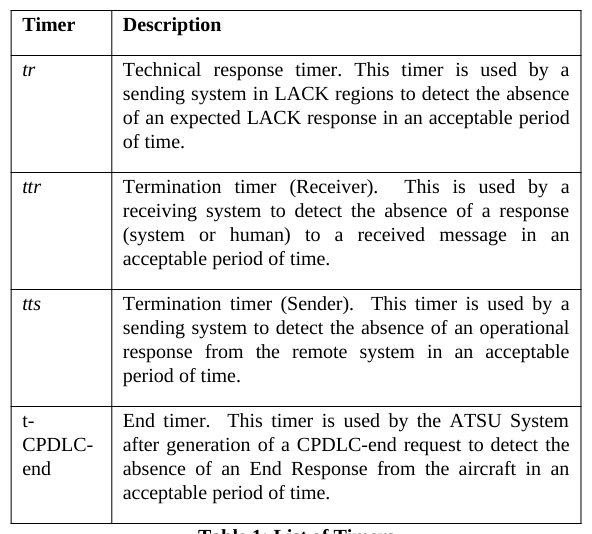
D-TAXI TIMERS MANAGEMENT A different timers were defines to deal with the different use cases such as delay in a response to a request message.
The list of timers as defined in EUROCAE WG-78/RTCA SC-214 is given in the following table:
Table 1: List of Timers
Figure 2 illustrates graphically the use of D-TAXI timers for a request issued by the flight crew on the airborne side. The timers tr, tts and ttr can be implemented on the ground side and/or on the airborne side.
Communications Airborne Side
Ground Side
REQUEST
tr
ttr
LACK
tts
CLEARANCE
Figure 2: Overview of D-TAXI timers
Figure available in the original PDF paper.
Operational values to be used for the ground timer ttr and tts are defined in Table 2:
D-TAXI transaction context Timer value Start-up, Push-back 45s
Update and simple taxi-out instruction 45s Simple taxi-in instruction 45s
Simple arrival expected taxi route 45 s Holding position instruction 45 s
Complex taxi in instruction (for large TMA) 100 s Complex arrival expected taxi route (for large TMA) 100 s
Table 2: Timer values with respect to D-TAXI transaction
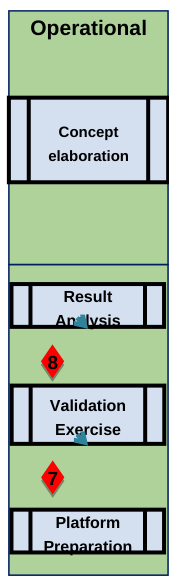
D-TAXI VALIDATION To prove the concept, a validation process was followed based on the E-OCVM European Operational Concept Validation Methodology (E-OCVM version 3.0) by EUROCONTROL.
The following diagram provides the workflow followed to validate the concept.
Operational Technical
Operational requirements OSEDs, SPRs
V&V needs V&V needs Plateform
Validation
Developed prototype
Report
Platform Modification
Modified Platform
Platform Integration
Integrated
Integrated
Platform
prototype
Platform Technical Acceptance
Accepted Platform
Figure 3: V&V life cycle
Figure available in the original PDF paper.
PLATFORM DESCRIPTION AND LIMITATIONS The exercise used a validation infrastructure composed of integrated components:
EUROCONTROL Integrated Tower Working Position (ITWP) simulator for Tower Runway and Tower Ground Controller Working Positions,
EUROCONTROL ITWP providing flight plans, airspace environment, tracks, pseudo pilot positions and time server.
Parkair System providing routing server system
AIRBUS cockpit simulator MOSART providing the AIRBUS 340 cockpit environment used to simulate 2 flights per exercise one on departure and one on arrival Validation infrastructure was installed at AIRBUS Toulouse premises. Interconnection of simulated platforms was performed using an agreed interfaces description.
The D-TAXI hardware infrastructure is not in the scope of the work, technical feasibility studies for the hardware was conducted on EMMA2 and continues in others SESAR projects (project 15.2.7 “Airport Surface Datalink” and project 09.16 “New Communication Technology at Airport” are addressing this technology. These 2 projects are contributing to EUROCAE WG82/RTCA SC223, the international WiMAX forum and the ICAO Aeronautical Communications Panel is planning to start developing Standards and Recommended Practices (SARPs))
DATALINK MESSAGES The following list details the Data link message set used to perform the validations. The messages come from the Working Group WG78 SPR version J. (the Version M was released after the validation plan was started)
Downlink Messages: WILCO,UNABLE,STANDBY, ROGER, AFFIRM, NEGATIVE,DUE TO [due to reason],Free text (From FC Only),Free text (for BTV EXIT),LOGICAL ACKNOWLEDGMENT,DE-ICING COMPLETE,REQUEST DEPARTURE CLEARANCE [departure clearance request],DE-ICING STARTED,FOR DE-ICING,ABLE INTERSECTION [intersection] RUNWAY [runway],REQUEST PUSHBACK, [pushbackpositionO], REQUEST START-UP,REQUEST TAXI [taxi requestO],REQUEST EXPECTED TAXI ROUTING [taxi request].
Uplink Messages: UNABLE, STANDBY, [departureClearanceR], CONTACT [unit id] [frequencyO], MONITOR [unit id] [frequencyO], LOGICAL ACKNOWLEDGMENT, CURRENT ATC UNIT [unit id], START-UP APPROVED [assigned timeO], PUSHBACK APPROVED [pushback positionO] [assigned timeO ], EXPECT [clearance typeR] [assigned time ], EXPECT TAXI [taxi route] [taxi durationO], RESUME TAXI [taxiresumeconditionO], RUNWAY [runwayO] TAXI [taxi route], DE-ICING APPROVED, HOLD POSITION, FOR DE-ICING, CAN YOU ACCEPT INTERSECTION [intersection] FOR DEPARTURE RUNWAY [runway], REVISED [revision reasonO], [distance ground] AVAILABLE, HOLD SHORT [ground locationR] VALIDATION PROCEDURES, SCENARIOS AND ASSUMPTIONS
According to the E-OCVM guideline, a validation plan was produced in which the procedures were detailed; the following is an extract from the procedures that were applied during the validation exercise:
During simulation runs with D-TAXI the participants should try to use data link at all times unless instructed not to by the simulation supervisor or in cases where the participant needs to use R/T to clarify a situation or where it is considered that the data link messages available are not sufficient to cover the operation need (e.g. a complex push back instruction)
On first contact with a new sector (e.g. Tower Ground Controller) the Flight Crew (FC) shall make a radio check before commencing to use data link. This R/T check is not required if the previous sector has instructed the FC by R/T or data link to Monitor the next frequency.
The mixing of R/T and data link instructions is permitted, e.g. if the FC commence to use data link and then use R/T it is ok to revert to using data link.
When a Data link message sent by the FC times out the FC can either send the message again or contact ATC by R/T
When a Data link message sent by the ATCO times out the ATCO can either send the message again or contact the FC by R/T The operational environment used for the validation was based on the Paris-Charles de Gaulle (LFPG) airport environment. The traffic samples were based on real flights using Paris CDG, however the parking stands have been modified to suit the northern part of the airport environment. It is not possible to control the arrival flights during the approach phase, so they were pre-programmed for normal spacing on Runway 27R with some landing also on Runway 27L. Departure flights had a programmed EOBT (Estimated Off Block Time) and it was up to the ATCOs to decide whether the flights could commence at these times, subject to the operational situation at the time during the exercise run.
The validation objectives includes more subjects than D-TAXI and its integration into the HMI, but hereafter we focus only on the objectives related to the D-TAXI.
In order to access the D-TAXI objectives, the samples had 85% of the aircraft data link equipped. Each traffic sample contained several flights where the aircraft type was an Airbus A340, and the flights were either arrivals or departures and had different assigned parking stands. Any one of these flights could be selected prior to the start of an exercise run to be the flight performed by the AIRBUS Cockpit simulator. The flight was selected according to the objective that was tested during the exercise run. The Ground South position managed flights arriving to and departing from Terminal 2 B and D Aprons but only planned to use the northerly runways.
4 traffic samples were defined.
Traffic sample 1 = 85% Data link Equipped – 60 minutes with 36 ARR, 39 DEP and 3 Vehicles Traffic sample 2 = 85% Data link Equipped – 60 minutes with 36 ARR, 36 DEP and 3 Vehicles
Traffic sample 3 = Low Visibility – 60 minutes – Based on R67B_100H sample with 30% less Arrivals and Departures (28 ARR, 28 DEP) and 3 Vehicles Traffic sample 4 = De-Icing planned for 40% of departures – Based on R67B_200H sample (36 ARR, 36 DEP (of which 15 require remote DE-ICE) and 3 Vehicles)
A total of 12 runs were conducted, each run last one hour. Each run corresponds to a pre-defined scenario using one of the traffic samples.
4 ATCO from France, Italy and Germany and 8 pilots participated to the validation for one week.
In order to prepare the ATCOs for the Validation, a dedicated training session was organised at EUROCONTROL EEC Bretigny using a 3D Tower simulator and the ITWP platform.
D-TAXI VALIDATION ANALYSIS METHOD The main source of data comes from using subjective methods of analysis: observations, questionnaires and debriefings.
Observations Observation was used to gain an indication of:
o Controllers situation awareness, for example failure of controllers to identify certain events / potential hazards o The usability and utility of the HMI, for example controllers’ difficulty in the HMI, and possible errors they may perform when interacting with the Platform; suggestions for improvement and other general observations, comments and remarks.
Questionnaires A number of different questionnaires were used throughout the evaluation to gain the necessary feedback from the participants regarding the D-TAXI functions and its integration into HMI.
Post exercise questionnaire The post exercise questionnaire contains open questions for controllers to note down any additional comments relevant to the exercise just completed.
Post simulation questionnaire A bespoke post simulation questionnaire was used to gather all the relevant information regarding the Data link D- TAXI functions and its integration into the HMI.
The final questionnaire was distributed to participants at the beginning of the evaluation, to enable them to understand the feedback required from the evaluation in terms of utility and usability. However, the participants were requested to fill it out on the last day of the evaluation.
The Human Performance KPA has been addressed by assessing the impact of the new concept on situation awareness and mental workload areas. Questionnaires have been created for both domain based on models developed in the EUROCONTROL SHAPE (Solutions for Human Automation Partnerships in European ATM) project which objective was to assess the impact of new automation on the human operator. The SHAPE project has yielded a set of questionnaires which assess the impact of automation on workload AIM-s (Assessing the Impact of Automation on Mental Workload), situational awareness SASHA (Situation Awareness for SHAPE) but also teamwork and trust.
Debriefings Post exercise technical debriefing
After the controllers have completed the questionnaires a short post-exercise debriefing led by the operational experts took place. The debriefing gave controllers and pilots the opportunity to discuss any issues which have arisen during the previous exercise.
Post-evaluation debriefing A post evaluation debriefing was held at the very end of the evaluation session after the final questionnaire have been completed and collected.
The success criterion for the evaluation of every objective was depending on the controllers feedback collected during the simulation session. Using the rating scale, controllers rated the degree to which they agreed/disagreed with the statements developed by the validation project team to assess the usability and utility of every function under test. Each item has a six point scale ranging from from 1 “strongly disagree” to 6 “strongly agree”.
Analysis of the collected data quantified the degree of agreement/disagreement with regards to the addressed validation objectives.
The Objectives set are related to the D-TAXI messages content, the utility of the message and the usability of the HMI, for example: Utility & Usability of Revised Taxi Function
TU01. The Revised D-TAXI is useful Results – ATCO=6 APRON=4 Mean=5
TU02. The Revised D-TAXI Taxi Update is easy to use Results – ATCO=3.5 APRON=3 Mean=3.25
RESULTS ANALYSIS During the experiment, we had two groups of people: ATCOs managing the Ground and the runway movements and Apron Managers.
Situation Awareness The overall resulting means for the exercises where the D-TAXI operations were used are:
For the Tower Ground North Controller 4.02. This corresponds to a “Good” level of situational awareness.
For the Tower Runway Controller 4.91. This corresponds to a value close to a “Very Good” level of situational awareness.
These results indicate that the Data Link function, with its associated HMI elements, maintains the controller’s situational awareness to a suitable level to perform his/her tasks; the figure below details the ATCOs’ answers to the SASHA questionnaire:
7
6
5
4
Scale from 1 to 6
3
GND North Runway
2
1
I was able to plan I was surprised
I had to search
During the exercise I started
During the exercise There
by a an event I for an item of
During the exercise I was more ahead of the
was a risk of
and organise my work as I wanted did not expect
information
traffic at all
to focus on a single problem or
(like an a/c
times?
a specific area of
calling )
the airport?
forgetting something important ?
Figure 4: Situation Awareness results for Ground North and Runway controllers Questionnaires were also filled in for 1 baseline exercise without the Data Link function activated. The purpose was to assess the difference, if any, of the controller workload between the two scenarios.
Figure available in the original PDF paper.
For the Tower Ground North Controller 5.33. This corresponds to a “Very Good” level of situational awareness. Compared to the result in Data Link environment, 4.02, there is a decrease of situation awareness on the Tower Ground position in Data Link environment. This can be explain that the initial exercises were still sort of training exercises for the controllers and results were hence affected. Nevertheless the situation awareness in D-TAXI environment remains good and acceptable for the Tower Ground controller to perform his/her tasks.
For the Tower Runway Controller 5. This corresponds to a value close to a “Very Good” level of situational awareness. Compared to the result in D-TAXI environment, 4.91, there is a nearly no change in controller situation awareness which can be explained by the fact that Data Link do not concerned too much the Tower Runway position.
Safety The safety aspects linked with the introduction of D-TAXI and Routing functions were addressed in the questionnaires where three questions were asked to ATCOs and Apron managers.
The table below provides the results for both groups of people.
Table 3 Safety results for ATCOS and Apron managers
We can observe that the ATCOs are positive concerning safety aspects linked to the introduction of the new concept as no critical safety element was identified.
The Apron Managers are more sceptical and not convinced of the safety impact either negative or positive of the new concept on apron operations. This can be explained by the fact that it was the first time that data link and routing functions were simulated on the Apron area and tested by Apron managers. This clearly shows that apron managers are lacking experience of the concept and need to perform additional evaluations. It is to note that these results are also in line with the situation awareness results with the same explanation Mental Workload
ATCOs were asked to fill in an AIM-s (Assessing the Impact of Automation on Mental Workload) questionnaire after every exercise and were asked to rate the degree to which they agreed/disagreed with eight statements in order to measure their level of mental workload during the just completed exercise. The final result provides a mean on a scale from 1 to 6 where the level of mental workload can be considered as 1: none 2: very little, 3: little, 4: much 5: Very much 6: Extreme.
The overall resulting means for the exercises where the D-TAXI operations were used are:
For the Tower Ground North Controller was 1.84 which indicates a value between “None” and “Very little” workload, which is a satisfactory.
For the Tower Runway Controller was 1.43 which also indicates a value between “None” and “Very little” workload, which is again satisfactory.
The result for the baseline exercise without D-TAXI gives a result of 1.4 for the Tower Ground North controller and 1.00 for the Tower Runway controller. This indicates that without D-TAXI, the mental workload was even lower which is normal since it corresponds to today operations.
Detailed results for controller workload are represented in the figure below. We have mentioned the questions on these two graphics, nevertheless the beginning of each question has been deleted “During the exercise how much effort did it take…”.
4
3
Scale from 1 to 4
2
1
Runway GND Runway GND
Runway GND Runway GND
Runway GND Runway GND
Runway GND Runway
GND North North
North North
North North
North North Effort to plan
Effort to issue Effort to issue
Effort to access relevant Effort to prioritise
Effort to manage the data link HMI?
and execute movements on
Effort to prioritise requests?
Effort to maintain an overview of the
timely clearances by
timely clearances by
tasks?
data link?
R/T?
aircraft information?
traffic situation?
the ground using data link Push Back and
Figure 5: Mental Workload results for Ground North and Runway controllers
Figure available in the original PDF paper.
CONCLUSIONS
This paper describes some of the result of the validation exercise conducted in the context of the SESAR program to validate the integration of the D-TAXI concept into an Advanced Controller working position.
The results of the experiment and the very positive feedbacks collected from the Air Traffic controllers’ show that not only implementing datalink function has a very little impact on their mental workload but it can improve the safety at airport. All ATCOs agree that they were not confused when applying procedures using both datalink and R/T and that they can manage the datalink communication appropriately.
Despite the lack of training on the new system, the controllers were able to learn quickly and use efficiently the advanced controller working position, they found most of the D-TAXI messages useful but depending on the controller expertise and local implementation procedure some of the messages are less important for implementation.
The controllers highlighted a Human factor issue as in a voice communication they can have an additional feeling about the pilot readiness to execute a clearance; this feeling is removed by using datalik.
Another known issue is the situation awareness of the other users during a “silent communication” as in today’s operation; the other users listening to the frequency can have more information about what is happening around them. A possible enhancement can be to offer to the user the possibility to subscribe to all datalink exchange that is for interest for him, this feature should be further investigated.
REFERENCES
ED-78A, Guidelines for Approval of the provision and use of Air Traffic Services supported by Data Communications ICAO Doc 9694, Manual Of Air Traffic Services Data Link Applications, 1st Edition 1999 ICAO Doc 9476, Manual of Surface Movement Guidance and Control Systems (SMGCS), 1st Edition 1986, 2nd Amdt 1987 ICAO Doc 9830, A-SMGCS Manual, 1st Edition 2004 ICAO Annex 14, 5th Edition 2009, Vol. I 10th Amdt. Jörn Jakobi et al (2009), EMMA2 Recommendations report. RTCA SC-214/EUROCAE WG-78, Air Traffic Services Safety and Interoperability Requirements, Version H, 03/02/2010 SESAR Joint Undertaking, http://www.sesarju.eu. SESAR, DEL06.07.03-D10-Final OSED V00.01.00, 2012 SESAR, DEL06.07.02-D07-Data link routing information - development (V2) V00.01.00, 2012 SESAR P06.07.02 D80 Validation Plan (VALP) D80 V1.0, 10 December 2013 SESAR P06.07.03 D81 Preliminary VARL Advanced routing V0.0, 29/01/2013 Thomas Ludwig et Al, Implementation and validation of TAXI-CPDLC functionality within the EU Project EMMA2, ICAS2010
LISTED IN THE AHFE DIGITAL BOOKSTORE CATALOGUE
Explore the complete digital volume
Advances in Human Aspects of Transportation: Part II
Read this individual research paper free through the original publisher, or explore the full digital proceedings book.
ISBN 978-1-4951-2098-5
Explore this ISBN in the AHFE Bookstore ↗Listed in the July 2026 bookstore catalogue; search by ISBN to confirm current availability · Digital book purchase optional