Caitlin Anne Surakitbanharn, Steven J. Landry (2021). Development and Application of a Hybrid Control Theory Model to Quantify Human-Machine Interaction Problems on the Flight Deck. In: Advances in Human Aspects of Transportation: Part II. AHFE Open Access, vol. 16. https://doi.org/10.54941/ahfe100707
Previous work has been conducted by McRuer [McRuer, 1973] to model the gain and delay of the pilot-aircraft system using classic control theory methods. However, a continuous extraction of gain and delay further enhances the ability to gather valuable, quantitative data to make inferences about human-machine interaction problems that occur on the flight deck. A parameter tracking system, based on McRuer’s crossover model, has been developed to simultaneously and continuously track the gains and delays at the pilot-machine interface with which pilots track particular axes. The values extracted for gain and delay may be indicative of particular human factors issues that are prevalent in the cockpit, such as inattention, complacency, low situational awareness, and high workload. This model has been developed for use in an artificial tracking task, where it has been observed that if gain and delay are allowed to change freely, the model is overfit and not realistic, as it is believed that gain and delay change rarely, though not necessarily slowly. To combat this, one gain/one delay is applied to the system to find time periods where the fit is poor, and these frames of time are then re-evaluated to find a gain/delay value that fits, and this method is applied across all poorly fit time periods to create a well-fit model. This method of modeling is then applied to a realistic flight simulation task for pilots and is intended to evaluate the levels of gain and delay for specific human-machine tasks incurred on the flight deck, and which axis are affected the most in flight.
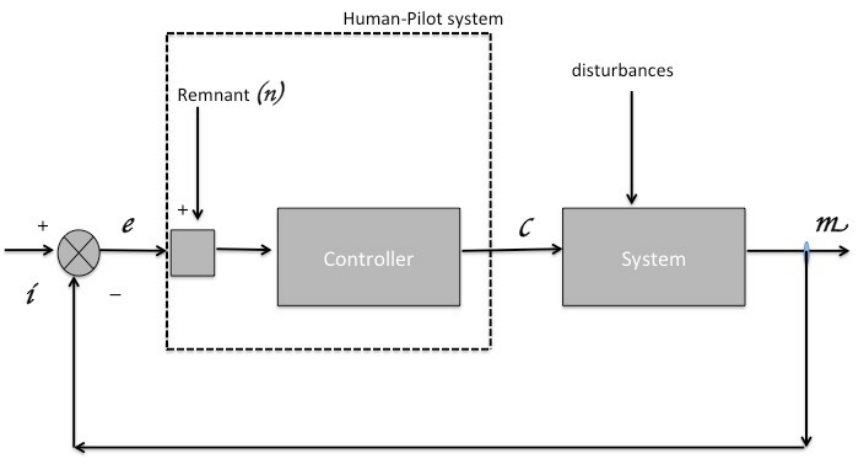
The pilot-aircraft system as defined by McRuer states that the pilot and aircraft must be analyzed as one system, wherein the pilot reacts to displayed errors (e), normal and desired command inputs (i), and vehicle output motions (m) in order to produce control actions (e). This closed-control loop is illustrated below in Figure 1.
Human Aspects of Transportation II (2021) https://openaccess.cms-conferences.org/#/publications/book/978-1-4951-2098-5
Figure 1. Pilot/Aircraft Closed Loop Control Circuit (Adapted from McRuer, 1973)
The remnant (n) and controller transfer characteristics are functions of operator, procedural, and environmental variables. That is, the decision making process for control actions is affected by the operator, procedures, and the environment. Once a control action is decided, it is performed by the Human-Pilot system and input into the system, which could be the rudder, the yoke, the elevator, a display etc. Disturbances also feed into the system occasionally. Once a control action is performed in the system, an output is recorded (m). If disturbances were present, the system output may not be desirable, resulting in an error, which will loop, back to the beginning of the system [McRuer, 1973] [McRuer, Krendel 1974].
This closed-loop control circuit is repeated several times throughout a given flight, and several loops may be present in the system at once [4]. In order to accomplish control and guidance of the aircraft, the pilot sets up many of the loops around the airplane, which could not perform these tasks by itself. For example, in order to increase the altitude of the aircraft, the pilot-human system may set up a closed loop around the aircraft elevator, around the aircraft yoke in the cockpit, and perhaps around radio as well. In this case, remnant transfer characteristics and control characteristics could be prior experience and knowledge of the operating pilot, physical condition of the pilot, time into flight (take-off, climb, cruise, descent, etc), standard operating procedures of the aircraft, governing aviation body rules and regulations, and/or weather conditions (Instrument or Visual Flight conditions).
Continuing the example of the control circuit around the aircraft elevator, the desired command input would be to increase altitude by 1,000 ft. The human-pilot system would decide on a course of action, given the transfer function characteristics, inside of the human-pilot system loop, and would then produce a control action, c, which feeds into the system. Here, the pilot would decide to pull the yoke of the aircraft to move the elevators of the aircraft upward. The system then processes the control action, and produces an outcome, or movement, m. The aircraft would, given the control action, tilt upward and climb in elevation. If the outcome is not the exact desired outcome, such as the aircraft climbed to a higher elevation than desire, and error would read back into the system (altimeter would show the altitude is too high), and the control loop would continue onward.
Of particular interest in these closed-loops circuits are the effective gains and delays incurred while these inputs and errors are occurring. Delays can be defined as the amount of time it takes for the human-pilot system to recognize the error, and Gains can be defined as the aggressiveness of the response; that is, how quickly the operator attempts to null the error.. Understanding the gains and delays of the human-pilot system are expected to be indicative of particular human-machine interface problems, such as situational awareness deficiency and reduced vigilance. These metrics may also help to identify periods of high or low workload in the cockpit [Ramadge, Wonham, 1987].
Human Aspects of Transportation II (2021) https://openaccess.cms-conferences.org/#/publications/book/978-1-4951-2098-5
APPROACH TO FIND HUMAN-MACHINE INTERFACE ISSUES (METHODS) In order to attempt to correlate variances in errors and the changes in the control parameters (gain and delay) in a single closed-loop event, it is valuable to determine several components for evaluation. First, the event must be defined, such as increasing aircraft altitude. Secondly, the event states must be defined, such as aircraft not climbing, aircraft climbing, etc. Next, the transitions between states must be identified. Finally, it must be determined which states are desirable and which states are undesirable. From this information, it is possible to evaluate what causes or influences transitions into undesirable states. Following the previous example of attaining desired altitude; a state model is defined in Figure 2. This state model is based on the assumption that the states of the system are closed over m, where m is defined as m=1 (¬ desired altitude) or m=2 (desired altitude) [Landry, 2010]. It is also assumed that the states of the system are closed over m.
This kind of state model can be applied to any closed-loop circuit that the human-pilot system enacts onto an aircraft. In the given example, the output of the function is m=2, the desired altitude. 1a is the current state of the system, or the current action of the airplane, and state 1a1’ are the future states of the system. The importance of these state models is to help determine which states are undesirable, and then these states can be further evaluated to potentially determine what factors cause the transition from a desirable state into an undesirable state. In this example, an undesirable state is one which does not directly lead to reaching the output goal state, m=2. These states would be { 1a1, 1a3 1a1’, 1a’2a, 1a’4a} as these states do not sufficiently lead to from m=1 to m=2 without transitioning to another state [Landry, 2010].
From this perspective, it is interesting to look at what behaviors or factors cause the system to be in undesirable states, and what behaviors or factors cause transitions from desirable states to undesirable states. Regarding the given example, it would be valuable to look at what causes the system to go from 1a2, the aircraft is descending or climbing to reach its desired altitude, to 1a1, the aircraft is not climbing or descending but has not reached its desired altitude.
The McRuer crossover model, which was previously developed, extracts continuous delays and gains, where the pilot-aircraft system is modeled as an integer of error with gains and delays. However, in the last 30 years, flight characteristics have changed, and large portions of all flights are flown using autopilot. Autopilot behavior is mostly uninteresting, as changes to the aircraft behavior are typically small and fairly routine throughout the flight, unless initiated by the pilot. However, there are parameters associated with the pilot’s discrete control behavior, such as the pilot’s selection of autopilot settings or modes, which is interesting, and defining the behaviors and factors which result in undesirable autopilot settings or mode selections could provide valuable insight into human-machine interface issues. Tracking this discrete behavior, however, is challenging, as there is no McRuer crossover equivalent for tracking discrete control systems.
DEVELOPMENT OF DISCRETE CONTROL A discrete event system is a dynamic system that evolves by way of abrupt occurrences of physical events at unknown intervals. The large goal of discrete control attempts to disable events that cause undesirable transitions, and enable events that cause desirable transitions [Wickens, 2008]. That is, try to disable the human-pilot system from performing the undesirable transition from state 1a2 to 1a1, and put controls in place to help enable the desirable transition from 1a1 to 1a2. A discrete control model can be theorized as follows:
G=(Q, Σ ,δ ,q0,QM ) where :Q=set of statesΣ=set of eventsδ=transition functionbetween statesof givenevents qo=initial stateQ M=¿of marker statesof interest In this model, G can be thought of as a “device that starts it its initial state,” or in this case, G is the aircraft or the part of the aircraft in which control is being applied to achieve a desired state [Wickens, 2008]. It is also of value, from a human factors perspective, to track the delay in the event occurrence. That is, it is interesting to track how long it takes for the human-pilot system to recognize that there is an error in the system Human Aspects of Transportation II (2021) https://openaccess.cms-conferences.org/#/publications/book/978-1-4951-2098-5
(delay, τ ¿, and it is also worthwhile to note how long it takes the human-pilot system to apply control to the system to correct the error (gain, k).
Figure 2 : State Model for Desired Altitude
APPLICATION OF THEORIES TO DETECT FAULTS Human Aspects of Transportation II (2021) https://openaccess.cms-conferences.org/#/publications/book/978-1-4951-2098-5
In order to determine if discrete control theory will help to answer the human-factors issues that arise in transitioning between desirable and undesirable states, several questions will attempt to be answered.
The first question is to determine if error variance correlates with workload. In order to test this theory, a human- subject experiment will be necessary. Human subjects (pilots) will be placed in a simulated flight environment where flight conditions will be presented under various conditions of workload. Workload conditions will vary according to multiple resource theory, where some tasks will come up unexpectedly when the pilot has additional resources available, and some tasks will come up unexpectedly where the demand for resources will exceed what is available [Wickens, 2008] [McRuer 1980]. Error variances will be then compared with NASA-TLX models to determine if they are correlated.
The next question is to determine whether control mode can be reliably identified. This will also require a human experiment where subjects are placed in a simulated environment where flight is presented under various conditions of workload, where workload expectations continue to be established by multiple resource theory. In this experiment, under various unexpected situations, the subject will have the method of control applied to correct a system error recorded, as well as have eye movements tracked. After the experiment is over, subjects will be interviewed and asked to report their control strategy. Although this data will be subjective, it will help to determine if the control method reported by the human subject and the apparent control method applied (determined by observing actions taken and eye movements) seem to match up appropriately.
Thirdly, it is invaluable to determine if delay and gains can predict human-machine interaction problems. A preliminary experiment to potentially prove or disprove this theory has been developed, where the subject is given a simple tracking task (a blue bar moves away from the center of the screen at random intervals) and the subject must use the mouse or tracking device to correct it back to the center. The amount of time it takes for the subject to initially begin moving the bar back to center is recorded, as well as the amount of time it takes for the bar to reach the center once the initial control is applied. This model is the first step in building a system that could track the gain and delay of a pilot correcting minor errors that present throughout a flight. While the current version of the experiment does not have human factors controls, such as the subject being subjected to a high workload or a low workload while tracing the bar, these may be implemented in the future to determine if there is any correlation between the values of gain and delay and the amount of workload. This tracking task is continues to be in- development, and key hurdles include an over-fit model which is generally not realistic due to these parameters being able to change freely, where in reality, gain and delay may change infrequently, but not necessarily slowly. In order to attempt to combat this, the model is being fit using one gain/one delay for a small portion where the fit is poor, and another gain/delay value is being used to fit the next portion of the model, etc. This method is being employed in hopes of creating a pieced-together but overall well-fit model for tracking gain and delay.
Finally, it is important to answer if the delays and control discrepancies can be clearly identified. While this question’s answer is the least developed, it is essentially the final step in determining if human-machine interface issues and human-factors problems can explain gain and delays in the human-pilot-aircraft control loop, and determine if paths from desired states to undesired states can be disabled. Methodology for answering this question will contain modeling open-loop flights first, and then closed-loop flights to compare what kind delays are incurred and which control measures are applied, but full determination of testing theories is beyond the scope of this paper.
CONCLUSION
When using a modified version of the McRuer crossover method to model the human-pilot and aircraft as a closed- loop system, it becomes potentially possible to determine various desired and undesired states in a given physical event during flight. When these states are evaluated, it may be possible to enable desired states and disable undesired states through discrete control theory. Unfortunately, no discrete control theory equivalent of the McRuer model exists, but development and capture of the gains and delays which occur in the system during an event when an error is presented could help to show human-machine interface issues which are prevalent. The understanding of this could lead to measures to disable undesired events and also help disable transitions from desired events to undesired events. In order to do this, a tracking task is being developed which is intended to be applied to a human- Human Aspects of Transportation II (2021) https://openaccess.cms-conferences.org/#/publications/book/978-1-4951-2098-5 subject (pilots) simulation to evaluate the levels of gain and delay. These values may help understand human factors issues which occur on the flight deck and how this affects the flight itself.
REFERENCES
Landry, S.J. , Lagu, A. Kinnari, J. (2010). “State-based modeling of continuous human integrated systems: An application to air traffic separation assurance.” Reliability Engineering and System Safety. Vol 95. Issue 4. April 2010. Pg 345-353. McRuer, D. (1973). “Development of Pilot-in-the-Loop Analysis.” AIAA Guidance and Control Conference, Stanford, CA,
1973. McRuer, D. (1980). “Human Dynamics in Man-Machine Systems.” Automatica. Vol. 16, Issue 3. May 1980, pg. 237-253 McRuer, D. Krendel, ES. (1974}. “Mathematical Models of Human Pilot Behavior.” Advisory Group for Aerospace Research, France. Pg 25-39. Ramadge, P. J., & Wonham, W. M. (1987). Supevisory control of a class of discrete event processes. SIAM Journal of Control
and Optimization, 25, 206-230. Wickens, CD. (2008). “Multiple Resources and Mental Workload.” Human Factors: The Journal of Human Factors and Ergonomics Society. June, 2008, vol. 50, no.3. pg 449-455.
Human Aspects of Transportation II (2021) https://openaccess.cms-conferences.org/#/publications/book/978-1-4951-2098-5
LISTED IN THE AHFE DIGITAL BOOKSTORE CATALOGUE
Explore the complete digital volume
Advances in Human Aspects of Transportation: Part II
Read this individual research paper free through the original publisher, or explore the full digital proceedings book.
ISBN 978-1-4951-2098-5
Explore this ISBN in the AHFE Bookstore ↗Listed in the July 2026 bookstore catalogue; search by ISBN to confirm current availability · Digital book purchase optional