Massimo Musio-Sale (2022). Human Factors in Yacht Designfor Older Adults. In: Advances in Human Aspects of Transportation: Part III. AHFE Open Access, vol. 17. https://doi.org/10.54941/ahfe100721
An ergonomics oriented toward older adults has responded to increasing social expectations, particularly since late in the 20th century. The popularity of yachting as a form of recreation for the middle class has grown since 1945, while average life expectancy has increased considerably over the past few years only, reflecting improved general economic conditions, better healthcare and nutrition. A higher general retirement age, and advancements in all life phases, also associated to a larger access to higher education have enabled the financial independence and economic security of adults in old age. Until late in the 20th century, adults aged between 60 to 70 years were frequently regarded as an old age group. Individuals who lived to age 90 may have been considered decrepit at the time. Conversely, individuals aged 80 or 90 today sport, on average, a high degree of interest for life and unprecedented physical potentiality. This vitality is also in association with the upper middle classes in terms of income and wealth, which is normally related to older adults. This potentiality to acquire and own costly goods, and a yacht is one, is arguably in reference to these classes of older individuals. To look for ergonomic design concepts that facilitate yachting for older adults is key to the future success of the industry vis-à-vis this new potential market.
OBJECTIVES/METHODS The ergonomics of yacht design for elderly users. Issues related to accessibility of recreational boating activities to older adults
Our initial focus is on an analysis of accessibility of recreational boating to older adults.
In this sense we need to identify whether we refer to cruises of one day or more, on motorboats or sailing yachts.
These cases are all interesting and require specific attention. Because we may not expect to cover all cases exhaustively, our focus will be on analyzing and methodologically solving cases in reference to key operational aspects of recreational boating on board a 10 meter boat on a one day cruise.
The ergonomic aspects of this analysis are replicated in situations of a greater complexity, including longer cruises and sailing, while our key focus is on the outdoor aspects of these activities.
Case studies are subsequently identified, analyzed and optimized, and spatial solutions are devised consistent with this discussion.
We have reviewed criticalities as follows: [Equation or mathematical symbol available in the original paper PDF] boarding and water access systems
[Equation or mathematical symbol available in the original paper PDF] transit on walkways to reach deck and sun areas [Equation or mathematical symbol available in the original paper PDF] docking maneuvers
[Equation or mathematical symbol available in the original paper PDF] access to lower deck spaces [Equation or mathematical symbol available in the original paper PDF] access to guest cabins and use of facilities
Boarding a yacht Access on and off a boat is one major criticality of boating. The relation of land and water is always variable because it engages two very different elements. On the one hand, there is land, a fixed element by definition; on the other hand there is water, ocean water, impacted by waves and tidal movements that force a boat to follow them.
This condition must also consider the variable determined by the infinite possibility of changing levels as water levels rise and fall, in respect of both the yacht’s landside connection and onboard access. These two bodies coexist but are never aligned except for no more than fractions of a second even in the best weather conditions.
While seemingly banal or negligible for younger adults, these aspects represent insuperable conditions for seniors aged 80 and over, such that may jeopardize the possibility to start a cruise in the first place. To this purpose, we investigate solutions that optimize the reciprocal balance of boat and boarding pier. While we may not prevent a boat from floating on a body of water or the ocean from following tidal movements, the wisest thing to do is to fit a buffer element in that mediates between the boat’s movement and the stability of land.
This solution is easily satisfied using a floating boarding pier. Floating docks ensure stability on water while replicating its movement, as boats do, at the same time that the elevation of the pier surface remains unchanged above water level, unaffected by tidal movements as water levels rise and fall. Floating docks are normally connected to land by means of large, modular gangways that accommodate to the floating pier movements, with a hinged connection at their landside end. No matter what their health status, the ability to ambulate of older adults is no longer automatic or instinctive, nor is it banal effort. Cautious, self protective behaviors in old age are more than motivated by a combined series of at least three factors: decaying muscular readiness, reduced flexibility and mobility of lower and upper limbs, and, last but not least, a significant decrease in vision that is normally corrected by means of spherical, multifocal lenses.
These progressive lenses are corrective lenses used in eyeglasses to correct a multiplicity of vision disorders of older adults, at the same time that they do not facilitate peripheral vision downward, affected by the refracted direction through the part of the lens optimized for reading, with a near vision focus, that is ill suited for descending stairs or, more in general, to help you look where you’re going. In these circumstances, older adults are particularly ill at ease with walking on uneven, irregular ground, or with the difficulty of accessing on a boat. This is why to facilitate access to a floating pier from land by means of a gently sloped, stable gangway may be regarded as a good solution to begin with.
Once past the gangway, a second phase involves access on board the yacht. Yacht design and docking maneuvers are both relevant to this phase. In the sailing world, particularly of Northern Europe, it is customary to dock bow in first. Sailboats are normally equipped with one auxiliary inboard engine, which does not facilitate to maneuver in reverse. Because of this, skippers find it more practical to dock bow in first and back out to have the clearance in the event that the boat may drift leeward affected by twin propellers in reverse. This choice has an impact on access on and off the boat because forestay and pulpit must be climbed over. But we all know how agile and youthful yachtsmen are, unconcerned with the issues of an ergonomics that may advance these aspects!
Our central focus is on the accessibility to older adults of short cruises on a motorboat. To facilitate access on and off a motorboat is easy enough to handle. Motorboats normally sport twin engine propulsion, that enables agile Human Aspects of Transportation III (2022) maneuvers in reverse. Also, bow thrusters are installed that are standard equipment on board motor yachts to provide additional control during docking, also in the event that the boat may fall leeward, enabling easier stern in maneuvers.
For boats that use outboard or stern drive engines, aft spaces can be configured freely enough. Conversely, due to their volumes, outboards significantly affect access of elderly users, who may have to bypass the engines’ volume while precariously transiting on slim platforms, if any, on the engines’ sides.
From these observations we understand that the architecture of a boat designed to enhance accessibility to older adults badly combine with outboard propulsion. We go back to our earlier concept of free aft spaces to establish that optimized design solutions consist in seeking to minimize changes in level between the elevation of the pier surface and the elevation of the yacht’s boarding level. Floating piers normally consist of a series of adjacent floating tanks, aligned to both sides of a rectangular boarding platform with grated flooring. This structure forms modules of 10 m in length and 2.5 m in width, for a walking surface normally at 40 to 60 cm above water level.
Based on this simple observation, there is significant useful information for yacht designers to enhance accessible recreational boating and its usability by older adults. Onboard access elevation that is 50 cm above water level ensures there is a good matching with the elevation of the boarding pier surface at water level. Proximity to a boarding pier is normally defined at a distance no greater than 50 cm. This enables reciprocal, non colliding movements of boarding pier and yacht. To take a step forward and overcome this distance is no problem for younger adults. Conversely, older people may lack the momentum or the ability to take longer steps as required to ensure safe access on board. This instance represents a new inconvenience that is minor at the same time that it may become insuperable for older adults.
To approach docks or piers further is theoretically possible, but poses risks of collision. Also, there is a risk that feet may become trapped in the gap, and this may be made more severe by pinching or crushing in the event that the boat is further pushed ashore. A day cruiser of an average comfort is normally 10 meters in length, with an estimated displacement of 5 to 6 tons. It is clear how the force induced by a wave onto the boat toward the dock cannot be stopped or hindered by human force. This said, it is also clear how boarding older adults in need of assistance on and off the boat is certainly difficult and potentially dangerous.
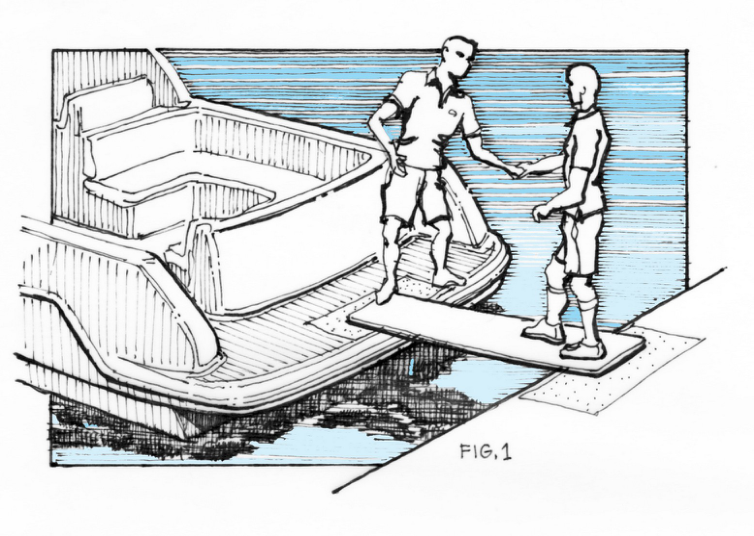
Figure 1. A basic gangplank enables greater efficiency than most solutions that are currently in the market. This ensures that there is a good matching of the elevation of the boarding pier surface and
the boat edge surface at water level to provide stability as required.
To obviate this, as in the earlier discussion on how to facilitate access on and off a boarding pier from land, it is also useful to fit a buffer element in that mediates between the boat’s movement and the stability of land.
Gangways have long existed, serving this purpose. Gangways are normally pivoted to the boat’s end, which enables a certain degree of freedom, suspended on one side to twin davits or, alternatively, to the mast head by means of a topping lift, as on board sailboats. This equipment is normally unsteady enough to walk on, not reassuring for elderly users in particular. There is a variety of electro-hydraulically actuated gangway models that are currently on the market. Efficient and flexible, gangways are normally costly, heavy equipment. Stable and adjustable, gangways remain rigid once fixed in a position as established. Hydraulically activated gangways replicate the boat’s movement exactly. Designed to enable access on and off the boat, gangways provide no buffer between the reciprocal movements of both the boat and the floating dock. A dangerous blade like effect may be caused in the event that the boat yaws unexpectedly. These structures would add 250 kilos to a vessel sized 10 meters and 5 tons, which equals one twentieth of the boat’s original displacement. A nonsense choice. To this purpose, a simple handcrafted gangplank may do, providing greater efficiency, sized some 120x35 cm, of marine plywood, to locate on skid pads between the boat’s edge and the boarding pier. The reciprocal movement of boat and pier is hence harmonized, enabling acceptable stability. Also, this equipment is easily movable after use, that has a very short duration. Notwithstanding, older adults may need assistance to pass safely across. (Fig.1) Swim platforms and ladder systems
Recreational vessels are normally equipped with ad-hoc ladders that favor access to sea for recreation.
Safety norms require that yacht design provides for access on board of nonelderly, nondisabled adults without the use of any ad-hoc movable accessory.
While the simplest solution consists in designing ad-hoc transom stairs, it has become more common lately to integrate a bathing zone as part of the yacht’s design, creating space level with the water to enhance a convivial atmosphere of guests, in and out of water. This solution consists in extending the upper deck towards the yacht’s transom area, which remains in its lower part only, and obtain an open terrace to facilitate boarding and water access, guest relaxation, and house the yacht’s tender during navigation.
Bathing platforms and beach deck spaces are normally at an elevation of between 30 and 50 cm above water level. Not too many to climb aboard in an emergency, but certainly more to exit the water in comfort and ease. Water access is generally provided by means of a simple metal tube ladder that has wooden steps to enable a broader tread base. Each half has two steps, at a distance no greater than 28 cm each. Now, 4 steps plus the platform height serve an elevation of 90 cm. Because swim platforms are normally 30 cm above water level, ladders extend for 60 cm underwater with 2 steps only, which is too modest to enable accessibility to older adults. To curl up and raise a foot to search for the lowest step on a swim ladder is virtually impossible for adults aged 80 or older due to their functional inability to perform actions as required to hook up to the lowest step underwater. It is necessary that a swim ladder be installed that is sufficiently extended to enable users of all abilities to utilize it in comfort.
Physiological necessities in this respect are to leverage a foothold that is deep enough underwater and requires no curling up. An ideal elevation should be measured in terms of a relation of a flexed leg no greater than 90 degrees in respect of the bust. This measure corresponds to an elevation of 35 cm of the foot. If we consider that the distance of shoulder and foot is normally 130 cm in older adults, we observe that a swim ladder must extend no less than 90 cm below the surface to enable easy accessibility to older adults. Simply, one step more than the standard models in use.
Once on the swim ladder, one next criticality for older adults is that they need to hold on and pull themselves up to keep their balance in an upright position while climbing up the yacht’s swim platform. In other words, while it may be no high priority for younger adults to emerge and climb the ladder to reach the boat’s platform in a crouched position, and stand up subsequently, older adults may find this maneuver extremely difficult if not impossible to perform.
Handrails above deck level may be suitable and convenient to serve this purpose and enable users of all abilities to maintain their balance as required in an upright position.
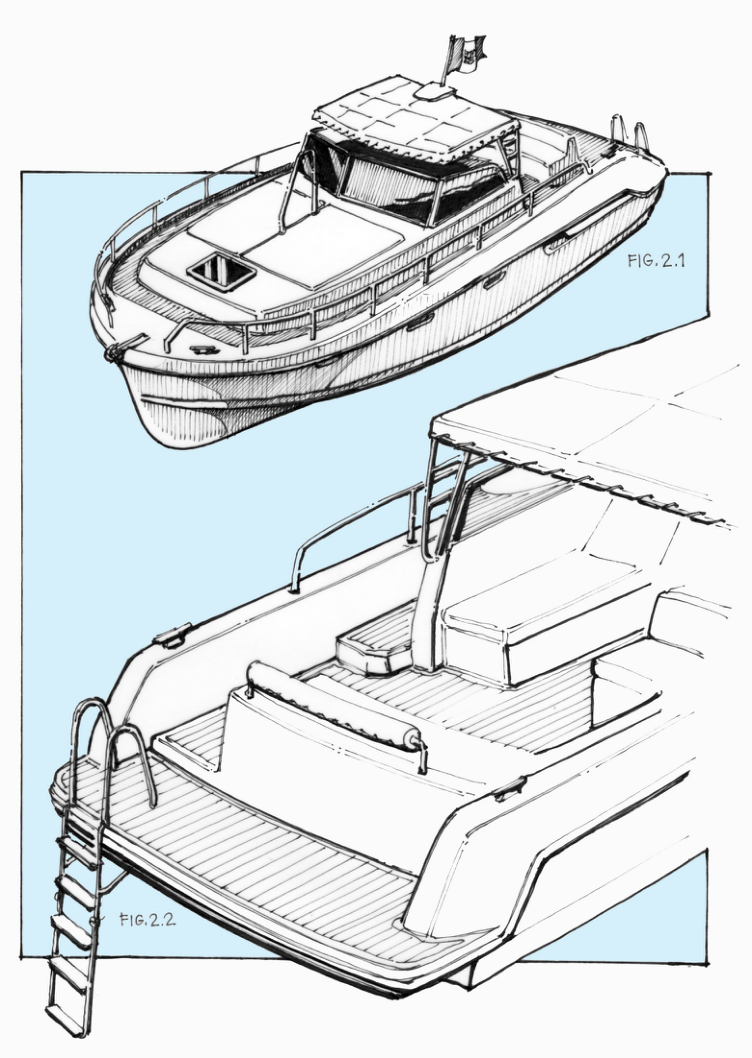
While we approximately calculate a reference to the 50th percentile, we observe that the handrails’ elevation must activate at a level of no less than the level that enables a bust flexion forward of 45 degrees approximately. We should also consider a simultaneous flexion of the legs with an inner popliteal angle no greater than 90 degrees while holding on with a vertically extended arm to mid femur elevation. If we add these anthropometrical kinematic mechanisms we clarify how handrails must be no less than 45 cm above deck level to serve this purpose. Lower handrails only force elderly users to use the ladder incorrectly, while ineffectively assisted in a way that can only be poorly supportive of their unsteady maneuvers.). (Fig.2.2)
Figure 2. (Fig. 2.1): An elevation of 45 cm of the deck house in respect of the deck’s level ensures better accessibility of open deck spaces to older adults. C-shaped handrails central to the yacht’s sun pad also facilitate the independent mobility of older adults from a seated to a standing position. (Fig.2.2): Four stair swim ladders extend 90 cm underwater to allow accessibility to older adults. Handrails 450 mm above deck level also conveniently serve this purpose and enable users of all abilities to maintain their balance in an upright position.
To consider this applied ergonomics represents a strategic choice for yacht builders who are targeting a contemporary market and seek for a larger sales potential in this affluent class of elderly clients. This choice may prove a winner particularly in reference to Europe or North America, characterized by wealthy older adults versus younger nouveau riches from the emerging markets of BRIC economies.
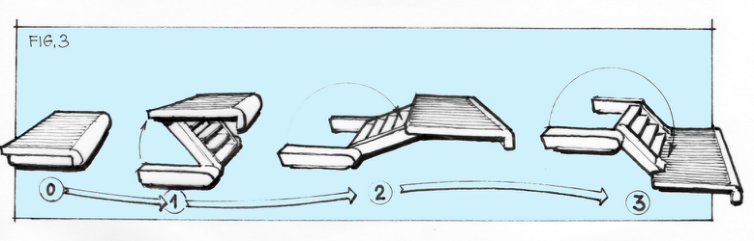
For larger vessels than a 10 meter day cruiser, electro-hydraulically actuated equipment exists that, designed to be utilized as a tender lift, performs all functions as described above to facilitate boarding and water access of older adults and people with special needs. A product manufactured by Opacmare of Rivalta Scrivia, Italy, Transformer hydraulically motions a platform served by automatically adjustable stairs for an extension of approximately 270 degrees, thanks to a double pantograph hinge. Transformer opens vertically to an elevation of 1 meter, extends also 1 meter onto the water surface and 50 centimeters below. (Fig.3) This is certainly the most complete, universal solution available today. Major criticalities of Transformer are its weight, a significantly complicated utilization and non negligible costs, which may impact a yacht’s sale price substantially.
Figure 3: Opacmare’s Transformer, hydraulic gangway. Performs all functions that facilitate boarding and water access of users of all abilities. Based on its total geometry and power movements, it is designed to be operated as a gangway, a submersible bathing platform and, due to its hydropower assistance, also as an easy tender lift for service craft. Cost and weight are major drawbacks of this genial solution, suitable for larger boats only.
Transit on side walkways to reach foredeck sun areas To access deck spaces and leave the confinement of the cockpit area means to enjoy boating fully. After navigation, when the yacht has reached the destination of choice for the day cruise, the yacht sits at anchor. Cast overboard from the most forward part of the yacht, near the bow stem, the anchor holds the boat placidly put, preventing it from falling leeward against a neighboring boat or ashore, or from drifting out to sea. At anchor, the yacht’s bow is normally into the wind. Irrespective of where the wind blows, strong or weak, a boat at anchor is always with the bow against the direction of the wind and, generally, of the waves. This creates two different livable environments, upwind and downwind. Fore spaces, ahead of the yacht’s windscreen are upwind. Upper deck areas downwind of the yacht’s windscreen and lower deck spaces are downwind.
When the yacht is at anchor, on clear summer days, foredeck spaces are most agreeable to enjoy in the sun and the natural landscape while a gentle breeze blows. This experience is a major opportunity for livability, which we may not want to miss on a day cruise. Reflecting the yacht’s aesthetics more than a functional utilization of lower deck spaces, access to fore is very often made difficult by narrow side walkways, that are sometimes totally absent.
Access to fore requires equilibristic balance and proven agility for the difficulty of finding handrails as appropriate along the transit from cockpit to fore. For a yacht designed to meet the needs of older adults, this aspect should not be neglected. To enable the utilization of forward spaces, design concepts must incorporate features that address the issue of older adults who are unsteady on their feet and need to find a balance to motion and ambulate.
Onboard movement aft to fore must be adequately protected, large and comfortable. Steep stairs should be avoided, accessing the yacht’s side walkways from the cockpit, not quite for the difficulty to climb them up, rather for the difficulty to descend them coming fore to aft. Also, handrails must adequately protect this passage on the outer side at least, better if on both sides of the walkway though. Older adults should be able to hold on to them and keep their balance, minimizing their uneasiness with the yacht’s floating movement.
To design acceptable handrails for walkways on board a 10 meter boat we must initially determine a basic walkable surface in terms of two near parallel feet: 220 mm should be enough. To this we may add the width of a gunwale or a bulwark on the yacht’s outer edge, and the deckhouse profile on the inside. On boats that are 90 per cent fiberglass construction gunwales are normally constituted by an inside wall, an upper part, which normally holds the handrails’ stanchions, and an exterior part that reconnects to the junction between deck and hull.
These three elements project a width of no less than 150 mm. The yacht’s deckhouse profile, which spreads outward top to bottom, has an aerial projection of approximately 100 mm. All things considered, on a small yacht designed to be accessible to elderly users side walkways should measure approximately 450 mm in width. A 10 meter yacht has normally a beam no larger than 3.50 m. Maximum width is measured at approximately 1/3 of the yacht’s length from fore. A boat’s cockpit starts at mid length approximately, where the hull beam’s width starts diminishing gradually. Access to the yacht’s side walkways is normally at 2/3 of its length from fore. Here the boat’s width is at least 30 cm less than its beam. Usable width in this location is 3.20 m. If we take off both sides a width as required to create an accessible walkable surface, we must subtract no less than 900 mm, which leaves us with 2.30m. From this we must subtract additional width for the cockpit’s sides encircling the yacht’s console and the windscreen base, which in a fiber glass construction are no less than 20 cm thick each.
This means that net cockpit area remains of 1.9 m width only. Very little to arrange helm station, access to lower deck spaces and, possibly, additional place to host one guest or the yacht’s skipper. This is the reason why side walkways on a yacht are normally narrow, undersized spaces to host the passage of older adults independently and safely.
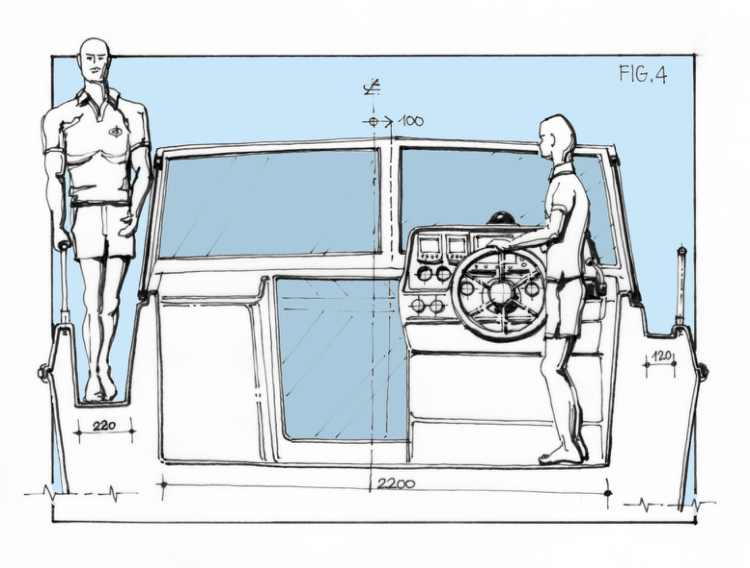
To tackle the issue of how to design accessible walkways on a 10 meter yacht seems virtually unsolvable. In fact, it is geometrically impossible to have both accessible walkways and enough cockpit space, based on the traditional design concept of a perfect symmetry between the port and starboard sides of the yacht. But if we misalign the yacht’s deck station profile by 100 mm only, we observe a prodigious redefinition of structural proportions and spaces. Subsequent to this choice, we may no longer have twin walkways versus one port side ergonomically satisfactory walkway of 450 mm and, at starboard, an auxiliary passageway where walkable surface is calculated at 120 versus 220 mm. (Fig.4).
Figure 4: The main section of a 10 meter boat design that enhances accessibility to older adults. A 100 mm starboard misalignment of the boat’s deck house enables comfortable, safe port passage aft to fore of elderly users. Auxiliary, undersized walkway surface at starboard is easy to use for younger adults and crews alike.
Also, the secret is this, to design a starboard walkway that is non recessed in respect of the deck’s floor. This enables a design of 100 mm less than 150 mm as required for deckhouse and gunwale profiles respectively. This reduced walkable surface of 300 mm enables a 2.20 meter cockpit, which represents a very different size than 1.9 m. The yacht’s control station features a dominating console, complete with steering wheel, throttles, navigational instrumentation, engine instrumentation, compass and facility controls, which project an 800 mm width. Seating to host – narrowly – the yacht’s pilot+one guest cannot be less than 1 meter in width.
While we consider this volume plus a possible enclave of the aft cabin that insists on cockpit volumes for no less than 600 mm in width, we obtain about 600 mm width design to arrange for the access to lower deck spaces, which is acceptable to allow easy passage through a sliding hatch to lower deck quarters.
While the yacht sits at anchor, guests may just wish to enjoy sunbathing on its foredeck while a gentle breeze blows refreshingly. The functional mobility of older adults in the performance of actions including sitting, lying down and rising back is impacted by the size of spaces and the equipment provided to serve their needs. As we earlier discussed in reference to access in and out of water of older adults, the functional mobility of lower limbs in older adults is limited to a range of motion of 90 degrees of femur and knee. This mobility is assisted by modest, unsteady muscular tone. There is a need to design spaces that are large enough and equipped to enhance the independent mobility of older adults.
While current aesthetics define deck surfaces in terms of a sleek aerodynamics, well defined deckhouse volumes enable better usability of foredeck spaces to older adults, who may favor the comfort of sitting, subsequently allowing a rotation of the pelvis to lean back onto the sun pad instead of being forced to lie down on it at floor level. An elevation of 45 cm of the deckhouse in respect of the deck’s level, as of a chair’s seat, is most suited to meet this need. To avoid volumes that interfere with the yacht’s aesthetics, recessed side walkways may be designed that help conceal the deckhouse profile, in part at least. This design concept provides for the accessibility of open deck spaces to older adults in the comfort as required to meet their needs.
A design of foredeck spaces with a C shaped handrail central to the sun lounge would ideally complement their accessibility to older adults. Installed longitudinally, aligned to the yacht’s keel, handrails offer a non indispensable but very useful support to older adults, while enabling their mobility from sitting to lying down onto the yacht’s sun pad and, more importantly, to help them stand up, unassisted and in comfort. One key aspect at issue in this respect is that this layout splits a yacht’s sun pad in two, which, under nonspecific conditions, may constitute a functional and aesthetic constraint to a free utilization of these spaces. Handrails may also serve an ornamental purpose and be utilized to arrange accessorial instrumentation including horn, radio antenna, flags and radar. (Fig.2.1) Docking maneuvers
That older adults perform these operations may seem excessive. Because this implies the assumption that older adults operate a boat unassisted, while to dock a yacht is normally performed by younger adults who are in charge of both conducting the maneuver and agilely seizing the lines to secure them to mooring bitts, fore and aft. On board a 10 meter yacht, stern mooring bitts are normally located on the structural bulwarks of the aft deck on both sides of the cockpit.
Midship or forward, bitts are generally situated at deck level, at a higher elevation than the cockpit to enable larger lower deck volumes. In general, designers would find it senseless to sacrifice lower deck volumes to favor the accessibility of mooring bitts to elderly users. Notwithstanding, in the event that habitability of interior spaces should be no priority, port walkways may be recessed entirely to obtain a relative elevation of mooring bitts at 400 mm approximately. Not many, but surely easier than the standard deck level currently offered.
In this sense luxury Monte Carlo motor yacht MCY 72 sets the pace for a design concept where the yacht’s forward equipment is installed on a work bench at 750 mm above deck level, which streamlines all maneuvers extremely. But because MCY 72 is a 20 meter yacht, this solution has absolutely no impact on lower deck spaces.
Access to lower deck spaces Access to lower deck spaces is one major criticality for older adults on a 10 meter yacht. Access to lower deck spaces is normally via a passage door from the yacht’s cockpit to below deck, sheltered by the windscreen, near the helm . There is normally a 1 meter difference in elevation between the cockpit’s floor level and below deck. The door has vertical and horizontal top openings that uncover part of the deckhouse to facilitate access through the deck down the companionway, in nautical terms. A common feature is a sliding hatchway door that slides transversally into space below the yacht’s console. A four step stairs with vertical height between steps of 25 cm enables access below deck.
Requirements under applicable safety regulations are that there must be a raised threshold between exterior and interior spaces, to prevent water which may invade the cockpit area and cover the cockpit floor from passing through to lower deck spaces, thus compromising flotation of the craft.
Ergonomically, this threshold is a hindrance and poses potential trip risks. Because of this, there is a need for warning systems to alert users. Alternatively, to reposition the top step of the stairs to below deck at the same level as the threshold may help mitigate this hazard.
Due to space constraints, stairs to below deck have significant slope, 60 degrees approximately, which requires users to descend stairs in the backward direction. While younger adults may cover this 1 meter downward distance in one jump normally, this elevation poses hazards to older users. There is a need to facilitate older adults by means of stable, comfortable side rails, which may not be standard equipment on board.
Restroom facilities Bathroom facilities on board a day cruiser are always narrow, undersized spaces. Doors normally open outward to enable access and door closure while user is in, and ensure access in an emergency. Facility equipment is basic and compact: a small wash basin 800 mm above the floor and water closet are normally the only equipment that there is. Floor is fiberglass, shower is a wet room type, with detachable sink faucet as hand held shower head and extensible supply pipe. Shower has pumped water drainage.
Because onboard facilities are normally located on one side of the yacht’s cabin, that is also normally on one side of the yacht, and due to the yacht’s hull shape, bathroom floors offer space to stand on that is normally an undersized surface of an irregular trapezoid shape. Water closets are installed that are laterally on a raised level of 200 mm, higher than is customary in residential buildings normally.
There are no usability issues ergonomically in this respect, for users of all ages. We may only observe that clear floor space should be enough to allow users a 360 degree rotation while there is no need to reopen the bathroom’s door. Also, users should be able to sit on the toilet seat or bend over to approach the sink while there is enough clearance for knees and buttocks. That doors open outward represents a functional solution in terms of space requirements that enable use of facilities and safety factors as earlier discussed.
Access to cabins and berths 10 meter day cruisers are normally equipped with separate cabins, additional to wardroom space plus kitchenette and restroom as earlier discussed. Guest cabins are fore and aft of the stairs from the yacht’s cockpit to below deck. While forward guest cabins are normally narrow due to a wedge like hull, aft cabins have comparatively smaller height, due to the intersection with upper cockpit outdoor spaces. Narrow in width, fore spaces are designed to ensure habitable height. Aft and midship rooms are conversely smallish in height, unaffected by narrow, wedge like hull lines. Midship cabins feature standard double bed accommodation very near or at floor level. There is never much height between bed and ceiling; also, part of the bed may be 600 to 700 mm lower than the mattress. Access to these rooms replicates the imaginary action of entering a drawer.
No need to say this design is totally inaccessible to older adults. Accessibility of forward guest cabin accommodation is conversely practicable. Single, twin or double, beds are normally 750 mm above floor level. Access to bed is designed to reflect the yacht’s hull lines, and there is a step forming a raised level which provides convenient seating for older adults at an elevation of 450 mm of the mattress to facilitate reclining further. The 1.9 meter high ceiling of a forward cabin enables 900 mm space above the bed, enough for users to sit on it head up. Forward cabins provide accommodation to older adults that is even more convenient than at home.
RESULTS AND CONCLUSIONS Yachts designed to enable accessibility of recreational boating to older adults are no special boats nor are they different than designs that already exist. Based on our earlier discussion, accessibility of recreational boating to older adults, safely and independently, only requires few essential considerations, that yacht builders normally neglect. Expected results of this research determine design indications that help define a product that meets mobility and usability expectations of older adults as a potential user group. We have analyzed the relations between the functioning levels of older adults and basic onboard operations. Physical functionality is considered in terms of reduced articular and muscular agility, and in reference to the psychological effects of cautious, self protective behaviors in old age.
Finally, there is a need for both designers and yacht skippers, to a lesser extent, to address issues as follows. Design concepts that enhance accessibility of recreational boating for older adults focus on large, unobstructed aft spaces to eliminate trip hazards; 4 step swim ladders that extend 1 meter underwater, with handrails 500 mm above deck level; one large, protected side walkway to enable safe passage aft to fore, complete with handrails on both sides; foredeck sun lounges at an elevation of 450 mm above deck plus handrails central to the sun lounge 500 mm above floor level that allow older adults to rise from a seat to a standing position unassisted.
To have older adults actively involved in operational activities including mooring operations requires that mooring equipment is positioned to enable use without needing to stoop or bend.
Access to lower deck spaces should be via stairs with solid, safe handrails on both sides.
To enable mobility of older adults with reduced agility and an inability to perform torsional body movements, interior design must focus on avoiding steps and elevations to eliminate trip hazards.
Crew officers have responsibility for supervising access of older adults on and off the boat, which is facilitated if the elevation of the pier surface is aligned with the yacht’s aft platform and a short, stable, accessorized boarding gangplank is temporarily arranged on skid pads at both its ends with no wheels to ensure better stability.
Crew officers need sensibility and etiquette to assist older guests in the performance of actions requiring support including access to restroom facilities, exit from the water and access to lower deck spaces, descending stairs in the backward direction preferably and holding on to handrails to ensure safety.
Finally, as discussed in our earlier introduction, old age in industrialized societies should no longer be regarded as a handicap versus an opportunity for development and growth of the yachting industry, that all builders should evaluate as strategic for their business.
Lest we forget, Sir Francis Chichester performed his solo around the world sailing voyage on board his 55 foot Gypsy Moth IV sailing yacht, aged 65. It was the year 1966. Today, senior yachters are many, many more than 50 years ago.
REFERENCES
A.A.V.V. (2002), “Active ageing: a policy framework”, World Health Organization Report, Genevra. A.A.V.V. (1991), “L'anziano attivo: proposte e riflessioni per la terza età e quarta età”, Fondazione G. Agnelli (Ed.), Torino. A.A.V.V. (2009), “L'assistenza agli anziani non autosufficienti in Italia”, Maggioli Editore, Santarcangelo di Romagna. A.A.V.V. (2002), “Studio sulla prevenzione e sul trattamento della non autosufficienza con particolare riferimento agli anziani”, Ministero del Lavoro e delle Politiche Sociali,: dipartimento per le politiche sociali e previdenziali, Roma, (Italy) Accolla, A. (2009), “Design for all. Il progetto per l'individuo reale”, FrancoAngeli (Ed), Milano. Butler, R. N., Miller, R. A., Olshansky, S. J., Perry, D. (2006), “Pursuing the longevity divided: scientific goals for an aging
world”, Internatinal Congress on Ageing Society, Toronto. Casiddu, N. (2008), “Anziani a casa propria. Linee guida per adeguare spazi e oggetti”, FrancoAngeli (Ed.), Milano. Cesabianchi, M., Cristini, C. (2002), “L'invecchiamento fra corporeità e creatività”, Oasi Editrice, Enna. Dreyfuss, H. (1994), “Le misure dell'uomo e della donna”, Be-Ma (Ed.), Milano. Human Aspects of Transportation III (2022)
Fantini, L. (2001), “Superare le barriere architettoniche, migliorando il confort e la sicurezza”, Maggioli Editore, Santarcangelo di Romagna. Musio-Sale, M. (2009), “YACHT DESIGN. Dal concept alla rappresentazione”, Tecniche Nuove (Ed.), Milano. Ornati, A. (2000), “Architettura e barriere”, FrancoAngeli (Ed.), Milano. Spadolini, M. B. (2000), “La progettazione amichevole. L'evoluzione del concetto di accessibilità per l'utenza debole.
Dall'habitat al design dell'oggetto”, Rima Editrice, Milano. Stabilini, F. (008), “Design e spazio terapeutico: il giardino Alzheimer”, Alinea (Ed.), Firenze.
Advances in Human Aspects of Transportation: Part III
Read this individual research paper free through the original publisher, or explore the full digital proceedings book.
ISBN 978-1-4951-2099-2
Explore this ISBN in the AHFE Bookstore ↗Listed in the July 2026 bookstore catalogue; search by ISBN to confirm current availability · Digital book purchase optional