Christian Busen, Anna Gerhards, Max Haberstroh, Eva-Maria Skottke, Markus Oeser (2022). Investigating the Effect of Long-Term Worksites on Road Users. In: Advances in Human Aspects of Transportation: Part III. AHFE Open Access, vol. 17. https://doi.org/10.54941/ahfe100741
A large part of German motorways is increasingly in need of modernization. In addition, the dimensioning of traffic routes has to be adapted to consistently growing traffic volumes. Worksites that have to be installed for road preservation and development are planned, following the existing technical regulations. However, the human factor is only considered poorly. Many accidents and traffic disturbances at worksites could be avoided if the driving behavior of road users would be taken into account for the particular situation "worksite". Therefore psychological aspects need to be taken into account for the design of future worksites. In the present study, funded by the Federal Ministry of Transport and Digital Infrastructure, not only driving behavior, but also heart rate and eye movement of the subjects were measured during test drives in real worksites in order to capture the behavior, workload and attitude that arise for road users when passing a worksite. In addition, longitudinal and lateral distances were detected by means of video cameras and additional measurements were performed at cross-sections. Based on these variables, local traffic parameters were determined. Based on the findings obtained in the study, recommendations for the installation and arrangement of worksites will be compiled which give consideration to the driving behavior. Overall, the aim is to reduce workload for road users in areas of worksites and thereby increase traffic safety.
Worksites in the federal motorway are an inherent part of the road scenery in Germany today and in the future, and they represent an interference with traffic. Currently, about 850 long-term worksites with an average length of 3,3 kilometers and a mean duration of 106 days are being installed in Germany [Steinauer et al., 2011]. In addition, about 100.000 short-term worksites arise every year nationwide [Kemper, 2010]. Particularly, in long-term Human Aspects of Transportation III (2022) worksites high demands with regard to attention and actual driving tasks are placed on road users due to traffic routings on narrow auxiliary lanes, which are partially deviated or diverted to the opposite lane. Furthermore, an exceeding of capacity limits can be observed due to overall increasing traffic loads and reduced capabilities in the areas of worksites. This can evolve into a massive traffic disruption. The increasing traffic loads also exert an impact on individual decisions of road users (e.g. speed choice, lane choice or choice of safety distances). This is further exacerbated at areas of narrow auxiliary traffic routings in long-term worksites due to the development of vehicle widths towards ever wider vehicles at constantly remaining lane widths.
Worksites on motorways are installed according to specifications in the appropriate regulations (in particular the "guidelines for securing workplaces at roads" (short “RSA”) (BMVBS, 1995). Although road users shall be conducted safe and quick through worksite areas, the mentioned regulations are mainly composed of technical aspects and do not consider the psychological aspects of drivers, as road users are an important factor for traffic. Human failures caused by high workload or the difficulty to control traffic situations lead to property damage, personal injury and traffic disturbances are caused due to accidents. Especially for the exceptional situation "worksite passing", the road user and his psychological properties need to be considered more intensively in order to make failure cases more unlikely.
BASICS Traffic-related aspects
In the "guidelines for securing workplaces at roads" (BMVBS, 1995), regulations can be found concerning widths of auxiliary lanes and speed limits. In detail,, the minimum lane width is specified as 2,5 m when assuming a vehicle width restriction of 2 m. Thus, the road user has at least 50 cm lateral security space. The trend is to provide the road user with an additional space of 10 cm by using smaller protection devices for the separation of opposing traffic. This additional width, however, is more and more filled by increasingly widened motor vehicles (restriction to 2,1 m at a lane width of 2,6m (Ellmers, 2012)).
In the „manual for worksite management on federal motorways“ (BMVBS, 2011) recommendations can be found that worksites should not exceed a length of 12 km. The length of a worksite is thereby dependent on factors such as traffic flow, traffic routeing, traffic safety, track characteristics and economic efficiency of the used machinery. Furthermore, traffic-related aspects include also rules on road traffic regulations (BMJ, 2013), after which a sufficient safety distance should be kept to the vehicle ahead and the right lane is to be used as long as the driver does not intend to overtake.
Compliance with the rules of road traffic regulations as well as effects of worksite situations on driving behavior of road users have already been investigated in several studies (e.g. Sümmermann et al.., 2010, Bakaba et al., 2012 or Fischer & Branolte, 2006).
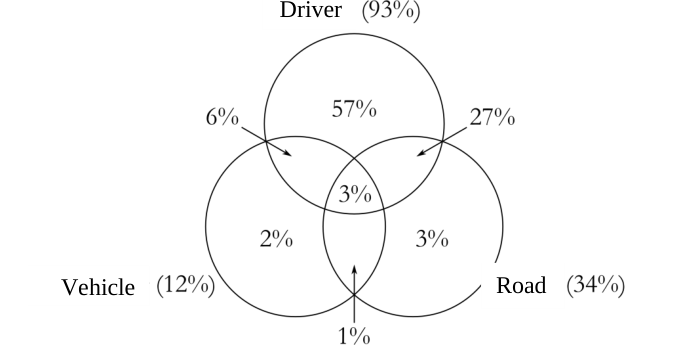
Traffic-psychological aspects The human as a road user and car driver is not only initiator but also participant of road traffic. The behavioral patterns of road users are very different, but should not be disregarded in their variations. The importance of a human as car driver becomes more obvious when considering the shares in accident causes for drivers, vehicles and roads (see Figure 1).
Driver
Vehicle Road
Figure 1. Shares in accident causes for driver - road -vehicle (according to International Human Factors Guidelines For Road
Systems Design, 2000, cited after Schlag et al., 2002)
Figure 1 shows that driver’s mistakes are the highest cause for accidents in the road traffic system. With 27 %, the impact of roads on road users represents the second highest share in accident causation, directly after the sole originator driver with a share of 57 %.
No doubt, that the actions of humans as road users are influenced by the vehicle and the road. A change in the given situation which is caused either by the road, the vehicle or other road users is forcing the driver to correct and adjust his driving behavior. The driver of a vehicle is constantly comparing the current state with the desired target state and is acting as soon as a difference between these two states exists. With this action he is changing the current state towards the target state (Echterhoff, 1991) (cf. Figure 2).
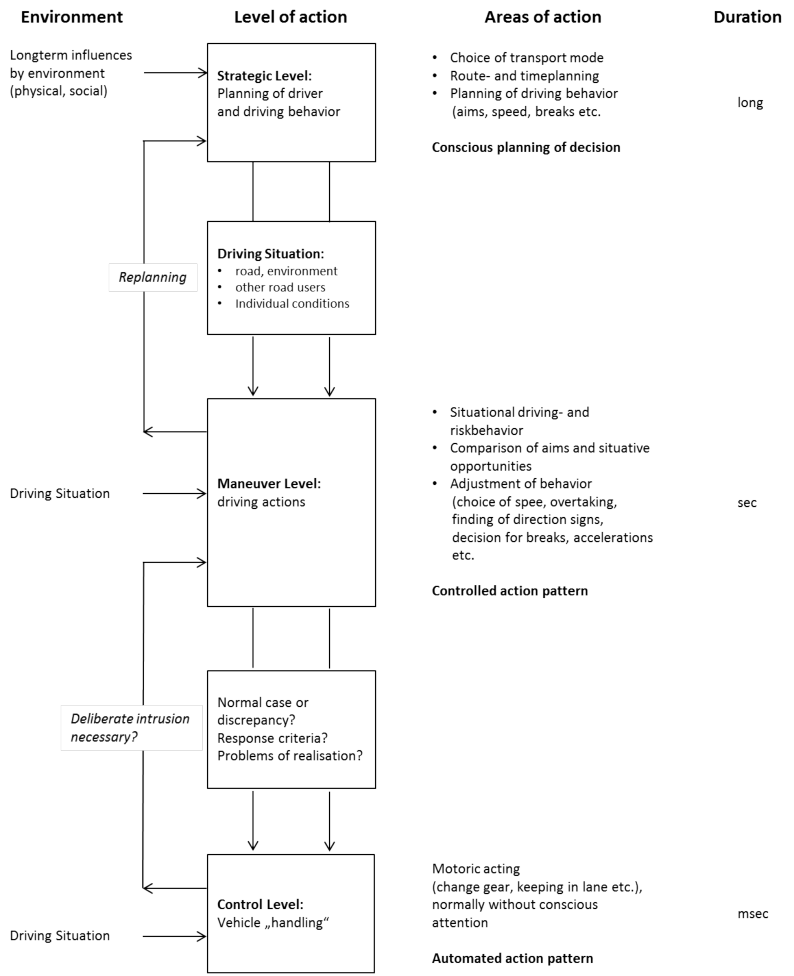
The comparison of the current state with the target state can be found on the manoeuvre level in the model of hierarchical action regulation according to Schlag (2005) (cf. Figure 5). The manoeuvre level of driving actions is influenced by the long-term strategic level at which a road user is planning his future actions. For example, he will choose a route and time period that corresponds to his aim to reach a certain place at a certain time.
The driving actions further include the handling of the vehicle with mostly subconscious actions for which the accomplishment takes only split seconds. While the above mentioned cycle between the strategic and the manoeuvre level is determined by the comparison of current and target state, the comparison of aims and situational possibilities and demands is significant between the manoeuvre and the control level and therefore influences the immediate vehicle handling. These automated patterns of action, which an experienced driver develops subconsciously, represent the accomplishment of situational-adapted manoeuvres which were decided on the manoeuvre level. „ Automatisms are fast and resource saving, however, they are not subject to conscious choice“ (Schlag, 2005). With only milliseconds of accomplishment, the road user performs the patterns of action which correspond to his driving actions and which are likewise influenced by the driving situation. These are deliberate interventions in driving actions, for example, to avoid a collision with another vehicle, but which are performed automatically and without conscious attention.
Figure 3: Driving behavior as hierarchical action regulation (according to Schlag, 2005) All three action levels are influenced by the physical and mental capacity of the road user (compare Schlag et al., 2002). These capacities of the vehicle driver are individually pronounced, change over time with the age and driving experience of the concerned person also depend on the actual present situation of this person.
Alternating relation between traffic-related and traffic-psychological aspects After the cycle according to Echterhoff (1991), the human and the road are two of three factors influencing each other. Thus, the human behavior is a factor that needs to find highly attention in the design of roads since the road itself in turn affects the human and his driving behavior (e.g. Echterhoff, 1991).
The design of transit areas in worksites is furthermore influenced by other factors which are caused by external restrictions and which even more restrain these worksite areas than usual external restrictions for road design. Here, in particular the following factors need to be mentioned: The cost-effectiveness of machinery use after which the length of the worksite and the arrangement of worksite orders is dimensioned, the traffic volume after which the number of auxiliary lanes is determined, the width of the existing cross-section as well as the effective width beside the construction site area after which both the number and the width of auxiliary lanes are calculated.
All these factors underlie directly measurable properties. The human factor, that is his motivation, emotions and mental capacity, are considered with lower priority when planning a worksite since these factors are not easily to measure. During the execution of construction works and the existence of the worksite itself, distinctive effects on the human behavior arise. These effects become indirectly measurable if, for example, an accident happens within the worksite area, which in addition to congestions and personal injury also causes economic losses due to resulting waiting times for road users and goods. According to the shares in accident causation (cf. Figure 1), it is very likely that a human as a road user can be the initiator of such accidents. However, accidents in worksites could be avoided if human factors would be considered more during the planning and setting up of worksites. The damage sums arising out of such an accident are measurable parameters for the impact that worksites exert. To increase traffic safety in worksites, the traffic regulations are adapted to the latest findings from research and practice and thus affect the planning of worksites. Unlike many other factors, the psychological influence of the worksite itself has not yet been explored sufficiently and therefore only marginally were taken into account by the planning of worksites.
So far, there are only a few studies specified on the psychological effects of worksites. A study of Maag et al. (2003) on aggressions in road traffic is concerned with the development conditions and occurrence of aggressive episodes on motorways, but does not explicitly include the aspect of construction site effects. An overview of the causes of aggressive behavior in road traffic can be found in Shinar (1999). According to this study, frustrating situations, such as driving time delays as they commonly appear at worksites, represent the starting point for aggressions. Out of this situation, the willingness to behave aggressively arises depending on the personality of the driver and environmental factors. Directly expressed aggressions can be observed in practice as tailgating (shoving) or indignity of other road users. Maag et al. (2003) furthermore interpret notorious driving on the left lane as a form of aggressive driving behavior.
In summary, it can be concluded that both, from a traffic-related perspective and from a psychological perspective, the influence of the worksite length and the dense worksite order on road users has not been sufficiently examined. The aim of the presented study is therefore to measure this influence from different levels and in different contexts and to derive recommendations for practical implementations. Empirical insight on the effects of design,, length and order of worksites on road users are to be gained during field tests and also in a driving simulator. Since both in- depth knowledge of traffic psychology and traffic engineering is needed for the design and realization of the study as well as for a targeted implementation of the results, an interdisciplinary collaboration of the departments psychology and traffic engineering is inevitable.
INVESTIGATIONS Psychological effects are not directly measurable and have to be detected on the basis of various observations. Since each human as a unique individual reacts differently to external influences, it is necessary to consider several observation variables together for making possibly precise and clear statements. Accordingly, in this case psychological effects are measured and evaluated based on the reactions of vehicle drivers.
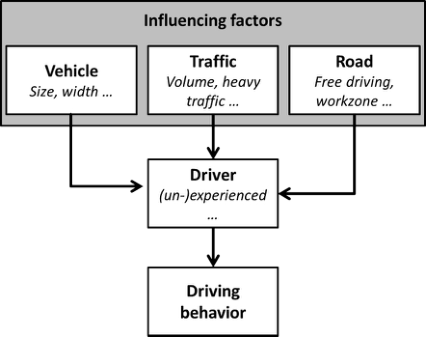
Figure 4. Considered influences on the driving behavior
In particular, the driving behavior of selected subjects was measured and evaluated when passing a long-term worksite. Overall, measuring drives were carried out at three different worksites. Variables were braking manoeuvres, overtaking behavior, choice of distance to the vehicles ahead, lateral movements, choice of speed, gaze behavior and heart rate during passing a worksite.
In addition, the number and type of all road users was measured at selected cross-sections within or before worksite areas in order to integrate the subjects into the overall traffic volume. Furthermore, the subjects were asked to fill in a questionnaire directly after the respective measurement drive. This survey was placed in a larger context. For this, answers to the same questionnaires from interviews and online surveys were evaluated. Regarding the worksite passing, it was thus possible to compare the attitude of the probands with the attitudes of a larger number of road users.
Based on the data that was acquired during the measurement drives hypotheses for the subsequent driving simulator tests are drawn. These hypotheses are based on the assumption that certain events and environmental conditions lead to a change in the road users driving behavior. Events that change the driving behavior can be overtaking manoeuvres or large vehicles (such as vans or smaller trucks) which use the opposite left driving lane and which are separated from the subject only by a portable protective device. Influencing environmental conditions can be traffic volume, tracking within the worksite, worksite length or the width of the present driving lanes.
In the field study, two routes are navigated by 10 analysis-relevant subjects, respectively. On the federal motorway A 5 in Hessen, a 11,5 km long worksite with a lane width of at least 3 m is located between the interchanges Ober- Mörlen and Friedberg at the measurement time. For driving direction towards the south (which is investigated), the maximum speed limit is 80 km/h. There is a traffic routing of 4+2, meaning that there are two driving lanes available for road users in the driving direction towards the south. On the A 4 in North Rhine-Westphalia two worksites with a length of 3,1 and 1,6 km are located between the interchanges Düren and Autobahnkreuz Kerpen. The left lanes of these worksites have a width of 2,6 m. Here, a traffic routing of 4+0 is used for both worksites and the maximum speed limits are set to be between 60 and 80 km/h. Additionally, the worksite near Düren has the special characteristic that the traffic is passed over an auxiliary driving lane next to the actual driving lane for about 500 m.
The following measurement equipment is used for the field study:
two vehicles (one vehicle for the subject and one following vehicle)
a heart rate measuring instrument to detect the heart rate of the subject, enabling the indication of stress
eye tracking glasses recording the eye movement of the subjects
an optical sensor on the vehicle of the subject, measuring the driving speed and the route
a camera facing the front of the subject's vehicle which enables the recording of the distance to the vehicle ahead and the evaluation of lane changes
a camera in the following vehicle facing forward, which enables the detection of lateral movements of the subject's vehicle and the evaluation of the operation of the brake pedal by the subject In addition, measurements are performed at cross-sections, forming the basis for detecting local traffic parameters. Also surveys are carried out both locally and online in order to make a larger amount (than solely that of the subjects) of subjective evaluations from road users available. This is necessary in order to place the assessments of worksites, given by the subjects, in a larger context.
BEHAVIOR OF THE DRIVER IN WORKSITES Following a data extraction, a hypothesis-based analysis and interpretation of the data was carried out. The evaluation was performed sub-hypothesis based in a first step, where suspected cross-dependencies were considered. Furthermore, the model of the driver's behavior was used as a hierarchical action regulation (see Schlag, 2005) for interpretations. Based on the results of the sub-hypothesis analysis, a main hypothesis based interpretation of the data was performed. Subsequently, the gained findings were considered together and subjected to a collective evaluation.
The hypothesis "the road user changes his driving behavior when overtaking" can be regarded as proven. During an overtaking manoeuvre, the road user acts in a different way from normal driving situations without overtaking. Indicators for this are the gaze behavior, the choice of speed and driving lane as well as lateral movements. The width of the auxiliary lane plays an important role for the overtaking manoeuvre of a road user since it exerts an impact on the choice of lane and lateral movements. Also the subjective feeling of the road user leads to this conclusion. It is pointed out that during the overtaking manoeuvre the road user is significantly more affected by large vehicles than by smaller vehicles.
The hypothesis "the traffic volume has an effect on the driving behavior of the road user" is evidenced by the data obtained. However, definitive statements can be made only in terms of speed choice and braking performance. The road user adapts his driving behavior to the situation of traffic volume and the opportunities given, whereby his actions are controlled and thus are to be assigned to the manoeuvre level.
The driving behavior within worksite areas with changing tracking represents a conscious adaption of the driving actions to the driving situation on a manoeuvre level. The tracking influences the driving behavior of the road user. This is evidenced by the gaze behavior, the choice of speed and driving lane and particularly by the heart rate evaluation. The road user clearly experiences stress (for over 60 % of the results) when passing diversions. The hypothesis is thus regarded as proven.
An opposing traffic event affects the behavior of the road user in terms of gaze behavior and (for 40% ) heart rate. Both are involuntarily running physical processes which are not consciously controlled by the subjects. In about a third of the obsereved events, a road user who fixates a large vehicle on the nearest opposite lane, experiences stress. The choice of speed, which is here investigated via braking performances, is not influenced by opposing traffic events. Also the tracking behavior is not affected by opposing traffic. Generally, the kind of structural element to separate the opposing traffic flow and the opposing traffic itself leads to the fact that the road user chooses a driving lane according to his personal sense of security. Here, the width of auxiliary lanes, the traffic volume and the traffic composition are important factors since the choice of the left auxiliary lane always includes an overtaking intention. If a road user has made the decision to change the driving lane on the manoeuvre level, the reactions to special opposing traffic events, as they are investigated here, can be found only in the human component (gaze behavior, heart rate). The actions on the manoeuvre level and the control level are unaffected by the studied events. The hypothesis "the oncoming traffic has an impact on the driving behavior of the road user" has been proven, but the performed investigations are not sufficient to detect the full extent of the influence.
With regards to all worksite lengths, a familiarization of the road user to the present situation can be observed via choice of speed and driving lane. This behavior is to characterize as situational driving behavior and risk behavior of the road user and thus belongs to the manoeuvre level. The driving behavior is consciously adapted to the situation and changes with familiarization to the situation. However, the heart rate and thus stress is not influenced by this familiarization. Accordingly, a trailer truck that has to be overtaken always carries the same risk potential for the road user, irrespective of the route section he is driving through within a worksite. No difference could be found for the observed behaviors when comparing the worksite with a greater length to the worksites with smaller lengths.
The lane width has an impact on the road user, which is reflected on the manoeuvre level in his driving actions. The road user feels more uncomfortable to overtake at narrow left auxiliary lanes. The gaze behavior of the road user is not influenced by the lane width but by the worksite situation. In the present case, the lane choice is also not affected by the lane width. A lower speed and a closer distance to the structural separation element left to the lane are chosen if narrower lanes are available. The road user is thus affected in his driving behavior by the width of the auxiliary lane.
In addition, an influence of the regular white pavement marking in the worksite area on the driving behavior of the road user can be observed. The subjects choose their tracking behavior in a way that a longer driving on the line is avoided and a lane is chosen where the tire is next to the line, even if this driving lane entails the fact that the road user comes closer to the structural element on the left than necessary.
CONCLUSIONS
A worksite represents an interference with traffic and influences the driving behavior of the road user. The road user experiences stress at distinctive situations while passing a worksite and adapts his driving behavior to the present conditions. This adaption is performed both on the manoeuvre level (for instance by the choice of speed, overtaking behavior and choice of driving lane) and in automated patterns of action on the control level (for instance by the lane and gaze behavior).
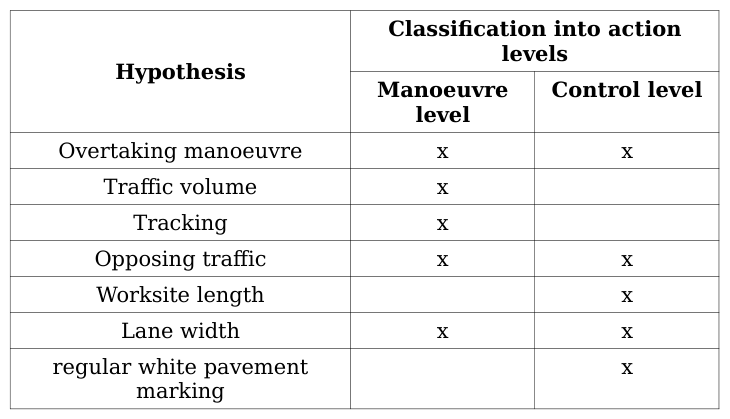
The driving behavior in single events and situations, which were considered in the hypotheses, cannot clearly be assigned to the manoeuvre and control level in a separated way. Rather, the individual aspects must be assigned to the two levels. In Table 1, a correction of the classification is made.
Table 1: Classification of the considered hypotheses into hierarchical action regulation after Schlag (2005) Classification into action levels
The driving aims which were previously specified by the road user (on a strategic level) also affect the subordinated action levels. Especially the lane and speed choice is affected thereof. To counteract differently selected driving aims, the task would have to be adjusted. This could for instance be done by asking the subjects to act as if the measurement drive would be a normal or official drive (see chapter 3.3). In addition, special driving objectives could be defined by the task, such as for instance rapid progress.
The procedure of this study, including literature review, drawing hypotheses, design and implementation of the field study, data evaluation and interpretation of results turned out to be productive. Events have been identified ("exclusively affecting" and "influencing and stress-inducing") which affect the driving behavior of road users and which can be observed in many worksites.
The observation situation influenced the subjects (compare chapter 2.3). Their driving behavior may be different from that which is chosen without observation. However, there is no quantity to measure this influence and therefore no change in the driving behavior in comparison to the normal situation can be measured. Thus, it is recommended that in further research the road user has to be observed without being aware of the state of observation. This could be achieved for example by followed drives or a continuous stationary data collection. However, this would exclude the detection of heart rates and gaze behavior. With a comparison of the data collected in this study, an estimation of the driving actions in terms of a possible external influence and the development of stress could be carried out.
In general, the sample of subjects only tends to fit into the sample of surveyed road users. However, since the sample of all surveyed road users is not large, no definitive statement about the representativeness of this data can be made. All observed and interviewed persons are participants in traffic so the observed driving behaviors apply to a portion of all road users. Thus, the statements derived here can be used for event identification.
Based on the event identification and the statements about the extent of influence exerted by these events, further investigations can be designed which are aimed to offer representative results for the total amount of road users. In addition, also other traffic routeings have to be considered in future since the influencing circumstances differ in each traffic routeing.
Additional studies might relate, for example, to the following facts, which were not subjected to closer examination in the present work:
Areas before a worksite
Interchanges (entrances and exits) in a worksite
Areas behind a worksite
The driving behavior of road users on the right auxiliary lane
Worksites designed according to alignment elements (site plan)
Different driving behavior for experienced and unexperienced road users
Different driving behaviors for road users who are familiar with a place and who are not familiar with a place Furthermore, a data analysis which is reciprocal to the evaluation is reasonable. Thus, it is conceivable that over the heart rate and its change further influencing and stress-inducing events are detected, to which a source can be assigned via video recordings.
Recommendations for the design of worksites can be derived from the statements made in this study. The design of worksites should be adapted to the psyche of humans and should consequently cause less stress:
The installation of diversions and deviations should be clearly arranged and faster to capture (optionally by larger curve radii and removing handicaps in the field of view).
Strong deviations should be avoided.
Portable protection devices to separate the opposing traffic flows should provide an increased sense of security (for instance enlarging their width).
Auxiliary lanes should be as wide that no restriction of vehicle widths must be prescribed.
Regular white pavement markings should be designed in a way that does not exert a visual, haptic or acoustic influence on the road user (for instance by removing or pasting over).
These recommendations are not always fully feasible due to boundary conditions and external restrictions. However, it is desirable that these recommendations are implemented as widely as possible to minimize the probability of a failure of the human factor.
REFERENCES
Bakaba, J.E., Enke, M., Heine, A., Lippold, C., Maier, R., Ortlepp, J., Schulz, R. (2012), Untersuchung der Verkehrssicherheit im Bereich von Baustellen auf Bundesautobahnen, Unfallforschung der Versicherer, German Insurance Association Research Report No. VI 04 Echterhoff, W. (1991), Verkehrspsychologie - Entwicklung, Themen, Resultate, Mensch - Fahrzeug – Umwelt, No. 26, TÜV
Rheinland GmbH Ellmers, U. (2012), Die neuen RSA – Neue Regelungen zu Fahrstreifenbreiten, Presentation on „Aachener Arbeitsstellensymposium“ Federal Ministry of Justice (BMJ) (2013), Straßenverkehrs-Ordnung vom 6. März 2013 Federal Ministry of Transport, Building and Urban Development (BMVBS) (1995), Richtlinien für die Sicherung von
Arbeitsstellen an Straßen (RSA-95). Bd. FGSV 370. Köln :Forschungsgesellschaft für Straßen- und Verkehrswesen e.V. Federal Ministry of Transport, Building and Urban Development (BMVBS) (2011), Leitfaden zum Arbeitsstellenmanagement auf Bundesautobahnen Fischer, L., Brannolte, U. (2006), Sicherheitsbewertung von Maßnahmen zur Trennung des Gegenverkehrs in Arbeitsstellen,
Research Reports of the Federal Highway Research Institute No. V 142 International Human Factors Guidelines For Road Systems Design cited after Schlag et al (2002) Kemper, D. (2010), Vergleichende Betrachtung der Sicherheits und Wirtschaftlichkeit von Arbeitsstellen kürzerer Dauer auf Autobahnen bei Tag und Nacht, Aachener Mittelungen Straßenwesen, Erd- und Tunnelbau Volume 52 Maag, C., Krüger, H.-P., Breuer, K., Benmimoun, A., Neunzig, D. & Ehmanns, D. (2003), Aggressionen im Straßenverkehr.
Research Report of the Federal Highway Research Institute, No. M151, Wirtschaftsverlag NW Schlag, B., Heger, R., Baier, M.M., Steinauer, B. (2002), Empfehlungen zur Berücksichtigung physiologischer und psychologischer Fähigkeiten und Grenzen der Kraftfahrer bei der Straßenplanung in Brandenburg, http://www.expertas.de/01_en/02_docs/016_psychologie_HegerSchlag04_de/SchlagHeger2004.pdf. - abgerufen am 2013- 09-16 Schlag, B. (2005), Risikoverhalten im Straßenverkehr, Wissenschaftliche Zeitschrift der Technischen Universität Dresden,
No. 55 Shinar, D. (1999), Aggressive Driving: The contribution of the drivers and the situation, Transportation Research Part F: Traffic Psychology and Behaviour, 1(2), 137-160 Steinauer, B., Sümmermann, A., Kemper, D., Baier, M.M., Klemps-Kohnen, A. (2011), „Sicherheitsbewertung von
Gegenverkehrstrennungen in Arbeitsstellen. on behalf of Federal Highway Research Institute (in process) Sümmermann, A., Kemper, D., Steinauer, B., Baier, M.M. (2010), Sicherheitsbewertung von Gegenverkehrstrennungen in Arbeitsstellen on behalf of Federal Highway Research Institute (unpublished)
LISTED IN THE AHFE DIGITAL BOOKSTORE CATALOGUE
Explore the complete digital volume
Advances in Human Aspects of Transportation: Part III
Read this individual research paper free through the original publisher, or explore the full digital proceedings book.
ISBN 978-1-4951-2099-2
Explore this ISBN in the AHFE Bookstore ↗Listed in the July 2026 bookstore catalogue; search by ISBN to confirm current availability · Digital book purchase optional