Philip Joisten, Nina Theobald, Bettina Abendroth (2022). Pedestrians’ Crossing Decisions While Interacting with Automated Vehicles – Insights from a Longitudinal Study. In: Human Factors in Transportation. AHFE Open Access, vol. 60, pp. 156–164. https://doi.org/10.54941/ahfe1002445
The decisions of pedestrians when crossing in front of automated vehicles (AVs) have been studied under the usage of external human machine interfaces (eHMIs) as explicit means of communication between AVs and other road users. Long-term effects of AV and eHMI exposure on pedestrians’ crossing decisions have not yet been intensively researched. Therefore, a longitudinal study with three sessions and two eHMI designs was conducted in a controlled field environment with 21 participants. A participant’s decision to cross in front of an AV was continuously measured using a hand-held device whose button was pressed when the participant felt safe to cross. Findings show that with increasing experience, pedestrians’ perceived safety to cross at close distances to a yielding AV increases when the AV is equipped with an eHMI displaying the vehicle’s status, perception and yielding intention. We conclude that when interacting with AVs, pedestrians' perceived safety benefits from eHMIs whose impact depends on pedestrians' experience.
Interaction between pedestrians and drivers of conventional vehicles (CVs) is based on implicit signals such as deceleration as well as non-verbal signals such as eye contact and hand gesture (Stanciu et al. 2018). With the intro- duction of automated vehicles (AVs), communication between road users needs to be re-evaluated. AVs equipped with high automated driving systems (ADS, SAE Level 4) can operate without the user’s supervision or readiness to take-over the driving task in specific domains (SAE International 2021). The- refore, users of high ADS are no longer available as communication agents. To prevent a lack of communication between pedestrians and AVs, external human machine interfaces (eHMIs) as explicit means of communication are developed (Bengler et al. 2020; Dey et al. 2020a).
Single session experiments investigating effects of AVs equipped with eHMIs on pedestrians’ crossing decisions show that eHMIs increase pede- strians’ perceived safety and trust when crossing in front of AVs (Clercq et al. 2019; Rouchitsas and Alm 2019; Kaleefathullah et al. 2020). An influence
Pedestrians’ Crossing Decisions While Interacting With Automated Vehicles 157
of eHMI information category (e.g., ADS-status, -perception, or -intention information) has been identified in empirical studies (Schieben et al. 2019; Faas et al. 2020b; Wilbrink et al. 2021). The study by Holländer et al. (2019) shows a decrease in pedestrains’ decision time to cross in front of AVs if these are equipped with eHMIs. However, comparing AVs with eHMIs to a CV, the study by Rodríguez Palmeiro et al. (2018) does not reveal any significant difference in pedestrians’ accepted critical gap in crossing decision.
To gain insights on long-term effects of AV and eHMI exposure on pedestrians’ crossing decisions, there is a need to conduct studies with a longi- tudinal design (Frison et al. 2020). Only one longitudinal experiment in form of a video simulation has studied changes in pedestrians’ perception and beh- avior when interacting with AVs and eHMIs with increasing experience over three sessions (Faas et al. 2020a). This study finds that as pedestrians gain experience over three sessions, decision times become shorter and confidence in crossing as well as perceived safety increase.
To add to the results of studies using video simulations and single session designs, a longitudinal quasi-experimental study in a controlled field test was conducted to answer the following research question: How does pedestrians’ feeling of safety change as their experience in interacting with AVs / eHMIs increases?
METHODOLOGY
Participants Participants were recruited in the environment of Technical University of Darmstadt. The sample constituted of N = 21 participants (8 female, 13 male) aged 21 to 26 years (mean (M) = 23.1 years, standard devia- tion (SD) = 1.5 years). Participants were randomly assigned to two test groups with two different eHMI types (group A: ADS-S, nA = 10; group B: ADS-SP/ADS-SPI, nB = 11), controlling for gender, χ2(1) = 0.53, p = .466. Data from three participants were excluded due to disclosure of the Wizard- of-Oz (WoOz) concept used in this study. Data of another participant who did not complete the study was excluded. All participants gave written consent for study participation and received monetary compensation.
Experimental Design A mixed 3 × 2 × 2 research design with two within-subject variables and one between-subject variable was conducted in a controlled field environment. The first independent, within-subject variable was experience corresponding to three study sessions (T1, T2, T3). The second independent, within-subject variable was the vehicle type (CV, AV as SAE Level 4). The third independent, between subject-variable was the eHMI type (ADS-S, ADS-SP / ADS-SPI; see section eHMI). The dependent variable was the participant’s feeling of safety to cross. This variable served as an indicator of pedestrians’ willingness to cross in front of the vehicle (Clercq et al. 2019; Walker et al. 2019) and was measured continuously in the study scenarios.
Scenario Participants experienced a traffic situation from the viewpoint of a pedestrian who had to decide to cross a shared space while a vehicle was approa- ching from the left. Following the established WoOz approach to explore pedestrian-AV-interaction, the AV was simulated by the CV being driven by a driver hidden in a ghost driver seat. The vehicle turned around at approx. 60 m before the participant and drove a straight route towards him/her at a constant speed of 20 km/h (using cruise control). A yielding as well as a non- yielding driving behavior was presented. For the yielding behavior, the vehicle began to decelerate at 22.2 m (time to arrival of 4 s) before the position of the participant. The vehicle stopped at approx. 1 m before the participant with a mean deceleration rate of -0.55 m/s2 (SD = 0.06 m/s2). For the non- yielding behavior, the vehicle drove past the participant at a constant speed of 20 km/h.
eHMI The eHMI consisted of a 360-degree light band of LED strips attached to the AV’s roof. Two eHMI types were used: The first eHMI type indicated the veh- icle’s automation mode (ADS-S). For this status information, on each vehicle side the light band’s central element (15 cm width and 5 cm height) consisting of 10 LEDs illuminated statically and permanently. The second eHMI type contained the aforementioned static information about the vehicle’s automa- tion mode and was further capable to display the dynamic information about the vehicle’s perception of other road users as well as dynamic information about the vehicle’s intention to yield (Faas et al. 2020b; Wilbrink et al. 2021). For the information about the vehicle’s perception, the light band segment lit up which had the smallest distance to the detected road user. For the infor- mation about the vehicle’s yielding intention, the light band segment which lit up due to road user perception pulsed at 0.5 Hz. Therefore, in the yiel- ding scenario, the second eHMI type displayed the status, perception, and intention information (ADS-SPI), whereas in the nonyielding scenario, only the status and perception information were displayed (ADS-SP). The dyna- mic eHMI signals were activated at the distance of 22.2 m (time to arrival of 4 s) to the participant.
Participant-Task A hand-held device was used to continuously measure the dependent variable in the form of the participant’s feeling of safety when crossing in front of the approaching vehicle. The description of the participant’s task was taken from Clercq et al. (2019): “Each time you feel safe to cross in front of the vehicle, proceed as follows: (1) Press the button on the hand-held device. (2) Keep the button pressed as long as you feel safe to cross. (3) When you no longer feel safe to cross, release the button. (4) As soon as you feel safe to cross again, press the button again. (5) The task ends when the vehicle has passed you.”
Study Procedure Participants took part in the study in three sessions (T1, T2, T3), i.e., three days over a time span of five days with the time interval between study days
Pedestrians’ Crossing Decisions While Interacting With Automated Vehicles 159
being the same for all participants. The study procedure was identical in each session. Each session began with a training regarding the eHMI and the hand- held device used to measure the feeling of safety. First, feeling of safety while crossing in front of a CV (the driver was visible, no eHMI) was measured for both study scenarios (i.e., yielding/nonyielding, with two trials each) in a total of four trials. Then, both study scenarios with an AV (the driver was not visible, with eHMI) were presented in a balanced order in 20 trials (i.e., ten trials for each scenario). Finally, a post-hoc interview was conducted. Study duration was approx. 45 minutes per session.
Data Analysis Trials were excluded due to outliers which were identified based on the dece- leration profile of the vehicle. Based on the data analysis procedure of Clercq et al. (2019), descriptive graphs of the percentage of participants pressing the button, i.e., feeling safe to cross, as a function of the distance between participant and vehicle were plotted. To test the effects of the independent variables on participants’ feeling of safety to cross, a safety score over all tri- als per session per participant was calculated which was defined as the total amount the button was pressed divided by the vehicle’s distance from 40 m to 2 m, segmented in 0.1 m increments.
RESULTS
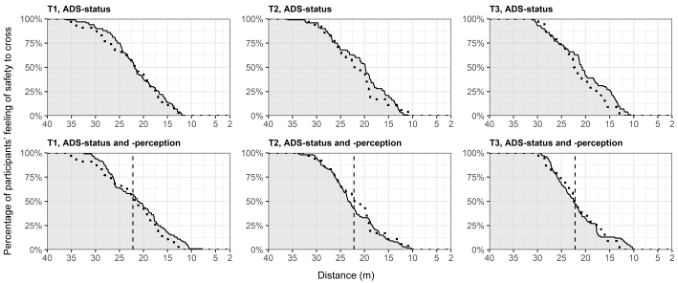
Nonyielding Vehicles At a distance of 40 m all participants felt safe to cross in front of nonyiel- ding vehicles, see Figure 1. Participants released the button on the hand-held device when the vehicles got closer. Fifty percent of participants felt safe to cross at a distance of approx. 20 m, i.e., a vehicle’s time-to arrival of approx. 4 s. At a distance of less than 10 m, no participant felt safe to cross. The gra- phs in Figure 1 indicate a linear decrease in participants’ feeling of safety as a function of distance. As experience increases, the decline of participants’ 100 % feeling of safety to cross starts later respectively at a closer distance to the nonyielding vehicles. The graphs for both vehicle types as well as both eHMI types are almost congruent in their pattern. Descriptive statistics of partici- pants’ feeling of safety to cross in front of nonyielding vehicles are reported in Table 1.
A three-way mixed ANOVA was run to determine the effects of experie- nce, vehicle type and eHMI type on participants’ feeling of safety to cross in front of nonyielding vehicles, see Table 1. Safety scores were normally distri- buted, as assessed by Shapiro-Wilk’s test (p > .05). There was homogeneity of variances, as assessed by Levene’s test for equality variances (p > .05). For the three-way interaction effect, according to Mauchly’s test the assumption of sphericity was violated, χ2(2) = 12.053, p = .002. Thus, Greenhouse-Geisser correction was applied. There were no statistically significant three- or two- way interaction effects between experience, vehicle type and eHMI type. The ANOVA found no significant main effects of experience, F(2, 30) = 0.685,
Figure 1: Percentage of participants’ feeling of safety to cross (y-axis) as a function of distance between pedestrian and nonyielding vehicle (x-axis). The solid line represents the AV condition with the eHMI type (group A: ADS-S; group B: ADS-SP). The dotted line represents the CV condition. The dashed line marks 22.2 m where the eHMI signal of perception for group B (ADS-SP) was activated. Percentage (excluding outliers) was calculated for the AV condition across 68 trials for group A (7 participants × 10 trials per session), 99 trials for group B (10 participants × 10 trials per session) and for the CV condition across 34 trials for both groups (17 participants × 2 trials per session).Table 1. Nonyielding vehicles: means (M) and standard deviations (SD) for sessions (T1, T2, T3) and three-way mixed ANOVA interaction effects.
Table available in the original PDF paper.
Variable ADS-S ADS-SP Total Three-way mixed ANOVA M SD M SD M SD Effect F df1 df2 ηp2 Automated vehicle: safety scores (%) T1 0.48 0.14 0.49 0.14 0.49 0.14 E × V × G 0.02 1.27 19.02 .00 T2 0.50 0.15 0.45 0.14 0.47 0.14 E × G 1.84 2 30 .11 T3 0.51 0.16 0.48 0.13 0.49 0.14 V × G 3.91 1 15 .21 Conventional vehicle: safety scores (%) E × V 0.65 1.27 19.02 .04 T1 0.43 0.15 0.48 0.16 0.46 0.15 T2 0.48 0.13 0.47 0.17 0.47 0.15 T3 0.48 0.14 0.49 0.12 0.48 0.12
Note. N = 17, nA = 7, nB = 10. ADS-S = ADS-status (group A); ADS-SP = ADS-status and -perception (group B); E = experience; V = vehicle; G = group / eHMI type. *p < .05
p = .512, ηp2 = .044, of vehicle type, F(1, 15) = 1.756, p = .205, ηp2 = .105, and of eHMI type, F(1, 15) = 0.007, p = .936, ηp2 = .000.
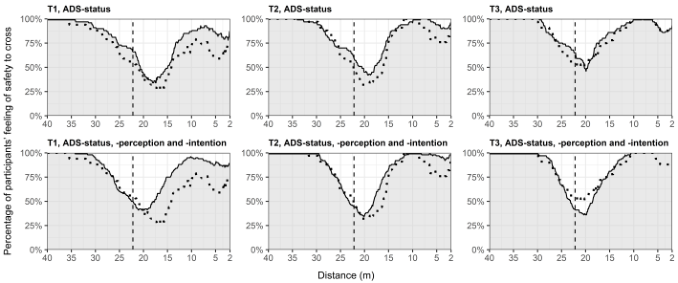
Yielding Vehicles Participants released the button on the hand-held device when the vehicles got closer and pressed the button again after the vehicles began to yield at 22.2 m, see Figure 2. For the distance between 35 and 10 m, the graphs of participants’ feeling of safety as a function of distance show a U-curve pattern. At a distance of less than 10 m, participants felt safe to cross in more than 75 % of the recorded trials for the AV condition. More participants of eHMI type ADS-SPI than eHMI type ADS-S felt safe to cross at distances below 10 m.
Pedestrians’ Crossing Decisions While Interacting With Automated Vehicles 161
Figure 2: Percentage of participants’ feeling of safety to cross (y-axis) as a function of distance between pedestrian and yielding vehicle (x-axis). The solid line represents the AV condition with the eHMI type (group A: ADS-S; group B: ADS-SPI). The dotted line represents the CV condition. The dashed line marks 22.2 m where the vehicle began to yield and where the eHMI signal of perception and intention for group B (ADS- SPI) was activated. Percentage (excluding outliers) was calculated for AV condition across 67 trials for group A (7 participants × 10 trials per session), 95 trials for group B (10 participants × 10 trials per session) and for CV condition across 32 trials for both groups (17 participants × 2 trials per session).
At the first session (T1), participants felt less safe to cross in front of a CV than an AV. With gaining experience (T2 and T3), the graphs in the CV condition converge towards the AV condition for group A, i.e., eHMI type ADS-S. For group B, i.e., eHMI type ADS-SPI, feeling of safety percentages increase with gaining experience at distances below 10 m. While participants with eHMI type ADS-SPI felt safe to cross below 10 m distance to the vehicle on 100 % of the recorded trials in T3, the graphs of eHMI type ADS-S still show a decline in distances below 10 m, with a minimum at approx. 5 m and an increase thereafter. Descriptive statistics of participants’ feeling of safety to cross in front of yielding vehicles are reported in Table 2.
A three-way mixed ANOVA was run to determine the effects of expe- rience, vehicle type and eHMI type on participants’ feeling of safety to cross in front of yielding vehicles, see Table 2. Safety scores were normally distributed, as assessed by Shapiro-Wilk’s test (p > .05). There was homo- geneity of variances, as assessed by Levene’s test for equality variances (p > .05). For the three-way interaction effect, according to Mauchly’s test the assumption of sphericity was met, χ2(2) = 4.069, p = .131. There was no statistically significant three-way interaction between experience, vehi- cle type and eHMI type, F(2, 30) = 2.006, p = .152, ηp2 = .118, indicating that the relationship between experience and vehicle type on safety scores was not significantly different between eHMI types. The ANOVA found one statistically significant interaction effect of experience and vehicle type on safety scores but no statistically significant main effect of eHMI type, F(1.34, 20.09) = 0.002, p = .962, ηp2 = .000. Simple main effects of experience and vehicle type were calculated using one-way ANOVAs with repeated mea- surements. Greenhouse-Geisser correction was applied if the assumption of
Table 2. Yielding vehicles: means (M) and standard deviations (SD) for sessions (T1, T2, T3) and three-way mixed ANOVA interaction effects.
Table available in the original PDF paper.
Variable ADS-S ADS-SPI Total Three-way mixed ANOVA M SD M SD M SD Effect F df1 df2 ηp2 Automated vehicle: safety scores (%) T1 0.79 0.15 0.81 0.14 0.80 0.14 E × V × G 2.00 2 30 .12 T2 0.84 0.16 0.83 0.11 0.83 0.13 E × G 2.85 1.3 20.1 .16 T3 0.87 0.14 0.84 0.11 0.86 0.12 V × G 0.23 1 15 .02 Conventional vehicle: safety scores (%) E × V 5.69* 2 30 .28 T1 0.64 0.15 0.74 0.24 0.70 0.21 T2 0.82 0.14 0.78 0.18 0.80 0.16 T3 0.85 0.15 0.84 0.15 0.84 0.14
Note. N = 17, nA = 7, nB = 10. ADS-S = ADS-status (group A); ADS-SPI = ADS-status, -perception and -intention (group B); E = experience; V = vehicle; G = group / eHMI type. *p < .05
sphericity was violated. Safety scores were not statistically significantly dif- ferent over experience in the AV condition, F(1.25, 20) = 3.087, p = .087 , ηp2 = .162. There was a statistically significant simple main effect of expe- rience in the CV condition, F(2, 32) = 12.255, p < .0005, ηp2 = .434. For the CV condition post-hoc tests with Bonferroni correction found statistically significant improvements in safety scores from T1 (M = 0.70, SD = 0.21) to T2 (M = 0.80, SD = 0.12), p = .025, 95% CI [0.01 – 0.19], and from T1 to T3 (M = 0.84, SD = 0.14), p = .002, 95% CI [0.05 – 0.23]. At T1, safety scores were statistically significantly higher in the AV condition (M = 0.80, SD = 0.14) compared to the CV condition (M = 0.70, SD = 0.21), F(1, 17) = 8.357, p = .010, ηp2 = .330, 95% CI [0.03 – .018]. Safety scores in the AV condition (T2: M = 0.83, SD = 0.13; T3: M = 0.86, SD = 0.12) compa- red to the CV condition (T2: M = 0.80, SD = 0.16; T3: M = 0.84, SD = 0.14) were not statistically significantly different at T2, F(1, 17) = 2.889, p = .107, ηp2 = .145, and at T3, F(1, 16) = .0541, p = .473, ηp2 = .033.
DISCUSSION
This study investigated changes in pedestrians’ perceived safety when crossing in front of AVs using a longitudinal design in a controlled field environ- ment. For nonyielding vehicles, perceived safety was unaffected by increasing experience and did not depend on vehicle or eHMI type: Despite increasing experience, participants felt equally safe to cross in front of a nonyielding CV or AV, independently from the eHMI information of status or status and perception. Thus, the eHMI’s dynamic information of perception had no influence on participants’ feeling of safety in interaction with a nonyiel- ding AV. An explanation is the dominance of implicit communication signals, i.e., in this case the vehicle’s constant speed (Lee et al. 2021).
For yielding vehicles, perceived safety to cross was higher for an AV than a CV at the first session (T1) and increased with gaining experience (T2 and T3). This result might be explained by the experimental sequence, as partici- pants experienced the CV before the AV. Although no statistically significant
Pedestrians’ Crossing Decisions While Interacting With Automated Vehicles 163
influence with respect to eHMI type or experience was found for the AV condition, the graphs of feeling of safety to cross as a function of distance between pedestrian and yielding vehicle displayed a characteristic and diffe- rent course for the eHMI types. In particular, participants who experienced the eHMI type ADS-SPI increased their perceived feeling of safety at close distances from the vehicle with increasing experience. This indicates that the dynamic eHMI information about the vehicle’s perception and intention to yield proves especially valuable in close distances and low speeds of an AV, which constitutes a situation perceived as ambiguous (Lee et al. 2021).
In post-hoc interviews, participants reported a high realism of the traffic situation in the controlled field environment. Nevertheless, a limitation of the study is the young study population, which prevents the generalizability of the study results to street crossing decisions of elderly people (Dommes et al. 2015). Further, statistical data analysis was conducted using an overall safety score based on the distance interval of 40 m to 2 m between vehicle and participant. However, the findings indicate a more complex and distance- dependent effect (Dey et al. 2020b) of experience on pedestrians’ crossing decisions in front of AVs, depending on eHMI type.
For the introduction of AVs in shared spaces, this research implies that with gaining experience, young pedestrians’ perceived safety when crossing in front of yielding AVs increases at close distances to the vehicle. This effect is enhanced when an AV is equipped with an eHMI displaying the vehicle’s status, perception and yielding intention. Our ongoing research will address pedestrians’ development of trust and mental models of AVs with increasing experience.
ACKNOWLEDGMENT
This work is a result of the research project @CITY - Automated Cars and Intelligent Traffic in the City. The project is supported by the Federal Ministry for Economic Affairs and Climate Action (BMWK), based on a decision by the German Bundestag, grant no. 19A18003M. The authors are responsible for the content of this work.
REFERENCES
Bengler, K., Rettenmaier, M., Fritz, N., and Feierle, A. (2020). From HMI to HMIs: Towards an HMI Framework for Automated Driving. Information, 11(2), 1–17. Clercq, K. de, Dietrich, A., Núñez Velasco, J.P., Winter, J. de, and Happee, R.
(2019). External Human-Machine Interfaces on Automated Vehicles: Effects on Pedestrian Crossing Decisions. Human Factors, 61 (8), 1353–1370. Dey, D., Habibovic, A., Löcken, A., Wintersberger, P., Pfleging, B., Riener, A., Martens, M., and Terken, J. (2020a). Taming the eHMI jungle: A classifica- tion taxonomy to guide, compare, and assess the design principles of automated vehicles’ external human-machine interfaces. Transportation Research Interdisci- plinary Perspectives, 7, 1–24. Dey, D., Holländer, K., Berger, M., Eggen, B., Martens, M., Pfleging, B., and
Terken, J. (2020b). Distance-Dependent eHMIs for the Interaction Between Auto- mated Vehicles and Pedestrians. 12th International Conference on Automotive User Interfaces and Interactive Vehicular Applications, 192–204.
Dommes, A., Le Lay, T., Vienne, F., Dang, N.-T., Beaudoin, A.P., and Do, M.C.
(2015). Towards an explanation of age-related difficulties in crossing a two-way street. Accident Analysis and Prevention, 85, 229–238. Faas, S.M., Kao, A.C., and Baumann, M. (2020a). A Longitudinal Video Study on Communicating Status and Intent for Self-Driving Vehicle Pedestrian Interaction. 2020 CHI Conference on Human Factors in Computing Systems, 1–14. Faas, S.M., Mathis, L.-A., and Baumann, M. (2020b). External HMI for self-driving
vehicles: Which information shall be displayed? Transportation Research Part F: Traffic Psychology and Behaviour, 68, 171–186. Frison, A.K., Forster, Y., Wintersberger, P., Geisel, V., and Riener, A. (2020). Where We Come from and Where We Are Going: A Systematic Review of Human Factors Research in Driving Automation. Applied Sciences, 10 (24), 1–36. Holländer, K., Colley, A., Mai, C., Häkkilä, J., Alt, F., and Pfleging, B. (2019). Investi-
gating the Influence of External Car Displays on Pedestrians’ Crossing Behavior in Virtual Reality. 21st International Conference on Human-Computer Interaction with Mobile Devices and Services, 1–11. Kaleefathullah, A.A., Merat, N., Lee, Y.M., Eisma, Y.B., Madigan, R., Garcia, J., and Winter, J. de (2020). External Human-Machine Interfaces Can Be Misleading: An Examination of Trust Development and Misuse in a CAVE-Based Pedestrian Simulation Environment. Human Factors, 1–16. Lee, Y.M., Madigan, R., Giles, O., Garach-Morcillo, L., Markkula, G., Fox, C., Camara, F., Rothmueller, M., Vendelbo-Larsen, S.A., Rasmussen, P.H., Dietrich, A., Nathanael, D., Portouli, V., Schieben, A., and Merat, N. (2021). Road users rarely use explicit communication when interacting in today’s traf- fic: implications for automated vehicles. Cognition, Technology & Work, 23 (2), 367–380. Rodríguez Palmeiro, A., van der Kint, S., Vissers, L., Farah, H., Winter, J.C. de, and
Hagenzieker, M. (2018). Interaction between pedestrians and automated vehicles: A Wizard of Oz experiment. Transportation Research Part F: Traffic Psychology and Behaviour, 58, 1005–1020. Rouchitsas, A. and Alm, H. (2019). External Human-Machine Interfaces for Autonomous Vehicle-to-Pedestrian Communication: A Review of Empirical Work. Frontiers in Psychology, 10, 1–12. SAE International (2021). Taxonomy and Definitions for Terms Related to Driving
Automation Systems for On-Road Motor Vehicles. USA. Schieben, A., Wilbrink, M., Kettwich, C., Madigan, R., Louw, T., and Merat, N.
(2019). Designing the interaction of automated vehicles with other traffic partici- pants: design considerations based on human needs and expectations. Cognition, Technology & Work, 21 (1), 69–85. Stanciu, S.C., Eby, D.W., Molnar, L.J., St. Louis, R.M., Zanier, N., and Kostyniuk, L.P. (2018). Pedestrians/Bicyclists and Autonomous Vehicles: How Will They Communicate? Transportation Research Record, 2672 (22), 5–66. Walker, F., Dey, D., Martens, M., Pfleging, B., Eggen, B., and Terken, J. (2019).
Feeling-of-Safety Slider. 2019 CHI Conference on Human Factors in Computing Systems, 1–6. Wilbrink, M., Lau, M., Illgner, J., Schieben, A., and Oehl, M. (2021). Impact of External Human–Machine Interface Communication Strategies of Automated Vehicles on Pedestrians’ Crossing Decisions and Behaviors in an Urban Environment. Sustainability, 13 (15), 1–18.
LISTED IN THE AHFE DIGITAL BOOKSTORE CATALOGUE
Explore the complete digital volume
Human Factors in Transportation
Read this individual research paper free through the original publisher, or explore the full digital proceedings book.
ISBN 978-1-958651-36-0
Explore this ISBN in the AHFE Bookstore ↗Listed in the July 2026 bookstore catalogue; search by ISBN to confirm current availability · Digital book purchase optional