Shuwen Tian, Peiwen Luo, Zhengyu Tan (2025). The Interaction Effects of Autonomous Vehicle Deceleration Style and eHMI Presence on Pedestrian Crossing Intentions. In: Advances in Human Factors of Transportation. AHFE Open Access, vol. 186, pp. 448–458. https://doi.org/10.54941/ahfe1006534
Communicating through external human-machine interfaces (eHMIs) is considered a potential solution to address the communication gaps and safety issues introduced by automated driving. This study investigates the impact of eHMI on pedestrian willingness to cross during the brief yet crucial 'deceleration-yield' process. Twenty-three participants experienced three different vehicle deceleration styles and two eHMI display conditions, including text-based eHMI and a baseline condition with no eHMI, through simulated videos portraying pedestrian scenarios. Participants continuously reported their real-time willingness to cross using an upward or downward swipe on a tablet and provided subjective assessments of anxiety and perceived risks through a questionnaire after each deceleration experience. The research findings indicate that a more aggressive deceleration approach decreases pedestrian willingness to cross, but the presence of eHMI can mitigate this effect. For pedestrians, the impact of eHMI is more pronounced when the vehicle's behavior exhibits its intent ambiguity. This study provides insights into scenarios where eHMI can be beneficial and offers design recommendations for eHMI implementation in real-world autonomous driving scenarios.
Road accidents have been a significant cause of fatalities globally, which can give rise to significant public health concerns. Currently, a substantial amount of research has been devoted to exploring the causes of road accidents. A cluster analysis on 1064 single-vehicle road crashes on crosstown roads in Spain from 2006 to 2016 (Casado-Sanz et al., 2020) indicated that, from the driver’s perspective, ‘Infractions committed by the driver’ was the most crucial factor influencing the severity of single-vehicle accidents on crosstown roads. In other words, driver-related human errors tend to significantly increase the occurrence of severe road injuries. Fully developed autonomous vehicles (AVs), capable of navigating complex environments, have the potential to reduce driver errors during driving, and are therefore considered capable of potentially decreasing the number of fatalities in road accidents.
The Interaction Effects of Autonomous Vehicle Deceleration Style 449
In fact, pedestrian crossings the road outside the pedestrian crossing are a common occurrence in most areas (Yannis et al., 2020). In such situations, pedestrians violate traffic regulations, and it becomes uncertain whether vehicles will yield. To understand the yielding intent of vehicles, pedestrians engage in explicit or implicit informal communication with vehicles when crossing the road. Previous studies have shown that pedestrians primarily rely on implicit cues to assess vehicles’ intention when crossing the road (Dey et al., 2019), mainly indicated by the vehicle’s deceleration (Fuest et al., 2020). However, when control shifts from the driver to an AV, pedestrians may no longer be able to discern the vehicle’s intent through driver centered explicit signals, such as gestures, which may negatively impact pedestrians’ sense of safety (Lundgren et al., 2017).
Communication signals through the external human-machine interfaces (eHMIs), such as additional lights, text, and auditory signals, are considered potential solutions to address the communication problems introduced by automated driving. Bazilinskyy et al. (2021) conducted an online study evaluating volunteers’ subjective perceptions as pedestrians toward various eHMI concepts, concluding that pedestrian-centric concept resulted in the highest sense of safety. In comparative studies of different eHMI concepts, text concepts are considered to convey information more clearly (Bazilinskyy et al., 2019) and require less learning (de Clercq et al., 2019).
Some studies have compared the impact of eHMIs and vehicle kinematic cues on pedestrians’ judgments of AVs’ intent, pointing to the conclusion that vehicle motion primarily assists pedestrians in understanding the intentions of AVs (Dey et al., 2021a). However, other research findings suggest that the presence of eHMIs positively influences pedestrians’ confidence and sense of safety while crossing roads (Bindschädel et al., 2022). When vehicles are equipped with eHMI, pedestrians cross earlier (Kaleefathullah et al., 2022), making it a potential benefit for alleviating traffic burdens (Bellet et al., 2022). In other words, although pedestrians can still judge when to cross the road based on vehicle motion in mixed traffic environments with both AVs and manually driven vehicles, the presence of eHMIs can provide a more positive psychological experience, and has the potential to enhance traffic efficiency.
Among vehicle kinematic cues, the deceleration process is considered the primary basis for pedestrians to judge the intent of the vehicle (Sucha et al., 2017). Pedestrians anticipate automated vehicles expressing their intention through early deceleration (Fuest et al., 2020), and the presence of eHMIs has the potential to reduce ambiguity in vehicles’ intention (Dey et al., 2021a). When eHMIs coexist with vehicle kinematic cues, their impact on pedestrians is not isolated, but involves complex interactions. The conclusion pointed out by Lau et al.’s online study is that, when there is a contradiction between eHMI and the vehicle’s yielding motion, pedestrians may overly trust eHMI and inadequately rely on vehicle motion (Lau et al., 2022). Virtual reality research by de Clercq et al. (2019) suggests that eHMI can enhance pedestrians’ sense of safety only when the vehicle does yield.
Although some studies have explored the respective effects of eHMIs on pedestrians’ psychology and behavior when the vehicle yields or does
not yield (Dey et al., 2020), there have been relatively rare studies on the interaction between the presence of eHMIs and vehicle speed change. Our study aimed to explore the multifaceted effects of eHMI on pedestrians’ psychology during the brief but critical process of ‘deceleration-yielding’. In this study, pedestrians were presented with three vehicle deceleration styles, and one eHMI concept known to be easy to learn and understand was presented in two states: present or absent. Pedestrians experienced vehicle deceleration through video simulations because actual road crossings prohibit pedestrians from reporting real-time perceptions, and virtual reality methods were found to potentially induce overly aggressive pedestrian action strategies (Dey et al., 2021b). The study collected pedestrians’ self-reported perceived risk (PR) and subjective anxiety to reflect their psychological states in different situations, as well as real-time crossing intentions during the vehicle yielding process to reflect their crossing decisions. The findings aim to provide guidance for the practical implementation of eHMI scenarios and display strategies in vehicles.
METHODS
Twenty-three volunteers participated in this study, including 12 males and 11 females, all aged between 22 and 29 years (Avg. = 23.3, SD = 5.6). The visual ability of each participant was either normal or corrected to normal. This research complied with the principles outlined in the Declaration of Helsinki. All volunteers provided informed consent before participating in the study, and participants were compensated for their involvement after the experiment.
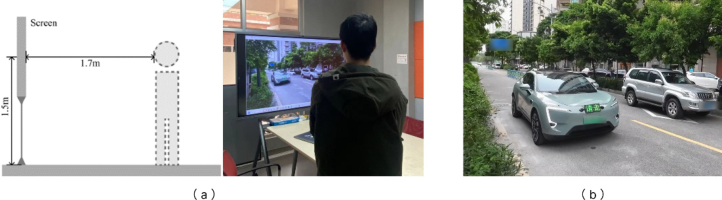
This experiment utilized a display screen to present videos of actual road scenarios featuring vehicle deceleration, creating a simulated environment for participants, as depicted in Figure 1(a). The eHMI display in the experiment was shown on a screen mounted above the vehicle grille (approximately 50 cm in length and 25 cm in width), as illustrated in Figure 1(b).
Figure 1: (a) Laboratory setup. (b) The experimental vehicle and the video recording environment.
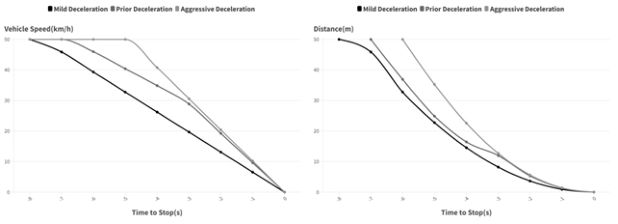
This study employed a within-subject design with two independent variables. The first independent variable was the vehicle deceleration parameter, categorized into three levels: (1) mild deceleration (MD), (2) prior deceleration (PD), and (3) aggressive deceleration (AD). Figure 2 illustrates the change in vehicle speed and the vehicle-pedestrian distance as a function
The Interaction Effects of Autonomous Vehicle Deceleration Style 451
of the time to stop (TS) of the vehicle. Under all three deceleration conditions, the vehicle’s speed when it was 50 meters away from the pedestrian was 50 km/h (considered a typical approach speed), and it eventually came to a stop at the location where the pedestrian was standing. The constant deceleration rates under the MD and AD conditions were adjusted based on the observed range of deceleration rates that drivers find comfortable in previous studies (Ackermann et al., 2019). In the condition of PD, the vehicle exhibited an early deceleration rate similar to the MD condition, while in the later stages, the speed and deceleration rate were similar to the AD condition.
The second independent variable is the presence of eHMI. The eHMI concept used in the experiment is a green Chinese ‘请走’ (Please Cross) text displayed at the vehicle’s grill. Its features are considered easily noticeable and less prone to misunderstanding. Figure 3 illustrates the specific eHMI concept, and Figure 1(b) shows its display in the experimental videos.
While watching the deceleration videos, a handheld tablet was used to measure participants’ real-time willingness to cross (WC). Participants were able to indicate an increase in their WC with a swipe up gesture and a decrease in their WC with a swipe down gesture from anywhere on the screen. After viewing each video segment, participants rated their level of anxiety during that deceleration segment and the PR of the vehicle’s driving on a Likert scale.
Participants were instructed to imagine themselves standing at the location where the video was recorded and preparing to cross the road, but without actually moving. After a practice session, participants watched six segments of vehicle deceleration videos in a balanced order. Finally, a brief interview was conducted with participants to gather their impressions regarding vehicle speed and eHMI display.
Figure 2: From left to right: (1) Speed of the approaching vehicle as a function of TS. (2) Distance between the vehicle and the pedestrian as a function of TS.Figure 3: The eHMI employed in this study conveys the message ‘please proceed’.
RESULTS
We first performed descriptive statistics on the mean scores per second of the participants’ input on WC, as well as pairwise comparisons (i.e., pairwise t-tests) of the scores for each second from 7 seconds before stopping (when the vehicles were already decelerating in all conditions) to 1 second after stopping (when participants were still modifying their scores), to analyze the change in participants’ WC with TS. Subsequently, a multifactor repeated- measures ANOVA was conducted for the three deceleration conditions and the two eHMI display conditions over the same timeframe to explore the effects of vehicle speed, eHMI presence, and their interaction.
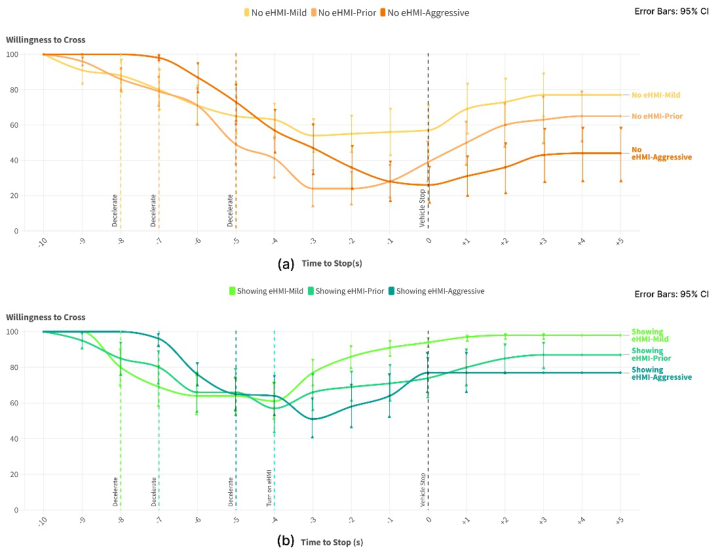
The average scores of participants’ WC, when the vehicle displays no eHMI concepts, are illustrated in Figure 4(a). Under the PD condition, the scores exhibit a similar declining trend to the MD condition in the early stages, followed by fluctuations similar to the AD condition but occurring earlier. Overall, the lowest scores and the final rising values under the MD condition are higher than the other two conditions. The PD condition exhibits similar lowest scores to the AD condition, but the scores eventually rise to a higher level under the PD condition. The results of pairwise comparisons among the three deceleration styles are presented in Table 1, with significantly differences highlighted in bold.
Figure 4: (a) The average WC scores with no eHMI. (b) The average WC scores with eHMI display.
The Interaction Effects of Autonomous Vehicle Deceleration Style 453
Table 1: Pairwise comparison of WC for the three deceleration conditions with no eHMI.
Table available in the original PDF paper.
TS Mild-Prior Mild-Aggressive Prior-Aggressive t(22) p t(22) p t(22) p
Table 2: Pairwise comparison of WC for the three deceleration conditions with eHMI.
Table available in the original PDF paper.
TS Mild-Prior Mild-Aggressive Prior-Aggressive t(22) p t(22) p t(22) p
−7S −1.492 .150 −4.674 <.001 −2.948 .007 −6s −.412 .684 −3.870 .001 −2.967 .007 −5s 1.222 .234 −1.473 .155 −2.768 .011 −4s 1.668 .109 −.516 .611 −2.119 .046 −3s 1.536 .139 3.981 .001 2.213 .038 −2s 2.932 .008 4.153 <.001 1.484 .152 −1s 3.273 .003 4.345 <.001 .901 .377 Vehicle Stop 2.998 .007 3.073 .006 −.106 .917 +1s 2.862 .009 3.366 .003 .607 .550 The average scores of participants’ WC are shown in Figure 4(b), with the vehicle displaying the text-based eHMI concept. In the descriptive graph, the onset of eHMI display is indicated by the light teal-colored dashed line. Overall, the trends in the scores for the three conditions are similar to those without eHMI display, but the fluctuations are milder, and the differences between the three conditions are smaller. The results of pairwise comparisons among the three deceleration styles are presented in Table 2.
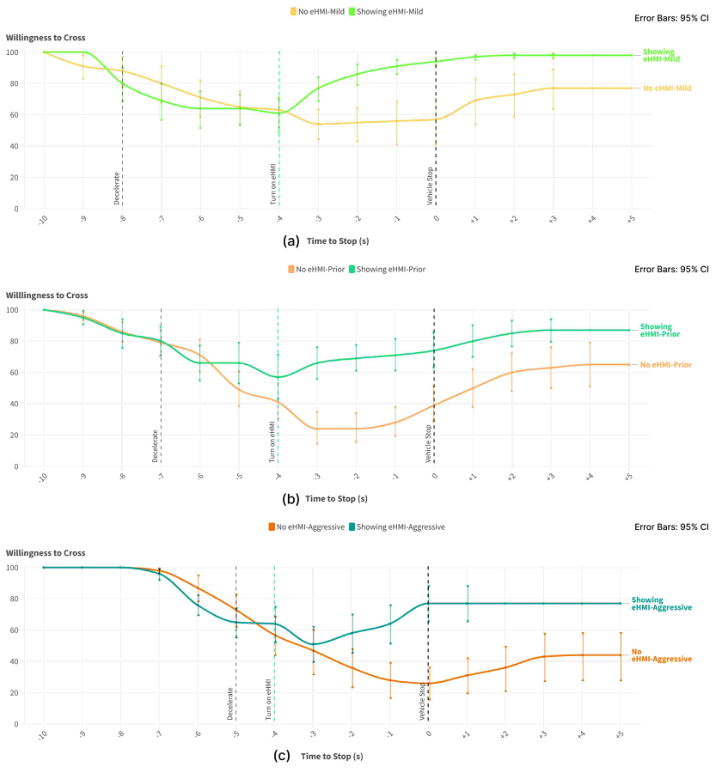
Figure 5 illustrates the average WC scores comparison between text-based eHMI and the baseline under the MD, PD, and AD conditions. Overall, in conditions where eHMI is displayed, there is a noticeable increase in scores after the activation of eHMI until just before the vehicle comes to a stop. However, the scores show a lower degree of increase after the vehicle has stopped, yet they remain at a higher level compared to the baseline conditions. This phenomenon becomes more pronounced as the aggressiveness of the vehicle’s deceleration increases.
Table 3 presents the pairwise comparison results between the conditions with and without eHMI under three deceleration conditions. Overall, the differences in the AD condition show a delay compared to the other two conditions.
Figure 5: Average WC scores under the MD condition (a), PD condition (b), AD condition (c).Table 3: Pairwise comparison of WC between the with-eHMI and baseline conditions under the three deceleration conditions.
Table available in the original PDF paper.
TS Mild-Prior Mild-Aggressive Prior-Aggressive t(22) p t(22) p t(22) p
The Interaction Effects of Autonomous Vehicle Deceleration Style 455
We conducted a repeated measures analysis of variance for the six experimental conditions of the vehicle (2 eHMI conditions * 3 deceleration conditions) ranging from 7 seconds before stopping to 1 second after stopping. The WC data did not pass the sphericity test, so the results of the multivariate test will be reported. The results indicate that the effects of eHMI, deceleration conditions, and their interaction are statistically significant and have a moderate effect size. The effect of eHMI presence was F(1, 22) = 7.561, p <.001, ηp = .326, whereas the effect of deceleration condition was, F(2, 44) = 3.095, p <.001, ηp = .328. The effect of eHMI presence * deceleration condition interaction was F(5, 110) = 3.035, p <.001, ηp = .323.
Additionally, pairwise comparisons were conducted for with and without eHMI for each deceleration condition. Under the same deceleration condition, scores with eHMI display were significantly higher than without eHMI, with stronger significance observed in the PD and AD conditions. When without eHMI, pairwise comparisons between different deceleration conditions showed larger differences compared to when text eHMI was present. Additionally, a statistically significant difference between the MD and PD conditions was only observed in the absence of eHMI.
We conducted descriptive statistics, paired t-tests, and repeated measures ANOVA for participants’ reported levels of anxiety and PR of the vehicle under the six experimental conditions.
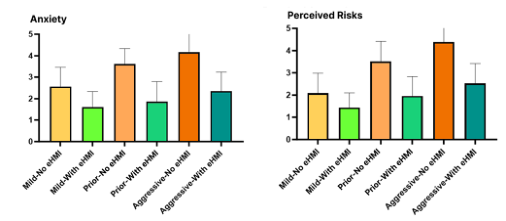
The average scores for each experimental condition are shown in Figure 6. As the vehicle’s deceleration style becomes more aggressive, participants reported higher levels of anxiety and PA. The presence of eHMI significantly reduced the average scores and minimized the differences between different deceleration styles.
Figure 6: Descriptive statistics for average anxiety and PR scores.
Pairwise t-tests showed that participants reported significantly higher levels of anxiety when there was no eHMI displayed in each deceleration condition. In each deceleration condition, participants reported significantly higher PR scores when there was no eHMI displayed. The results of the tests for the between-subject effects on anxiety and PR indicate that the effects of eHMI, deceleration conditions, and their interaction on both subjective ratings are statistically significant.
DISCUSSION
Overall, a more gentle and earlier onset of deceleration behavior by vehicles results in higher willingness for pedestrians to cross, consistent with previous research indicating pedestrians’ preference for early deceleration but with an extended crossing time (Fuest et al., 2020). However, when the deceleration style is more aggressive, even if the vehicle has signaled yielding intent by displaying eHMI or coming to a complete stop, pedestrians still require more time to confirm that the vehicle is no longer accelerating and is ready for them to cross, leading to a heightened sense of anxiety. The results of this study show that the presence of eHMI can reduce this confirmation time and mitigate the negative experiences associated with relatively aggressive deceleration styles.
The conclusions drawn from previous research suggested that pulse-light- based eHMI concepts have a relatively weak impact when vehicles are traveling at high speeds (Dey et al., 2021a). In this study, although the influence of eHMI on pedestrian willingness to cross takes longer when the vehicle speed is higher, its impact is more pronounced compared to mild deceleration. One possible explanation is that text-based eHMI concepts, while not requiring additional learning for comprehension, are less readable at higher speeds. Additionally, despite an increase in participants’ anxiety with the increasing aggressiveness of vehicle deceleration, the impact of eHMI under the early deceleration style is even slightly greater than that under the aggressive deceleration style. According to post-experimental interviews, participants reported that under the early deceleration condition, the initial deceleration seemed to convey the vehicle’s yielding intent, but later the vehicle maintained a relatively high speed, introducing ambiguity about whether the vehicle was yielding. Considering that the presence of eHMI can reduce the time for pedestrians’ “delayed confirmation” after the vehicle stops, eHMI appears to play a stronger role in clarifying intent and improving efficiency when there is ambiguity in the presentation of the vehicle’s kinematic cues.
According to the research findings, eHMI demonstrates potential positive effects in certain real-world driving scenarios. eHMI, by conveying additional information, accelerates the time required for pedestrians to confirm the vehicle’s intent before braking, potentially enhancing the efficiency of pedestrian crossing. When the vehicle’s speed variation blurs the yielding intention, eHMI clarifies the vehicle’s intent, thereby reducing the speed adjustment constraints for the vehicle in real traffic environments.
Our study suggests some design recommendations for eHMI in real- world scenarios. Participants generally reported that text-based formats were acceptable, although changes in pedestrian crossing intent scores and participant interviews indicated challenges in reading text when the vehicle was in motion. This suggests that displaying different forms and content of eHMI concepts at different stages of vehicle movement could clarify the vehicle’s yielding intent without imposing excessive attention costs on pedestrians.
The Interaction Effects of Autonomous Vehicle Deceleration Style 457
CONCLUSION
We conducted an experiment using video simulations to investigate the combined impact of vehicle deceleration parameters and eHMI displays on pedestrians’ crossing intentions and subjective perceptions. The results indicate that when the vehicle’s deceleration is more aggressive, pedestrians take longer to confirm the vehicle’s yielding intention and experience increased anxiety. The presence of eHMI can mitigate these negative effects. When there is ambiguity in the vehicle’s deceleration behavior, eHMI has a stronger impact on pedestrians’ crossing intentions. The findings suggest that more aggressive deceleration reduces pedestrians’ expectations of the vehicle yielding, but the presence of eHMI can mitigate this effect. This allows autonomous vehicles to drive in a manner that is more comfortable for the driver while enabling pedestrians to understand the yielding intentions efficiently without experiencing stronger negative emotional reactions. This study provides guidance for strategies in which autonomous vehicles communicate with pedestrians through eHMI.
REFERENCES
Backermann, C., Beggiato, M., Bluhm, L.-F., Löw, A., Krems, J. F., 2019. Deceleration parameters and their applicability as informal communication signal between pedestrians and automated vehicles. Transportation Research Part F: Traffic Psychology and Behaviour 62, 757–768. Bazilinskyy, P., Dodou, D., de Winter, J., 2019. Survey on eHMI concepts: The effect
of text, color, and perspective. Transportation Research Part F: Traffic Psychology and Behaviour 67, 175–194. Bazilinskyy, P., Kooijman, L., Dodou, D., de Winter, J. C. F., 2021. How should external human-machine interfaces behave? Examining the effects of colour, position, message, activation distance, vehicle yielding, and visual distraction among 1, 434 participants. Applied Ergonomics 95, 103450. Bellet, T., Laurent, S., Bornard, J.-C., Hoang, I., Richard, B., 2022. Interaction
between pedestrians and automated vehicles: Perceived safety of yielding behaviors and benefits of an external human–machine interface for elderly people. Frontiers in Psychology 13. Bindschädel, J., Krems, I., Kiesel, A., 2022. Active vehicle pitch motion for communication in automated driving. Transportation Research Part F: Traffic Psychology and Behaviour 87, 279–294. Casado-Sanz, N., Guirao, B., Attard, M., 2020. Analysis of the Risk Factors Affecting
the Severity of Traffic Accidents on Spanish Crosstown Roads: The Driver’s Perspective. Sustainability 12, 2237. de Clercq, K., Dietrich, A., Núñez Velasco, J. P., de Winter, J., Happee, R.,
2019. External Human-Machine Interfaces on Automated Vehicles: Effects on Pedestrian Crossing Decisions. Hum Factors 61, 1353–1370. Dey, D., Holländer, K., Berger, M., Eggen, B., Martens, M., Pfleging, B., Terken, J., 2020. Distance-Dependent eHMIs for the Interaction Between Automated Vehicles and Pedestrians, in: 12th International Conference on Automotive User Interfaces and Interactive Vehicular Applications, Automotive UI ‘20. Association for Computing Machinery, New York, NY, USA, pp. 192–204.
Dey, D., Martens, M., Eggen, B., Terken, J., 2019. Pedestrian road-crossing willingness as a function of vehicle automation, external appearance, and driving behaviour. Transportation Research Part F: Traffic Psychology and Behaviour 65, 191–205. Dey, D., Matviienko, A., Berger, M., Pfleging, B., Martens, M., Terken, J.,
2021a. Communicating the intention of an automated vehicle to pedestrians: The contributions of eHMI and vehicle behavior it - Information Technology 63, 123–141. Dey, D., van Vastenhoven, A., Cuijpers, R. H., Martens, M., Pfleging, B., 2021b.
Towards Scalable eHMIs: Designing for AV-VRU Communication Beyond One Pedestrian, in: 13th International Conference on Automotive User Interfaces and Interactive Vehicular Applications, AutomotiveUI ‘21. Association for Computing Machinery, New York, NY, USA, pp. 274–286. Fuest, T., Maier, A. S., Bellem, H., Bengler, K., 2020. How Should an Automated Vehicle Communicate Its Intention to a Pedestrian? – A Virtual Reality Study, in: Ahram, T., Karwowski, W., Pickl, S., Taiar, R. (Eds.), Human Systems Engineering and Design II, Advances in Intelligent Systems and Computing. Springer International Publishing, Cham, pp. 195–201. Kaleefathullah, A. A., Merat, N., Lee, Y. M., Eisma, Y. B., Madigan, R., Garcia,
J., Winter, J. de, 2022. External Human–Machine Interfaces Can Be Misleading: An Examination of Trust Development and Misuse in a CAVE-Based Pedestrian Simulation Environment. Hum Factors 64, 1070–1085. Lau, M., Jipp, M., Oehl, M., 2022. Toward a Holistic Communication Approach to an Automated Vehicle’s Communication With Pedestrians: Combining Vehicle Kinematics With External Human-Machine Interfaces for Differently Sized Automated Vehicles. Frontiers in Psychology 13. Lundgren, V. M., Habibovic, A., Andersson, J., Lagström, T., Nilsson, M., Sirkka,
A., Fagerlönn, J., Fredriksson, R., Edgren, C., Krupenia, S., Saluäär, D., 2017. Will There Be New Communication Needs When Introducing Automated Vehicles to the Urban Context?, in: Stanton, N. A., Landry, S., Di Bucchianico, G., Vallicelli, A. (Eds.), Advances in Human Aspects of Transportation, Advances in Intelligent Systems and Computing. Springer International Publishing, Cham, pp. 485–497. Sucha, M., Dostal, D., Risser, R., 2017. Pedestrian-driver communication and decision strategies at marked crossings. Accident Analysis & Prevention 102, 41–50. Yannis, G., Nikolaou, D., Laiou, A., Stürmer, Y. A., Buttler, I., Jankowska-Karpa,
D., 2020. Vulnerable road users: Cross-cultural perspectives on performance and attitudes. IATSS Research 44, 220–229.
LISTED IN THE AHFE DIGITAL BOOKSTORE CATALOGUE
Explore the complete digital volume
Advances in Human Factors of Transportation
Read this individual research paper free through the original publisher, or explore the full digital proceedings book.
ISBN 978-1-964867-62-5
Explore this ISBN in the AHFE Bookstore ↗Listed in the July 2026 bookstore catalogue; search by ISBN to confirm current availability · Digital book purchase optional