Ruisi Shi, Xing Chen, Ruolin Huang, Jingyu Zhang (2023). Enhancing Pedestrian Comprehension through a Bio-Motion eHMI Design for Autonomous Vehicles. In: Emerging Technologies and Future of Work. AHFE Open Access, vol. 117, pp. 188–194. https://doi.org/10.54941/ahfe1004418
1 CAS Key Laboratory of Behavioral Science, Institute of Psychology, China; Department of Psychology, University of the Chinese Academy of Sciences, China ↗
2 Chongqing Chang’an Automobile Co., Ltd., China ↗
Autonomous vehicles are transforming the transportation industry. In conventional traffic environments, human drivers convey intentions to other pedestrians using gestures and facial expressions. Yet, these traditional interactions, vital for safety, are conspicuously absent in autonomous vehicles, leading to comprehension difficulties and heightened street-crossing risks. While current External Human-Machine Interfaces (eHMIs) aim to mitigate this communication void, they often demand prior familiarization and fall short of intuitiveness, complicating the universal interpretation of a vehicle's intent. To address this, we've developed a novel eHMI for autonomous vehicles, capitalizing on biological motion features. These features, represented by moving dots, capture the movement of key joints in fundamental animal behaviors, such as halting and yielding. Drawing from leopards' skeletal and motion patterns, our bio-motion eHMI integrates animal communication metaphors, like 'please let me pass' and 'I will yield,' to enhance clarity in vehicle-pedestrian interactions. We investigate whether integrating these animal-inspired biological motion patterns into autonomous vehicles can bolster pedestrian comprehension of vehicle intent and movement, ultimately fostering safer street-crossing behaviors. 32 Chinese participants engaged in the experiment online, observing video clips that demonstrated vehicular movements via our eHMI. Subsequently, they answered multiple-choice questions assessing their understanding of the vehicle's movement and intent. The results show that the Bio-Motion eHMI significantly outperforms both Text eHMI and Non-display in interpreting vehicle movement. Moreover, both Bio-Motion eHMI and Text eHMI excel over Non-display in discerning vehicle intent. Impressively, the bio-motion eHMI not only stands out in accuracy concerning vehicle intent and movement but also garners superior subjective preferences compared to other interfaces. In conclusion, our biologically-inspired motion-centric eHMI presents a natural conduit for vehicle-to-pedestrian communication, ensuring swift and precise comprehension of vehicle intentions. This pioneering approach has the potential to revolutionize external vehicle interfaces, marking a new chapter in inclusive design within the autonomous vehicle realm.
Enhancing Pedestrian Comprehension Through a Bio-Motion eHMI Design 189
INTRODUCTION
Autonomous driving heralds a transformative era in automotives, introduc- ing the challenge of effective communication between autonomous vehicles, pedestrians, and road users. Traditionally, gestures and eye contact are crucial for conveying intent (Sucha et al., 2017), a feature not yet fully replicated in autonomous vehicles, thereby potentially increasing accidents and impeding public acceptance (de Clercq et al., 2019). Addressing this gap, researchers have proposed an external human-machine interface (eHMI), using in-car interfaces as a model, to communicate autonomous vehicle intent or move- ment to other road users, enhancing public acceptance (Eisma et al., 2020). Despite evidence of eHMI’s effectiveness (Wang et al., 2021), current eHMI designs often struggle with ambiguous symbols, unnatural communication, unclear meanings, and limited perception distance.
Given the limitations of current eHMI, the trend is moving towards biomimetic or bio-inspired eHMI to improve understanding across diverse cultural and age demographics. These designs, which incorporate biomimetic elements like feathers or extendable surfaces into the vehicle’s structure (Dey et al., 2018), use natural animal communication to signal the vehicle’s move- ment and intent. Despite these innovative strides, these eHMI designs face hurdles such as implementation challenges, ambiguous expressions, visibility issues, and cultural and age-related comprehension disparities. Contempo- rary systems often require prior learning and may not effectively convey the vehicle intent, necessitating further refinement.
In response to the challenges with existing bio-inspired eHMI, we turn our attention to point-light displays (PLD). Previous research has shown that PLDs can effectively represent human motion patterns (Johansson, 1973). Despite their simplicity, these studies have demonstrated that multitude of information can be gleaned from these displays, including action (Dittrich, 1993; Norman et al., 2004), emotion (Clarke et al., 2005; Dittrich, 1993), and identity (Cutting and Kozlowski, 1977; Troje et al., 2005). The motion patterns of PLDs have already extended from human movements to other animals (Mather and West, 1993). Remarkably, even preschool children can accurately interpret these point-light sequences (Pavlova et al., 2001), which demonstrates that the ability to perceive biological motion is already highly developed in early human life. Drawing from these studies, we propose an innovative strategy: using PLDs that mimic animal movements to commu- nicate vehicle-pedestrian interaction cues. In other words, our goal is to intuitively convey the vehicle movement and intent through these biomimetic point-light movements.
METHOD
Participants A total of 32 Chinese participants were recruited for this study. The mean age of the participants was 21.09 years (SD = 2.02), ranging from 18 to 26 years old. Among these participants, there were 17 females and 15 males. All participants had normal or corrected-to-normal vision.
The research was approved by the Institutional Review Board at University of the Chinese Academy of Sciences. Informed consent was obtained from each participant, and they were not informed about the specific purpose of the study beforehand.
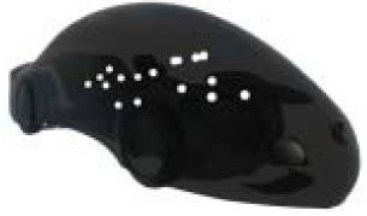
Material In this experiment, we utilized a biomimetic point-light model inspired by the cheetah, for which we identified key light points representing its form and created a motion skeleton model in the 3D computer graphics soft- ware. After adjusting the biomimetic motion of the cheetah skeleton model in Blender, we imported the model into the Unity game engine to link pre- set cheetah actions, culminating in the creation of the experimental scenario. For instance, the ‘Giving Way while Moving’ includes running, pawing the ground and bowing.
Figure 1: The outlook of the bio-motion eHMI.
Procedure This study was conducted using a within-subjects design, with the indepen- dent variable being the type of eHMI. The eHMI type had three conditions: Bio-Motion eHMI, Text eHMI, and a Non-display condition. The dependent variables were the participant’s accuracy of comprehension with respect to vehicle movement and intent.
Before the experiment, participants received an overview of the study con- text, focusing on understanding autonomous vehicle behavior. In the online- based experiment, participants observed a sequence of videos showcasing diverse vehicular movements and interaction methods. These interactional scenarios were presented without any supplementary background cues. After each video, a two-question comprehension task was presented. The first ques- tion assesses one’s understanding of vehicle movement, offering choices such as ‘from stationary to moving’, ‘from moving to stationary’, ‘maintaining a stationary state’, and ‘continual movement’. The second question addresses the vehicle’s communicated intent with options like ‘Please cross’ and ‘Do not cross’. Subsequent the questions related to a specific eHMI type, participants evaluated the respective eHMI using various subjective measures, including Satisfaction, Trust (Jian et al., 2000), Cognitive Safety (Cao et al., 2021), and Friendliness (UEQ, Laugwitz et al., 2008).
Enhancing Pedestrian Comprehension Through a Bio-Motion eHMI Design 191
The procedure, comprising three eHMI conditions, was reiterated in three blocks and counterbalanced using a Latin square design to mitigate order effects. Each block contained nine videos, each followed by compre- hension questions. Upon concluding the experiment, participants supplied demographic details and driving history.
RESULT
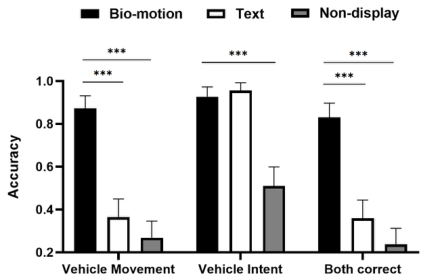
Comparative Analysis of Objective Accuracy Rates in Understanding Different eHMIs The statistics results can be seen in Figure 2. For the comprehension of vehi- cle movement, Bio-Motion eHMI notably outperformed both Text eHMI (β = 2.478, p <.001) and Non-display (β = 2.926, p <.001), as indicated by the Generalized Linear Model (GLM) analysis. Furthermore, the compre- hension of Text eHMI was also significantly greater than that of Non-display (β = 0.448, p = .0117). Regarding the understanding of vehicle intent, there is no significant difference between Bio-Motion eHMI and Text eHMI (β = −0.529, p = .2153). However, Bio-Motion eHMI is significantly higher than Non-display (β = 2.501, p <.001), and Text eHMI also significantly exceeded Non-display (β = 3.030, p <.001). In the combined measure of both vehicle movement and intent comprehension, Bio-Motion eHMI signif- icantly outperformed both Text eHMI (β = 2.169, p <.001) and Non-display (β = 2.760, p <.001). Furthermore, a significant difference was observed when Text eHMI was compared with Non-display (β = 0.591, p <.001).
Figure 2: Comparison of 3 types of eHMIs in objective accuracy rates.
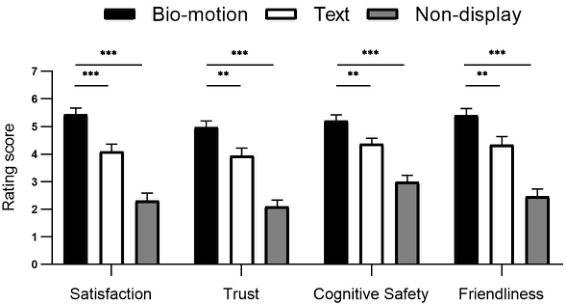
Subjective Evaluation of External Human-Machine Interaction Systems To investigate individuals’ subjective preference degree for external human- machine interaction systems, the following 4 subjective indicators were covered: Satisfaction, Trust, Cognitive Safety, and Friendliness(See Figure 3). Repeated measures MANOVA was used to analyze the impact of eHMI type on the subjective preference for an external human-machine interac- tion system. the main effect of eHMI type was significant on all 8 indicators
(Wilks’ Lambda = 0.222, F = 7.715, p <.001) Upon conducting a one-way ANOVA test with repeated measures for each indicator, the main effect of eHMI type on all dependent variables was significant (FSatisfaction = 46.851, FTrust = 42.378, FCognitiveSafety = 33.990, FFriendliness = 44.297, all p <.001). Post hoc tests showed that Biological Motion eHMI significantly outper- formed text eHMI (tSatisfaction = 4.149, p <.001; tTrust = 3.278, p = .0017; tCognitiveSafety = 3.125, p = .0027; tFriendliness = 3.362, p = .0013) and non- display conditions (tSatisfaction = 9.649, p <.001; tTrust = 9.089, p <.001; tCognitiveSafety = 8.170, p <.001; tFriendliness = 9.295, p <.001) in all 4 dimensions.
Figure 3: Comparison of 4 subjective preference indicators of eHMIs.
CONCLUSION
In this research, we have innovatively designed a new type of eHMI for autonomous vehicles by leveraging biological motion features. These fea- tures, visually embodied by moving dots, encapsulate the movement of key joints exhibited in crucial animal behaviors such as stopping, accelerating, yielding, and not yielding. Our conclusions, Bio-Motion eHMI significantly outperforms other types in interpreting vehicle movement, and also surpasses non-display types in identifying vehicle intent. Overall, our biologically- inspired motion-centric eHMI fosters natural interactions between vehicles and pedestrians, enabling quick and precise comprehension of vehicle intent for safer crossings.
ACKNOWLEDGMENT
This study was supported by the National Natural Science Foundation of China (Grant No. T2192932). Thanks for Yahua Zhen and Yunqi Yang in their help in conducting this experiment.
REFERENCES
Bartneck, C. et al. (2009) ‘Measurement Instruments for the Anthropomorphism, Animacy, Likeability, Perceived Intelligence, and Perceived Safety of Robots’, International Journal of Social Robotics, 1(1), pp. 71–81. Available at: https: //doi.org/10.1007/s12369-008-0001-3.
Enhancing Pedestrian Comprehension Through a Bio-Motion eHMI Design 193
Cao, J. et al. (2021) ‘The development and validation of the perceived safety of intelligent connected vehicles scale’, Accident Analysis & Prevention, 154, p. 106092. Available at: https://doi.org/10.1016/j.aap.2021.106092. Clarke, T. J. et al. (2005) ‘The Perception of Emotion from Body Movement in Point-
Light Displays of Interpersonal Dialogue’, Perception, 34(10), pp. 1171–1180. Available at: https://doi.org/10.1068/p5203. Cutting, J. E. and Kozlowski, L. T. (1977) ‘Recognizing friends by their walk: Gait perception without familiarity cues’, Bulletin of the Psychonomic Society, 9(5), pp. 353–356. Available at: https://doi.org/10.3758/BF03337021. de Clercq, K. et al. (2019) ‘External Human-Machine Interfaces on Automated
Vehicles: Effects on Pedestrian Crossing Decisions’, Human Factors, 61(8), pp. 1353–1370. Available at: https://doi.org/10.1177/0018720819836343. Dey, D. et al. (2018) ‘Interface Concepts for Intent Communication from Autonomous Vehicles to Vulnerable Road Users’, in Adjunct Proceedings of the 10th International Conference on Automotive User Interfaces and Interac- tive Vehicular Applications. New York, NY, USA: Association for Computing Machinery (AutomotiveUI ‘18), pp. 82–86. Available at: https://doi.org/10.1145/ 3239092.3265946. Dittrich, W. H. (1993) ‘Action Categories and the Perception of Biological Motion’, Perception, 22(1), pp. 15–22. Available at: https://doi.org/10.1068/p220015. Eisma, Y. B. et al. (2020) ‘External Human–Machine Interfaces: The Effect of Display
Location on Crossing Intentions and Eye Movements’, Information, 11(1), p. 13. Available at: https://doi.org/10.3390/info11010013. Jian, J.-Y., Bisantz, A. M. and Drury, C. G. (2000) ‘Foundations for an Empirically Determined Scale of Trust in Automated Systems’, International Journal of Cognitive Ergonomics, 4(1), pp. 53–71. Available at: https://doi.org/10.1207/ S15327566IJCE0401_04. Johansson, G. (1973) ‘Visual perception of biological motion and a model for its
analysis’, Perception & Psychophysics, 14(2), pp. 201–211. Available at: https: //doi.org/10.3758/BF03212378. Laugwitz, B., Held, T. and Schrepp, M. (2008) ‘Construction and Evaluation of a User Experience Questionnaire’, in A. Holzinger (ed.) HCI and Usability for Edu- cation and Work. Berlin, Heidelberg: Springer Berlin Heidelberg (Lecture Notes in Computer Science), pp. 63–76. Available at: https://doi.org/10.1007/978-3-540- 89350-9_6. Mather, G. and West, S. (1993) ‘Recognition of Animal Locomotion from Dynamic
Point-Light Displays’, Perception, 22(7), pp. 759–766. Available at: https://doi.or g/10.1068/p220759. Norman, J. F., Todd, J. T. and Orban, G. A. (2004) ‘Perception of Three-Dimensional Shape From Specular Highlights, Deformations of Shading, and Other Types of Visual Information’, Psychological Science, 15(8), pp. 565–570. Available at: http s://doi.org/10.1111/j.0956-7976.2004.00720.x. Pavlova, M. et al. (2001) ‘Recognition of Point-Light Biological Motion Displays by
Young Children’, Perception, 30(8), pp. 925–933. Available at: https://doi.org/10. 1068/p3157. Peugh, J. L. (2010) ‘A practical guide to multilevel modeling’, Journal of School Psychology, 48(1), pp. 85–112. Available at: https://doi.org/10.1016/j.jsp.2009.09.002. Sucha, M., Dostal, D. and Risser, R. (2017) ‘Pedestrian-driver communication and decision strategies at marked crossings’, Accident Analysis & Prevention, 102, pp. 41–50. Available at: https://doi.org/10.1016/j.aap.2017.02.018.
Troje, N. F., Westhoff, C. and Lavrov, M. (2005) ‘Person identification from biological motion: Effects of structural and kinematic cues’, Perception & Psychophysics, 67(4), pp. 667–675. Available at: https://doi.org/10.3758/BF03193523. Wang, P. et al. (2021) ‘Pedestrian interaction with automated vehicles at uncontrolled
intersections’, Transportation Research Part F: Traffic Psychology and Behaviour, 77, pp. 10–25. Available at: https://doi.org/10.1016/j.trf.2020.12.005.
LISTED IN THE AHFE DIGITAL BOOKSTORE CATALOGUE
Explore the complete digital volume
Emerging Technologies and Future of Work
Read this individual research paper free through the original publisher, or explore the full digital proceedings book.
ISBN 978-1-958651-93-3
Explore this ISBN in the AHFE Bookstore ↗Listed in the July 2026 bookstore catalogue; search by ISBN to confirm current availability · Digital book purchase optional