Ziqiang He, Ke Jiang, Jingyu Zhang, Yue Gao, Zhao Li Na (2023). Collaborative design based on Metaverse technology: Case of interactive design of children's educational products. In: Human-Centered Metaverse and Digital Environments. AHFE Open Access, vol. 99, pp. 29–36. https://doi.org/10.54941/ahfe1003928
Explore the feasibility of the application of meta universe technology in collaborative design. Method: Taking the interactive design of children's education products as an example, this paper combs and analyzes the process participants and their needs in the collaborative design, builds a collaborative design process for children's education products, builds a corresponding meta universe space according to the process, invites participants to conduct collaborative design experiments and evaluate the design effect, so as to verify the feasibility of the application of meta universe technology in collaborative design. Conclusion: Experiments prove that the meta universe technology can obtain more complete design requirements, improve design efficiency and effect, and optimize design process and experience by improving the participation of participants in the design process
With the development of design research content and methods, a collabora- tive design method has been proposed. Designers can directly stimulate the creativity of users through the theory and tools of collaborative design, and guide them to create new services, products, or experience solutions. Alth- ough collaborative design optimizes the experience of the design process to improve the efficiency and effect of the design, it still faces many problems and challenges, such as insufficient participation and innovation potential of collaborative design participants, low efficiency of collaborative design tools, and insufficient guidance ability of designers. This paper attempts to solve the above problems in collaborative design by introducing the Metaverse technology, comparing the design efficiency and effect between the Meta- verse collaborative design and the traditional collaborative design through experiments.
Collaborative design started from the participation design in Northern Europe in the 1970s. As a design method that attaches importance to the
design process, the collaborative design emphasizes bringing users and stake- holders into the design development process, expanding the range of users’ participation, deepening the depth of users’ participation, and improving their participation initiative.
Curedale R believes that collaborative design is a creative and tentative process centered on people through tool construction and action. The col- laborative design has three elements, namely participants, researchers and tools.
Collaborative design participants: use tools to participate in the collabo- rative design process, provide creativity according to their cognition and life experience as users under the guidance of researchers, and provide solutions for product, service, and experience design.
Collaborative design researcher: To guide the collaborative design process, but also to create and improve tools. Sometimes the researcher and designer roles are the same person or group of people.
Collaborative design tools: Links between researchers and participants, which stimulate the creativity of participants, and then convey information about creativity to researchers.
To sum up, classical collaborative design theory focuses on the potential of participants, the communication effectiveness of tools, and the boost of researchers.
Through the definition of Metaverse and collaborative design, the possi- bility of Metaverse technology’s involvement in collaborative design can be analyzed. First, the interaction of virtual attributes enables human relations to be reconstructed online, which provides feasibility for improving the con- nection and sense of participants in collaborative design. In addition, the interaction modes in the Metaverse technology can empower the traditional collaborative design tools and improve the use efficiency of tools. Therefore, the development of the Metaverse can create new interaction modes, social scenes, and technology platforms through collaborative design.
COLLABORATIVE DESIGN WORKSHOP This collaborative design workshop was carried out in two rounds, the Metaverse-based collaborative design workshop was set as the experimen- tal group, and the traditional collaborative design workshop was set as the control group.
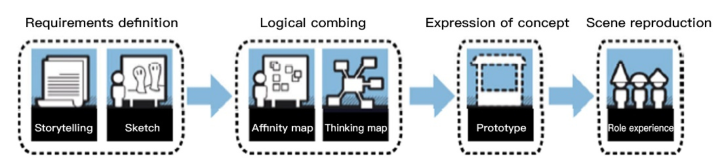
The design goal of both groups was to obtain a set of interactive design solutions for children’s educational products. Through analyzing the data collected during the collaborative design process, The efficiency of the tools used in the two groups of collaborative design is summarized. Finally, two groups of collaborative design workshops were conducted to compare and explore the effect of the intervention of Metaverse technology on the effi- ciency and effect of collaborative design. To ensure the effectiveness of the comparative experiment, the two groups of collaborative design workshops had the same flow, as shown in Figure 1.
The two groups of collaborative design workshops had the same partici- pants number and composition, consisting of one young teacher and three
Collaborative Design Based on Metaverse Technology: Case of Interactive Design 31
Figure 1: The Process of a Collaborative Design Studio.
children. The young teachers teach the same subjects, and the gender com- position of the children is the same as the grade they are in two boys and one girl, both in Grade 5. All of the children did not have mental health con- ditions such as autism, attention deficit disorder, or hyperactivity disorder, and the two groups of researchers were the same in the collaborative design workshop.
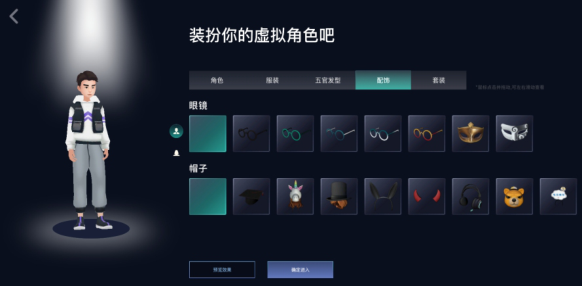
Firstly, the researcher guides the participants to use the Metaverse plat- form, where the participants can create and dress up their Metaverse virtual characters, as shown in Figure 2.
Participants were then guided into a formal collaborative design session and started using the collaborative design tools.
Storytelling: The experimental group’s storytelling is shown in Figure 3. In Quesenbery’s theoretical system of user experience storytelling, story tel- ling not only serves as a means of insight but can also integrate itself into the user experience and even become part of the brand. Through the cre- ation of virtual characters and the fun interaction of online ice-breaking games, the strangeness between participants was broken. At the same time, the warm and comfortable virtual space created environmental conditions for participants to actively participate in the storytelling.
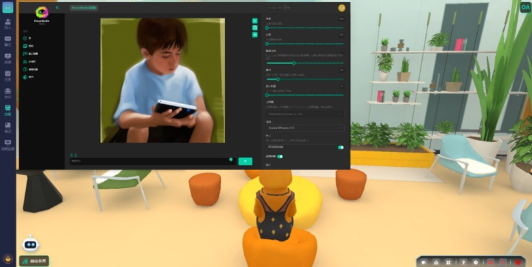
Group sketch: The group sketch of the experimental group is shown in Figure 4. Group sketching is a quick and effective tool to develop ideas while explaining them. In collaborative design, it is used to share and tap into team insights. At this stage, we embed the AI drawing engine of Dream Studio
Figure 2: Character Creation Interface.Figure 3: The interface of the storytelling session.Figure 4: The interface of the group sketch session.
into the co-design platform, and draw sketches accurately and efficiently through the two methods of “text-based image generation” and “iterated image editing”, as shown in Figure 4.
Affinity map and thinking map: Affinity map classifies a large amount of data by correlation in a way that improves thinking efficiency statistically, and finally finds relevant information groups. Thinking a map is a tool for visualizing ideas and finding logical connections. The whole thinking map first places a problem or idea at the center of thinking. Then use signs, lines, words, and pictures to build a thinking system around the starting point. We did this through collaborative tools on the Metaverse Co-design platform.
Prototype design: A prototype is an important tool for user experience design after the successful transformation of requirements. We introduced the Master go design engine into the Metaverse design platform and com- pleted the prototype design and construction (completed the construction of prototype design) under the guidance of the researcher.
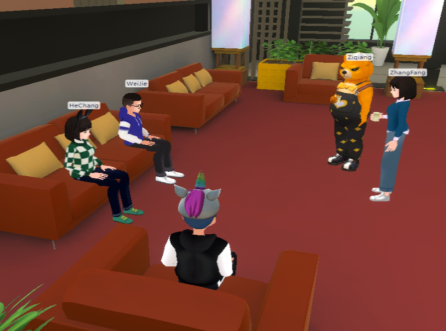
Role experience: Participants, designers, or researchers simulate the service experience, and carry out some potential condition changes for some functi- ons, rehearse the service plot several times, or exchange roles. We simulated the use experience of the above design prototypes in classrooms, homes, and
Collaborative Design Based on Metaverse Technology: Case of Interactive Design 33
Figure 5: The interface of the role experience session.
other scenes in the Metaverse collaborative design platform, as shown in Figure 5.
The workshop process and tools of the control group were the same as those of traditional collaborative design workshops.
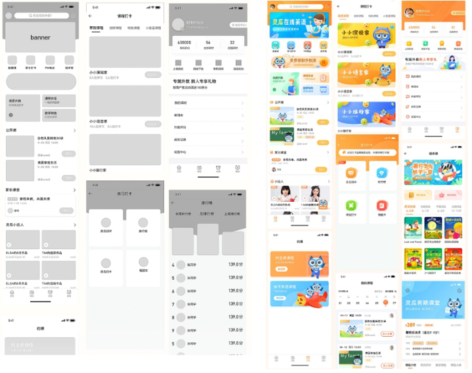
The experimental group workshop finally produced 3 APP prototypes, which were selected and designed in detail by the designers and formed a mature design scheme. This scheme helps children learn English in the form of picture books, which adds a lot of fun to boring language learning. Meanw- hile, the test content is combined with the two parts of English used in daily use, forming the use in learning. The virtuous circle is even more impressive after use. The design result is shown in Figure 6.
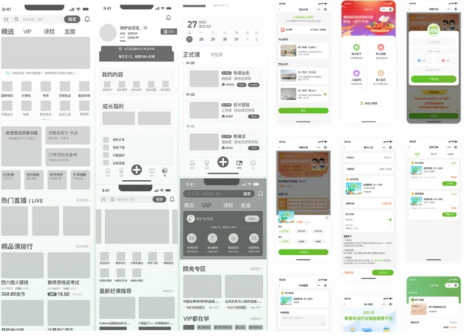
The control group workshop finally produced 2 APP prototypes, which were selected and designed in detail by the designer and formed a mature
Figure 6: The design result of experimental group workshop.Figure 7: The design result of control group workshop.
design scheme. This scheme provided a platform for children to purchase courses online. Children or their parents could purchase corresponding cour- ses, parents or teachers could monitor children’s learning and carry out regular assessment. The design result is shown in Figure 7.
COLLABORATIVE DESIGN RESULTS EVALUATION The two evaluation data of tool effectiveness evaluation of collaborative design tool are fitness degree and feedback degree. The two rating scales are designed according to the Likert scale, and the full score is 5 points. The participants scored the tool for fitness degree, aiming to obtain the partici- pants’ comfort level and learning difficulty of using the tool. The feedback degree is scored by the researcher on the tool, aiming to obtain the quantity and quality of effective information obtained by the researcher after using the tool.
Based on the survey of all participants and researchers, the effectiveness scores of collaborative design tools are shown in Table 1.
By analyzing the above data, it can be found that: in the storytelling section, the experimental group scored slightly higher, because the ice-breaking section of the experimental group was more interesting and participants had a stronger desire to express themselves in the digital virtual space. Howe- ver, due to the lack of face-to-face eye contact, the possibility of continuous communication was weakened. In terms of group sketching, the scores of the experimental group were significantly higher than those of the control group, because the participants of the experimental group could more accu- rately and vividly express their ideas and describe their needs with the help of AI drawing tools, while the participants of the control group had medio- cre drawing skills and could not effectively communicate their ideas through drawing. The scores of the experimental group and the control group were almost the same in terms of mental maps and affinity maps because the role of tools in these two links was not very important. What was more impor- tant was that participants summarized the needs and sorted out the logic
Collaborative Design Based on Metaverse Technology: Case of Interactive Design 35
Table 1. Effectiveness scores of collaborative design tools.
Table available in the original PDF paper.
Group Tools Fitness degree Feedback degree Experimental group Storytelling 4.2 4.0 Group Sketch 4.4 3.8 Affinity map 3.6 3.2 Thinking map 3.7 4.0 Prototype design 2.4 2.9 Role experience 3.6 3.8 Control group Storytelling 4.0 3.9 Group Sketch 3.2 3.1 Affinity map 3.5 3.3 Thinking map 3.9 4.0 Prototype design 2.9 3.1 Role experience 3.1 2.9
Table 2. Sample human systems integration test parameters (Folds et al. 2008).
Table available in the original PDF paper.
Group Authenticity of requirements
Innovation degree
Users’ experience Experimental group 4.2 4.4 4.0 Control group 4.0 3.8 4.0
together. In terms of prototype design, the scores of the experimental group were lower than those of the control group, because the prototype design tools introduced by the experimental group were more professional, difficult to get started and cost participants more to learn. In terms of role experie- nce, the score of the experimental group was significantly higher than that of the control group. This is because, in the offline scene, participants could not have in-depth role experience due to emotions such as stage fright, while online participants were less affected by this problem and could participate in this part more easily and happily.
In addition to evaluating the use efficiency of tools in the collaborative design process, we also invited 5 volunteers (including 2 professional design teachers and 3 ordinary users) to evaluate the collaborative design results of the two groups of workshops from three aspects: the authenticity of pro- duct requirements, the innovation degree of solutions and the comfort of user experience. The evaluation results are shown in Table 2.
By analyzing the above data, it can be found that the authenticity of pro- duct demands and innovation of solutions of the experimental group are slightly higher than those of the control group, and the two groups have similar performance in terms of user experience comfort.
CONCLUSION
This paper explains how to explore collaborative design through Meta- verse technology. Then, we compare the similarities and differences between
collaborative design supported by Metaverse technology and traditional col- laborative design through two sets of experiments and verify the feasibility of the application of Metaverse technology in collaborative design by evalu- ating the use efficiency of collaborative design tools and collaborative design results of the two sets of experiments. It is also found that Metaverse techno- logy can improve design efficiency and effect by improving the use efficiency of each tool in the collaborative design process.
For future work, we will continue to optimize the use effect and experience of collaborative design tools in the Metaverse, and constantly improve the Metaverse collaborative design platform.
REFERENCES
CHANG Fang-yuan, J. (2015) Usability Evaluation of Smart Phone Application Graphic User Interface Base on Eye-tracker, in: Packaging Engineering, pp. 55–58. CUREDALE R, M. (2013) Service Design: 250 Essential Methods. London: Design
Community College ln. GREENBERG S, BOHNET R, J. (1990) Group Sketch: A Multiuser Sketchpad for Geographically-distributed Small Groups, in: Design Community, pp. 411–438. QUESENBERY W, BROOKS K, M. (2010) Storytelling for User Experience. London:
Rosenfeld Media. SANDERS, STAPPER P, J. (2008) Co-creation and the New Landscapes of Design, in: Codesign: International Journal of Cocreation in Design and the Arts, Taylor, Francis (Ed.). pp. 217–223.
LISTED IN THE AHFE DIGITAL BOOKSTORE CATALOGUE
Explore the complete digital volume
Human-Centered Metaverse and Digital Environments
Read this individual research paper free through the original publisher, or explore the full digital proceedings book.
ISBN 978-1-958651-75-9
Explore this ISBN in the AHFE Bookstore ↗Listed in the July 2026 bookstore catalogue; search by ISBN to confirm current availability · Digital book purchase optional