Yoshihiro Sejima (2026). i-EyFuze: An Eye-Shaped eHMI in Autonomous Vehicles that Provides Intentions for Pedestrians. In: Affective and Pleasurable Design. AHFE Open Access, vol. 204, pp. 31–38. https://doi.org/10.54941/ahfe1007329
Autonomous driving technology has attracted considerable attention in recent years. Among them, eHMIs (external Human Machine Interface) that display text and symbols as a method of conveying a vehicle’s intentions have been actively developed. However, there are cases where the vehicle’s intentions are difficult to understand for pedestrians, or the differences in language and culture lead to various interpretations. Therefore, a method that enables pedestrians to intuitively understand the vehicle’s intentions is required. In our previous project, a twinkling eye interface that mimics the human eyeball was developed. In this interface, the self-shadow is superimposed to clarify the self-visualization in addition to the eye. It was demonstrated that the self-visualization supports intuitive interaction, such as paying attention and increasing interest. In this study, an Eye-Shaped eHMI called i-EyFuze was developed. i-EyFuze visualizes the vehicle’s recognition state by superimposing the pedestrian’s image onto the gaze display, thereby enhancing the communication of the vehicle’s driving intentions. In addition, the effectiveness of the developed eHMI was demonstrated by sensory evaluations through an experimental environment that simulated a pedestrian crossing.
With the recent advancement of information and communication technology, autonomous driving technology has attracted attention. This technology has not only technical challenges such as using sensors and evaluating the accuracy of AI in traffic environments, but also a major challenge in terms of social traffic communication. Specifically, the transition from human-to- human communication between pedestrians and drivers to human-machine communication between pedestrians and driverless vehicles makes conveying and sharing intentions difficult.
Current communication in traffic environments is primarily achieved through non-verbal cues such as eye contact and gestures. For example, when a pedestrian crosses the road, if the driver signals the pedestrian to cross, the pedestrian begins to cross regardless of the vehicle’s position or speed (Mori and Yano, 2018). In other words, signals from the driver play an important role in guiding the pedestrian. However, because communication in traffic environments does not rely on verbal messages, mutual understanding is
32 Sejima difficult, and it leads to unexpected traffic accidents. Therefore, social traffic communication technology that enables pedestrians to cross safely is required.
To address such social traffic communication, eHMIs (external Human- Machine Interfaces) have been developed, which attach devices to vehicles and project graphics and text onto the road or front of the vehicle. eHMIs are attracting attention as information presentation devices in traffic environments (Ackermann et al., 2019, Loew et al., 2022). However, differences in pedestrian attributes, such as language and culture, can lead to different interpretations of information presented by vehicles (Bazilinskyy et al., 2022). Therefore, there is a need for a method of conveying intentions that can intuitively guide pedestrians regardless of their attributes.
In our previous project, a twinkling eyes interface that mimics the human eye was developed (Nakase et al., 2025). This interface visualizes the user by superimposing a self-shadow in addition to conventional gaze display. Self- visualization has been demonstrated to promote intuitive cognition, such as ease of attention. Therefore, by using a twinkling eyes interface to convey the intentions and recognition state of an unmanned autonomous vehicle, it is expected to clarify the guidance effects of self-visualization.
In this study, i-EyFuze, an Eye-shaped eHMI that visualizes the pedestrian by superimposing the image of a pedestrian was developed. Furthermore, an impression evaluation experiment simulating a crosswalk demonstrated that visualizing the vehicle’s recognition state strengthens pedestrians’ perception of the vehicle’s driving intentions.
RELATED WORKS eHMI can be divided into three types: Text display, Projection, and Eyeball display.
Text display communicates driving intentions to pedestrians by displaying messages externally to the vehicle. For example, when crossing a street, pedestrians can judge whether to cross the street based on messages such as “Please go ahead,” “Stopping,” or “Autonomous driving in progress” (Daimon et al., 2022). However, the longer the displayed text, the more attention and time it requires to read. Language dependency also becomes an issue (Bazilinskyy et al., 2022).
Projection supports pedestrians’ perception by projecting symbols and messages onto the road surface near the vehicle. For example, the pedestrian can immediately recognize that the vehicle is reversing by displaying an arrow on the eHMI in addition to brake lights (Mason et al., 2022). Furthermore, displaying directional signals on the road surface can serve as a warning even in situations where the vehicle’s turn signal is difficult to see (Kodama and Yano, 2021). On the other hand, Projection has been reported to divide attention between the vehicle and the displaying objects (Eisma et al., 2020).
Eyeball display uses eye-like devices mounted on the front of the vehicle to communicate through gaze (Jaguar Land Rover, 2018). For example, vehicles equipped with eyeballs can reduce pedestrians’ errors in crossing decisions by using their gaze (Chang et al., 2022). Furthermore, by using vehicle headlights as human eyes and displaying emotional expressions, it gives pedestrians the impression that the vehicle is less threatening and more acceptable (Wang i-EyFuze: An Eye-Shaped eHMI in Autonomous Vehicles That Provides Intentions 33 et al., 2023). However, pedestrians tend to use turn signals as a cue, because a vehicle’s gaze does not necessarily improve the guiding effect (Gui et al., 2023).
The above-mentioned methods are not sufficient for clearly conveying a vehicle’s guiding intentions. Therefore, a new system that pedestrians can intuitively understand in terms of the vehicle’s guidance intention is required.
i-EyFuze: AN EYE-SHAPED eHMI This study proposes an Eye-shaped display as an eHMI called i-EyFuze that externally displays the vehicle’s awareness of the traffic environment (Fig. 1). In addition to the vehicle’s gaze, which has been the focus of previous research, i-EyFuze visualizes the vehicle’s awareness and guidance targets on the display. This visualization includes traffic participants such as pedestrians, cyclists, and other vehicles, as well as traffic environment information such as traffic lights and symbols. The visualization enables traffic participants to intuitively grasp the vehicle’s awareness and improves predictability. For example, in addition to directing the vehicle’s gaze toward a crossing pedestrian, the system superimposes the pedestrian’s image onto the gaze display. The superimposition creates a sense of security when crossing the street. Furthermore, the slow closing of the eyelids while the vehicle is decelerating can be interpreted as an expression of drowsiness and conveys the vehicle’s intention to stop to pedestrians. By incorporating traffic symbols such as road symbols and driving directions, it is expected to strengthen intentions that cannot be expressed by gaze alone.
Furthermore, by superimposing an image of the pedestrian on the eyeball display that shows the vehicle’s gaze target, the vehicle intuitively presents the situation in which the vehicle identifies the individual pedestrian. Furthermore, as a cue for the pedestrian to cross the street, the vehicle intentionally shifts its gaze to the crossing destination and guides the pedestrian. In this case, by shifting the pedestrian’s image with a delay in addition to the vehicle’s gaze shift, the pedestrian is given the sensation that “the vehicle is looking at the same destination as the pedestrian.” This visual feedback is expected to promote pedestrians’ understanding of the vehicle’s intentions, due to the synergistic effect of the intention attribution effect through gaze and the self- referential effect using the pedestrian’s own image.
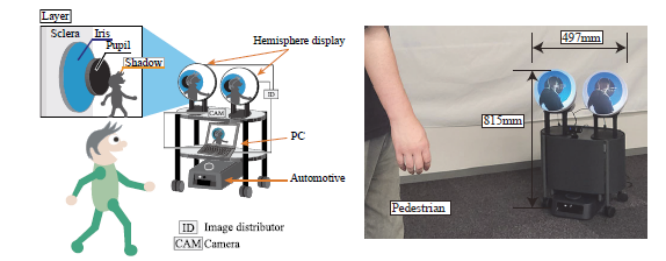
34 Sejima The configuration of i-EyFuze proposed in this study is shown on the left in Fig. 2. i-EyFuze consists of a laptop computer running Windows 11, a hemispherical display (GakkenWORLDEYE), a video distributor, a webcam (CMS-V43BK-3), and a simulated vehicle (Preferred Robotics kachaka). The eyeball is simulated by projecting geometric figures that mimic the pupil and iris onto the hemispherical display. YOLO11 was used to extract pedestrians. Images from which pedestrians were extracted were filled with gray and then overlaid on the pupil. The processing rate from camera input to overlay rendering was approximately 25 frames per second (fps). The simulated vehicle was equipped with two adjustable shelves, and by installing the hemispherical display on top of the simulated vehicle, it was at approximately the same height as the vehicle’s headlights (Figure 2, right).
Figure 2: Configuration of i-EyFuze.
SIMULATED EVALUATION EXPERIMENT In this experiment, the effects of superimposing on a self-shadow were investigated using a simulated vehicle based on a scenario simulating traffic conditions. The comparison modes were three modes: the mode (A) showing only the pupil, the mode (B) showing only the self-shadow, and the mode (C) showing the superimposed self-shadow on the pupil. Evaluation was performed using a paired comparison and a 7-point scale. The participants were thirty Japanese students in their 20s.
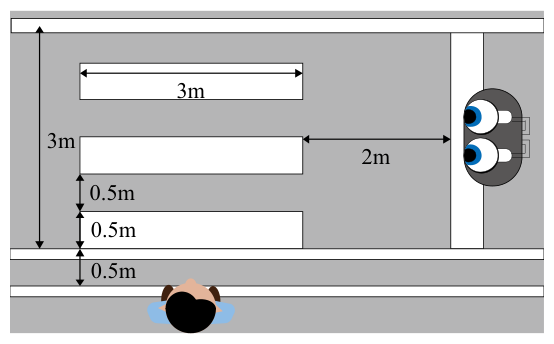
The experimental conditions were as shown in Fig. 3. The experimental scenario was designed such that a simulated vehicle detects a pedestrian and stops just before the stop line. The simulated vehicle began moving 3.0 m before the stop line and was stopped near the line. For safety reasons, the experimenter manually operated the simulated vehicle using a dedicated application. After the simulated vehicle stopped, the comparison modes were presented. The simulated vehicle’s moving actions were the same in each mode, and the participants observed the presented mode while making one round trip across a simulated crosswalk.
The experimental procedure was as follows. First, the participants were instructed to perform a paired comparison of modes. In the paired comparison experiment, based on the criterion of “perceived recognition i-EyFuze: An Eye-Shaped eHMI in Autonomous Vehicles That Provides Intentions 35 by the vehicle”, they selected the better mode. Next, they experienced each mode and were asked to evaluate their sensory responses on a 7-point Likert scale based on nine items: “(1) Did you think about crossing the street?”, “(2) Did you feel eye contact?”, “(3) Sense of familiarity?”, “(4) Sense of security?”, “(5) Sense of trust?”, “(6) Sense of fear?”, “(7) Did you feel that attention was drawn to your appearance?”, “(8) Did you feel your privacy was protected?”, and “(9) Did you feel the vehicle recognized you?” They were presented with the three modes that were counterbalanced in a random order.
Figure 3: Experimental environment.
Figure available in the original PDF paper.
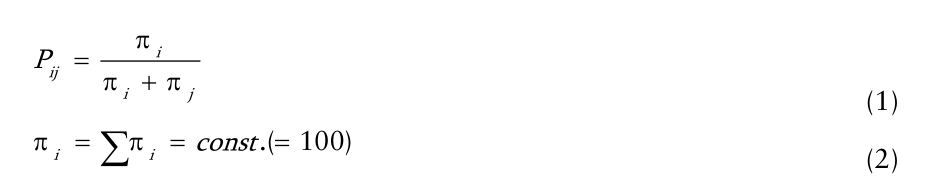
EXPERIMENTAL RESULT The results of the paired comparison are summarized in Table 1. In this table, the number of winners is shown. Mode (A) won 21 comparisons against mode (B), and the number of total winners was 34. Figure 4 shows the calculated results of the evaluation provided in Table 1 based on the Bradley- Terry model given in Eq. (1) and (2) (Takeuchi, 1978).
i ij
Equation reproduced from the original PDF.Table 1: Results of paired comparison.
π: Intensity of mode i, 𝑃ij: Probability of judgment that i is better than j
(A) (B) (C) Total (A) 21 13 34
(B) 9 7 16 (C) 17 23 40
(A)
(B)
(C)
π
Figure 4: Comparison of the preference π based on the Bradley-Terry model.
Figure available in the original PDF paper.
Equation reproduced from the original PDF.Equation reproduced from the original PDF.
2 = 0.01). The proposed mode (C), the superimposed on the self-shadow, was evaluated as the best; followed by mode (A), the only eye mode; and mode (B), the self-shadow mode.
The questionnaire results are shown in Fig. 5. From the results of the Friedman signed-rank test and the Wilcoxon signed rank test, “(7) Self- recognition” had a significance level of 1%, and “(1) Crossing intention,” “(5) Trust” and “(6) Fear” were at 5% between modes (A) and (C). In addition, “(2) Eye contact,” “(3) Familiarity” and “(4) Safety” had a significance level of 1%, and “(9) Perceived recognition” was at 5% between modes (B) and (C). Also, “(2) Eye contact” and “(7) Self-recognition” had a significance level of 1%, and “(3) Familiarity” was at 5% between modes (B) and (C).
In both experimental results, mode (C) was evaluated as the best for simulated traffic communication. These results indicate the effectiveness of i-EyFuze.
Figure 5: Result of sensory evaluation.
Figure available in the original PDF paper.
CONCLUSION
This study described the development of the Eye-shaped eHMI “i-EyFuze” which conveys the vehicle’s intentions in traffic communication. Based on a scenario simulating a traffic scene, an impression evaluation was conducted i-EyFuze: An Eye-Shaped eHMI in Autonomous Vehicles That Provides Intentions 37 under the condition that a simulated vehicle presents a superimposed self- shadow onto its gaze display. The effectiveness of the proposed self-shadow superimposition method was supported by the sensory evaluation results.
ACKNOWLEDGMENT
This work was supported by the Japan Keirin Autorace Foundation (JKA).
REFERENCES
Ackermann, C., Beggiato, M., Schubert, S. and Krems, J. F., An experimental study to investigate design and assessment criteria: What is important for communication between pedestrians and automated vehicles?, Applied Ergonomics, Vol. 75, (2019), pp. 272–282. Bazilinskyy, P., Dodou, D. and de Winter, J., Crowdsourced assessment of 227 text-
based eHMIs for a crossing scenario, Advances in Transportation, Vol. 60 (2022), pp. 141–155. Chang, C.-M., Toda, K., Gui, X., Seo, S. H. and Igarashi, T., Can Eyes on a Car Reduce Traffic Accidents?, Proceedings of the 14th International Conference on Automotive User Interfaces and Interactive Vehicular Applications (AutomotiveUI’22), (2022), pp. 349–359. Daimon, T., Taima, M., Lee, J. and Furutani, T., Research on Communication
between Low-Speed Automated Transportation and Logistics Services Vehicles and Surrounding Traffic Participants, SIP Final Results Report (2nd Phase), Vol. 2022, No. 1 (2022), pp. 138–143 (in Japanese). Eisma, Y. B., van Bergen, S., ter Brake, S. M., Hensen, M. T. T., Tempelaar, W. J. and de Winter, J. C. F., External Human–Machine Interfaces: The Effect of Display Location on Crossing Intentions and Eye Movements, Information, Vol. 11, No. 1 (2020), Article 13. Gui, X., Toda, K., Seo, S. H., Eckert, F. M., Chang, C.-M., Chen, X. A. and Igarashi, T.,
A Field Study on Pedestrians’ Thoughts toward a Car with Gazing Eyes, Extended Abstracts of the 2023 CHI Conference on Human Factors in Computing Systems (CHI EA’23), (2023). Jaguar Land Rover, (28 August 2018) JAGUAR LAND ROVER’S VIRTUAL EYES LOOK AT TRUST IN SELF-DRIVING CARS, Website: https://www.jlr.com/ news/2018/08/jaguar-land-rovers-virtual-eyes-look-trust-self-driving-cars Kodama, T. and Yano, H., External Human Machine Interface That Presents The
Predicted Area of Vehicle Existence to Pedestrians, Proceedings of the 26th Annual Conference of the Virtual Reality Society of Japan, (2021), 2C1-7(in Japanese). Loew, A., Graefe, A., Heil, A., Guthardt, N., Boos, M., Dietrich, A. and Bengler, K., Go Ahead, Please! -Evaluation of External Human–Machine Interfaces in a Real-World Crossing Scenario, Frontiers in Computer Science, Vol. 4 (2022), Article 863072. Mason, B., Lakshmanan, S., McAuslan, P., Waung, M. and Jia, B., Lighting a Path
for Autonomous Vehicle Communication: The Effect of Light Projection on the Detection of Reversing Vehicles by Older Adult Pedestrians, International Journal of Environmental Research and Public Health, Vol. 19, No. 22 (2022), Article 14700. Mori, K. and Yano, N., The Effect of Driver’s Signal Sending on Pedestrians to Start Crossing at a Non-Signalized Crosswalk, Journal of Traffic Engineering, Vol. 4, No. 1 (2018), pp. B1-B5 (in Japanese).
human shadows on attractive pupils, Transactions of the JSME (in Japanese), Vol. 91, No. 943, (2025), pp. 24–00241. Takeuchi, K., Gensho to Kodo no Naka no Tokei Suri, Shinyosha, (1978), pp. 133–148 (in Japanese). Wang, Y., Wijenayake, S., Hoggenmuller, M., Hespanhol, L., Worrall, S. and Tomitsch,
M., My Eyes Speak: Improving Perceived Sociability of Autonomous Vehicles in Shared Spaces Through Emotional Robotic Eyes, Proceedings of the ACM on Human-Computer Interaction, Vol. 7, MHCI (2023), Article 214.
LISTED IN THE AHFE DIGITAL BOOKSTORE CATALOGUE
Explore the complete digital volume
Affective and Pleasurable Design
Read this individual research paper free through the original publisher, or explore the full digital proceedings book.
ISBN 978-1-964867-80-9
Explore this ISBN in the AHFE Bookstore ↗Listed in the July 2026 bookstore catalogue; search by ISBN to confirm current availability · Digital book purchase optional