Kevin Clark, James Kwolyk, Sruti Vijaykumar, Kazuhiko Yamazaki (2023). Tokyo Sensory Safari: Experience Innovation & Human Factors Immersion. In: Creativity, Innovation and Entrepreneurship. AHFE Open Access, vol. 74, pp. 138–143. https://doi.org/10.54941/ahfe1003315
The intention: Bring people to Japan to learn about human senses and cognition. This was just before the world locked down for the COVID-19 pandemic. The plan: Conduct a Sensory Safari that coincides with the Tokyo 2020 Olympics. An opportunity for people to experience Tokyo at peak form and Japan at the top of its hosting spirit. An immersive way to expose participants to all human senses and methods for making offerings that are more understandable and fully human compatible. This curated experience is inspired by Proctor & Gamble CEO A.G. Lafley and his visit to Japan decades earlier. After this visit he invests heavily in design and human factors seeking Japan-unique innovation in product packaging and placement. Uniqueness found only in Japan that persists to this day. Three years later, the country reopens for business and tourist travel and the renewed Tokyo 2023 Sensory Safari is again set in motion. Behind the safari is the Content Evolution SenseMapping practice team, with pioneering members of the now 30-year-young ThinkPad notebook computer, including the first IBM designer collaborating with the legendary industrial designer Richard Sapper, and the first named brand steward for IBM ThinkPad (today Lenovo). SenseMapping is a process and perspective to create coherence at the intersection of an organization (how it behaves and what it makes) with its value chain, customers, and stakeholders, and the intersection of human sensory perception and sense-making in the head, heart, and gut. The outcome: This paper documents the design of this immersive action learning experience, the framework for both observing and documenting product and service experiences while in Tokyo and sending participants home with a draft plan for action.
“Japan is definitely a civilization where design is important,” says A.G. Lafley CEO emeritus of Proctor & Gamble (P&G) in Fast Company. “We have to create a great customer experience every time you touch the brand, and the design is a really big part of creating the experience and the emotion.” “If you stay focused on experiences, I think you will have a lower risk of designing something that may measure well in a lab but may not do well with the consumer.” (Reingold, 2005).
Tokyo Sensory Safari: Experience Innovation & Human Factors Immersion 139
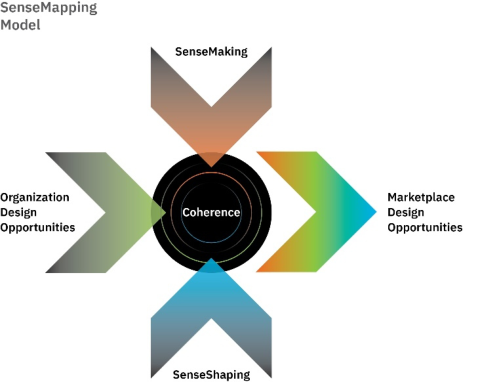
Figure 1: SenseMapping is a practice of the Content Evolution federation. The Sense- Mapping model connects clients and customers through the lenses of all five human senses and sensemaking in the context of both organization design and marketplace design opportunities.
The experiences Lafley had while running P&G Asia out of Tokyo caused him to elevate investment in design when he became CEO.
This is the inspiration for the Tokyo 2023 Sensory Safari. Created and designed by the Content Evolution SenseMapping practice team, this Sensory Safari is an immersive week-long action learning program. Participants see examples of packaging and service interactions that cannot be experienced anywhere else in the world. Where apples are gift-wrapped in the grocery store. Where checking out of a convenience store is performed by “touching” a hologram in the air.
The principles of SenseMapping will be unpacked every morning at the Tokyo vertical campus of Musashino Arts University. Then off for four days to explore the diversity of sensory experiences available in the country: seeing, hearing, touching, tasting and smelling Japan.
On the fifth day experiences and observations come together in a planning session. Participants leave Japan with a plan.
SenseMapping is a fully human and coherent approach to design that inclu- des both sensory innovation and sensemaking in the head, heart, and gut of both organization employees and the customers they serve.
SENSEMAPPING SenseMapping (SenseMaping, 2021) is a coherent sensory intelligence and sensemaking approach. All five of the primary human senses are considered: seeing, hearing, feeling, smelling, and tasting (SenseShaping) – along with imprints and retrieval in the head, heart and gut (SenseMaking; logical, emo- tional, instinctual; mapping experiences to the prefrontal cortext and cortext of the human brain, and the amygdala for more hard-wired responses).
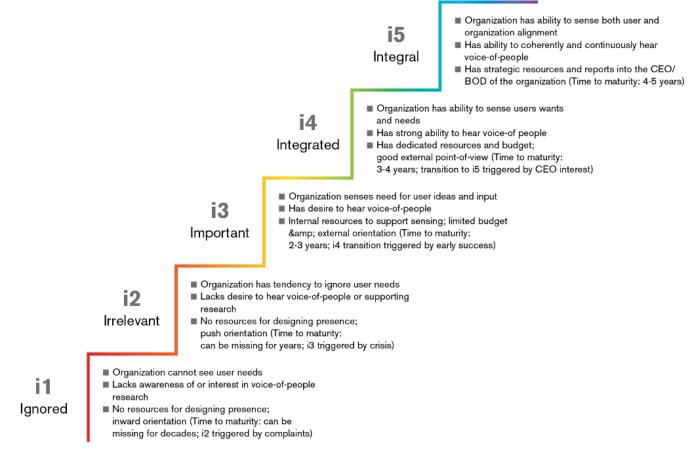
SenseMapping i5 Diagnostic
Figure 2: SenseMapping i5 Diagnostic. This scale allows organizations to map where they are today on the journey to applying SenseMapping core ideas and design of presence principles. SenseMapping is a practice of the Content Evolution federation.
As a professional practice, SenseMapping experience design and engage- ment are all about innovative and fully human design of presence. Sense- Mapping brings coherence to the physical world around us and the world of the mind and stimulates conditions to bring about flow experiences (Csikszentmihalyi, 2008).
SenseMapping benefits from sensing and understanding, and then desi- gning from the perspective of shared values.
The Tokyo Sensory Safari works to unpack elements of SenseMapping briefly every morning for four days at Musashino Arts University for par- ticipants, then out for guided exploration and observation with Tokyo as a canvas. Participants will benchmark themselves and their organization in current state at the start of the program using the SenseMapping i5 Diagnostic – and then use it again later to measure progress.
While inspired by A.G. Lafley of P&G, the design of the Sensory Safari is the work of the Content Evolution SenseMapping practice team. This team includes pioneering members of the now 30-year-young ThinkPad notebook computer, including the first IBM designer collaborating with the legendary industrial designer Richard Sapper (Dr. Kazuhiko Yamazaki), and the first named brand steward (Kevin Clark) for IBM ThinkPad (today Lenovo).
SHARED VALUES AND MISSION SenseMapping right from the start considers the interaction of companies and customers – and organizations and stakeholders. Designing from the perspe- ctive of shared values: What the organization wants to accomplish and what
Tokyo Sensory Safari: Experience Innovation & Human Factors Immersion 141
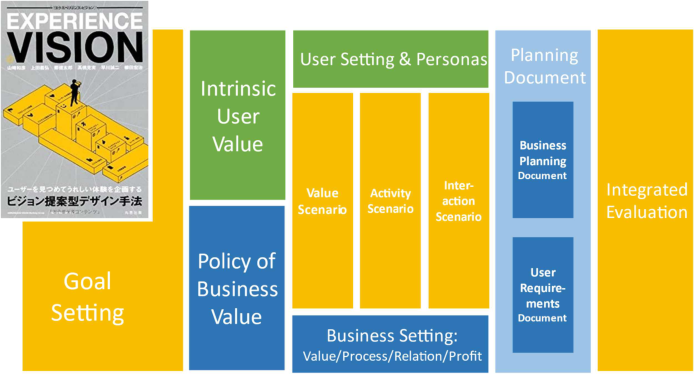
Figure 3: Experience vision framework adapted from the book experience vision.
the customer or stakeholder wants from the organization today and poten- tially wants in the future. The Experience Vision (Yamazaki et al., 2012) design method informs this intersection of interests and provides a way to create multiple scenarios and use rapid prototyping to explore possibility and potential.
SenseMapping believes every anticipated interaction should be intenti- onally designed, and since many interactions cannot be fully known in advance, the organization should be designed to sense and respond to chan- ging contexts. Understanding the customer experience and engagement as Sensepoints (all five human senses vs. the more common term “touchpoints”) starts to move an organization toward intentionally and purposeful and fully human research and offering design.
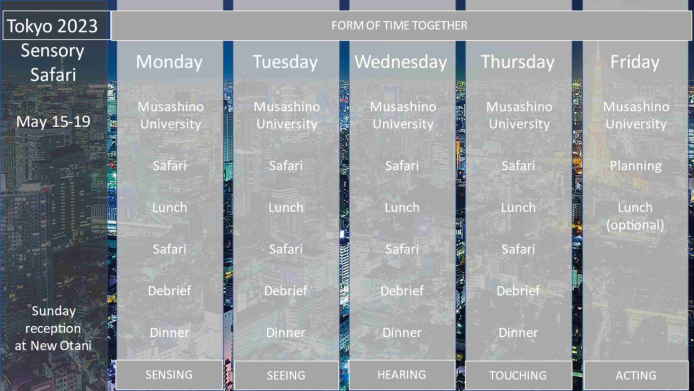
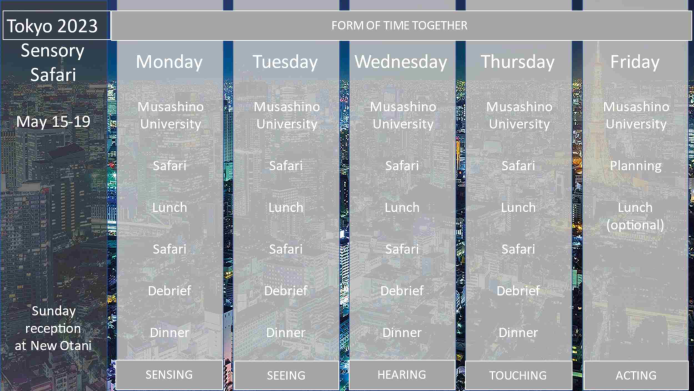
ON SAFARI IN TOKYO Here is the overall layout of the week for the Tokyo Sensory Safari:
Participants arrive on Sunday and are invited to a reception to get to know each other before the week and work begins.
The two primary locations for participants are The New Otani Hotel and Musashino Arts University.
The first four days of the program follow a consistent pattern; the last day is different.
Monday through Thursday the day starts by moving from the New Otani to the Tokyo high-rise campus of Musashino Arts University (the former Sony Music building).
Then it is out each day to observe and experience first-hand unique Tokyo shopping, packaging and service interactions. The safari will include visits to some leading design centers, currently including Lenovo & NEC notebook computer design studio, Hitachi, Panasonic, and Sony.
Figure 4: Tokyo 2023 sensory safari full week layout for participants.Figure 5: Example of a SenseMapping planning & journey map. Multi-track jour- ney maps by Content Evolution connect planned and intentional experiences across customer and constituent domains.
DEPARTING WITH A PLAN Participants will leave Japan with a plan.
The Tokyo Sensory Safari is an immersive action learning program and experience.
After four days of layered learning and documented first-hand observa- tions with a focus on all five human senses, Friday morning is different. This is the time to take all the raw material and ideas gathered during the week and turn it into preliminary action plans. Something tangible people can take home and doing something quickly and then build permission for more rigorous and resource-demanding over time.
IMMERSIVE ACTION LEARNING The SenseMapping methodology is a strong approach for innovation and designing presence, co-creating with customers and stakeholders. SenseMap- ping reveals the previously invisible connections of intentions and shared values of an organization with its customers and stakeholders. This provi- des the ability to design and test design that more comprehensively expresses human wants and needs. Delivering it as action learning in an immersive and rich setting such as Tokyo in a society that greatly values design is a meaningful and memorable approach for this week-long workshop.
Tokyo Sensory Safari: Experience Innovation & Human Factors Immersion 143
ENDNOTE The Tokyo 2023 Sensory Safari was originally designed to coincide with the Tokyo 2020 Olympics. Both the Olympics and the Sensory Safari were post- poned due to worldwide lockdowns and travel restrictions in the wake of COVID-19 (SARS-CoV2 virus). As the authors of this paper near the paper submission deadline a new round of travel restrictions born not from the pan- demic but from economic uncertainty may cause this innovative program to be postponed again to the fall of 2023 or the spring of 2024. We considered what a virtual experience would be like and weighed the pros and cons and decided that an in-person and immersive workshop was worth the wait. Feed- back to the Tokyo 2023 Sensory Safari has been very positive and we look forward to discovering a favorable intersection for our valuable immersive action learning experience and global economic recovery.
REFERENCES
Experience Vision: Vision Centered Design Method and “Scenario Based Design Method” created by Dr. Kazuhiko Yamazaki, Yoshihiro Ueda, Kentaro Go, Seiji Hayakawa, Koji Yanagida, Maruzen Press, 2012. Flow: The Psychology of Optimal Experience, Mihaly Csikszentmihalyi, Harper
Perennial Modern Classics, 2008. SenseMaping described in “Designing from the Inside Out,” Clark, Yamazaki, Hoskins, Baer, Kwolyk, Applied Human Factors and Ergonomics (AHFE), Best Paper Award, 2021. “What P&G Knows about the Power of Design,” Fast Company, Jennifer Reingold,
2005.
LISTED IN THE AHFE DIGITAL BOOKSTORE CATALOGUE
Explore the complete digital volume
Creativity, Innovation and Entrepreneurship
Read this individual research paper free through the original publisher, or explore the full digital proceedings book.
ISBN 978-1-958651-50-6
Explore this ISBN in the AHFE Bookstore ↗Listed in the July 2026 bookstore catalogue; search by ISBN to confirm current availability · Digital book purchase optional