Kazuhiko Yamazaki, Satoru Inoue, Hisae Aoyama, Takeuhi Kimiaki (2024). Remote Digital Tower to support Air Traffic Control Systems. In: Advances in Human Factors of Transportation. AHFE Open Access, vol. 148, pp. 43–48. https://doi.org/10.54941/ahfe1005193
Traditionally, air traffic control towers have relied on controllers and flight information officers to visually monitor the airspace through tower windows to ensure safe air traffic management. However, issues pertaining to tower maintenance and staffing have emerged. These challenges have prompted the exploration of a new air traffic control paradigm, the Remote Digital Tower (RDT). The RDT system facilitates air traffic management operations remotely using technological advancements such as cameras, sensors, information devices, and networks, thereby obviating the need for on-site control towers.This project aims to facilitate the safe and efficient operation of the RDT system. It focuses on proposing designs for both software and hardware that are secure, intuitive, and effective for the system's use.The design emphasis is on creating user interface software that allows controllers to conduct air traffic control operations remotely and on developing the hardware of the control console for these operations. A design team, including former air traffic controllers, has been assembled to incorporate user perspectives and expert insights into the design process.The initial phase of the design process involved analyzing the operational tasks of traditional control towers, system functionalities, and user interactions. Subsequently, a prototype system was developed, featuring a 360° panoramic display and a control console. The control console's interface was simplified by consolidating various displays and keyboards into a single touch-panel display. Interviews with former controllers informed task analysis, which guided the design of the prototype system.The software's operational panel was designed based on the task analysis. The user interface design was conceptualized from the task design, considering the basic layout and methods of operation, resulting in the creation of wireframe prototypes. These prototypes underwent multiple user evaluations, which informed the iterative design process to refine the interface based on continuous feedback.For the hardware design of the control console, the task design was fundamental. The prototype included considerations such as installing a large touch display and was developed with the average physique of Japanese operators in mind, optimizing the placement and angles of the panoramic and operational screens. The prototype's shape was repeatedly refined to ensure optimal form while accommodating the operational needs.The final software prototype proposed a cockpit-type interface, consolidating the operational interface into a single touch-panel display. This display integrated functions such as radar, scheduling, camera feeds, and system controls, which were hierarchically organized to simplify operations. In particular, the scheduling display was designed to be compact, incorporating existing scheduling elements and spatially categorizing aircraft movements without overwhelming other displays. Design considerations also extended to readability, with user-friendly choices for font sizes and color schemes.The final hardware design prototype for the control console aimed for a form factor that ensured visibility and ease of operation for both the touch panel and panoramic screens. The design took into account operator comfort and included necessary features such as telephones and note spaces. The shape was organically designed to be familiar and comfortable for operators.In summary, this project successfully proposed designs for both software and hardware to enable the safe and efficient operation of the RDT system. While the designs prioritize safety, usability, and efficacy, it is acknowledged that the user evaluations conducted were limited. Future work will involve continuing to refine the designs based on broader user evaluations to achieve a higher level of design maturity.
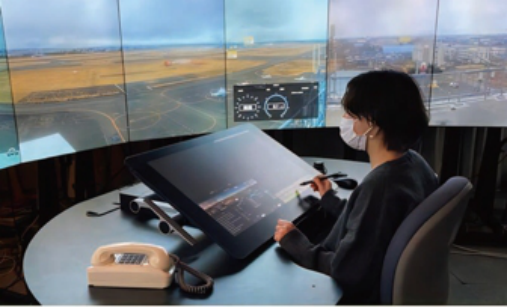
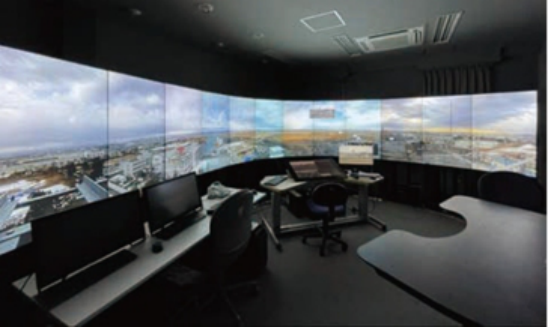
Air traffic control towers have traditionally relied on visual monitoring through tower windows for safe air traffic management. Issues related to tower maintenance and staffing have led to the exploration of a new air traf- fic control paradigm called Remote Digital Tower (RDT). The RDT system replaces the conventional on-site control tower with a remote system utiliz- ing cameras, sensors, information devices, and networks, allowing for remote air traffic control (see Fig. 1). Research and development towards the practi- cal implementation of this system are underway, particularly in Europe and the United States (SESAR Joint Undertaking, 2014 and 2015) (Peter, and Wen-Chin, 2018).
This project aims to enable the safe and efficient operation of RDT systems at Japanese airports. While there are both large and small airports, this paper focuses on the design of software and hardware for control desks specifically tailored for Memanbetsu Airport, a small airport in Japan. The objective is to propose a safe, user-friendly, and effective design for the RDT system (Inoue, 2020 and 2021).
DESIGN PROCESS FOR RDT SYSTEM The design focus of this study includes the user interface design for the software that enables remote air traffic control via the RDT system and the hardware design of the control desk operated by air traffic controllers. A design team, including former air traffic controllers, was organized to incorporate their perspectives and expertise into the design process.
In the initial stages, we conducted interviews with former air traffic con- trollers to identify necessary RDT functions and perform task analysis. Based on the task analysis, we developed the basic structure of the RDT design. The fundamental components consist of a “360-degree panoramic display,” a “control desk with a large touch display for software operation,” and an “environment supporting the control desk.” The 360-degree panoramic display replaces the traditional visual monitoring by combining multiple ver- tical displays. The control desk consolidates several displays and keyboards into a single large touch display. The supporting environment includes the operational table for the large touch display.
Next, we developed the basic layout for the user interface and hardware design based on the task analysis and basic structure. We created and eval- uated wireframe prototypes of the software interface. Following this, we developed and assessed prototypes that included graphical elements. For the hardware design, we created and evaluated a prototype of the control desk suitable for the basic layout.
USER RESEARCH AND TASK ANLYSIS We conducted interviews with former air traffic controllers to design tasks necessary for tower control operations. The interviews focused on tasks dur- ing departures, arrivals, and emergencies. The collected task information was documented as “microtasks” on a task sheet. We outlined the opera- tional environment and functions for Memanbetsu Airport, creating a task sheet that includes “tasks during departures,” “tasks during arrivals,” “tasks during emergencies,” and a “function list.”
Remote Digital Tower to support Air Traffic Control Systems 45
SOFTWARE DESIGN The software operation panel was designed based on task analysis. The user interface was conceptualized from task design, considering the basic lay- out and operation methods, resulting in a wireframe prototype. The task sheet identified eight functions: (1) Communication Panel, (2) Automatic Terminal Information Service (ATIS), (3) Weather Information Receiving Unit (WRU), (4) Camera Control, (5) Flight Progress Strip Panel, (6) Radar Screen, (7) Panorama Screen, and (8) Wind Direction and Speed (METAR). These functions were integrated into a single large touch display and a panoramic screen.
The large touch display screen employs a “cockpit interface” to enhance usability and clarity. The primary characteristics of the cockpit interface include the following: “displaying all information on a single screen rather than through a window system,” “presenting essential information on a large screen,” and “ensuring that all information is presented in the most comprehensible manner.”
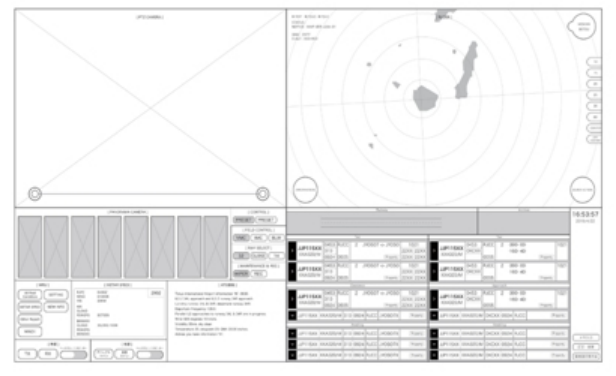
Figure 2: Wireframe for software design.
From the overall screen layout, a wireframe prototype was developed, incorporating the essential functions for the large touch display screen (see Fig. 2). During the layout examination, a paper prototype with text sizes was utilized to evaluate the actual operational dimensions.
The design concept for the layout of the large touch display screen focuses on compactly organizing the Communication Panel, ATIS, and WRU, while allowing the Camera Control to be arranged horizontally. The Flight Progress Strip Panel, which is frequently used, is strategically positioned at the bottom for ease of operation via the touch panel.
Specifically, the Camera Control video screen and Radar Screen, which are less frequently operated, are positioned at the top. Beneath the Cam- era Control video screen are the camera operation panel, ATIS, and WRU.
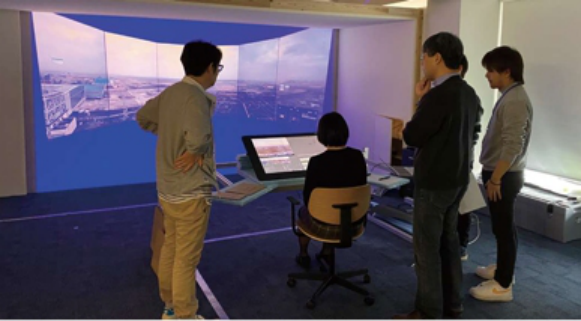
The Flight Progress Strip Panel is situated below the Radar Screen. A wire- frame prototype was created based on these functionalities and concepts. With the collaboration of former air traffic controllers, user evaluations were conducted, and the interface was iteratively refined based on continuous feedback (see Fig. 3).
Figure 3: Evaluation for the prototype.
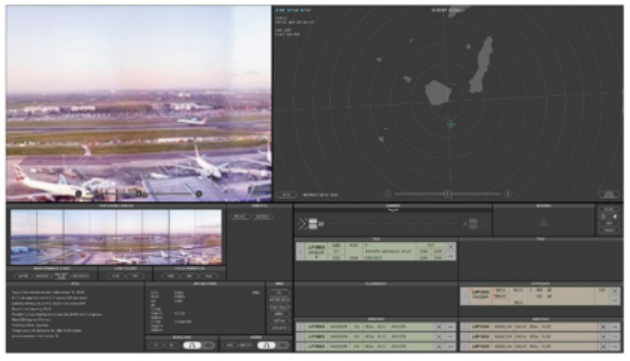
The final software prototype, derived from the wireframe prototype, selected a readable font size considering the hierarchy of information (see Fig. 4). The color scheme employs bright colors exclusively for the frequently used Flight Progress Strip, while the rest of the elements are rendered in darker hues. This prototype was refined through user evaluations conducted by former air traffic controllers, tailored to tasks at Memanbetsu Airport.
Figure 4: The final software prototype.
Remote Digital Tower to support Air Traffic Control Systems 47
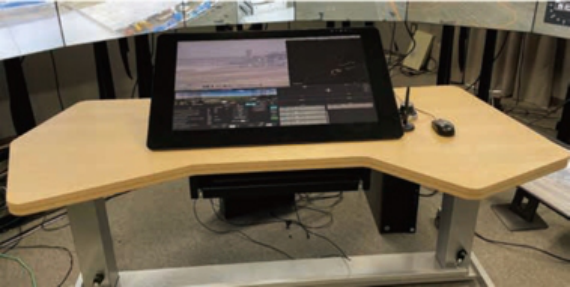
HARDWARE DESIGN For the hardware design of the control console, the task design was funda- mental. The prototype included considerations such as installing a large touch display and was developed with the average physique of Japanese operators in mind, optimizing the placement and angles of the panoramic and opera- tional screens (see Fig. 5). The prototype’s shape was repeatedly refined to ensure optimal form while accommodating the operational needs.
Figure 5: Prototype for hardware design.
The final hardware design prototype for the control console aimed for a form factor that ensured visibility and ease of operation for both the touch panel and panoramic screens (see Fig. 6). The design took into account oper- ator comfort and included necessary features such as telephones and note spaces. The shape was organically designed to be familiar and comfortable for operators.
Figure 6: The final hardware design prototype.
CONCLUSION
This project proposed software and hardware designs to enable the safe and efficient operation of RDT systems. Although the designs prioritize safety, usability, and effectiveness, the user evaluations conducted were limited. Future work will involve broader user evaluations to further refine the designs and achieve higher design maturity. This paper introduced current efforts in developing RDT technology, emphasizing interface design. The RDT sys- tem, leveraging digital technology, aims to improve safety, economy, and efficiency, with various operational models being explored. We intend to continue evaluation and problem-solving to realize practical implementation soon.
ACKNOWLEDGMENT
We thank Ryuho Gozu, Ritsuki Nakayama, and Nariaki Mieki for their cooperation in the design considerations introduced in this paper.
REFERENCES
Inoue, S. (2020). “Study on User Interface Design of Remote Tower Systems” Industry-Academia Research Report 2020, Social Creative Musashino Art Uni- versity Research Canter for Social Creativity. Inoue, S. (2021). “Design Research for the Realization of Digital Control Tow-
ers” Industry-Academia Research Report 2021, Social Creative Musashino Art University Research centre for Social Creativity. Peter, K. and Wen-Chin, L. (2018). Multiple Remote Tower for Single European Sky: The Evolution from Initial Operational Concept to Regulatory Approved Implementation, Transportation Research Part A: Policy and ractice, Vol. 116, pp. 15–30. SESAR Joint Undertaking (2014). OSED for Remote Provision of ATS to Aero-
dromes, including Functional Specification, SESAR Joint Undertaking (2015). Multiple remote tower - Safety assessment report for multiple remote tower.
LISTED IN THE AHFE DIGITAL BOOKSTORE CATALOGUE
Explore the complete digital volume
Advances in Human Factors of Transportation
Read this individual research paper free through the original publisher, or explore the full digital proceedings book.
ISBN 978-1-964867-24-3
Explore this ISBN in the AHFE Bookstore ↗Listed in the July 2026 bookstore catalogue; search by ISBN to confirm current availability · Digital book purchase optional