Paula Trigueiros (2022). Freedom, equality, identity: the Right to Design. In: Ergonomics In Design. AHFE Open Access, vol. 47, pp. 405–412. https://doi.org/10.54941/ahfe1001963
Lab2PT, School of Architecture, Art and Design, University of Minho, Guimarães 4800-058, Portugal; CIAUD, Research Centre for Architecture, Urbanism and Design, Lisbon School of Architecture, Universidade de Lisboa, Lisbon, 1349-063, Portugal ↗
When advocating for typically excluded groups in society, it is common for arguments to invoke general principles of universality and equality, referring to the Universal Declaration of Human Rights and to other instrumental documents of a developed society. Considering the wide scope of design fields and its influence on products, services for our quality of life, we can perceive the power and responsibility of design in the observance of those principles. The proposed argument will be categorized according to three perspectives. First, Design as a noun: by enriching the markets for products and services that meet people’s expectations and needs, design is promoting freedom of choice. The second, Design as a verb, is about processes of promoting the right (of people with disabilities) to self-determination and to active and informed participation in decision-making and creation processes. Third, Design as a theme acknowledges designers’ powers and emphasizes their social responsibilities, as activists of change. This paper offers a reflection on the different contributions and responsibilities of Design in promoting fundamental rights such as dignity, freedom of choice, and the right to personal identity of diverse audiences. This article is therefore a manifesto for the Right to Design, drawing on relevant literature, practical experiences, and case studies.
“As stated in article 1 of the Universal Declaration of Human Rights, ‘all human beings are born free and equal in dignity and rights’ (…) Equality can also be conceived in terms of societal goals, whereby States are obligated to develop policies and actions to ensure that the value of equality is refle- cted in the concrete living conditions of all persons” (United Nations Enable, 2016, p. 3). It is not common to think of Design in connection to roles considered so fundamental that they could be held up as examples. However, it is difficult for us to think of any area in our life in which we are not surrounded and, in some way, dependent on products or solutions resulting from Design. Thus, we are confronted with how much (our) quality of life and the rights of all people can be linked to the work of designers - those who are responsible for
conceiving, predicting, and developing adequate solutions for each needed situation. Alongside this diversity of skills, which provide designers the power of change, comes the responsibility to do so.
Much of what has been done and written about Design for over a century reflects this vision: its interventional and critical role in changing paradi- gms, mentalities, behaviors, and in promoting quality of life, adapting to that which, in each circumstance, stands out as a priority. Different labels added to “design” seek to highlight different sensibilities for how this role can or should be performed: social+design; emotional+design; sustainable+design; positive+design; ergonomic+design; design for all… Inclusive Design is one of the ways to express this natural vocation of designers to improve the world around them. Focusing on the perspective of people with disabilities, we argue that inclusive design strategies and practices may also contribute to the promotion of the Right to Design.
Fifty years ago, Papanek (1971) described a scenario in which a design company was exclusively dedicated to specialized work in solving the needs of humanity, which would result in products to help people with intellectual disabilities and functional diversity, among others in situations of inequality and disadvantage. As a form of social return (or a kind of tax) he advocated that all designers should dedicate 10% of their time and talent to helping solve the problems of the 75% of humanity in need (Papanek, 1971, p. 80).
Many positive changes have happened since this book was published, but at its core it remains very actual and pertinent. Margolin (2014, p. 15) highlighted the “struggle between visions of the world” evidenced in the con- frontation between reality and the intentions expressed in the texts of the declarations of human and children’s rights, by the UN. Redström (2020) talks about paradigm evolution in Design, from when he was dedicated to “making things” to the current perspective in which he began to dedicate himself to “making things possible” (Redström, 2020, p. 89). He defends that the problems haven’t changed all that much - but rather the perspective and willingness of designers to understand them and get involved.
“DESIGN Research (…) is rarely seen as a capacity with democratic poten- tial, much less as belonging to the family of rights. (…) is not only the production of original ideas and new knowledge (…) It is the capacity to systematically increase the horizons of one’s current knowledge, in relation to some task, goal or aspiration.” (Appadurai, 2006; Benesch & Onkar, 2020). By making a purposeful misreading of Appadurais’ 2006 paper “The right to research”, Benesch and Onkar wanted to consider and imagine what could be the right to design and what could be the role of design education within informed citizenship (Benesch & Onkar, 2020, 1’20”- 2’11”) There has been a positive evolution concerning relevant practices that embody the social vocation of design, in several domains, such as those rela- ted to sustainability, citizenship and also in terms of the inclusion of groups in vulnerable situations.
We started the discussion of this topic at a workshop in 2017 (Trigueiros, 2017). In this paper we have gathered some examples and ideas related to three perspectives on how Design may contribute to fundamental principles and thus be considered as a right in itself.
Freedom, Equality, Identity: The Right to Design 407
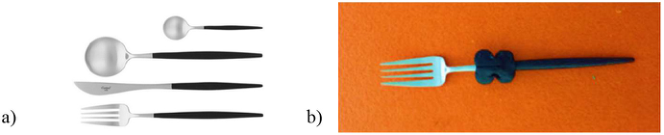
Figure 1: (a) Cutlery of cutipol “Goa” model (www.cutipol.pt) and (b) with accessory application (author).
DESIGN AS A NOUN, A VERB AND A THEME Design as a Noun
First, we’ll start with Design as a noun. This is predicated on the notion that the value of equality should be reflected in the concrete living conditions of all people.(United Nations Enable, 2016). Here we focus on the role of design in enriching the markets for products and services that meet people’s expectations and needs, considering their diversity and circumstances, thus promoting freedom of choice.
In 2017 we organized a workshop about “The right to design”(Trigueiros, 2017). The first example was based on cutlery from Cutipol “Goa” model, by José Joaquim Ribeiro, awarded with the “Good Design Award 2016”. We argue that some of the attributes of simplicity that differentiate and makes it successful are the ones that may create difficulties for those who have limita- tions in the ability to control or hold their hands. This problem is identical in many other objects that we consider elegant and good examples of product design.
There are numerous alternatives in assistive products. But, even when reco- gnized as useful, they are often rejected by the stigma associated with them (Bispo, 2018; Damazio, 2014). On the other hand, we see how some chil- dren’s accessories deal with identical functional problems creating adherent, colorful and appetizing accessories. By being markedly childish, they do not serve the purposes of adults, asking for more and new designs. There are other anti-stigmatizing approaches, such as the humorous “underful” towel (Labmemo, 2014) whose pattern is revealed when wine is spilled, demystif- ying the problem of accidents at the table. It is the lack of alternatives in the market that reduces people’s freedom of choice.
Anoter example concerns clothing design as it is directly related to the right to identity. People with prolonged illnesses, hospitalized and with permanent disabilities may benefit of the power of clothing and fashion design, when it comes to guaranteeing their right to personal identity and image. So, it is important that designers confront situations of diversity that appeal to their talent and vocation.
We got to know an example of this when talking to Sandra1. For her wed- ding day she dressed the crutches in the same fabric as her dress, because “these were already part of her body”. Lucy Jones created the “Seated design
1Fictitious name of a person with multiple sclerosis, interviewed by the author (Italy, 2018).
408 Trigueiros
collection” (Jones, 2015), a set of sleeves designed for seated people. These prevent the discomfort and disfigurement caused by people having their arms always bent. Marteli et al (2022) are studying the design of clothing that can facilitate the autonomy of people with Parkinson’s Disease (Marteli et al., 2022; Nardoni, Letícia & Trigueiros, 2021). In addition to the functional requirements, it became clear the need to create design solutions that allow clothing to be adapted while maintaining iconic and significant elements for people’s identity. The case of a portuguese Fado singer with Parkinson Dise- ase was discussed within the workshop. This highlighted the need to create interesting and varied alternatives in clothing, adequate to constraints of ill and bedridden people, in hospitals and institutions, so that they respond to their differentiation and personal identity needs and rights.
Design as a Verb The second approach, Design as a verb, addresses the direct involvement of people in the design process: co-deciding and co-designing. Focusing on People With Disabilities (PWD), this is about promoting the right to self- determination, to active and informed participation in decision-making and creation processes.
“Nothing about us, without us” is the motto of the internationally reco- gnized Movement for Independent Living. They showed how damaging the individualistic and biomedical approach to disability was and highlighted the importance of examining the experience of disability as perceived individually and collectively by PWD (Veiga et al., 2021). A lot of events, discussions and projects are often held to (allegedly) ‘help PWD’, without actually involving them in the decision-making and development process. Attitudes of conde- scension or paternalism are also neither adequate nor favorable to achieve the goals of inclusion.
At this point, we must introduce a good example: TOM is an acronym that results from the hebrew expression “Tikkun Olam Makers” which means “Makers fixing the world” (TOM global - Making the Difference, 2014). These particular ‘maker marathons’ include PWD within the teams from the very start: they are the ones that propose, define priorities and describe the constraints of a challenge to be given to volunteers. In short, they are the ones who decide which ‘problems’ are worth solving and participate in assessing them. This non-profit organization exists since 2014 and started in Porto, Portugal with a 72-hour event, held in June 2017: the TOM-Porto (Trigueiros et al., 2017). There were some designers among the volunteers at TOM-Porto and addressed Francis’ challenge. He has cerebral palsy and works with the computer and needs a keyguard - a keyboard cover that helps people who may have trouble pressing only one key at a time. The solution was techni- cally simple and was solved using a laser cut of an acrylic plate. However, in addition to the technical aspects, it was possible to include a cork covering with a small logo of the football team that Francis is a fan of. This detail seems unimportant, because it’s easy to do in any other situation. But it was very significant for Francis: he was very happy with his new assistive device, for being differentiating and personalized. It is paradoxical that assistive devices,
Freedom, Equality, Identity: The Right to Design 409
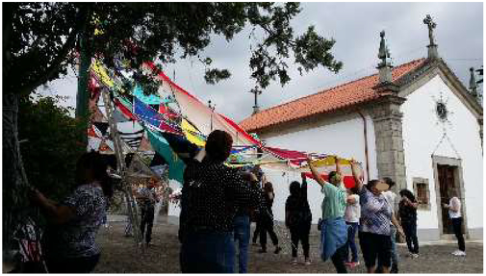
Figure 2: Installation of the ‘Manto’ in the churchyard of the local church, with the participation of the community (author).
being often adapted to each user, cannot also be configured according to other preferences of the people to which they belong. In this case the process allo- wed the group members to get to know and understand the preferences of this user since the beginning.
Participatory Design and co-Design practices emphasize the role of the designers as facilitators, capable of recognizing that participants can be experts - more than themselves (Visser, 2009). These are demanding activities in terms of interpersonal communication skills, which require some experie- nce. The previous example highlighted the importance of PWD participation in the organization and in the decision process, in situations of singular and personalized design. But participatory design practices have evolved to help designers better understand the diversity of citizens and circumstances. Those practices promote giving voice to citizens’ ambitions and expectations, and translating them into the design of flexible comprehensive solutions, in which everyone feels represented. These are important and complex tasks for design to respond to the challenges of a democratic and equitable soci- ety. ‘Manto’ project (meaning “Mantle”) is an example of a communitarian design intervention for engagement of unemployed groups of women in the north Portugal (Fig. 2) (Trigueiros et al., 2019).
Design as a Theme Third, Design as a theme acknowledges designers’ unique position to com- municate and draw attention to phenomena of exclusion, inequalities, and non-compliance with people’s rights. It emphasizes the need to provide designers with adequate awareness and information – as “warriors”, agents, and activists of change.
Talented designers choose their battles and fight them with all their strength and talent. But, how can the “battle” for the Right to Design be promoted if designers are not aware of and moved by these causes? Despite the value of arguments, opportunities and social benefits that can result from Inclusive Design, we know that few designers deliberately choose this approach to implement design. The same concern applies to related fields.
410 Trigueiros
Veiga and others (2021) note that few researchers are permanently interested in the cultural and social issues of disability and alert: “We urgently need more and more research, as urgently as we need more and more inclusion” (Veiga, et al. p. 12). Margolin highlighted that “We also need more speech – more writing, lectures, conferences and discussions – that can generate a mobilization of people concerned with new modalities of social practices (of Design)” (Margolin, 2014, p. 16).
This leads us to the role of Schools and Academia. We believe the training of future designers should be guided in a more comprehensive and tolerant sense of diversity, aware of the social role of design. As young people, they are absorbing a whole set of references that will mark their attitude and future professional practices. Living with elderly people or PWD can trigger sensi- tivity and interest in the causes of inclusion. But most young students do not have this experience (Choi, 2014). Their youth perspective is more favora- ble to looking at the world with optimism “in their image”, using personal experience when designing (Norman, 1988). Pullin’s work (2009) illustrates mutual advantages that would result if the design of solutions for PWD were contaminated by the culture and the “fun” of design schools. Several authors agree that academic activities help young people to appreciate inclusion and innovation through people-oriented design (Clarkson et al., 2015; Trigueiros & Burrows, 2007).
Raising awareness and inspiring is essential to spark interest in challen- ges we face today. We believe that the strategies and tools that are usually developed to promote inclusion can also contribute to changes and mobilize designers to become better professionals and citizens.
CONCLUSION
Inclusive is comprehensive, evolving and complex.
Inclusion respects the recognition of diversity, the rights and values of democracy, of civilization as we understand it today.
In this paper, we relate a wide designers’ competences with the challenges of today’s society - which is why Design has become a Right and a way to address people’s expectations regarding respect for the values set out in the Universal Declaration of Human Rights and, namely, those of the PWD. In this sense, we argue that it is necessary to promote more inclusive Design, that is, more aware and informed Design.
We illustrated these statements with examples of product and service design that promote dignity and freedom of choice in the marketplace, and emphasized the relevance of participatory processes and of PWD’ participa- tion, defending values of individuality, privacy and self-determination.
Aware of the complexity of these challenges and the lack of critical mass in their defense, we agree with other authors on the significant role that designers’ talent can play in deepening research and communicating results, collaborating in the dissemination of the theme of inclusion to meet the goal of equality – a principle that summarizes the set of human rights.
In summary, we highlighted that by working on the challenges of today’s society, designers are reinforcing their role in realizing everyone’s rights to
Freedom, Equality, Identity: The Right to Design 411
improve their quality of life and have their needs and desires satisfied, i.e., to promote the Right to Design.
ACKNOWLEDGMENT
The authors would like to acknowledge Lab2PT of the School of Archite- cture, Art and Design, University of Minho (ref. UID/04509/2020); CIAUD, Research Centre for Architecture, urbanism and Design of the Lisbon Sch- ool of Architecture, Universidade de Lisboa (ref. UIDB/04008/2020); and FCT, Foundation for Science and Technology, Portugal, for the institutional support. They also acknowledge the students and authors mentioned in this paper.
REFERENCES
Appadurai, A. (2006). The right to research. Globalisation, Societies and Education, 4(2), 167–177. https://doi.org/10.1080/14767720600750696 Benesch, H., & Onkar, K. (2020, Novembro 24). The Right to Design. https://www.
youtube.com/watch?v=4U-UeDT61NQ Bispo, R. (2018). Design contra o estigma. http://hdl.handle.net/10400.8/3058 Choi, Y. M. (2014). User Capabilities Versus Device Task Demands in a Tape Dispenser Product for Persons with Limited Dexterity. Em P. M. Langdon, J. Lazar, A. Heylighen, & H. Dong (Eds.), Inclusive Designing (pp. 13–23). Springer International Publishing. https://doi.org/10.1007/978-3-319-05095-9_2 Clarkson, P. J., Coleman, R., & Coleman, R. (2015). History of inclusive design in
the UK. Applied Ergonomics, 46, 235–247. Damazio, V. M. M. (2014, Fevereiro 4). Sobre Labmemo. LABMEMO. https://labm emo.wordpress.com/sobre/ Jones, L. (2015). Seated Design Collection. LUCY JONES. https://www.lucyjonesd
esign.com Labmemo. (2014, Fevereiro 10). Toalha de Mesa Underfull. LABMEMO. https://la bmemo.wordpress.com/2014/02/10/toalha-de-mesa-underfull/ Margolin, V. (2014). Design e Risco de Mudança. Verso da História / ESAD. Marteli, L. N., Paschoarelli, L. C., da Silva, F. M., Trigueiros, P., & Barbieri,
F. A. (2022). Case Study on the Experience and Perception of Rehabilitators and Caregivers of People with Parkinson’s Disease in the Interaction with Clo- thing Assistive Devices: Narratives About Everyday Problems, in Portugal. Em N. Martins & D. Brandão (Eds.), Advances in Design and Digital Communication II (pp. 412–424). Springer International Publishing. https://doi.org/10.1007/978-3- 030-89735-2_34 Nardoni, Letícia, & Trigueiros, P. (2021, Julho 6). Inclusão pelo design de vestuário (Reflexão sobre o caso de pessoas com Doença de Parkinson) [Workshop]. Norman, D. (1988). The Psicology of Everyday Things (Basic Books, Perseus Book
Group). Papanek, V. (1971). Design for the Real World: Human Ecology and Social Change.
Pantheon Books. Pullin, G. (2009). Design meets Disability. MIT Press. Redström, J. (2020). Certain Uncertainties and the Design of Design Education. She Ji: The Journal of Design, Economics, and Innovation, 6(1), 83–100. https://doi. org/10.1016/j.sheji.2020.02.001 TOM global—Making the Difference. (2014). TOM. http://tomglobal.org/
412 Trigueiros
Trigueiros, P., Broega, A., & Carvalho, J. (2019, Agosto 8). MANTO project – design for social inclusion in Póvoa de Lanhoso. Wastes: Solutions, Treatments and Opportunities III; CRC Press. https://doi.org/10.1201/9780429289798-90 Trigueiros, P., & Burrows, A. (2007, Abril 1). Thinking better...creating for all. Proceedigns of INCLUDE 2007. INCLUDE 2007 - Internatio- nal Conference on Inclusive Design, Royal College of Art, London. https: //www.rca.ac.uk/research-innovation/research-centres/helen-hamlyn-centre/kno wledge_exchange/include-conferences/include-publications-and-proceedings/ Trigueiros, P., Teles, R., & Godinho, F. (2017). TOM:Porto “Mudar o Mundo” no
Porto: Reflexão crítica sobre os desafios e resultados do ≪Tikkun Olam Makers≫ no Porto, no âmbito das Jornadas SUPERA, em Junho 2017. Universidade do Minho. http://hdl.handle.net/1822/51507 United Nations Enable. (2016). Convention on the Rights of Persons with Disabilities [A/RES/61/106]. https://www.un.org/development/desa/disabilities/resourc es/general-assembly/convention-on-the-rights-of-persons-with-disabilities-ares 61106.html Veiga, C. V. da, Fernandes, L. M., & Verdugo, M. A. (2021). Nota Introdutória: Mais
Investigação, Melhor Inclusão. Revista Lusófona de Estudos Culturais, 8(2), 7–17. https://doi.org/10.21814/rlec.3711 Visser, F. S. (2009). Bringing the everyday life of people into design. Delf University of Technology.
LISTED IN THE AHFE DIGITAL BOOKSTORE CATALOGUE
Explore the complete digital volume
Ergonomics In Design
Read this individual research paper free through the original publisher, or explore the full digital proceedings book.
ISBN 978-1-958651-23-0
Explore this ISBN in the AHFE Bookstore ↗Listed in the July 2026 bookstore catalogue; search by ISBN to confirm current availability · Digital book purchase optional