Iris Graessler, Benedikt Grewe, Marc Fritzen (2025). The importance of structure in transformation chaos: A Transformation Framework. In: Human Systems Engineering and Design (IHSED2025): Future Trends and Applications. AHFE Open Access, vol. 198, pp. 368–378. https://doi.org/10.54941/ahfe1006790
Dynamic market conditions, technological disruption and social change require organizations to continuously adapt and evolve. However, studies on organizational change show that the majority of transformations undertaken fail because they are characterized by a lack of clarity, overload and ineffective measures. This paper shows how a clear structure as a critical success factor can make the chaos and challenges of a transformation manageable. The focus here is on a practice-oriented framework that divides a transformation into nine essential building blocks with activities that are critical to success. The structure of the framework is understood as a flexible organizing principle for a transformation without hindering creativity and dynamics. Case studies show the adaptability and applicability of the framework to different characteristics and dimensions of transformation. The transformation framework provides an operative structure and enables transformation managers for transparent orchestration and implementation of transformation.
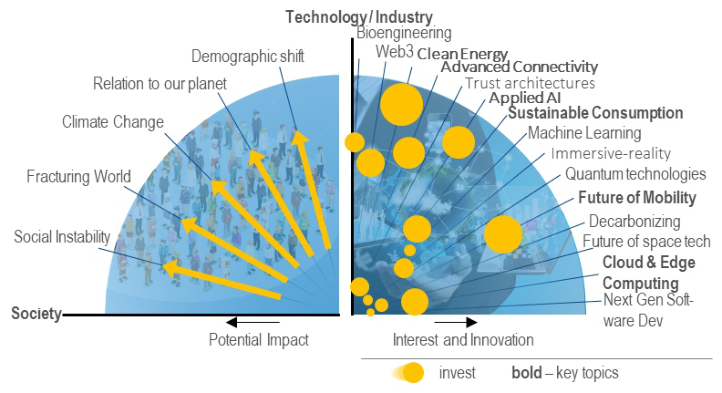
INTRODUCTION: BALANCING AMBITION AND REALITY Technological and social megatrends are forcing companies to continuously adapt to changing external conditions in order to maintain their own market relevance and be successful in the long term. Technological megatrends (Figure 1, right part) such as clean energy, the future of mobility and (applied) artificial intelligence are forcing companies to rethink their working methods, business models and products in order to benefit from competitive advantages and keep up with the competition. Social megatrends (Figure 1, left part) such as demographic change, sustainability requirements and social instability are also influencing the need for organizational change. For example, demographic change is leading to an ageing workforce and an increasing demand for skilled workers, which is prompting companies to develop new working models and practices (Gaub, 2019; PwC International, 2024; Yee et al., 2024). In theory, a variety of approaches such as agile methods, self-organized teams and golden circle-oriented mission statements offer conceptional solutions to address these different kinds of challenges an organization is
The Importance of Structure in Transformation Chaos: A Transformation Framework 369 confronted with. Nevertheless, practical insights show the domination of parallel initiatives without a clear connection to each other, overburdened managers and a hectic pace of operations which risk transformations success by overloading an organization with measures.
Figure 1: Megatrends in society and technology are forcing transformation in organisations (accoring to (Gaub, 2019; PwC International, 2024; Yee et al., 2024)).
Consulting practice and current studies (such as Boer et al., 2019; Hughes, 2016; Mankins & Litre, 2024; Mutaree, 2021) consistently show that change does not only fail due to a lack of insight into the necessity of change, but often due to the inability to implement it in a targeted, effective and consistent manner. In this area of tension between transformation ambition and operational chaos, structure in terms of continuous orchestration is an essential dimension, which is frequently overlooked. Therefore, structure should not be considered exclusively in a sense of organizational charts or hierarchies, but rather as a consciously designed organizing principle that provides orientation, coherence, and enables commitment to change. Nevertheless, existing models, such as 8-stages by (Kotter, 2012), Adkar (Hiatt, 2006) or 7S (Waterman et al., 1980), often focus either on behaviour or organizational elements of the organization and consider changes in sequential order, without addressing a holistic coordinating view.
This paper addresses the importance of structure in complex organizational transformations from the perspective of the authors’ many years of industry and consulting experience. Based on recurring core activities, challenges and structural elements in both successful and failed transformations, a practical framework is presented that structures transformation into nine central building blocks. With the authors’ insight that transformation is always accompanied by a degree of chaos, the aim of the framework is to provide a working model that does not prevent
chaos but makes it manageable through clear structuring and continuous orchestration of transformation activities.
The framework thus represents a pragmatic, systematizing synthesis that closes gaps in existing approaches, particularly in the area of structure-giving operationalization of transformation. Its advantages lie in its integrative, adaptive and practical design, which functions both strategically and operationally. Thus, the transformation framework provides an operative structure and enables transformation managers for transparent management and implementation of transformation. Moreover, the transformation framework is an instrument for management communication.
STATE OF ART Organizational transformation describes a disruptive change that affects an organization at its core (Scherm & Pietsch, 2007). Different dimensions can be addressed within organizational transformation, such as strategic alignment, cultural change, or the implementation of new business models (Cummings & Worley, 2009). The overall goal of transformation is typically to adapt organizations to external conditions, drive innovation, and ensure long-term competitive advantage (Bucy et al., 2016). Although transformation and change are often used synonymously, a distinction can be drawn: Organizational transformation describes a change program initiated from the top down, while organizational change describes a change initiated from the bottom up (Bittner-Fesseler et al., 2023).
After the need for managed organizational transformation was recognized in the 1980s based on an understanding of evolutionary organizational development (Scherm & Pietsch, 2007), various approaches of mapping complexity and structure of organizations were published. Waterman et al. show an expanded understanding of an organization that includes soft factors such as culture, values and leadership behavior in addition to formal aspects and is used in the 7S model to evaluate organizations (Waterman et al., 1980). While the Adkar model focuses on aspects of the organization’s individuals, such as awareness, desire knowledge, ability and reinforcement, building up on the premise, that individuals form the organization (Hiatt, 2006).
In change management, approaches are discussed that provide direction in the execution of transformation and facilitate effective change. Early approaches, such as the Three-Phase-Model by (Lewin, 1951), laid the foundation for subsequent methodologies. Lewin describes the three phases that organizations undergo during transformation: unfreeze, change, and refreeze (Lewin, 1951). Kotters eight-stages model concretizes specific actions in transformation management, such as creating a sense of urgency or communication and manifestation of change (Kotter, 2012). Further approaches align overarching action fields on a processual model of change, from analysis and goal definition to line operation (Graessler, 2004a; Gräßler, 2004b). In field of change management, approaches of systems theory and agility have also become established: Organizations are considered as dynamic, self-organizing systems in which change is not planned in a linear fashion,
The Importance of Structure in Transformation Chaos: A Transformation Framework 371 but must be accompanied iteratively (Senge, 2006). One challenge of change management lies in the simultaneous use of existing structures with the simultaneous exploration and implementation of new structures. This dilemma is symbolically referred to as the “conversion of a ship on the high seas” (Hartwich, 2014) and is discussed in approaches to ambidexterity (O’Reilly & Tushman, 2013). Further specialized approaches address cultural aspects of transformation and provide models to design an organizational culture transformation (Ipinazar et al., 2021) as well as assess factors of culture critical to transformation effort (Graessler & Grewe, 2024). More than that, specified transformation approaches such as digital transformation (Krapf, 2022), agile transformation (Bergius et al., 2018) or Systems Engineering transformation (Graessler & Grewe; Graessler & Grewe, 2025) are discussed.
Various fields of action for successful change management are discussed in common approaches, such as a common vision, visible leadership and commitment, structured communication, cultural embedding and empowering the organization for implementation. Despite these numerous approaches, empirical studies continue to show reasons for the failure of transformations, which are mainly due to inadequate communication, unclear responsibilities and insufficient anchoring of the change (such as Hughes, 2016; Mankins & Litre, 2024; Mutaree, 2021; Sackmann et al., 2019). It can therefore be assumed that existing models have insufficient operational orientation for concrete application in the design and management of multi-layered transformation initiatives. Therefore, a holistic, application-oriented approach is necessary that supports controllable structures of transformation and supports both the depth of change in terms of content and process complexity of transformation initiatives.
INSIGHTS FORM TRANSFORMATION PRACTICE A multitude of studies addresses the high rate of transformation initiatives. In order to identify critical aspects, a variety of challenges and critical patterns of transformations are identified from industrial practice regarding implemented transformation programs. The aforementioned challenges and patterns can be categorized into four distinct clusters.
Lack of Realism and Too Much Naivety The time required for change and the necessary qualifications are underestimated. Nevertheless, effort is put into high expectations for theoretical concepts and models without first taking practical, pragmatic steps to receive feedback from the organization. The expectation lies in the belief that implementation can be done all at once, like a big bang to the organization. Furthermore, interfaces with other units are ignored for now.
Missing or Misleading Prioritization A standardized agenda is pursued without addressing and resolving personal conflicts in the team or resistance and reservations about the transformation in the organization. Interfaces within the organization are also ignored or
insufficiently developed. Repeated changes of direction by leadership confuse those involved and encourage resistance. Moreover, implementing the change without premature piloting in a limited environment increases the risk of overloading the organization.
Uncoordinated Communication and Lacking Information Flow The organization lacks a clear and consistent vision that provides employees with orientation and serves as a binding reference point for decisions. Instead, vague messages, changing narratives or complete communication gaps prevail. This can be seen, for example, in the fact that information about goals, progress or decisions is either not communicated at all, only selectively or not in a targeted, user-friendly manner, which happens both out of uncertainty and conscious reservation.
The organization’s uncertainty leads to repeated or questioned decisions. At the same time, key stakeholder groups are involved in decisions too rarely or too late. The result is a wide scope for interpretation, which encourages speculation, rumors and resistance and inhibits acceptance of the transformation.
Role Miscasting Managers play an administrative role instead of leading by example and are reluctant to take on responsibility, which creates a vacuum with a lack of direction for change. Individual players exhibit fragmented leadership behavior, primarily pursuing their own agenda, for example to secure personal influence or manipulate the change in their own professional interests. Key roles critical to success of transformation, both in terms of content and organization, are not defined and filled or are filled by people who lack the will and conviction to shape the transformation. At the same time, there is a lack of visible, credible multipliers in the organization who could serve as points of reference and catalysts for change.
The insights into the practice of transformation programs show the need for a structured approach that takes into account key areas of action that are critical to success. It becomes clear that a successful transformation requires the interconnection of the right technical content, controlled program management and a holistic change architecture.
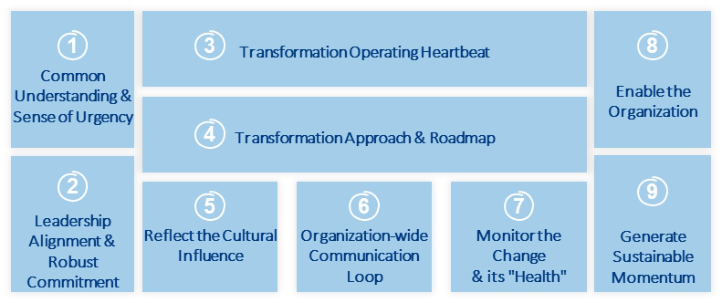
A FRAMEWORK FOR STRUCTURING TRANSFORMATION The Transformation Framework represents a holistic change architecture that can be tailored to the respective scope and needs of an organization. With key questions and core activities, it provides guidance for use in transformation management and the initiation of transformation programs. The framework is based on nine building blocks, which are connected in a logical, non- sequential way (see Figure 2). In many cases, the various building blocks are addressed in parallel and overlapping over the course of the project.
The Importance of Structure in Transformation Chaos: A Transformation Framework 373
Figure 2: The transformation framework contains nine essential building blocks.
1 – Common Understanding & Sense of Urgency A shared understanding of the needs, urgency, challenges and previous experience forms the basis for the transformation. The joint definition of a scope and initial goals ensures that the transformation is set up correctly, the right activities are initiated and the people involved are motivated.
2 – Leadership Alignment & Robust Commitment Leadership alignment/commitment involves the conclusion of a contract that obliges management to comply with the target and create the necessary boundary conditions. This involves defining the initial core team and its mission. The progress of the transformation is regularly reflected with top management, any need for action is identified and contractual adjustments are drawn up.
3 – Transformation Operating Heartbeat The transformation operating heartbeat comprises roles and measures for managing the transformation. The aim is to define the central project structure and processes for the transformation project so that content can be developed in an orderly manner, delivery results can be managed, and the “broad masses” can be brought on board.
4 – Transformation Approach & Roadmap A structured and lean approach provides orientation during processing, synchronizes different teams and their dependencies and ensures transparency with regard to deadlines. Established change management approaches such as 8 stages by Kotter or ADKAR can be tailored and applied for this purpose.
5 – Reflection of Cultural Influence The culture is primarily shaped by existing and new processes, actions and events. This must be brought into focus from the outset, as the culture of the
“broad masses” has a significant influence on how well the content-related changes can be anchored throughout the organization.
6 – Organization-Wide Communication Loop Regular, user-oriented communication of current results and change measures to the “broad masses” serves to increase transparency and understanding within the organization. This leads to greater involvement of the organization or the “broad masses” and promotes proactive action and the motivation to help shape change.
7 – Monitoring of Change & Its “Health” A good “state of health” of the teams and the organization is crucial in order to make the transformation a success. This includes not only the core team in the operating heartbeat, but also central stakeholders and management circles, for example, for which it is necessary to form a performance team.
8 – Enable the Organization In order to move and enable the organization, skills development of teams and individuals must be structured in line with the content of transformation and, if necessary, new skills must be built up. At the same time, this must be done in an organized manner in order to achieve the greatest possible impact.
9 – Generate Sustainable Momentum For a sustainable momentum of transformation, multipliers, supporters and critics of transformation are a decisive factor in winning over and mobilizing the “broad masses” and at the same time making the organization “heard”.
PRACTICAL APPLICATION AND TAILORING The transformation framework presented here was developed based on the findings of success-critical factors from experience in a large number of transformation projects in various sectors. Building on this, the transformation framework has been structurally applied in various transformation projects, proving to be a practical and adaptable tool. The following case studies examplary illustrate how the framework has been used in different initial transformation situations and industries as a basic transformation architecture and as a communication tool for management communication.
Holstic Application in Automotive Industry As part of a transformation project lasting more than three years at an international automotive manufacturer, the framework was used as the basic transformation architecture and in particular in the implementation of a pilot project in vehicle engineering. The nine building blocks were not considered purely sequentially, but rather in an overlapping and iterative manner.
The starting point and basis of the pilot project is the clear vision that has been developed, which serves as the North Star to guide all
The Importance of Structure in Transformation Chaos: A Transformation Framework 375 transformation activities. Building on this, the management team was committed to common principles and understanding of their roles by contracting. Also, an overarching transformation organization with assigned roles has been established to manage and provide operational support for the transformation.
As a guideline for the transformation a transformation roadmap is defined and established. During the implementation of the project, the importance of organizational cultural aspects became apparent on several occasions: cultural hurdles, such as silo thinking, mistrust or resistance to change, hindered transformation measures and the progress of transformation. A lack of information flow also proved to be critical. This was particularly evident in communication strategies that were not implemented across the board, which meant that relevant content was not conveyed to the right target group and key decisions were not made transparent to all those involved.
A systematic “health check” was established to accompany the change, which evaluated progress at regular intervals. To this end, observations in work meetings, analysis of results artefacts and interviews conducted with project participants were analyzed and form the basis for a fact-based reflection on the “organizations health”. Moreover, a comprehensive training program was set up for the long-term empowerment of the organization, which trains the employees concerned in several training waves. To lay the foundations for a lasting, sustainable change, a multiplier network was initiated at various levels.
Initialization of Transformation in Construction Machinery Industry In a project to transform a manufacturer of construction machinery, the framework is used to structure the early phase of the transformation program. The aim is to take all key elements of a successful transformation into account from the outset. First, the composition and responsibilities of the core team were defined. Building on the framework, an initial target image was created and communicated in the form of a change story. A communication plan was then developed to communicate targeted, consistent messages to the organization. Based on a stakeholder analysis, potential supporters and critics were identified and specifically involved in the transformation through direct participation or increased communication. The building blocks of the transformation framework were briefly considered in the development of a transformation roadmap, thus creating a guideline for operational planning and structured alignment of further transformation activities.
Tailoring Based on Assessment and Prioritization Another project examined the application of the Transformation Framework to a small organization in which transformation activities had already been initiated. Based on key questions, the nine building blocks were evaluated in terms of ongoing and completed activities. This evaluation and prioritization resulted in a customized framework that focused specifically on previously underrepresented areas of action and set clear priorities for the next transformation phase.
CONCLUSION
A fundamental transformation architecture that creates an overarching structure in transformation is an often-underestimated factor in transformation success. Structure is not understood in a sense of organizational charts or hierarchies, but rather as a consciously designed organizing principle that provides orientation, coherence, and enables commitment to change.
This gives a clear message for transformation management: structure must neither be an end in itself nor a rigid requirement. Over-structuring entails the risk of overload due to formalism, while under-structuring often leads to a lack of orientation, inconsistent measures and ineffective implementation, especially in complex organizations with diverse stakeholders.
The transformation framework presented addresses these aspects. It provides a clear framework in the form of essential fields of action (building blocks) and activities that guide the development of success-critical roles, decision-making processes, roadmaps and communication structures. Nevertheless, the framework as a design structure leaves sufficient room for flexibility and iteration, for example through its logical, non-sequential context.
Those responsible for transformation should therefore view structure as an enabler that creates transparency regarding responsibilities, procedures and objectives, thereby facilitating a uniform alignment. At the same time, however, a structure cannot be assumed as one-size-fits-all. It requires situational tailoring, depending on the initial situation and scope of transformation.
ACKNOWLEDGMENT
The authors would like to acknowledge Jan Richter for his commitment and significant contribution to the development of this Transformation Framework.
REFERENCES
Bergius, O., Rosenke, K., Frosch, D., Ludwig, B., & Vollmer, P. (2018). Die agile Transformation: Unternehmen auf der Reise zur Anpassungsfähigkeit. PwC International. https://www.pwc.de/de/digitale-transformation/die-agile-tran sformation-unternehmen-auf-der-reise-zur-anpassungsfaehigkeit.html Bittner-Fesseler, A., Krutzke, A., & Hermann, K. (2023). Change Kommunikation als
Managementaufgabe. Springer Fachmedien Wiesbaden. https://doi.org/10.1007/ 978-3-658-39010-5 Boer, O., Buck, R., Guggenberger, P., & Simon, P. (2019). Wie der Wandel Wirklichkeit wird: Ob Traditionsunternehmen oder Unicorn – in einem dynamischen Umfeld muss jede Organisation ihr Operating Model neu ausrichten. Aber wie gelingt die Transformation? Sechs Tipps. Akzente, 2019(3), 58–63. https://www.mckinsey.com/~/media/mckinsey/locations/europe%20and%20m iddle%20east/deutschland/branchen/konsumguter%20handel/akzente/ausgaben %202019/akzente_3_19_58_transformation.pdf.
The Importance of Structure in Transformation Chaos: A Transformation Framework 377
Bucy, M., Finlayson, A., Kelly, G., & Moye, C. (2016). The ‘how’ of transformation. Cummings, T. G., & Worley, C. G. (2009). Organization development and change (9th ed.). South-Weston Gengage Learning. Gaub, F. (2019). Welcome to 2030: The Mega-Trends. European Strategy and Policy
Analysis System. https://ec.europa.eu/assets/epsc/pages/espas/chapter1.html Graessler, I (2004a). Design and Change Management for Mass Customization. In Industrial Simulation Conference (ISC). Symposium conducted at the meeting of Industrial Simulation Conference (ISC), Malaga. Graessler, I, & Grewe, B. Structuring Systems Engineering Transformation: A three-
step cycle of Transformation. In 35th CIRP Design Conference 2025. Graessler, I, & Grewe, B (2025). SETup automotive: A Method for Systems Engineering Transformation in automotive industry. Design Science Journal, 11(11). https://doi.org/10.1017/dsj.2025.10 Graessler, I, & Grewe, B (2024). Importance of cultural change in Systems
Engineering Transformation: A model for cultural assessment. In AHFE International, Human Systems Engineering and Design (IHSED2024) Future Trends and Applications. AHFE International. https://doi.org/10.54941/ahfe 1005551 Gräßler, I. (2004b). Kundenindividuelle Massenproduktion. Springer Berlin Heidelberg. https://doi.org/10.1007/978-3-642-18681-3 Hartwich, E. (2014). Grundlagen Change Management: Organisationen strategisch ausrichten und zur Exzellenz führen (1. Auflage). Schriftenreihe der Führungsakademie Baden-Württemberg. Richard Boorberg Verlag GmbH & Co KG. https://www.nomos-elibrary.de/10.5771/9783415050747 https://doi.org/10.5771/9783415050747 Hiatt, J. M. (2006). Adkar: A model for change in business, goverment and our community (First edition). Prosci Learning Center Publications. Hughes, M. (2016). Leading changes: Why transformation explanations fail.
Leadership, 12(4), 449–469. https://doi.org/10.1177/1742715015571393 Ipinazar, A., Zarrabeitia, E., Rio Belver, R. M., & Martinez de Alegría, I. (2021).
Organizational culture transformation model: Towards a high performance organization. Journal of Industrial Engineering and Management, 14(1), 25. https://doi.org/10.3926/jiem.3288 Kotter, J. P. (2012). Leading change (W. Seidenschwarz, Trans.). Harvard Business Review Press. Krapf, J. (2022). Wie wird digitale Transformation erfolgreich gemessen? Ein
Erfahrungsbericht aus der Praxis. In N. Alm, P. C. Murschetz, F. Weder, & M. Friedrichsen (Eds.), Die digitale Transformation der Medien (pp. 161–179). Springer Fachmedien Wiesbaden. https://doi.org/10.1007/978-3-658-36276-8_8 Lewin, K. (Ed.). (1951). Field Theory in Social Science: Selected theoretical Papers.
Harper & Brothers Publishers. Mankins, M., & Litre, P. (2024). Transformation That Work: Lessons from companies that are defying the odds. Harvard Business Review, 2024(May-June). https://hbr.org/2024/05/transformations-that-work Mutaree. (2021). Change-Fitness-Studie 2020/2021. https://mutaree.com/services/c
hange-fitness-studie-2020-2021/ O’Reilly, C. A., & Tushman, M. L. (2013). Organizational Ambidexterity: Past, Present, and Future. Academy of Management Perspectives, 27(4), 324–338. https://doi.org/10.5465/amp.2013.0025 PwC International. (2024). Megatrends: Five global shifts reshaping the world we
live in. PwC International. https://www.pwc.com/gx/en/issues/megatrends.html
Sackmann, S., Eichel, V., & Schmidt, C. (2019). Change-Fitness – eine besondere Herausforderung für die Führung. In S. Sackmann (Ed.), Führung und ihre Herausforderungen (pp.175–200). Springer Fachmedien Wiesbaden. https://doi. org/10.1007/978-3-658-25278-6_10 Scherm, E., & Pietsch, G. (2007). Organisation: Theorie, Gestaltung, Wandel
(1. Aufl.). Oldenbourg Wissenschaftsverlag GmbH. https://ebookcentral.proques t.com/lib/kxp/detail.action?docID=1767660 Senge, P. M. (2006). The fifth discipline: The art and practice of the learning organization (Rev. ed.). Crown Business. Waterman, R. H., Peters, T. J., & Phillips, J. R. (1980). Structure is not Organization:
McKinsey 7s-Model. Business Horizons (Volume 23, Issue 3), 14–26. https://ww w.sciencedirect.com/science/article/pii/0007681380900270 Yee, L., Chui, M., & Roberts, R. (2024). McKinsey Technology Trends Outlook
Human Systems Engineering and Design (IHSED2025): Future Trends and Applications
Read this individual research paper free through the original publisher, or explore the full digital proceedings book.
ISBN 978-1-964867-74-8
Explore this ISBN in the AHFE Bookstore ↗Listed in the July 2026 bookstore catalogue; search by ISBN to confirm current availability · Digital book purchase optional